
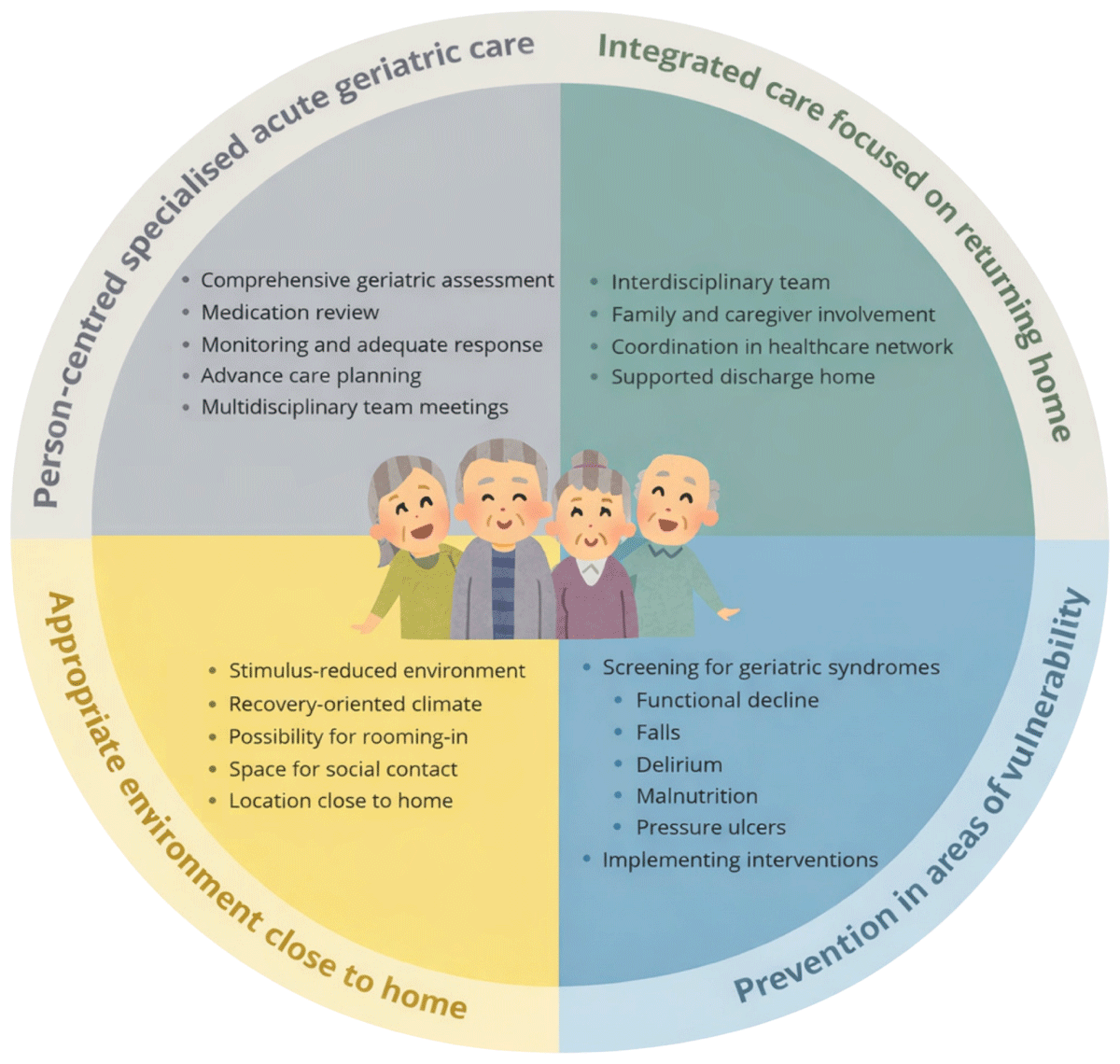
Figure 1
Core model elements of the Acute Geriatric Community Hospital (AGCH).
Table 1
Setting and admission criteria in the first quarter of 2024.
| AGCH1 | AGCH2 | |
|---|---|---|
| Location | Standalone skilled nursing facility | Intermediate care ward within a general hospital |
| Number of beds | 23 | 28 |
| Nr. of AGCH beds | 23 | 4 |
| Nr. of GR beds | 0 | 24 |
| Medical resources | ||
| Diagnostics | ECG, Early Sense beds, blood pressure monitor, urimeter, bladder scan, pulse oximeter, INR POCT meter, POCT glucose meter, daily laboratory testing and/or cultures (e.g., wound, urine, sputum, faeces) via external laboratory, radiological imaging (available once per week). | ECG, blood pressure monitor, urimeter, bladder scan, pulse oximeter, INR POCT meter, POCT glucose meter, daily laboratory testing and/or cultures (e.g., wound, urine, sputum, faeces) via external laboratory, radiological imaging (available Monday to Friday). |
| Medical treatment | Peripheral IV line, PICC line (IV medication administered via syringe pump, volumetric pump, or bolus), oxygen concentrators (up to 20 L/min per patient), portable oxygen cylinders, nebulization, indwelling urinary catheter, venipuncture, tube feeding, nasogastric tube, gravity drainage or PEG, stoma care, compression bandaging, specialized wound care, isolation with contact and airborne precautions, freedom-restricting interventions (e.g., bed rails, sensors). | Peripheral IV line, PICC line (IV medication administered via syringe pump, volumetric pump, or bolus), oxygen concentrators (up to 10 L/min per patient), portable oxygen cylinders, nebulization, VAC therapy, indwelling urinary catheter, venipuncture, tube feeding, nasogastric tube, gravity drainage or PEG, drain care, stoma care, compression bandaging, specialized wound care, suturing and suture removal, isolation with contact and airborne precautions, freedom-restricting interventions (e.g., bed rails, sensors). |
| Paramedical treatment | Daily physiotherapy from Monday to Saturday (with training room available in the building). Treatment by dietician and occupational therapist on request. | Daily physiotherapy from Monday to Friday (with training room available in the building). Treatment by dietician, occupational therapist, speech therapist, spiritual caregiver and social worker on request. |
| Admission route | Through the EDs and the acute admission units of general and academic hospitals. | Through the ED and the subacute geriatric unit of a general hospital. |
| Inclusion criteria | Patients aged 65 years or older (or clearly a geriatric patient, e.g., known to the geriatric outpatient clinic) Acute medical care demand: - Cardiology: congestive heart failure - Pulmonology: respiratory tract infection or pneumonia, COPD exacerbation - Neurology: neurological observation after, for example, a fall, delirium, or unknown cause. - Internal medicine: infections (such as urinary tract or soft tissue infections), poorly controlled diabetes, dehydration, electrolyte disturbance - Pain due to osteoporotic vertebral compression fracture, osteoarthritis, etc. One or more geriatric issues: Delirium, dementia, increased fall risk, reduced self-sufficiency | Patients aged 70 years or older Acute medical care demand: - Cardiology: mild form of congestive heart failure; - Pulmonology: upper respiratory tract infection combined with COPD exacerbation and/or congestive heart failure; - Neurology: no known inclusion criteria - Internal medicine: infections with or without delirium, dehydration with or without the first three criteria; - Pain due to osteoporotic vertebral compression fracture, osteoarthritis, etc. |
| Exclusion criteria | Hemodynamically unstable (expected need for ICU care), severe behavioral issues, recent TIA or stroke (due to absence of daily occupational and speech therapy). | Medically unstable, risk of wandering, severe behavioural issues. |
[i] AGCH = Acute Geriatric Community Hospital, GR = Geriatric Rehabilitation, ECG = Electrocardiogram, INR = International Normalized Ratio, POCT = Point-of-Care Testing, IV = Intravenous, PICC = Peripherally Inserted Central Catheter, VAC = Vacuum-Assisted Closure, PEG = Percutaneous Endoscopic Gastrostomy, ED = Emergency Department, COPD = Chronic Obstructive Pulmonary Disease, ICU = Intensive Care Unit.
Table 2
Staffing in the first quarter of 2024.
| AGCH1 | AGCH2 | |
|---|---|---|
| Geriatrician or internist | 6% | 1% |
| Elderly care physician | 0% | 3% |
| Nurse specialist | 7% | 0% |
| Physician assistant | 5% | 1% |
| Medical resident | 6% | 11% |
| Registered nurse (bachelor’s degree) | 17% | 0% |
| Registered nurse (associate’s degree) | 34% | 32% |
| Nursing assistants | 2% | 12% |
| Healthcare assistants | 9% | 22% |
| Physical therapist | 6% | 8% |
| Dietician | 0% | 1% |
| Occupational therapist | 0% | 1% |
| Medical secretaries | 3% | 4% |
| Team supervisor | 2% | 3% |
| Manager | 2% | 1% |
| Total FTE deployment | 41.27 for 23 AGCH beds | 7.39 for 4 AGCH beds |
[i] AGCH = Acute Geriatric Community Hospital, FTE = full-time equivalent.
Table 3
Patient characteristics per AGCH in the first quarter of 2024.
| AGCH1 Q1 2024 (n = 132) | AGCH2 Q1 2024 (n = 29) | |
|---|---|---|
| Age in years, mean (SD)* | 82 (7.7) | 83 (8.6) |
| Men, n (%)* | 55 (41.7%) | 9 (31.0%) |
| Living situation, n (%) | ||
| Independent alone | 82 (62.1%) | 15 (51.7%) |
| Living with others (partner, children) | 37 (28.0%) | 9 (31.0%) |
| Nursing home/assisted living | 10 (7.6%) | 1 (3.4%) |
| Missing, n (%) | 3 (2.3%) | 4 (13.8%) |
| Marital status, n (%) | ||
| Married or living together | 45 (34.1%) | 11 (37.9%) |
| Single or divorced | 39 (29.5%) | 1 (3.4%) |
| Widow or widower | 46 (34.8%) | 13 (44.8%) |
| Missing, n (%) | 2 (1.5%) | 4 (13.8%) |
| Born in the Netherlands, n (%)* | 95 (72.0%) | 26 (89.7%) |
| Charlson Comorbidity Index†, mean (SD)* | 5.2 (1.8) | 5.9 (2.6) |
| Dementia, n (%) | 20 (15.2%) | 8 (27.6%) |
| Polypharmacy‡, n (%) | 105 (79.5%) | 19 (65.5%) |
| Missing, n (%) | 0 (0) | 5 (17.2%) |
| Primary admission diagnosis, n (%)* | ||
| Respiratory (including infections) | 48 (36.4%) | 8 (27.6%) |
| Other infections | 29 (21.9%) | 13 (44.7%) |
| Gastrointestinal | 5 (3.8%) | 1 (3.4%) |
| Cardiac | 12 (9.1%) | 3 (10.3%) |
| Electrolyte disturbance | 8 (6.1%) | 0 (0%) |
| Neurology | 5 (3.8%) | 2 (6.8%) |
| Other | 25 (19.0%) | 2 (6.8%) |
| Delirium at admission* | 30 (22.7%) | 9 (31.0%) |
[i] AGCH = Acute Geriatric Community Hospital, Q1 = first quarter, SD = standard deviation. *No missing variables. †Ranging from 0 to 31, with a higher score indicating more severe comorbidity [17]. ‡Use of five or more medications at the same time.
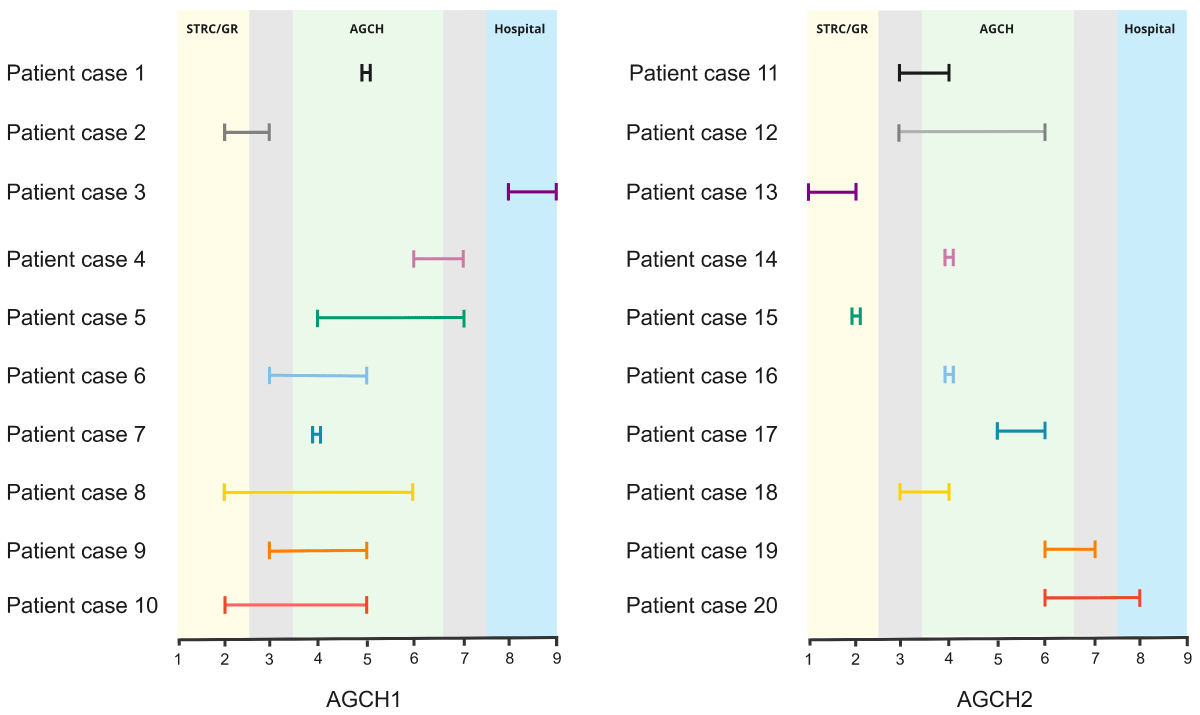
Figure 2
Referral appropriateness.
AGCH = Acute Geriatric Community Hospital, STRC = Short-Term Residential Care, GR = Geriatric Rehabilitation. The yellow area represents referral decisions to STRC or GR: x = 1 indicates lower-complex primary care needs, and x = 2 indicates higher-complex primary care needs requiring further observation. The green area represents AGCH referral decisions: x = 4 indicates lower-complex AGCH care needs, x = 5 indicates medium-complex AGCH care needs, and x = 6 indicates higher-complex AGCH care needs. The blue area represents hospital referral decisions: x = 8 indicates lower-complex hospital care needs with location-specific requirements (e.g., closed ward or quarantine), while x = 9 indicates higher-complex hospital care needs. The grey areas represent referral decisions where the expert is uncertain whether the patient’s care needs align with STRC/GR or AGCH care (x = 3), or whether the patient’s care needs are more appropriate for AGCH or hospital care (x = 7).
Table 4
Key performance indicators in the first quarter of 2024.
| AGCH1 Q1 2024 N = 132 | AGCH2 Q1 2024 N = 29 | |
|---|---|---|
| Length of AGCH admission* | ||
| Average LOS (days) | 12.5 | 9 |
| Median LOS (days) | 9 | – |
| Discharge destination, n (%) | ||
| Home, with or without home care, with or without LTC | 90 (70.3%) | 15 (51.7%) |
| STRC | 8 (6.3%) | 0 (0%) |
| GR | 10 (7.8%) | 3 (10.3%) |
| Nursing home or assisted living | 7 (5.5%) | 3 (10.3%) |
| Hospital (with or without ED visit) | 4 (3.1%) | 2 (6.9%) |
| Not applicable (e.g. patient deceased) | 9 (7.0%) | 2 (6.9%) |
| Missing | 4 (3.0%) | 4 (13.8%) |
| ED or hospital visits for imaging during AGCH admission, (%)† | 2 (1.6%) | 2 (6.9%) |
[i] AGCH = Acute Geriatric Community Hospital, LOS = length of stay, LTC = long-term care, STRC = Short-Term Residential Care, GR = Geriatric Rehabilitation, ED = Emergency Department, Q1 = first quarter. *Missing LOS data for four patients at AGCH1. No missing LOS data for AGCH2. †Missing data on imaging for four patients at AGCH1 and no missing for AGCH2.
Table 5
ED discharge destinations in the first quarter of 2024.
| PARTNERING HOSPITAL Q1 2024 | PARTNERING HOSPITAL Q1 2024 | |
|---|---|---|
| Number of 70+ patients admitted to the ED | 1238 | 997 |
| Discharge destination of 70+ patients admitted to the ED, n (%) | ||
| The hospital where the patient initially presented at the ED | 292 (23.6%) | 461 (46.2%) |
| Another hospital | 136 (11.0%) | 7 (0.7%) |
| Home with or without district care, with or without LTC | 700 (56.5%) | 489 (49.0%) |
| AGCH | 37 (3.0%) | 29 (2.9%) |
| STRC and GR | ¥2 (0.2%) | 8 (0.8%) |
| Not applicable (e.g. patient deceased) | 64 (5.2%) | 3 (10.3%) |
| Missing | 7 (0.6%) | 0 (0%) |
| Number of 80+ patients admitted to the ED | 524 | 448 |
| Discharge destination of 80+ patients admitted to the ED, n (%) | ||
| The hospital where the patient initially presented at the ED | 132 (25.2%) | 220 (49.1%) |
| Another hospital | 75 (14.3%) | 3 (0.7%) |
| Home with or without district care, with or without LTC | 258 (49.2%) | 199 (44.4%) |
| AGCH | 26 (5.0%) | 16 (1.6%) |
| STRC and GR | 0 (0%) | 9 (0.9%) |
| Not applicable (e.g. patient deceased) | 30 (5.7%) | 1 (0.2%) |
| Missing | 3 (0.6%) | 0 (0%) |
[i] ED = Emergency Department, AGCH = Acute Geriatric Community Hospital, STRC = Short-Term Residential Care, GR = Geriatric Rehabilitation, Q1 = first quarter.