
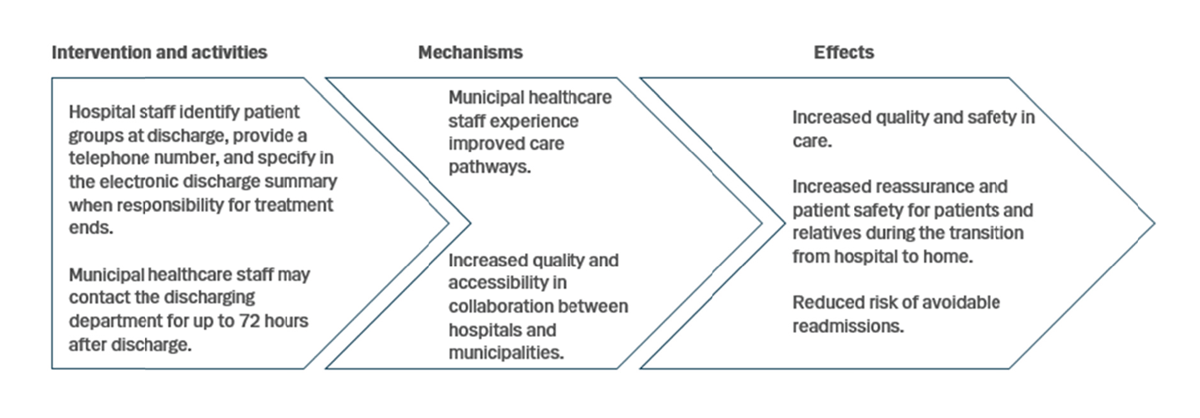
Figure 1
Logic model of the 72-hour treatment responsibility for hospitals.
Table 1
Overview of data collection methods and a brief description of data.
| DATA SOURCE | DESCRIPTION |
|---|---|
| Survey | Survey for municipalities and hospitals: 18 questions Survey for GPs: five questions Themes included: - Implementation and operation of the agreement - Perceived meaningfulness of the agreement - Use of the agreement - Cross-sector collaboration - Impact on patient pathways Both questionnaires were distributed by email. Municipalities and hospitals received a reminder after one week with no answer. To remind GPs, a description of the survey was published on a professional website for GPs. |
| Cross-sectoral medical record audits | Audit panels had the possibility to look up necessary information on a case in local electronic systems. Focus at the meetings was on application of the agreement, cross-sectoral collaboration and communication, and prevention of readmissions. |
| Electronic patient records | |
| Number of discharge reports sent | Upon discharge to municipal nursing care, hospitals must send discharge reports to the municipality. These reports include essential information on the patient’s care plan. The agreement enabled indicating in the reports if the patient was discharged with a 72-hour treatment responsibility. Fluctuations in the number of discharge reports issued could suggest a pronounced focus on discharge documentation with the agreement. We compared the number of discharge reports with the number of discharge reports in the target group in 2023. |
| Number of correspondence messages sent and received | Correspondence messages are a secure way of electronic communication within the healthcare sector. The agreement stipulates that telephone communication between the municipality and the hospital must be supplemented by written correspondence from the hospital to the municipality. Fluctuation in corresponding messages sent and received was seen as an indication of the cross-sectoral communication about patients. |
| Number of updated shared medication records (Fælles Medicinkort) at discharge | The shared medication record is a national IT solution in the Danish healthcare system, designed to provide an overview of each citizen’s current medication. Updated shared medication record at discharge is one aspect of a secure transition between sectors. We investigated the percentage of patients discharged with 72-hour treatment responsibility having updated shared medication records. This number was compared with the corresponding number among all individuals discharged. |
| Number of readmissions within 30 days after discharge among citizens covered by the agreement | We investigated the development in readmissions in the target group to get insights in the agreement’s potential to prevent readmissions.Readmissions were characterized as a hospital stay lasting 12 hours or more within 30 days following the initial admission, accompanied by a 72-hour treatment responsibility.Admissions related to cancer or cancer-associated conditions; hospice stays; or readmissions resulting from accidents, violence, or suicide attempts were excluded. |
[i] Table describes the three data collection methods used for the study together with a brief description of the collected data.
GPs: General practitioners.
Table 2
Response rates to the survey distributed on sectors.
| CHARACTERISTICS | n (%) |
|---|---|
| General practitioners | 48 (24) |
| Municipal healthcare professionals | 73 (33) |
| Hospital healthcare professionals | 95 (49) |
[i] Table shows number and percentage of invited healthcare professionals in each sector responding to the survey distributed on General practitioners, municipal healthcare professionals and hospital healthcare professionals.
n: number of responders.
Table 3
Characteristics of the study population for cross-sectoral medical record audits.
| CHARACTERISTICS | 24-HOUR TEMPORARY CARE FACILITIES | NURSING HOMES | OWN HOMES |
|---|---|---|---|
| Number of cases | 20 | 7 | 8 |
| Gender | |||
| Women | 7 | 5 | 3 |
| Age span (years) | 60–95 | 68–93 | 59–88 |
| Main reasons for hospital admission | Fall Fracture COPD Lung infection Confusion Heart disease Cancer Covid-19 General frailty | Fall Fracture COPD Lung infection Confusion Depression Anxiety General frailty | Fall Heart disease Diabetes type 2 Diarrhoea Kidney problems Back pain General frailty |
[i] Table shows the characteristics of the study population for cross-sectoral medical record audits conducted on patient cases from 24-hour temporary care facilities, nursing homes, and cases where municipal nursing care is provided in the citizens’ own homes.
COPD: Chronic Obstructive Pulmonary Disease.