
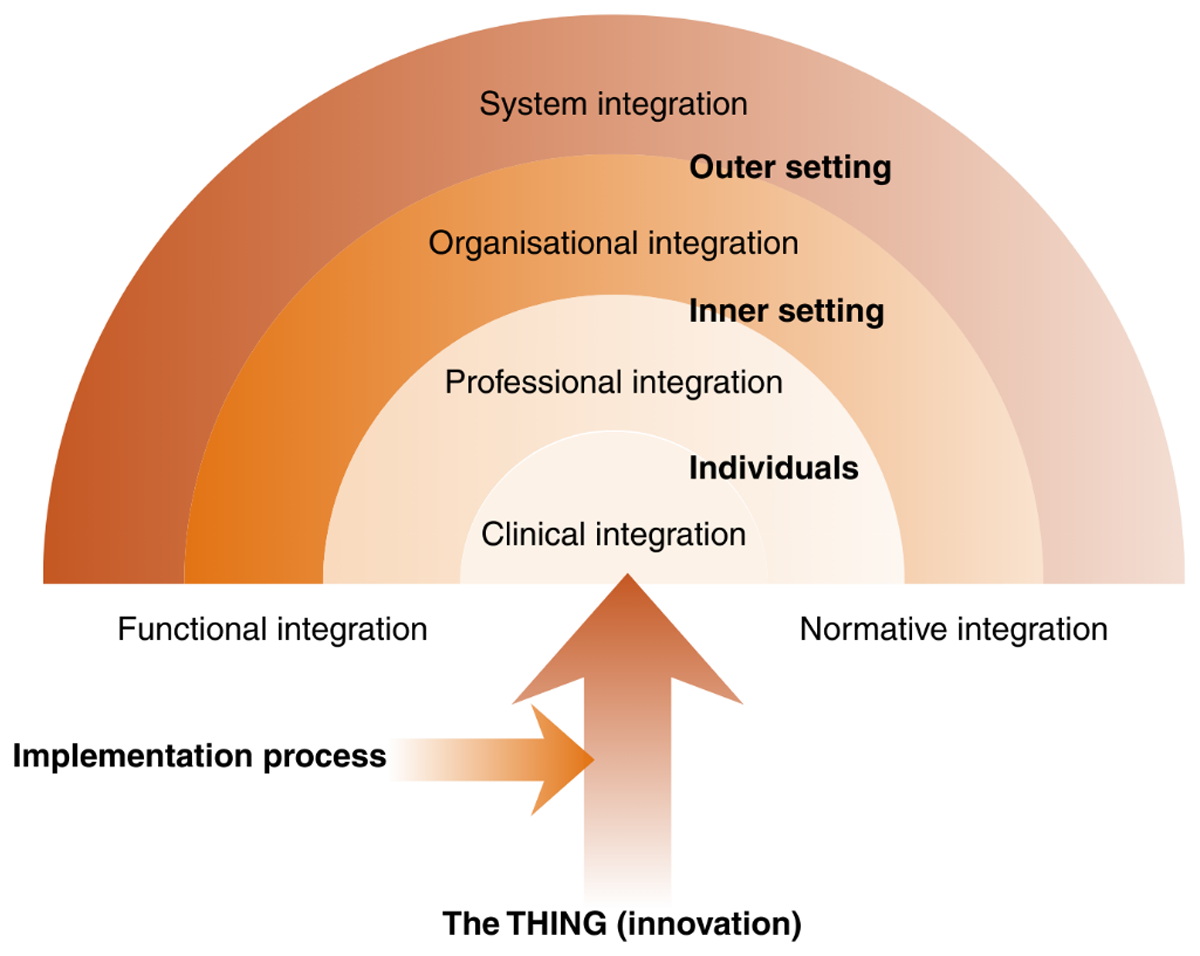
Figure 1
The Rainbow Model of Integrated Care and Consolidated Framework of Implementation Research. Adapted from: Valentijn et al. (2013) [28] and The Center for Implementation (2025) [29].
Table 1
Selected barriers and facilitators, their CFIR determinant and level of RMIC, with illustrative quotes.
| DETERMINANT | DETERMINANT CFIR | LEVEL OF THE RMIC | QUOTES | |
|---|---|---|---|---|
| Barriers | Insufficient involvement of citizens in the design of the group consultations. Important sub barriers:
| Process – Assessing needs Innovation – Innovation design Outer setting – Local conditions Outer setting – Local attitudes | Clinical/normative integration | Q1: ‘But it also has to do with: you put things in front of me that I don’t like. You want me to cook certain things that I don’t know how to cook.’ – Clinical level Q2: ‘This is a theme about losing weight. Especially among women, it is a private theme. It’s a… It also has to do with self-confidence, self-confidence. So in a group where there are men there, you’re not really going to be able to get that out, so out of, that a woman is going to tell something so intimate.’ – Clinical level Q3: ‘I also hope that the consultations will be carried even more by the local residents themselves, so that it really comes from the community. And that they also get a voice in designing the consultations, for example.’ – Professional level Q4: ‘Adjusting [the intervention] to the group, there’s still a lot to be done in that, in my opinion’ – Organisational level |
| Gap between the group consultations and local follow-up initiatives | Innovation – Innovation design | Professional/functional integration | Q5: ‘At this one there were lots of dieticians and someone from, for people with financial problems, for people with financial, you name it. All sorts of things were there. Eating problems.[…] Heart foundation was also there and I understood that all. Also understand why they were invited. I was only wondering like: what’s the added value? The performance did go nicely. It was nice. The atmosphere and everything. That was all right. But after that I did notice some people were like: what am I here for? What is the actual help?’ – Clinical level Q6: ‘Often they are in different trajectories and then it may occur that I lose track of them, but they are still actually working on a trajectory, which also originated from the group consultation. So that link, if indeed something is documented or streamlined, that we can also better keep track on that. […] So often you lose the people who try something and it doesn’t work out and then think: it didn’t work out, I’ll stop. Whereas a moment of contact or a signal of: this person has stopped, if we can pick this up again, it will be easier to pick up the trajectory again.’ – Professional level | |
| The lack of embedding of the group consultation into formal agreements/structures. Important sub barrier: Roles within the implementation team are unclear. | Process – Planning Individuals – Implementation leads | Organisational/functional integration | Q7: ‘For that to spread out completely in the neighbourhoods, there is – I think – still a lot depending on enthusiastic colleagues – professionals – rolling that out. Ideally, you would like to secure that in a function within…. In a neighbourhood, for instance. That it is not person-dependent, but more embedded.’ – Organisational level | |
| Fragmented financing systems | Outer setting – Local conditions; Inner setting – Available resources | System/functional integration | Q8: ‘[…]funding is a problem and has been for some time, because on the one hand you have the angle from medical support and support from the social domain, with the health insurer and municipality looking at each other like: who is going to pay for what?’ – Organisational level Q9: ‘And yes, you know, I think this is actually another one of those typical annoying cases of the responsibility lies everywhere and therefore nowhere.’ – System level | |
| Inadequate evaluation of effectiveness and the implementation process. | Process – Reflecting and evaluating | Organisational/functional integration | Q10: ‘Sure she asked that at some point. Sure that that also came up and I may have mentioned something. But not very well-founded and not very well thought out, I think.’ – Professional level Q11: ‘But to put it very simply: to get a payment title for group consultations, you will have to present results from the field, if you would want to pay for it from the ZVW [Health Insurance Act].’ – System level | |
| Facilitators | Widespread enthusiasm for the concept of the group consultations | Innovation – Innovation relative advantage Inner setting – Mission alignment | Professional/normative integration | Q12: ‘During group consultations, we notice that people truly feel heard.’ – Professional level Q13: ‘Well, if you go to one of those group consultations […] and you find out there: who is that dietician? Oh, […] that seems like a really nice person. And you can make an appointment right away, that’s of course perfect. Then you really have, just that warm referral.’ – Organisational level |
| Sense of urgency for change among stakeholders | Inner setting – Tension for change | Professional/normative integration | Q14: ‘I said: well, I’m open to that kind of thing too, just offering care in a different way instead of just one-on-one. Because sometimes you think: “Hello, does it sink in?” or “what about the advice I give?” And then when someone says, for example, after ten times, “I’ve never heard that before.” Then I think, I think I’ve already told them ten times.’ – Professional level | |
| Adaptability of the initiative to the local context | Innovation – Innovation adaptability | Clinical/normative integration | Q15: ‘Yes, because you see that that’s important for success. That you respond to the needs in the neighbourhood’ – Professional level Q16: ‘If there are a lot of questions regarding quitting smoking, then we’ll ask aa smoking cessation coach to join. So that way you can adjust it a little bit each time too.’ – Professional level |
Table 2
Main identified barriers and the matched strategy.
| BARRIER | IMPLEMENTATION STRATEGY FROM ERIC |
|---|---|
| Limited involvement of citizens in the design of the group consultations. | Involve patients/consumers and family members |
| Gap between the group consultations and local follow-up initiatives | Organise clinician implementation team meetings Involve patients/consumers and family members |
| The lack of embedding of the group consultation into formal agreements/structures, resulting in dependence on the intrinsic motivation of involved partners for continuation of the initiative. | Develop a formal implementation blueprint Obtain formal commitments |
| Fragmented financing systems | Use other payment schemes Develop resource sharing agreements |
| Inadequate evaluation of effectiveness and the implementation process. | Capture and share local knowledge Develop and organise quality monitoring systems |