
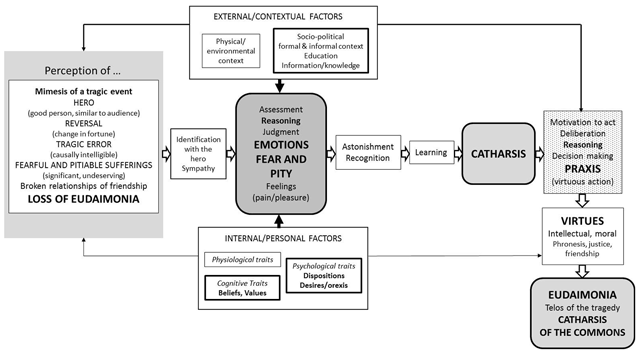
Figure 1
Simplified representation of the catharsis of the commons.
Table 1
Comparison of the Aristotelian-inspired, institutionalist, moral and phronetic approaches to the tragedy of the commons.
| Criteria | Approaches | |||
|---|---|---|---|---|
| Aristotelian-inspired | Institutionalist | Moral | Phronetic | |
| Analysis – Description, Explanation | ||||
| Focal spatial scale | Individual (citizen) and community | Community | Individual | Individual and community |
| Time frame | (*) Long-term | Short-medium | (*) Long-term | Short-long |
| Model of human behavior and decision making | Value and instrumental rationality Rational individuals aiming at personal and the common good (eudaimonia) | Instrumental rationality Rational individuals (utility maximizers) aiming at personal and the common good | (*) Value rationality Rational individuals aiming at personal and the common good | Value and practical rationality Rational individuals aiming at the personal and common good |
| Focus and priorities | Praxis Learning Rationality & Emotions Virtues Political regime, state legislation | Institutions Appropriation and provision problems Direct impacts | Personal and political virtues | Values; Virtues; phronesis Praxis Deliberation Judgment |
| Understanding of the CPR dilemma | Rationality/virtues exercised in the wrong context lead to tragic outcomes | Individual rationality exercised in the ‘wrong’ context (lack of incentives) leads to tragic outcomes due to free riding | Lack of morals/virtues in resource use decisions produces tragic outcomes | Lack of phronesis in resource use decisions produces tragic outcomes |
| Role of individual traits | Strong (values, virtues, experience, character and other personal traits) | Strong (age, education, values, etc.) | Strong (values, virtues) Moral reasons of praxis | Strong (education, experience, phronesis) |
| Role of ethics/values | Strong | Implicit | Strong | Strong |
| Role of social capital | Strong The central role of friendship (philia) | Strong The central role of social capital (Cooperation, trust, social bonds, learning) | (*) Strong Cooperation, trust, social bonds | Strong Cooperation, trust, social bonds |
| Role of context | Strong (Legal, institutional geographic, socio-economic, cultural) | Strong (Institutional, geographic, socio-economic, cultural) | Strong Contextual nature of virtuous action | Strong Situatedness of knowledge, decisions and praxis |
| Role of emotions | Explicit | Implicit | (*) Explicit | Implicit |
| Role of power | (*) Implicit | Not discussed | (*) Not discussed | Power relations central for praxis |
| Goals of CPR management and governance | Individual and collective eudaimonia | Sustainable CPR management and governance | Stewardship ‘Citizenship’ Improve relationships among people Political engagement | (*) Sustainable governance; Apply phronesis to ensure the ethical use of science (episteme) and technology (techne) in concrete decision situations |
| Model of CPR management | (*) Democratic, open, participatory Guided by the doctrine of the mean, and the sufficiency principle | Polycentric, multi-level governance Adaptive co-management Adaptive governance | (*) Moral basis of CPR management (whatever CPR management happens to be) | Phronetic planning Value-rational, interactive, reflexive, deliberative, participatory governance Sufficiency, moderation |
| Means of CPR management | Education in virtue Situated, detailed management schemes Political institutions (democratic laws) | Situated management schemes Institutional arrangements, incentive schemes, innovation Rights (all kinds) | (*) Priority on education to complement incentive schemes and technical solutions | Situated ‘mean’ solutions; management schemes combining a variety of means |
[i] (*) Needs further elaboration for valid assessment and comparison.
 Strong commonalities.
 Weak commonalities (variations).