
Academic and political debates related to the commons are vast and extremely diverse. They all relate to different forms of sharing resources collectively, however they imply various conceptions of community, commoning and commoners, as well as different understandings of the relationship between common and public goods. Even when focusing on the urban context, the scope of discussion remains extensive and polysemic. The so-called “urban commons” refers to the shared governance of various urban resources, ranging from the city as a common to various types of resources at different scales, including natural, hybrid and built environments such as water bodies, wetlands, shared gardens and parks, as well as public spaces, workplaces and shelters. It also considers immaterial resources, knowledge and capabilities (Feinberg et al., 2021). The notion includes existing commons to be defended and commons to be created through collective efforts and struggles.
In accordance with Bollier and Helfrich’s conceptualisations, the term ‘commons’ refers to ‘living social systems through which people solve their shared problems in a self-organised manner or co-produce them’ (2021, p. 29). These commons might be supported by appropriate legal frameworks that facilitate the coproduction of ways to govern local resources, involving users and other stakeholders.
This special issue examines approaches based on the notion of commons applied to land for housing in urban areas in the Global South. This collection of papers, based on collective research, lies at the intersection of the spatial turn in social studies and critical legal studies (Festa, 2023). It focuses on local cases of collective, cooperative and/or alternative modes of governing land rights, and of contesting the commodification of urban land. This standpoint is associated with a rights-based approach to land tenure, prioritising land use rights over ownership and the social function of land over the benefit of individual landowners. This approach to land tenure is crucial for achieving the United Nations’ objective of inclusive cities (SDG 11). Specifically, we consider that the right to the city, the right to adequate housing and the right to land security are fundamental principles that should be upheld by all. These are unlikely to be achieved through conventional land and housing schemes, such as recent affordable housing policies based exclusively on private ownership and access to mortgage credit.
This special issue comprises six articles exploring diverse approaches to land-based commons aimed at creating and securing housing for low-income households in urban areas of the Global South. The focus is on initiatives and projects that concretely provide housing options for urban dwellers. Some of the cases analysed refer to experiences of commons (or projects of commons) that have been consolidated by processes of institutionalization within cities. Examples include housing cooperatives in Uruguay (Valitutto & De Souza Lopez) and Senegal (Simonneau, Tall & Diongue); collective usucapion (usucapião coletiva)1 in Brazil (Gonçalves & do Vale); and Community Land Trusts (CLT) in Puerto Rico and Brazil (Algoed & Hernández Torrales). Others are based on pre-existing rural common land that became a resource as cities expanded, as in New Caledonia (Cassourret & Salenson) and India (Raman & Denis).
Methodologically, in line with Ferreri and Vidal (2022), we argue that land-based and housing commons should be considered not only at the time of their creation, but also in terms of access, management and maintenance, and their ongoing social accessibility. This perspective is imperative in order to overcome the niche effect and the mirage of best practices, and to give full consideration to models that can scale up while avoiding clubbing effects. Thus, the papers in this collection are all based on contextualised case studies, some of which take a longitudinal approach.
This introduction provides an overview of recent literature on commons as applied to land and housing before presenting our analytical framework. The final section discusses the articles through three cross-cutting questions.
The emergence of housing commons studies
Recent studies have drawn attention to the emergence of collaborative and cooperative housing models, particularly in Europe (see, for example, Czischke, Carriou, & Lang, 2020; Ferreri & Vidal, 2022; Griffith, Jepma, & Savini, 2022). Collaborative and cooperative housing encompasses various forms of co-housing involving different degrees of collaboration between residents and other stakeholders, such as public bodies. However, questions have been raised about the inclusivity and accessibility of collaborative housing: which stakeholder is responsible for its initiation, benefits, limitations and perpetuation (Balmer & Bernet, 2015)? Tensions are highlighted between projects with transformative power – which aim to promote social inclusion and self-governance, challenging capitalist development and existing power dynamics. They rely on tactics to subvert existing legislation and the land zoning regulation. These radical projects need a continuous struggle against established systems, which is difficult to achieve (Volont, 2022; Ferreri, 2024). Other projects are rooted in conservative networks, which are not particularly conducive to social inclusion, and lead to consolidate existing systems. While literature on urban land and housing commons in the Global North is growing, as collaborative housing models on collectively owned land expand, a different dynamic of scholarly development is occurring in relation to Southern cities, with until recently, a significant Global South-North divide (Shelby, 2024).
Housing, land, and communities in rapidly urbanising and postcolonial worlds
In urban areas of the Global South, housing needs are pressing and land tenures are diverse, plural and often related to long-established forms of collective tenure associated with rural settings. Examining land-based commons for housing is related to three well-established areas of research, which we briefly review here.
Firstly, it relates to debates on informal settlements and their upgrading. While in the Global North, land-based commons often involve the appropriation of derelict, abandoned or underutilised urban land and infrastructure, viewed as ‘cracks in the system’ (Volont & Dobson, 2021), in the Global South, they are more frequently found in existing informal settlements and may represent a form of regularisation. Indeed, encroachment of public or private land and unauthorised construction represent a major form of urbanisation in the Global South, and informal settlements often constitute the majority of the housing stock there. In many countries, national housing policies have alternated between eviction and in situ land regularisation and neighbourhood upgrading through basic services for example. Although 1950s housing policies aimed to provide an alternative to poor urban housing through direct public production, they were quickly overwhelmed by rapid urban growth and a lack of investment capacity. These policies were then undermined by the need to reduce public debt, resulting in a shift towards market mechanisms for producing affordable housing. Since the 2000-decade, eviction and subsequent rehousing remain the dominant approach toward informal settlements, along with affordable housing policies based on public-private partnerships. Yet, neither market-based approaches nor subsidized public housing have proved capable of significantly reducing the prevalence of precarious housing conditions (Aalbers et al., 2020; Deboulet, 2016; Marot et al., 2022). Nevertheless, various forms of regularisation and upgrading of precarious neighbourhoods are also taking place often initiated by residents and community-based organisations. Yet, these collective and cooperative dynamics of housing production and upgrading remain understudied as they continue to receive minimal support from public policy.
Secondly, the housing crisis is occurring in areas where land tenure schemes are complex. They are characterised by collective land tenure — otherwise known as traditional or customary commons — and the colonial and postcolonial history of its dismantling (Le Roy, 2019). Rather than being owned, customary commons are managed at the rural community level through usage rights (in the agricultural, pastoral, and fisheries sectors, for example). These rules aim to preserve community needs rather than individual ones. As Danouta Liberski-Bagnoud (2023) puts it about rural communities’ relationship to land in Burkina Faso: ‹Human beings belong to the Earth, rather than the other way around›. Private tenure was imposed during colonisation as an extension of the colonial discourse of mastery and exploitation of nature. Colonial and postcolonial states were built ‹against the commons›, based on property and land registration (Charbonnier, 2024). In parallel, the rapid urban sprawl has reinforced the dismantling of traditional commons due to the pressure of land commodification, assetisation and environmental enclosures (Bon, 2021a; Bon et al., 2023; Chau, 2022; Chitonge et al., 2017). Within cities, the tendency has recently accelerated due to more market-driven and exclusive management of municipal public land (Aalbers et al., 2020; Bon, 2021b; Kumar, 2025).
Lastly, it should be noted that the narrative of the dismantling of traditional commons by ‹predatory› urbanisation has also shaped the field of land-based commons in the Global South, particularly in Africa (Bertrand, 2021), obscuring and ignoring collective action and mobilisation in urban contexts. Here, research on communities in urban settings is helpful. It has demonstrated that urban communities are based on contractualisation rather than social belonging and are characterised by greater mobility and diversity. Additionally, relationships between members tend to be more transient and less stable than in traditional rural communities, as urban environments are socially and economically complex and already ‘saturated’ (Huron, 2015) with regulating institutions (Foster & Iaione, 2019; Huron, 2015; Polko, 2024). These findings might help us to move away from a nostalgic narrative on community dynamics and shed light on these understudied forms of collective action for securing urban land and housing.
An emerging literature on land-based commons for housing in a southern and global perspective
Recent publications have begun to include research on housing commons in the Global South within the general literature on collective land tenure.
A first series of publications were focused on documenting specific and isolated cases, often bottom-up local initiatives and pushed or initiated by international organisations such as development agencies or NGOs as pilot projects. They examined their development and questioned their inclusion in public policy or in international fora. For instance, Gillespie (2018) examined a collective, self-help housing project in Accra that was initiated by a housing cooperative and its savings groups, which are affiliated with Slum Dwellers International (SDI), with the support of UN-Habitat. The article opens up the discussion on the potential benefits of public support. Bassett (2005), Midheme (2013) and later on Simonneau, Bassett and Midheme (2020) documented the implementation of a pilot Community land trust in the secondary city of Voi, Kenya, and the limited support of national government. The cumulated research on this specific case has shown that political support to non-conventional land arrangement can be unstable: the Voi CLT was cited as a best practice in the national Habitat II report in the 1990s, but has never been promoted as a tool in national slum upgrading programmes.
More recently, taking a broader view and adopting a longitudinal perspective, Shelby (2022) examines Thailand’s Baan Mankong slum upgrading programme, which is based on community organising, collective land tenure, and channelling infrastructure subsidies and housing loans to urban communities at a national scale. With a critical perspective, the article considers the role of the State in urban commons and the risk of community control being diluted in the pursuit of scalable solutions. It also emphasises that the political intent and organisational structures of a movement can significantly impact its ability to uphold ‘commoning’ practices, even when faced with state co-option and increasing bureaucratic rigidity. It is also worth noting a range of publications on housing cooperatives in Latin America that discusses the balance between community control and professionalization and the conditions of the cooperative model’s dissemination (Duyne Barenstein & Pfister, 2019; Sanjinés Encinales et al., 2024). This scholarship highlights the importance of observing such initiatives in the long term in order to assess their capacity to endure beyond the first generation of residents and with the involvement of various stakeholders, including the state, as well as their potential for scaling up.
Nord-South comparative approaches to ‘collective housing tenure’ are also emerging. These approaches encourage the consideration of case studies on and from the Global South, in order to bring them into conversation with research conducted in the Global North. Through a systematic literature review, Guisan et al. (2025) identify five distinct clusters that categorise different approaches to housing commons. These range from the study of problems related to collective action in multi-owner housing (separate housing units within one shared building) to that of housing as a political practice against capitalism. Shelby (2024) reviews literature on various models of “collective housing tenure” in a global perspective, their institutional forms, and the theoretical underpinnings and empirical findings of scholars. Shelby identifies key avenues of research to be explored with a comparative strategy. First, she encourages studying the ‘politics of scale’, through the examination of the stakeholders’ motivations over the long-term and how organizations can maintain both political autonomy and relation to state policy necessary to scaling up. Second, she shed light on the circulation of models, and facilitating networks.
The aforementioned studies share a focus on two interconnected dimensions: the dynamic dimension, pertaining to sustainability, and the relational dimension, encompassing the circulation of models and networks, which are at the core of our own approach developed below.
Land-based commons for housing in the Global South: a theoretical framework
This curated collection aligns with this emerging body of comparative literature, albeit focusing on comparison between cases across the Global South, in Latin America, Asia, and Africa. It contributes to the debate through an empirical approach of contextualised case studies. The latter include an array of initiatives and projects characterised by their objective to curtail and subsequently reverse the mercantilist evolution of land and housing. These initiatives are often local and aim to be inclusive.
This collection is also a theoretical contribution: to us, examining the issue of housing in the Global South through the lens of the commons means critically observing three components.
Firstly, it means taking a critical look at the realisation of the social function of land and property (Mathivet, 2014). The concept of ‘the social function of land’ is defined as follows: property rights are considered ‘a tool aimed at specific goals rather than a strictly selfish prerogative’ (Bernard and Thys, 2014). As posited by Bernard (2016), three dimensions in relation to the social function of urban land are identified: affordability, sustainability and security of tenure, and participation (see Figure 1).
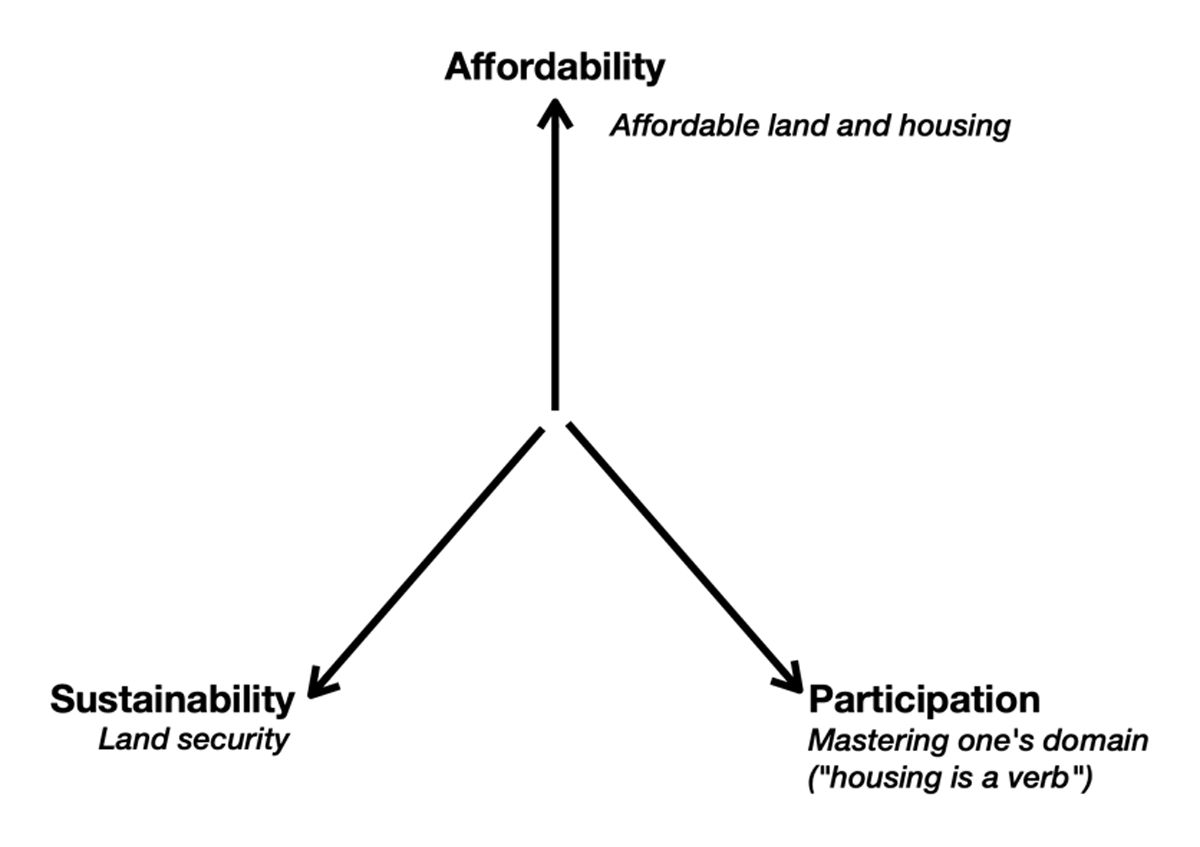
Figure 1
Three dimensions of the social function of land.
Source: Authors, based on Bernard 2016.
Secondly, long-term preservation of urban land is also considered. This involves examining the conditions for the sale, preservation or transfer of plots of land while retaining a land-based commons after the first generation of founders of the ‘community’ (see Figure 2). Studying fairly mature initiatives with a long history is important in order to assess the long-term dynamics, in terms of the actual realisation of the housing project, its maintenance, and intergenerational transfer.
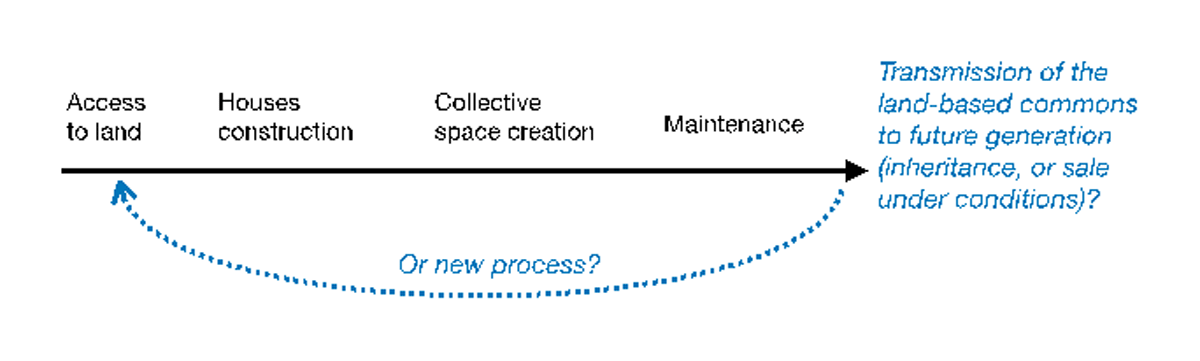
Figure 2
Replication over time of land-based commons.
Source: Authors.
Thirdly, given that land-based commons are often initiated on a small scale and rooted in local social dynamics, questions must be raised about their potential for diffusion and scaling up. A number of these initiatives are gaining recognition, and sometimes their dissemination occurs in various contexts, such as the Community Land Trust in North and Latin America and housing cooperatives in Latin America. According to Defalvard (2020), commons dissemination should be translocal, referring to situations in which local practices and initiatives are connected through international networks. The following questions arise: How do local experiments circulate across scales? How are ‘models’, ideas, and principles disseminated? Through which channels and stakeholders? The extent to which local initiatives contribute to challenge mainstream land and housing policy paradigms at urban, national and international levels deserves close examination.
Six Articles on Commons and Commoning for Housing in Urban Context
This collection departs from collaborative and comparative research supported by the French Development Agency (AFD) under its strategic banner ‘A World in Common’ (Simonneau & Denis, 2021; Simonneau et al., 2023). In this research, we studied housing projects for low-income households that were either developed from scratch or aimed to regularise a precarious neighbourhood through land pooling. These previous work and case studies (de Souza et al., 2021; Simonneau et al., 2019; Soares-Gonçalves, 2021) form the basis of three research articles in this collection: one on the implementation of Brazilian collective usucapion (Soares Gonçalves & do Vale); one on customary land tenure in New Caledonia (Cassourret & Salenson); and one on Indian commoning practices (Raman & Denis). The issue also contains three original articles on housing cooperatives in Senegal (Simonneau, Tall and Diongue), technical assistance to Uruguayan cooperatives (Valitutto & De Souza Lopez) and the community-to-community circulation of Community Land Trust (CLT) principles (Algoed & Hernández Torrales).
Throughout the case studies, particular emphasis is placed on the local manifestations of commoning. According to Bollier (2016), commoning is defined as a series of “acts of mutual support, conflict, negotiation, communication, and experimentation required to establish systems for managing shared resources” (p. 2). In the context of housing struggles, commoning is an important step in the regularisation of informal settlements, which face inadequate public regulation and pressure from real estate development. This collection of articles shows that the concept can be used to describe a variety of situations, ranging from customary land in New Caledonia and rural common lands in India to housing cooperatives in Senegal and Uruguay, and CLTs in Puerto Rico and Rio de Janeiro. The papers emphasise that, in urban contexts, commoning is highly politicised, involving ongoing contestation, resistance and negotiation rather than merely collective resource management. It also transcends traditional rural definitions, adapting to urbanising areas where communities may comprise diverse and even unfamiliar individuals united by shared interests, sometimes on a temporary basis.
Together, these contextualised case studies offer a broad perspective on land-based commons for housing and can be considered in relation to three cross-cutting questions.
Community Agency, Collective Action, and Knowledge Transfer
The articles place significant emphasis on communities’ agency and the tools of collective action they use to secure their rights to land and housing. These include the formation of resident associations by squatters united in opposition to eviction, the use of social networks, or a refined understanding of state procedures for their own benefit. Residents’ involvement in participatory processes is paramount, including their participation in planning, decision-making and self-construction. This approach has been shown to foster a sense of community cohesion and empowerment, building on the shared objective of accessing and securing housing. In their paper, Céline Cassourret and Irène Salenson demonstrate that historical Kanak communities constitute a resource for collective action and innovation in the fields of urban and economic development in New Caledonia.
The papers also discuss the importance of knowledge production, transfer and sharing. This includes the dissemination of technical and administrative expertise from professionals to community members and the broader concept of ‘open-source urbanism’, where expert knowledge and lived experiences intersect (Sassen, 2011). Specifically, in their paper, Line Algoed and Maria Hernández Torrales argue that the knowledge and contributions of low-income urban communities are often undervalued in policy studies, despite their crucial role in generating ideas and sometimes in influencing the global circulation of policy.
The transmission of knowledge is also a concern. Indeed, it has been observed that the know-how and capabilities to act collectively and to create, secure, and rehabilitate precarious housing circulate at various scales within cities and countries, between residents and professionals, but also through the Global South and eventually from the South to the North (Valitutto & De Souza). For example, Line Algoed and Maria Hernández Torrales’s contribution to this issue demonstrates how community-to-community exchanges between Puerto Rico and Rio de Janeiro have been instrumental in promoting community land trust initiatives in Brazil. Following the publication of this article, the new Master Plan of Rio de Janeiro was adopted in December 2023 and incorporated legal provisions for establishing Community Land Trusts. They present an alternative to individual property ownership for favela inhabitants, providing legal tools to promote self-governance and constrain land speculation during the rehabilitation of the neighbourhood. This paper builds on the exchanges between Puerto Rico and Rio de Janeiro and highlights the role of community-based organization in promoting the global circulation of grassroots initiatives, such as the Caño Martín Peña Community Land Trust in Puerto Rico. The paper emphasises that the dissemination of communities’ and residents’ knowledge can contribute to making social change occur.
The Multifaceted Role of the State and Institutions
The papers all explore the pivotal, though often ambiguous, role of the state and various public institutions in commoning processes. The state can facilitate commoning processes by implementing legal frameworks, facilitating land access and restitution, providing financial support and offering technical assistance. However, the state can also hinder or even co-opt commoning initiatives. Examples of this include the inadequacy of conventional planning instruments for customary land, the appropriation of communal lands for profit-driven initiatives, and the risk of ‘being commoned’ (Shelby, 2022), whereby state agendas incorporates grassroots movements into top-down instruments. The papers illustrate how communities engage in complex negotiations and resistance with multiple government agencies, using legal provisions, political connections and direct action (e.g. protests and petitions) to assert their claims. The Uruguayan case is distinctive in its emphasis on the role of intermediary technical stakeholders (IATs), who act as ‘gatekeepers’ with a dual objective (Valitutto & De Souza): to prevent institutional co-optation, and to ensure legal compliance. They also facilitate the community’s autonomy.
Laws and legal instruments can support community initiatives, through several forms. In Rio de Janeiro, prior to the establishment of the CLT, an alternative instrument already existed: the Collective urban special usucapion. In their paper, Rafael Soares Gonçalves and Josiane do Vale explain how the residents of the Chácara do Catumbi condominium complex mobilised and subsequently collectively managed this legal instrument. Legal support has been instrumental in bringing the adverse possession process to fruition. This paper is based on an action research approach, and also highlights the pivotal role of supporting organisations in articulating local and collective initiatives to create and defend common land for housing. In this instance, the authors — a social worker and a lawyer/historian — collaborated with a local pastoral society and a team of architects to document and formalise the claims, thereby strengthening the residents’ position. However, the limits of the community are highlighted, as are the capacity to align individual interests and aspirations around common rules, and to overcome conflicts during the commoning process.
The Uruguayan case study also shows how legal provision can effectively support community initiatives. For instance, the legal definition of housing cooperatives stipulates that they must collaborate with technical teams. This places a unique and vital responsibility on public authorities: rather than doing the work for the residents, the focus is on supporting them and providing them with the means to develop quality housing. The remarkable achievements of mutual aid housing cooperatives in Uruguay can be attributed, at least in part, to the pivotal role of these technical teams, as elucidated by Irene Valitutto and Ignacio de Souza Lopez in this issue.
In contrast, Claire Simonneau, Serigne Mansour Tall and Momar Diongue analyse the development of housing cooperatives in Senegal, observing shifts in institutional support and changes in the nature of solidarity within these cooperatives. The authors question the continuity of political support for housing cooperatives, which is publicly displayed but in an environment increasingly shaped by competition for access to land.
While the four articles above relates to the creation and circulation of urban commons for housing, two further articles analyse collective schemes supported by rural and traditional commons that existed prior to urban expansion, in India and New Caledonia (Cassourret & Salenson; Raman & Denis). These customary and village commons were transformed into an urban resource, enabling disadvantaged communities to assert their rights in the city based on their long-standing rights over the commons. The articles emphasise the importance of place-based collective action and of ‘commoning’ to claim and secure acquired rights over commons in order to establish proper housing.
These two contributions also demonstrate that the recognition of these rights needs political support and, in certain instances, legal reforms, for which the communities must advocate and establish political alliances. In New Caledonia, for instance, recognising collective property rights for Kanak communities meant departing from the principles of indivisibility and unitary statehood guaranteed by the French constitution. In southern India, this means recognising land rights for the poor in urban areas, which are only recognised in principle in rural areas currently.
Challenges to Sustainability and Long-Term Viability
Despite their potential, these initiatives face significant challenges regarding their sustainability and long-term viability. These include the uncertainty of land agreements across generations, the difficulty of securing financial investments due to non-conventional land tenure and persistent operational challenges in cooperative housing production.
The fluidity of property rights, ongoing legal battles and shifting political dynamics mean that maintaining claims and collective management is a continuous and often precarious struggle. The tension between collective ideals and more capitalistic, individual practices within communities also poses a challenge to long-term cohesion. For instance, conventional Senegalese cooperatives typically lack provisions in favour of long-term collective use rights, and land is mainly considered as an investment by their members (Simonneau et al.). In India, the pursuit of profit in urban development often results in the exploitation of former rural common lands, thereby intensifying competition for land ownership (Raman & Denis). In this regard, the Community Land Trust’s most significant innovation is its long-term, even perpetual, non-speculative nature.
However, the existence of legal provisions does not guarantee their implementation on a large scale and on a consistent basis. In Rio, for instance, collective adverse possession has been legally recognised since the late 1980s, yet only one successful case has been documented by Rafael Soares Gonçalves and Josiane do Vale.
Towards a fairer city through land-based commons for housing?
Across these varied contexts, the different papers gathered here collectively illustrate the dynamic and evolving nature of urban commons, where communities actively shape their living environments through collective action, innovative legal interpretations and strategic collaborations. They also enable us to move beyond the definition of commons of a third way between the state and the market. They demonstrate the complexity and intertwining of relationships between actors, particularly with the state in institutionalisation processes, and with intermediary organisations, whether activist organisations, international NGOs supporting local social movements, or professionals.
This curated collection of articles addresses the overarching objective of social justice and inclusive urban development. Commoning practices and cooperative models have been developed to facilitate enhanced access to land and housing for economically disadvantaged, marginalised or historically segregated communities. The papers explore strategies to bridge development gaps and reduce socio-spatial disparities that persist or are accentuated in rapidly expanding cities. This includes providing adequate housing and amenities on former customary lands and acknowledging the right to settle for households experiencing homelessness or landlessness, facilitated by establishing a collective tenure system. However, challenges posed by commodification and speculation remain a recurring concern.
Research on land-based commons for housing in the Global South contributes to renewing the debate on land and housing in these regions, which has largely focused on the contrast between state-led and market-based solutions. It also significantly contributes to the broader debate on commons, offering nuanced, empirical insights into the multifaceted dynamics of land and housing management. These papers shed light on the challenges, innovations and socio-political complexities of securing and managing land for housing in various southern urban contexts.
Tribute to Eric Denis
This co-authored introduction was nearing completion2 at the time of Eric Denis’s sudden passing away.
A geographer and long-standing specialist on land issues in the Global South, Eric Denis was a driving force behind the scholarly development of this research.
His work in India, Sudan and Egypt, among other places, demonstrates the special attention he paid to communities and individuals, their experiences of cities and territories, and their aspirations and desires. He was committed to exploring the dynamics of urban worlds, constantly moving between scales — from the individual plot to larger territories and the world at large — and examining complex, often informal, legal land tenure arrangements; the economic realms of the most vulnerable; and the aspirations of people. He always adopted an empirically grounded approach, free of romanticisation.
He was one of the leading representatives of the urban section of the “Land and Development” Technical Committee within which he gave a voice to the informal sector and precarious urban dwellers. He contributed to the collective book ‘Rethinking Precarious Neighborhoods’, edited by Agnès Deboulet and published by the AFD, with Solomon Benjamin and Bhuvaneswari Raman. This contribution in particular laid the groundwork for collaboration with the AFD and a broader research programme on land-based commons — a programme of which this special issue is one of the outcomes.
In the context of the Indian case, he and his co-authors explicitly drew the link between commons and the collective regularisation of informal settlements, in this special issue and other publications. Drawing on a thoroughly documented analysis of ‘land regularisation routines’ in India, they helped to shed light on the combination of individual and collective practices employed by residents to assert and secure their land rights. By renewing the debate on participation based on detailed observations of residents’ initiatives, this work highlighted the dynamics of collective action in rapidly urbanising communities caught up in power relations, where low-income residents provisionally and strategically unite to assert their rights to common lands in the face of powerful actors. One of the major contributions of Eric and his co-authors was to show that land-based commons are not merely land or a legal status, but also a form of ‘commoning’ (collective action). This is an essential aspect for understanding the implementation of land regularisation in cities in the Global South. A second innovative contribution was demonstrating that individuals and communities in precarious situations can seek to ‘accumulate wealth’ through their land holdings without this amounting to speculation, notably to fund family or collective tontine schemes.
Within the international comparative programme, Eric’s contribution has also laid in his ability to establish links between the studied territories, examine research findings from a cross-cutting perspective and draw attention to subtle changes.
All his colleagues remember his kindness, curiosity and commitment to giving everyone a voice, across different generations, disciplines and geographical contexts. As with his other collaborative projects, he succeeded in fostering a horizontal dynamic within the reseach collective in recent years, encouraging the generous sharing of knowledge and methods. This was particularly evident in his guidance of the iterative theorisation of the work, the coordination of the research and the production of this special issue. This issue is dedicated to him.
Claire Simonneau, co-scientific coordinator of the ‘Land- based Commons for Housing’ programme for Géographie- cités, and Irène Salenson, programme coordinator for AFD.