
Introduction
The energy transition from fossil fuels to renewables raises fundamental questions on how energy systems are organized, who controls them, and who benefits from them (Jenkins et al., 2016). Recently, scholars and activists have advocated for a commons-based approach to the governance of renewable energy, often positioning the idea of the commons as a third alternative to state and market-based models of ownership, control, and governance. In this understanding commons is based on a logic of cooperation, sharing and reciprocity, rather than one of profit and competition, associated with the market, and hierarchical centralization, associated with the state (Acosta et al., 2018; Bauwens et al., 2024; Becker et al., 2017; Giotitsas et al., 2022; Hoops, 2024; Kaandorp et al., 2024; Melville et al., 2017; Villamayor-Tomas & García-López, 2021; Wade & Ellis, 2022). Yet, there are tensions within commons research between those who envision the commons as a reform oriented critique of market driven approaches to renewable energy (RE) development, or as a radical break with free market capitalism (Bauwens et al., 2024). Indeed, many proponents of commons based models of social organization tend to offer strong critiques not only of the market, but also of the state, sometimes reducing the state to a mere protector of markets (de Jongh, 2021). However, as this article will argue, such perspectives risk overlooking the diversity of ways in which the notion of the commons is interpreted and institutionalized in practice across different political and cultural contexts.
In Norway, the flow of water, harnessed for the purpose of producing electricity, came early on to be perceived as a shared resource and societal good that was to benefit both the national and local communities. This approach was the result of a yearlong political-ideological struggle in which hydropower was normatively constructed as a form of commons and managed by the public at different levels (Slagstad 2001). This regime included a strong local imprint through municipal ownership and involvement in general provision of electricity, referred to as kraftkommunalisme (power municipalism) (Thue 1996, Skjold 2015). Current energy policy, however, reflects the broader tendency where neoliberal reforms have shifted the balance from a state-oriented understanding and governance of energy resources as a common national resource, towards a market-based energy governance. The construction of major privately owned wind farms in Norway, is a concrete manifestation of this tendency. The “disruption” of the interrelationship between energy production and local development currently seen in onshore wind power development has contributed to widespread public resistance, which can be seen as opposition to the “enclosure” of the energy commons – i.e., the process of market privatization and restriction of access to shared resources (Bollier, 2002).
Yet, we have not seen the same push for self-organized energy cooperatives in Norway as we have seen in other European countries (Standal et al., 2020). Compared to e.g. Germany and Spain, where movements of decentralization and small-scale local production of RE have manifested through actions sometimes framed as commons or commoning (Atutxa et al. 2020; Becker et al. 2017; Varo et al. 2023, such forms of self-organized, communitarian “energy commons” are few in a Norwegian context. Instead, protests are being articulated as a massive resistance to wind power in general, leaving limited room for bottom-up approaches. As will be argued in this paper, this lack of bottom-up initiatives may be related to the historical legacy of the Norwegian state and municipality involvement in energy provision and how this model integrated energy production with a distributive and social rationale (Slagstad, 2001).
This particular Norwegian approach to the energy-society relationship suggests that institutional history is crucial in understanding both how opposition to enclosure takes different forms in different contexts, and how the notion of commons is articulated differently in different RE discourses. The Norwegian discourse makes visible a prevailing consensus on commons, where the resource itself is seen as shared and operationalized through state governance at the national and local level, and not merely beyond and in opposition to state (and market). This further demonstrates that the logics of state, market, and commons may relate to each other in various ways, and that policy solutions in practice do not always represent pure expressions of any single logic or mode of social organization. This highlights the importance of developing context-specific understandings of the commons as well as theoretical conceptualizations of changeable and interdynamic relationships between the three dimensions. Allowing for the normative notion of commons to be understood and operationalized differently across different contexts, without being confined to a specific set of organizational forms, makes it possible to activate its social and political potential, also in contexts where collective self-governance of energy enjoys less support. Indeed, some scholars have expressed interest in exploring the interlinkages between commons, state and market, arguing that such an approach remains largely undertheorized in both the general commons literature and the energy commons literature more specifically (Bauwens et al., 2024; Volont & Smets, 2022).
In line with such perspectives, I find it useful to distinguish between the commons as a normative idea of “something” conceived, argued and fought for as shared and a societal good, and the commons as a material practice of self-governance. While the commons as a normative idea may have traction within a particular societal context, collective self-governance as a mode of social organization does not necessarily enjoy the same traction. Furthermore, as this article argues, the normative content of the commons can be reflected in the governance of a particular good, such as electricity, to varying degrees, rather than existing only in binary opposition against and beyond state and market (Angel 2017). Consequently, governance arrangements may represent compromises and hybridization between commons, state and market logics. Concrete examples from a Norwegian context include the existence of a market-based electricity system with municipal ownership, municipal entitlement to so-called concessionary power (i.e. owners of larger hydroelectric power plants must deliver a share of the electricity produced to the municipalities where production is sited) or private ownership moderated by ground rents and other special taxation schemes (as is recently the case with wind power in Norway), or as a model of public provision where electricity is not perceived and managed as a commodity, as was formerly the case in many countries (Goldthau 2012).
Recognizing that different actors, values and “logics” simultaneously form part of the energy sector (Avelino et al., 2014), the paper suggest it may be appropriate to conceptualize the relationship between the logics of the commons (cooperation), the state (hierarchy), and the market (competition) within a triadic relationship. On this note, policies can be more or less influenced by normative commons principles, which undergo historical shifts. While the center of gravity in the neoliberal era has largely swung toward the market as the determinator of the energy-society relationship, the notion of the commons offer a potential basis for reframing energy resource governance in terms of shifting the focus (back) in a more socially equitable direction (Wade & Ellis, 2022) and from individual to collective terms (Haarstad et al. 2023, p. 13).
In this article, the interlinkages between commons, the state, and the market are explored trough revisiting the Norwegian history of energy governance, in particular hydropower and wind power. The notion of commons is discussed in relation to this history of shifting energy regimes, while arguing for a conceptualization of commons that acknowledge the presence of and shifting relationship between all of these three logics. The paper is structured in four parts, 1) a presentation of theoretical perspectives on the commons and energy commons, 2) methodological outline, 3) an empirical chapter exploring Norwegian energy history, and 4) a discussion of commons theory within this context, focusing on its role in institutional arrangements and policy discourse.
Commons in theory
A managerial regime and a normative turn
The renewed academic interest in the idea of the commons can be traced back to Elinor Ostrom’s “Governing the Commons” (1990). Counter to Hardin’s (1968) famous claim that resource depletion could only be prevented by privatization or state control, she showed how communities often manage resources sustainably through collective self-governance. Ostrom, who focused on the governance of traditional irrigation systems, grazing lands and forests, sometimes used commons interchangeably with common-pool resources, referring to a specific type of resources characterized by subtractibility (one person’s use reduces the resource availability for others) and non-excludability (high costs associated with excluding users) (Ostrom et al., 1999). More recently this definition has been challenged by scholars who do not define commons according to its natural characteristics, but rather see commons as socially constructed trough discourse and action (Euler, 2018, Helfrich, 2012). As such a normative and political understanding of commons has emerged, emphasizing value-based governing principles such as sharing, participation, voluntarism, and solidarity (de Jongh, 2021; Giotitsas et al., 2020).
From these perspectives, commons is seen as an alternative governance model in which ownership, production, and consumption are decentralized and embedded in local contexts (Shiva, 2006). As such, the commons has increasingly been advanced as a normative model for collaboration beyond markets and states (Becker et al. 2017; Bollier & Helfrich 2012). This normative approach, rooted in post-Marxism (Dardot & Laval 2019; Hardt & Negri 2009; Harvey 2013) and green activism Bollier & Helfrich 2012; Shiva 2006) frames commons as a political project challenging the expansion and dominance of free markets, that are associated with the neoliberal world order (Villamayor-Thomas & García-López 2021). Thus, it is framed as a countermovement to enclosure – i.e. the commodification and privatization of material and immaterial resources and restriction of community rights and access to resources (Harvey, 2005). Commons as a radical alternative to capitalism has been described with various adjectives, including new, normative, critical, emancipatory, and political (Bauwens et al. 2024; Laerhoven et al. 2020; Hess 2008). As we will see in the next section, differences in understandings of the commons also shape perceptions on the role of the state and the market, and whether the logic of commons are seen as possible to integrate with or to be kept separate from state (hierarchy) and market (profit) logics – also in energy transitions.
Commons, state and market
As commons are often seen as a separate third governance alternative to state and market (Agrawal et al., 2023), it is perhaps unsurprising that less attention has been directed at understanding interlinkages between these domains. Whereas there is a recent interest in exploring how commons may function in relation and not only in opposition to the state as well as the market (Volont & Smets 2022), tensions still persist between those who view the commons as relationally intertwined with state and market institutions and those who regard it as fundamentally oppositional (Villamayor-Thomas & García-López 2021). Indeed, several influential contributors not only adopt a market critical approach, but a distinct anti-state position (de Jongh, 2021). In this political approach, commons represent an emancipatory project aimed at establishing autonomy from capital centric social structures, in which the state is seen as an accomplice always acting in the interest of capital accumulation logics (Cumbers 2012, p. 6). A similar critique is found in David Harvey’s analysis of neoliberalism, where the modern state is seen primarily to secure private property rights, free markets, and global trade. Where markets do not exist, the state’s role has been to create and protect them through regulation (Harvey 2005). The liberalization of the European energy system since the 1990s, transforming a public-provided utility into a market traded commodity, exemplifies this shift (Moss et al. 2015).
In contrast to the autonomous and revolutionary approaches to the commons found for example in Dardot and Laval (2019), De Angelis (2013), Hardt and Negri (2009), and Bollier (2024), de Jongh (2021) argues that it is a misconception to assume that state provision of public goods and commons are oppositional. On the contrary, political commons must be embedded within public authoritative infrastructures to realize its transformative potential. This perspective calls for a “virtuous interplay between public and commons modes of provision of goods” (de Jongh p. 775). Similarly, although critical to current state practices, Harvey also rejects simple anti-state conceptualizations of the commons, advocating instead a strategy in which the state “supply more and more in the way of public goods for public purposes” (Harvey, 2013, p. 88). Indeed, some have even argued against the idea of common ownership as distinct from public ownership, arguing that both can be seen as capturing attempts to create forms of collective ownership that restricts capitalist social relations, such as private property rights and the prevalence of market governance (Cumbers, 2012). Broadly speaking, criticism of the neoliberal state needs not to entail undermining the state but rather reclaiming and reinforcing it in new ways. Similarly, Haarstad et al. (2023) argue for an inclusive commons understanding that does not restrict it to a specific set of governance mechanisms. Instead, they argue that the commons should be understood as a political reorientation from individualism to collectively oriented society, broadly framing commoning as “reclaiming values of public interest, equality, and social justice” (p. 9).
Drawing particularly on Haarstad et al. (2023) and Cumbers (2012), this paper argues for distinguishing between the commons as a normative idea where resources are normatively understood as shared (in this case energy resources), and the commons as a material practice of collective self-governance, autonomous from the state and the market (for example energy communities producing electricity for their own use). This distinction serves two purposes. First, it acknowledges that the commons as an normative orientation (i.e. resources as shared, accompanied by values of public interest, equality, and social justice) may be present and influence the practical governance solutions, without necessitating collective self-governance for its realization. Second, it recognizes that in practice, policies and governance regimes are rarely pure expressions of either state, market, or commons-based governance. Rather these three are present (or absent) in varying degrees. I will argue that this distinction (of idea and practice) broadens the scope of the notion of commons. From this departure point, the commons can be invoked to critically contest current policies and support the advancement of more socially just forms of governance that counterbalance the unchecked capitalist market logic that increasingly dominates the energy sector, and the global economy in general. This broad conceptualization opens the concept and places the normative content rather than specific governance solutions at the forefront. Moreover, it allows for context-specific interpretations and adaptations. This includes the possibility of energy commons “within the state” (Angel 2017) or even commons with interlinkages to the market, as some scholars have advocated, albeit as a transformative paradigm designed to serve the broader social good rather than corporate interests (Barnes 2001; Mcdermott Huges 2021). As this paper will show, the notion of energy as a commons was operationalized in Norway not through collective self-governance autonomous from state and market but through diverse public governance mechanism. Such governance mechanisms were designed to specifically limit the reach of the market and to ensure that both natural resource exploitation and electricity itself served a social purpose at national and local levels (Slagstad 2001, Thue 1996). The mechanisms (practices) that came to prevail were grounded in a normative construction of water resources as a commons, and electricity as a social good, rather than a private commodity and financial asset. More specifically the mechanisms referred to here include, among others, the right of reversion, public ownership, ground rent, concession fees, and concessionary power, which I will return to later. Municipalities were particularly important, as they took an active role as producers and providers of electricity for general supply, while also ensuring that economic revenues generated remained within the local community (Skjold 2015).
The interlinkages between state, market and the commons
The political commons literature taking an anti-statist position, appears to pay limited attention to differences between states and how such differences are shaped by cultural, ideological, and historical factors. It is worth noting the existence of a broad body of literature in which states are not merely reduced to top-down power concentrations aligned with capital interests, but as arenas where pluralistic interests are articulated and expressed at both national and local levels. Whitin such approaches, policy development is understood as the result of conflict, dissent, cooperation, and negotiation among competing interests (Schmidt, 2022; Weible et al., 2023). The state is thus shaped both from within and from outside – a process where numerous actors may be involved, such as citizens, voters, pressure groups, and social movements (Avelino et al. 2014). Institutional history then may create both opportunities and constraints on policy actors (Hay & Lister, 2022). Indeed, it is difficult to speak of state logic in singular as there is as much need to contextualize the state as there is a need to contextualize understandings of the commons (Clausen 2016). An argument in line with Bob Jessop’s (2016) account of the state as polymorphic, meaning that the state displays different forms and functions across spatial-temporal context, and depending on the specific policy challenge at hand (Jessop 2016, p. 8). Similarly, the commons can be seen as a polymorphic (re)orientation from individualism to collectively oriented society. Moreover, the state’s historical role as a trustee of energy as a commons in Norway, also shapes how the commons, including how it may relate to state and market, is perceived in today’s energy policy discourse.
Different contexts require the translation and adaptation of the idea of the commons. Here, the commons are also understood more broadly as a political idea informing energy discourse and practice, without confining it to the more specific institutional arrangement of collective self-governance. Recognizing that collective interests can be advanced through diverse governance models, it may be appropriate also to view the commons in a triadic relationship with the state and the market. Within this relationship, governance may to varying degrees be shaped by a commons value logic, which in practice creates different interlinkages between the three spheres.
Therfore, in the simple triangle (Figure 1), inspired by Alcock (2010), the commons are positioned in relation to the state and market. This approach partly overlaps with theories of network governance, in which networks are understood as a distinct mode of coordination, characterized by cooperation, trust and solidarity, in contrast to hierarchy (state) and the market (non-hierarchal) (Thompson 2003). In a similar way, the commons can be understood as governance arrangement, situated in relation to the state and the market. However, governance arrangements rarely represent pure forms, rather they can reflect different degrees or combinations of either state, market, and commons. Hence, processes of re-municipalization of the energy grid in Germany can be conceptualized as a reorientation away from the market towards both the state and the commons (Becker & Moss 2017, Angel 2017). Likewise, citizen-led energy generation initiatives in Germany and Spain can be understood as energy commons, while remaining connected to the grid and thus not completely separated from the market, thus positioning it somewhere in between commons and market in the triangle below. (Hoops 2024, Ordeñana et al. 2024). Similarly, the public governance and taxation regime of hydro energy in Norway can be seen as combining a commons value logic with state and marked governance. Although these examples involve different governance arrangements, they still display “commons like” qualities.
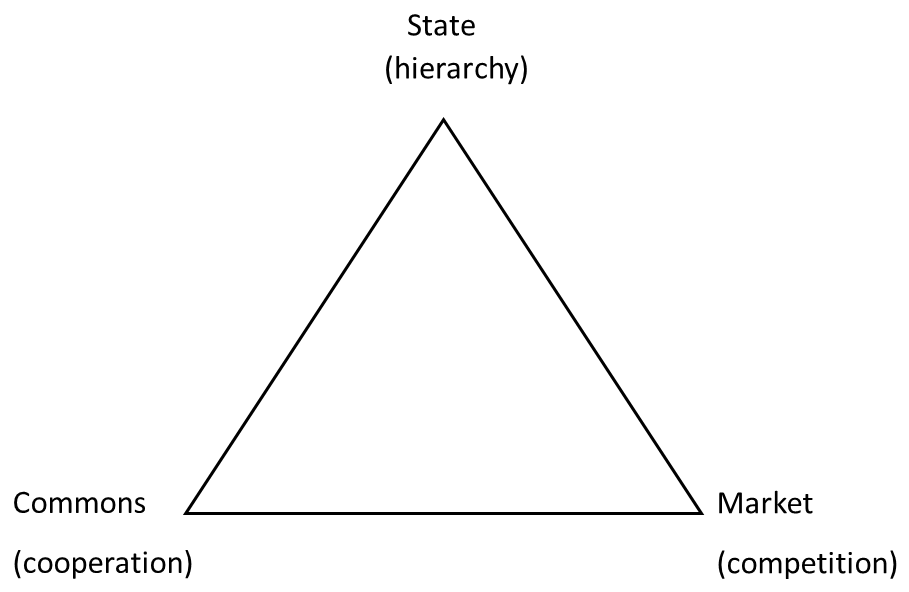
Figure 1
A triadic relation between state, market and commons.
Thinking about commons, state and market in such a triadic relationship rest on the understanding that these spheres are not stable entities with clear demarcations, but rather shifting formations whose relations are continuously negotiated across time and space. Each embodies a core of ideas, values and rationalities, while the outer layers may be changed and rearticulated trough discourse and practice (Hammer, 2020). Struggles over the “right” balance between these three is not new, and in Norway it has been a persistent point of contestation throughout the process of modernization (Slagstad 2001), which resurface today in ongoing debates on the governance of RE.
Commons and RE-research
The research applying the concept of the commons to RE reflects the broader commons literature. These include a focus on the institutional design of collective governance of energy production, distribution, and use, as well as the broader social and political implications of the notion of commons within the energy sector (Bauwens et al., 2024, Diaz Valdivia, 2023). Although commons theory is also used within the RE field to posit an alternative beyond market and state, there is also support for the idea that commons-inspired governance solutions can take various forms (Bauwens et al., 2024, Wade & Ellis, 2022). Accordingly, the commons literature in RE has addressed both direct citizen control and ownership of energy resources, while some have also shown interest in the idea of commons in connection with a strengthened role for public authorities, combined with greater democratic participation (Becker et al. 2017). For example, Varo et al. (2023) examine energy, water, and housing commons in Barcelona, and argue that the purpose of the commons is “to renew the relationship between institutions and organized citizenry,” as well as to “re-articulate the public through the commons” (p. 13). Similarly, Wade and Ellis (2022) use the concept of socialized wind rights, emphasizing the need to view wind in RE as a commons resource. They further argue that energy transition strategies must account for the cultural, historical and institutional particularities of each context. In societies with greater acceptance of state involvement, increased public influence may also serve to secure a broader communal interest, whereas other contexts may call for collective self-governance approaches.
Methodology
The paper contributes to debates on energy commons and the relationship to the state and market by examining Norwegian energy governance history as an empirical case of how a particular understanding of the commons has been operationalized in practice. Norwegian energy history, and how it relates to ideas of commons, is thus treated as a single case study where its uniqueness and shifts over time is explored in depth (Yin 2014).
As the article is intended as a contribution to a conceptual debate, it places less emphasis on presenting new empirical material. The analysis rather draws on existing research literature describing the history of Norwegian hydro and wind power, combined with the reading of government white and green papers. Norwegian energy history is well documented in several research and policy publications, which frequently refer to natural resources and energy as shared, most commonly through the term “fellesressurs”. This concept is prevalent in several energy governance documents, where it is used to frame natural resources and energy as shared and belonging to society, that is, as a national commons (e.g. NOU 2004: 26, pp. 14, 123–124, Meld. St. 28 2019–2020, p. 76, NOU 2023: 3 p. 14). Still, when Norwegian energy history is interpreted through the lens of current (energy) commons research, it is within a new interpretive framework.
Additionally, the study draws on ten interviews conducted with representatives from the Norwegian Water Resources and Energy Directorate (NVE), the authority responsible for processing energy licenses in Norway. The representatives held different positions within the organization but had been involved in wind power licensing in different capacities. Two additional interviews were conducted with representatives of civil society organizations that have voiced critical perspectives on wind power development. All the interviews addressed topics such as wind energy conflict, energy resource ownership and rights, community involvement, and perceived needs for policy change. The interview material has been instrumental in shaping the analytical orientation of the paper but is used only to a limited extent in the empirical analysis. Instances where interview data are cited directly, are referred to as personal communication.
From theory to practice: Norwegian energy Commons within and beyond the State and Market
This section outlines the main trajectories of Norwegian energy policy. It shows how the balance shifts between the logic of commons, the state, and the market over time. Also, it demonstrates that understanding and governing commons are historically and contextually situated, and in a Norwegian context, a normative construct that shaped governance practices. For much of the twentieth century, hydropower was understood and managed as a shared resource, institutionalized within a governmental logic where state and municipal control, responsibility and ownership coexisted. Although public ownership largely persisted after the liberalization (i.e. creation) of the energy market, this model has been challenged, shifting the balance within the triadic relation away from state and commons towards a market logic. This is particularly evident in the development of wind power, where tensions between understandings of energy resources as shared, expectations for democratically anchored decision-making, local economic benefits and a prevailing marked liberal energy regime, are being brough to the surface. This section starts with the emergence of hydroelectricity in its early phase and continues with a description of recent wind power.
Market and the local state
When the generation of hydroelectricity became possible in Norway in the late 1800s, property rights to water resources was private (NOU 2004: 26). Ownership to water resources was attached to land ownership, and the landowners whose property bordered a body of water thereby also held the corresponding rights to the part of the river, stream, or lake bordering their land. These rights included the right to exploit the water for industrial purposes. Before hydroelectric power, the water rights had not been significantly valuable as waterways were numerous, small, and geographically dispersed (Faugli, 2020). Norway (and the other Nordic countries) differed in this regard from European countries, where the state, as a representative of the public, was regarded as the owner of waterways (NOU 2004: 26). Correspondingly, the first use of hydroelectricity was by private companies. With few exceptions, early production and use of electricity was tied to small-scale private industrial enterprises generating electricity for internal lighting (Faugli, 2020). By 1885, however, electricity supply had extended beyond internal use as the first privately owned hydroelectric plant began delivering electricity to subscribers (Faugli, 2020). Thus, from its very inception, electricity in Norway was a private resource and a commodity on the market (Thue, 1996). Still, the early phase was characterized by small industrials companies mainly utilizing electricity for its own purposes, with limited distribution.
Soon, however, municipalities began producing and distributing electricity. The first municipal power plant was established in 1891 initially for street lighting, later expanding to serve subscribers (Faugli, 2020). Many municipalities began acquiring waterfalls and producing and distributing electricity through municipally owned production and transmission that supplied electricity to nearby communities (Faugli, 2020). Municipalities subsequently assumed varying degrees of responsibility, as electricity producers and distributors, making electricity supply in the early phase partly private and partly public (Thue, 1996). In some rural areas of Norway private cooperatives were also established, however this form of ownership and operation never reached the scale or significance in the electrification process as seen in countries like Denmark and Sweden (Rinde, 2001). This can be linked to the role that municipalities filled as providers of electricity to the public at an early stage of electrification. The decentralized and local embeddedness of consumption and use associated with the commons (Shiva 2006) was thus operationalized through municipal provision, rather than citizens self-organization.
Different explanations have been identified for what has been referred to as the municipal “conquest of electricity supply” (Skjold, 2015). First, the emergence of electricity coincided with the period of municipal institution-building, when municipalities increasingly assumed responsibilities for providing social goods. A key motivation for municipal engagement was to secure electricity for small local industries and households. General provision was early regarded as a public responsibility (Skjold, 2015). Second, abundant waterfalls gave most municipalities the opportunity to produce electricity from a local resource, a distinctive Norwegian feature. Third, during and after World War I, greater access to capital enabled municipalities to finance hydropower development through loans (Skjold, 2015). Fourth, as will be discussed in the next section, the central government supported municipal involvement through legislation.
In sum, the early electrification in Norway was characterized by isolated local monopolies where both municipalities and private companies owned production and distribution (Rinde, 2001). As a recent government report notes: “Local authorities and industry found their own solutions in the early phase of the country’s electrification” (NOU 2023: 3, p. 37). Public development relied on private loan capital, and supplying small industries was an important part of the political rationale (Skjold, 2015; Thue, 1996), showing that the social dimension co-existed and was not independent of a capitalist market logic. Almost in parallel with electricity’s emergence as a commodity, it came to be regarded as a public good, an idea institutionally expressed through early municipal involvement. As hydropower expanded and electricity increasingly could serve industrial purposes on a larger scale, the central state became more involved in shaping the electricity sector.
The entering of the central state
As technology advanced and electricity could be used on a larger scale, Norwegian water resources became attractive for both national and international market actors (Thue, 1996). Around the turn of the century private interests backed by foreign and Norwegian capital began purchasing waterfall rights (Faugli, 2020), leading to a significant expansion of hydropower by private industrial companies (Thue, 1996). By 1906, about 75 percent of developed waterfalls were owned by foreign companies (Faugli, 2020). This entry of large-scale industry triggered fundamental debates concerning access to and ownership of Norway’s hydropower resources. Questions about natural resource ownership, including waterfalls, became subject to extensive parliamentary debates for several years (Slagstad, 2001). These debates culminated in konsesjonslovene (The Concession Laws), enacted between 1906 and 1917, which regulated the electricity market and hydropower ownership to secure state control over this natural resource (Løding, 2017).
The legislation introduced konsesjonsplikt (concession requirement) and hjemfallsrett (right of reversion). Under this framework private acquisition of waterfalls required state authorization, which was granted for a limited period, typically 60 to 80 years, after which ownership of the waterfall and the infrastructure was reverted to the state without compensation (Skjold, 2015). Private producers were also required to provide konsesjonskraft; where a designated share of the generated electricity were to be distributed to the host municipality (Bryndhildsen & Næss, 1992). Combined, these mechanisms secured state control while at the same time creating a distributive link between hydropower and local communities. This legal framework allowed hydropower to be developed with private and foreign capital, while preserving state oversight and ultimately securing state ownership (NOU 2004: 26). Furthermore, municipalities gained an advantage vis-av-vis private firms since konsesjonsplikt applied only to private actors and not to the municipality (Skjold, 2015). Until the 1920s, the central state’s main role in the electricity sector was to support and facilitate municipal engagement (Skjold, 2015).
This created a dual structure in the electricity sector: municipal ownership aimed at ensuring local general supply, referred to as kraftkommunalisme (power municipalism) (Skjold, 2015; Thue, 1996), alongside private entities producing electricity under regulations to serve large scale industry. After World War II, the state assumed a more direct role as developer and producer, and industry came to be supplied mainly by state owned facilities rather than private ones (Skjold & Thue, 2007). Public authorities at the central and local level thus gained control over most electricity production, slowly reducing the role of the private sector (Thue, 1996). Today, hydropower still accounts for about 90 percent of Norway’s electricity, of which 88 percent is publicly owned: 41 percent by the state, 42 percent by municipalities, and 4 percent by counties (NVE 2025).
Like current energy commons perspectives, this governance regime was rooted in a critique of capitalism and its associated free market approach. The concession laws became a tool for protecting public interest against private capital, ensuring that natural resources like hydropower were managed according to societal needs rather than individual profit (Slagstad, 2001). Central to this critique was the belief that private property rights were not absolute or “sacred”, but should be subject to the “tribunal of public good” (Slagstad, 2001, pp. 73, 526). This resulted in a “significant modification of private property rights”, as the right of reversion is a strong example of (NOU 2004: 26, p. 47). Through Parliamentary debates the idea of ground rent was also advanced, referring to the notion that the surplus value generated by nature itself beyond labor and capital inputs was considered part of a national commons (Fuglestad & Almås, 2021). Importantly, much like the notion of commons more broadly, ground rent is not simply a techno-economic issue, but rest on a normative argument that natural resources should be shared, an idea that gained influence through political struggles. These ideas and subsequent laws, institutionalized hydropower as a common resource (Fuglestad & Almås, 2021; Thue, 1996). Combined with municipalities taking a central role as owner and operator, it fostered a decentralized model of public electricity supply (Rinde, 2001), thus embedding a specific form of commons logic within a governmental logic.
The concession laws marked a fundamental break with the liberal governance system that had prevailed until then. Within a decade, the legislation transformed the character of hydropower from an unregulated and tradable commodity into one of society’s most heavily regulated economic assets (Skjold, 2015). This shift ushered in what has been described as a new form of democratic capitalism or “a capitalism morally refined by society” (Slagstad, 2001, p. 529). Yet, it remained capitalism, with industrial demand for electricity always being a central concern (Bryndhildsen & Næss, 1992). From this perspective, a commons logic was intertwined with state and market logics. I.e. the governance regime was grounded in a normative notion of hydro resources and electricity as a common good, though different from collective self-governance. However, this specific communitarian approach was diluted through liberalization policies in the 1990s, marking a shift away from commons orientation toward market enclosure of the commons (Clausen & Cruickshank 2023).
The market turn
From the 1970s onward, the global rise of neoliberal ideology has broadly shifted policies toward privatization and marketization (Harvey 2005), which also have influenced the Norwegian political landscape (Innset 2020). Through the Energy Act (introduced in 1990) the electricity sector underwent market reform. By creating a market for the production and trade of electricity, the aim was to ensure a more economically efficient allocation in production and consumption (Ot.Prp Nr 43, 1990). A distinction was drawn between monopoly and competitive segments of the sector; the electricity grid remained a monopoly, while production and retail was open to competition. The reform also promoted larger entities to enable more cost-effective operations and to harmonize electricity prices, which had varied across regions (NOU 2023: 3; Ot.Prp Nr 43, 1990). The reform represented a transformation of electricity from public provision to a commodity. Municipal and state energy production, once tasked with supplying cheap electricity to industry and communities, were now mandated to operate as profit-maximizing enterprises (Thue, 1996). It shifted the rationale of hydropower from provision and as a symbol of local, regional, and national collective interests, to a market-based commercial activity (Claes & Vik, 2011; Thue, 1996). The economic discourse of socioeconomic profitability thus reframed electricity from infrastructure to business.
It has been pointed out that the reform was not driven by pressure from the sector, interest groups or popular demand (Claes & Vik, 2011). On the contrary, public debate on the reform was limited. Thue (1996) notes that the reform was shaped partly by the “the play of chance” (p. 89). Still, certain structural challenges were raised in the policy discourse at the time, particularly the prevalence of numerous small-scale production and distribution units, which was framed as a systemic weakness, hindering economic efficiency (Ot.Prp Nr 43, 1990; Thue, 1996). This was not necessarily viewed as a problem within an understanding of electricity as a public good and instrument for regional development and industrial policy. It did, however, conflict with the economic logic gaining influence in the energy sector in the years leading up to the reform. Indeed, Thue (1996) traces the reform initiative to the community of economists within the Ministry of Finance and the broader discursive change in society, which fostered gradual acceptance of market reform (p. 91). The preparatory documents similarly note a shift in attitudes in the direction of greater acceptance for deregulation and competition (Ot.Prp Nr 43, 1990, p. 6). A crucial point here is that the question of ownership was not on the agenda when the Energy Act was adopted (NOU 2023: 3). Public ownership of hydropower largely remained intact. What changed was the prevailing logic of electricity: from a provision model based on self-cost principles to a financial instrument for the state and municipalities, where the main objective of public ownership became economic return (Løding, 2020). Public authorities, including municipalities, thus operate as financial actors on par with private industry, in contrast to the normative ideals associated with the notion of commons.
Still, scholars have argued that pre-neoliberal institutional logics continued to shape the energy sector in the years following the reform (Midttun 1996; Inderberg 2011). As Inderberg (2011, p. 313) notes, an “inheritance of social responsibility” persisted as a normative ideal but was gradually displaced by an economic logic that prioritized cost efficiency and revenue generation, while broader societal concerns were relocated to the central state in its regulatory role (Inderberg 2011, p. 314). Similarly, in line with Harvey’s (2005) account of the neoliberal regulatory state, Thue (1996, p. 163), notes that this process entailed a shift in the center of gravity of public governance, away from the local level (associated with a commons logic) toward state-level governing at a distance, thereby increasing the need for central regulation.
The reform also aimed to consolidate utilities into larger organizational entities, a process that continues today (NRK, 2022). While municipal ownership remains, ongoing consolidations dilute the local commons dimension by increasing the distance between owners and users, and production and consumption. This means that the balance within the triad shifted towards the market, although without replacing the communal dimensions secured through continued state and municipal ownership of hydropower as well as ground rent and other forms of special taxation. Notably, this institutional legacy did not guide decisions in the next phase of Norwegian energy history. In the implementation of wind power, the balance had further shifted towards a market logic, a trajectory that also characterizes the current governance regime of utility-scale solar power, where commons like qualities have yet to emerge.
Resisting Renewable energy
As a result of climate transition, demand for electricity is expected to rise (NOU 2023: 3) and particularly wind power is seen as a central part of this process. Wind power has a relatively brief history in Norway, over the past decade, it has non the less accounted for the majority of new generation capacity (Inderberg, 2020). Today, 65 onshore wind farms accounts for approximately 10 percent of Norwegian electricity production, making wind the second largest electricity source after hydropower (NVE 2025).
Wind power emerged through a market approach, which has affected how it has been perceived and contested. The procedure for development marks a shift from the institutional legacy of public governance. Hence, the process usually started with a developer initiating contact with local landowners, after which a private lease agreement was established between the parties. Engagement between the developer and the municipality usually occurred only after such an agreement had been made (Inderberg 2020), thereby reducing the role of the municipalities in the planning process. Although scholars have noted that municipalities have exercised a form of informal veto-power over development decisions, the formal decision-making authority was from 2008 placed at the central Norwegian Energy Directorate (Inderberg et al. 2019). In several cases the municipal attitudes towards wind power project shifted over the course of the planning process, generating conflict between local and central authorities, as well as between authorities and the members of the public (Interview with senior staff member in NVE). This centralized planning regime was moreover in contrast to the otherwise decentralized decision-making authority that municipalities have over planning and land use decision, which gave rise to perceptions that local democracy had been sidelined in the process. Importantly the model of private (often foreign ownership) was in stark contrast to the decentralized municipal ownership regime seen in hydropower, where municipalities and their residents were used to substantial economic benefits accrued locally from both ownership and taxation (Eikeland et al. 2023). Further, the underlying norm of nature resources belonging to the whole of society, forms an important background for understanding wind power controversies in Norway (Saglie et al. 2020). As one informant representing an NGO argues “at least hydropower is owned by the municipality, and thus “owned by me as a citizen” (Personal communication). The lack of local democratic processes and distributive links between wind energy and local community development is widely acknowledged as part of the driving force for opposition to wind power, including by the regulatory authority itself, stating that “part of the wind power debate has been shaped by the fact that we have been accustomed to hydropower in Norway, from which municipalities receive substantial revenues” (Personal communication).
Considerable opposition to wind power gradually emerged in Norway, initially through local protest, that later mobilized into a nationwide movement and as a result, onshore wind power entered a crisis of legitimacy (Vasstrøm & Lysgård, 2024). Citizens voiced skepticism for multiple reasons, including concerns of nature impacts. This led to a complete halt in licensing processes in 2019, pending reform aimed at ensuring stronger local and regional grounding (Meld. St. 28). At the time, however, questions about ownership and sector specific taxation on wind power were not on the government agenda. A white paper at the time stated that it was no need to require that wind power should be owned or controlled by any specific type of actor (Meld. St. 28, p. 79), nor was it inclined to implement ground rent taxation, due to low profitability in wind power and the need to maintain a predictable framework condition for the wind industry (p. 76). Such statements found in official documents further exemplify how the balance had shifted towards a market logic. This stance, however, was challenged following a parliamentary election in 2021, after which a labor led government implemented a production tax on wind power allocated to host municipalities and later ground rent tax, allocated to the state (Ministry of Finance, 2023). This shows how a commons discourse again was invoked, when the Prime Minister stated in a press briefing: “it is still about our natural resources and how we manage them, and about how we ensure that income from our common natural resources benefits the community and is distributed fairly” (Støre 2022, para 4, own translation). Although far from being a revolutionary departure from a prevailing market logic this development suggests a rebalancing of governance towards a commons logic as these tax instruments “reflect the fact that the electricity sector harvest from our common resource and therefore must contribute to the community” (NOU: 2023: 3, p. 14, own translation), and further are “based on theprinciple that the community should receive a share of the benefits derived from the use of a common resource” (Meld St. 28 2019–2020, p. 76, own translation). This underlying principle is visible in government reports and white papers making inquiry into the topic of energy, as the examples above illustrates While the terminology used in the Norwegian discourse does not always easily translate into the theoretical framings of energy commons as collective self-governance beyond state and market, the underlying normative rationale of the historic energy regime as well as more recent policy change remains that of a commons-oriented approach.
Both in discourse and practice, links between energy and a broader social rationale situate energy governance within a historically rooted compromise between commons, state, and market. One that continues to shape policy, and legitimacy claims in contemporary energy debates. The way wind power policy evolved during the years of rapid expansion was, however, far from being guided by a commons-inspired approach. Few issues in recent Norwegian politics have generated such pronounced conflict, revealing how a market-dominated approach failed to provide a legitimate foundation for wind power. Interestingly, calls for collective self-organization through various forms of energy communities were largely absent from the debate. Instead, demands for increased national control, political steering of the sector, and public ownership is among the opinions being expressed by political parties and interest groups (Interview with civil society organizations, 2024; Marsdal & Rambøl, 2022). These perspectives often share a critique of the current market liberal regime yet tend to favor a return of the state over autonomous collective self-governance approaches. The arguments voiced in public debate resonate with Norway’s institutional legacy of commons within the state showing how values associated with the notion of the commons may influence discourse and practices.
Discussion
A different energy commons
The Norwegian energy history shows that the commons as a normative idea has contributed to shaping energy policy from an early stage and still continues to influence discourse and practice related to energy politics. This approach to energy governance has rested on an understanding that the community (fellesskapet) is “the rightful owner of the waterfalls and the values it creates” (NOU 2004, p. 222). It thereby exemplifies a situation where waterfalls (later also other natural resources) are defined as a commons and in which a practice was developed where the commons was publicly governed. This notion of the commons seen in a Norwegian context was expressed through governance mechanisms such as concession requirements, public ownership, reversion rights, concessionary power, ground rent (to the state), and natural resource taxation (to municipalities) (NOU 2019:16). These mechanisms can be understood as commons-oriented governance mechanisms, institutionalized “within the state” (Angel, 2017). Historically it has functioned to limit the sphere of a free market approach (Slagstad, 2001). The normative perception of natural resources as a commons and the associated governance mechanisms, later also inspired the management of Norway’s oil and gas resources (Midttun et al. 2003). Over time, however, this governance regime has been challenged by the market reform that represents a shift in the balance from a commons within the state, toward the market. This became particularly visible in relation to the controversies surrounding wind power expansion.
The Norwegian governance of hydro resources also exemplifies the existence of energy commons at different scales, with hydropower articulated and governed as a national shared resource, which at the same time included a strong local imprint through municipal ownership and distribution. This reflects a normative grounded view of natural resources as shared and governed collectively and democratically, through both the state and municipalities, rather than private ownership (Fuglestad & Almås, 2021). By contrast, the governance of commons through practices of self-governance beyond the state and market, has played a limited part in this history of Norwegian energy commons.
The understanding of hydropower as a national commons emerged through critique, but not rejection of capitalism. Principled debate about how hydro resources were rightfully held in common, and a belief in the need to counterweigh a free market approach, ended up in a public governance regime. This has later been argued to constitute a compromise between a market logic and an ethical democratic justice orientation (Slagstad 2001, p. 157), which we may now associate with the emergence of political energy commons research. In recent decades, however, neoliberal impulses have shifted the balance towards the logic of the market, also in Norwegian governance, and the energy sector has not been exempted (Fuglestad & Almås, 2021; Hammer, 2020; Innset, 2020). Indeed, Norway was among the first countries in Europe to liberalize its energy system (Thue 1996), which reframed electricity as a commodity and commercial activity. Yet it did not represent a full transition to market-based governance, since the state and municipal ownership of hydropower persisted alongside other mechanisms designed to restrict a pure market approach. However, when wind power gained prominence, the balance had shifted even further in favor of the market, highlighting a sharp contrast with the historical commons-oriented governance of hydropower.
Still, the institutional arrangements that once linked energy production with democratic governance and distributive justice remained part of a collective memory. As notions of energy as a shared resource came under pressure (particularly in recent onshore wind energy developments) this contributed to fueling a countermovement. Hence, opposition to wind power has undermined the legitimacy of the prevailing market-based governance regime, but this mobilization differs from what is identified as commons movements in an international commons context. Whereas collective self-organization beyond the state and the market is here often emphasized as a defining feature. In the Norwegian context, the opposition is to a lesser extent framed as anti-capitalism. Rather, it reflects a desire to reconnect electricity with local and national economic development, and to safeguard the conditions for both households and traditional industries by ensuring continued access to low-cost electricity.
The triadic relation between commons, state and market
The history of Norwegian energy commons outlined in this article demonstrates that the three logics of state, market, and commons have coexisted within energy governance over time, although the balance between them has shifted. As both state and municipal ownership and management of energy resources came to dominate in the Norwegian energy regime, this institutional legacy continues to shape contemporary discourses and understandings of electricity as a common resource. This legacy is also important for how the concept of the commons is seen today, where market-driven enclosure of common resources generates resistance, yet initiatives for collective self-governance og energy resources remains limited. Thus, I want to advance a central argument that just as capitalism in general and modern-day neoliberalism do not always manifest as fixed manuscripts, but rather as flexible ideas open to contextual adaptation (Ban, 2016), the notion of the commons can be understood similarly. As a set of normative ideas the commons may exert influence on governance across time and space. However, whereas neoliberal ideology seeks to advance the domain of the free market, commons ideology (values of collective interest, equality, and social justice etc.) questions and challenges the advancement of free markets. We have seen this exemplified in the Norwegian context, where a commons logic influenced energy governance and where the state and municipality functioned as trustees of energy resources. Later, when the market-liberal regime guiding the RE transition came under significant criticism and lost legitimacy, it triggered a return to historically cemented understandings of electricity as a common resource, which is an observable narrative in today’s energy discourse. This led to policy changes, including the introduction of a ground rent tax on wind power (to the state) and a production tax (to the host municipalities). While this by no means represents a post-capitalistic revolution, it does acknowledge energy and the natural resources need to produce it as commons and to some extent mark a shift of the balance back towards commons principles.
Further, in this discussion, I wish to highlight two dimensions of the concept of the commons. The first concerns whether it is possible to distinguish between the normative content of the commons and the governance arrangements through which it is realized. When understood politically (as a set of normative ideas), commons perspectives assert that a governance object whether it being material or immaterial belongs to the collective. What constitutes this governance object and who makes up the collective varies by context and issue, and is shaped by culture, norms, practices, and negotiation (Haarstad et al., 2023). The second dimension concerns the commons as a distinct management regime based on collective self-governance, qualitatively different from state-based or market-based forms of governance. These two dimensions, ideas and governance, are closely linked but not necessarily inseparably bound. That is, the idea of the commons; the moral claim of something being shared, the advancement of right to access, ownership and not be excluded, can be realized through different governance mechanisms, both within and beyond the frameworks of state and market. Energy production might for example be owned and governed by a municipality, or by a group of people collectively, which also sell electricity through the grid, thus engaging in market relations. In other words, the idea of the commons can be accommodated through different institutional arrangements that may interlink with both state and market. If the discourse on the commons becomes too rigid in prescribing a singular governance form which in an energy context would be limited to the need for citizens to organize themselves and invest time and money into producing energy, there is a risk that it may remain more of an abstract academic ideal, detached from political realities.
In Norway, it was a combination of the central state and local government that upheld collective interests and acted as a counterweight to the dominance of the market. The underlying justifications for this mode of governance were a normative understanding of water resources and energy as shared. This development further took place within a capitalist system, meaning that the commons logic was, in practice, intertwined with both the state and the market. It was never a matter of either one or the other; rather, they existed integrated. Taken together, this produced a more socially oriented form of capitalism than the laissez-faire liberalism of the time when this regime emerged. Using Norwegian hydropower and wind power as examples thereby illustrates that the state (including municipalities) is an institutional form in which commons principles can be realized. Thus, a sharp demarcation of the commons as collective self-governance outside the state and the market, does not adequately capture the Norwegian experience. Additionally, anchored in Cumbers (2012, p. 7) the argument is here made that collective governance trough the state similarly to collective self-governance outside the state, can constitute a viable form of collectivism suited to “reclaiming economic space from capitalist social relations”.
Thus, the idea of the commons can serve as a productive entry point for challenging dominant hegemonic approaches to energy governance, without necessitating a bottom-up revolution which to be fair does not appear imminent in the Norwegian context. An open and pragmatic approach to the concept of commons within the energy governance may foster policy learning, institutional innovation, and policy solutions that may accommodate communal aspects of energy production, distribution and use more effectively (Goldthau, 2014). This conclusion draws on the Norwegian case, where resistance and activism against market-driven wind power development have been significant yet have not led to a popular “rush” toward establishing energy cooperatives or taking matters into citizens’ own hands.
In commons literature there is a tension between autonomous approaches with a distinct anti-state position, and those who represent a more pragmatic view that would allow for interplay between public and private modes of provision (De jong 2021, p. 775). The latter would entail allowing involvement from the state in managing the commons, and perhaps even allowing for linkages between energy commons and market governance to be made. Despite such tensions, different positions tend to share a normative point of departure where resources are seen as shared, and where continued commodification and the expansion of the market into new domains, including the energy sector, are critiqued. Thus, commons thinking represents a counterweight against this, aiming for a more democratic, locally anchored and justice-aware distribution of societal goods. In the energy commons literature, the governance mechanism to realize this is often, (not always) related to resource users’ self-governance, for example through cooperatives and energy communities. The limited presence of energy communities or cooperative forms of energy production in Norway (Standal et al. 2023) as well as a lack of visible bottom-up activism promoting such organizational forms supports this claim. This can be seen as a paradox, as civil society in general is characterized as vibrant with high levels of organizational membership and voluntarism (Selle et al. 2019). The organized opposition to wind power, which currently counts 23 000 members, is an example of that. While we should remain sensitive to the state’s potential co-optation of grassroots movements and self-organizing processes (Villamayor-Tomas & García-López, 2021), it is equally important to recognize the distinction between Norwegian social-liberal and social-democratic traditions, in which the state (including municipalities) has historically been deeply involved in the economy and social life, and Anglo-American liberal traditions. We should also be mindful that the language of emancipation from state and market carries a risk of placing the responsibility for the energy transition and distributive justice onto civil society itself and thereby legitimizing the withdrawal of the state. As noted by Taylor (2019), we should be cautious about placing the heavy burden of energy transition on communities and individuals. Thus, there is little reason to assume that the state has outlived its role just yet. On the contrary, it may well be time to reclaim it.
Conclusion
The idea of the commons is increasingly employed as a conceptual framework in energy-society research with a distinct political orientation, emphasizing social rights, inclusion, cooperation and active citizens involvement in the governance of energy (Bauwens et al. 2024). By revisiting Norwegian energy history in the context of hydroelectricity and, more recently, wind energy, this article has explored how the idea of the commons has been translated into and operationalized within Norwegian energy discourse and governance practice. The empirics have shown that waterfall resources used in the production of electricity, from an early point in the history of electricity, came to be defined as a commons resource (later this idea was also expanded to the understanding of other natural resources (such as petroleum). Further, this normative idea of energy as commons was operationalized through various governance mechanisms, which included direct central and local ownership and control of the energy resources, rights of reversion, and ground rent taxation as central components. The aim of these governance mechanisms was to ensure general access to electricity, national and local resource control, and that host communities benefited socially and economically from resource use (Skjold 2015, Thue 1996). Furhter, through political deliberations, the commons were constructed as a normative idea and institutionalized through the central state and local state, thus establishing the state as an enabler of the commons. Combined, these mechanisms provided a moderating force and counterbalance to the free market.
Later this regime was challenged, first through the liberalization and commodification of electricity, and more recently the dominance of private ownership to wind power, signaling a partial departure from the historical legacy of direct state and municipal involvement and ownership in energy developments. The center of gravity had thus shifted further from a commons logic towards a market logic, contributing to tensions and contestation in current RE governance discourse. Hence, the political idea of energy commons and its associated institutional legacy is still observable and shapes current energy discourse and practice. Recent changes in onshore wind energy, where ground rent and production tax have been implemented, exemplify this. I have argued that such governance mechanisms can be seen as a rebalance from a pure market logic towards a commons logic. In addition, it illustrates that in practice neither the commons, the state or the market are always a matter of absolutes, but rather they exist with different weights and changing relations vis-a-vis each other.
Following from this, the article has illustrated that the notion of the commons is expressed through a distinct “local flavor”. Therefore, the article argues that the idea of the commons should remain open for interpretation into different institutional and cultural contexts. An approach that includes an openness to a variety of governance solutions that sets out to reclaim values of public interest, equality and social justice (Haarstad et al., 2023). Such an approach creates space for also viewing the idea of commons more broadly than within a specific institutional regime where collective self-governance beyond/outside state and market is the defining characteristic. Through this framing, this article has sought to broaden the scope of how commons can be understood as well as to bring the concept of commons into dialogue with state and market-based modes of governance. Still, this operationalization of the commons may contain some limitations. In Norway it reflects a tendency to “look to the state” for solving societal challenges, which may dampen more direct citizen engagement in the energy transition – for example through various forms of self-organized energy commons. Meanwhile, attention to decentralized and small-scale energy production has increasingly entered the agenda in Norway in the wake of the legitimacy crisis surrounding wind power. Going forward there will be a need for research on the balance between state involvement, active citizen participation and (dis)connection to the market in the RE transition. Such research should also address questions of inclusion and exclusion regarding self-governance.
Acknowledgements
The author gratefully acknowledges comments of the two anonymous reviewers.