
Introduction
The concept of “commons” pioneered by Ostrom scholarship has been influential in understanding diverse property relations among communities that resemble neither the state nor the market. Commons refers to “a natural or man-made resource system that is sufficiently large as to make it costly (but not impossible) to exclude potential beneficiaries from obtaining the benefits from its use” (Ostrom, 1990:30). Two significant attributes are – excludability which refers to possibility of devising ways to exclude individual from the benefit and subtractability that refers to benefit consumed by one subtract its availability to others (Ostrom, Gardner and Walker, 1994:6; Ostrom, 2005:23; Anderies and Jenssen, 2013:43). Mechanism of exclusion and subtraction are structured by institutions considered legitimate by the society. In this regard, tribes rely on self-governing traditional institutions that govern the society and resources through customary practices which in commons literature imply “procedural rules or working rules, framed by those directly involved” (Ostrom, 1990; Anderies & Janssen, 2013). Therefore, they are seen as whole society each with its own language, territory, culture, customs and so on (Xaxa, 2008) “with all intra group regulation in the hands of the council of group leaders” (Gadgil and Guha, 1992:81).
The context of commoning varies across societies and change overtime due to internal or external factors. This depends on the underlying circumstances of property and access which determine resource utilisation, distribution and benefit sharing mechanism. Property relations among post-colonial societies exhibited plural legal culture due to the imposition of state legal system within the existing customary practices. Consequently, “some people have de jure rights to property, others have de facto rights unrecognised by the state” (Ellickson, 1991). Ribot and Peluso defined property as “the right to benefit from things”, while access as “the ability to benefit from things” (2003:153). Both are sanctioned by institutions (state or traditional) and legitimised by law or custom. They identify two mechanism of access viz. rights based and structural or relational from which some people benefit from resources without property rights (2003:162–164). However, negotiating such claims produces a “grey zone” between what people have right to and what they merely have access to (Sikor and Lund, 2009:16). Departing from the grey zone, Garcia and Dijk (2019) advances a theory of “claim making” arguing that, through three practices viz. grounding claims, talking claims and representing claims there is a possibility of translating access into property or vice-versa. Property and access are therefore evolving and not fixed entities but maintained through the constant negotiation of claims (Garcia and Dijk, 2019:168) where “actors employ their skills and power to creatively negotiate rules and structures to optimize their benefits” (Milgroom, et al., 2014). It is riddled with questions of power where the rules and norms change in response to both social and ecological processes (Agrawal and Gibson, 1999; Berry, 1989). Among the tribes under traditional regime de facto practices are significant (Beck, 1994; Menon and Vadivelu, 2006) where claims are conditioned by place of residence and descent (Moor, 2015:89). The earlier is linked to territoriality that influence, effect, or control objects, people, and relationships over a geographic area (Sack, 1983:56) and the latter to collective identity that ushered shared meanings and conditioned the means of inclusion and exclusion from access (Ashmore, et al., 2004; Mosimane, et al., 2012:346). These elements patterned the resource systems and utilisation to avoid “illegal access” (Ribot and Peluso, 2003) and random exploitation of the resources.
Another critical dimension in studying tribal commons is the impact of the market that introduced new arena for negotiating claims. Several works among the highland communities in Meghalaya (Karlsson, 2011), Nagaland (Wouters, 2020), Indonesia (Li, 2014) and New Zealand (Rata, 1999) delineated how neoliberal capitalist relations evolve through commoditisation and privatisation, reshaping relationship between tribes and their resources. Capitalist relations play into the pre-existing inequalities and social hierarchies (Wouters, 2020:11) through the “erosion of noncommoditised relations” (Li, 2014:116). This often resulted in consolidating private rights rather than expanding collective rights. Similarly, trade process in this case concretises the chief property right thereby limiting villagers’ access claims. Therefore, this paper illustrates how access claims on commons are negotiated and compromised through a reverse process of appropriation of property right.
In Manipur, “both the colonial and post-colonial states assumed that formal law and rights prevail in the valley, while customary law and claims prevail in the hills” (Haokip, 2021:24). However, the expanding state and market domination has raised critical questions on tribal land and forest governance. There has been continuous attempt to extend the Manipur Land Revenue and Land Reforms Act, 1960 (MLR&LR-1960) to the hill areas with the most recent being the seventh amendment bill introduced in the state assembly in 2015. Another is the ‘forest enclosure’ through ‘reserved forest’, ‘protected forest’ or ‘wild-life sanctuaries’ under the Indian Forest Act, 1927 and its subsequent amendments. These attempts were aimed to legally consolidate land and forest into private, public and state property. It is a “complicated phenomenon and sometimes it may be contested” as it often assumed imposition of pre-determined rigid categories rather than accommodating existential differences (Acheson and Acheson, 2010:553). For instance, the eviction of K. Songjang village on 20th February, 2023 which was alleged to be encroacher of the Churachandpur-Khoupum protected forest in Churachandpur district resulted in resistance from the tribes. Haokip (2024:38) argues that, “apart from the historical injustice of evicting them from their habitat, they were not even given any form of restorative justice that is needed.” The dichotomy emerged from a disjunction between de jure legal recognition and de facto customary practices. Similarly, the market engulfed by neoliberal ideologies introduced new consciousness through commoditisation and privatisation. As Broegaard (2009:151) pointed out, the market proposal for resource allocation is not anti-state, but rather land titling and credit facilities coheres in an attempt to redistribute landed resources in developing nations. The neglect of customary rights triggered anxiety for fear of dispossession and deprivation. Therefore, analysis of the customary practices is essential to understand the nature of resource extraction and benefit sharing amidst state and market initiative for resource redistribution.
This paper explores the unique traditional land and forest commons among the Kukis where commoning is based on ‘access rights’ rather than collective ownership. Entrenched in custom, the commons situation is manifested through chief ownership and villagers access rights (Kipgen, 2018; Gangte, 2012). The Kukis refers to a conglomeration of different cognate tribes having social, culture and linguistic affinity (Gangte, 2012; Haokip, 2010). Their territory disperses across the hills of Northeast India, Northwest Myanmar and the Chittagong hill tracts of Bangladesh. In Manipur, they lived in the hills surrounding the Imphal valley, with concentration on the southern hills (Shaw, 1929:11; McCulloch, 1859; Pemberton, 1835:14–16). Their social, economic and political lives are organised around the traditional institution of chieftainship (Gangte, 2012; Haokip, 2009). The intertwined conception of land, identity and customary practices reflects what Sitlhou (2015a) termed as a “geographical and cultural territory” which further characterise their distinctive property relations and governance mechanisms.
The paper examines key dimensions that shape the commons situation such as ownership system, institutional arrangements, governance mechanisms, resource systems, access rights, and the market effect, demonstrating the circumstance under which commons evolve, persist or change. The first section, as discussed earlier, introduced the scope of the study with relevant concepts. The second section provides the ethnographic context and the methods used. The third section examines the context of ownership and inheritance. The fourth section examines the traditional institution arrangement vis-à-vis commons governance mechanisms. The fifth section provides a typology of land and forest which produce a commons situation. The sixth section examines the different livelihood centred resource systems to discuss provisions of access rights. The seventh section analyse the market effect which resulted in diminishing of commons resources. The final section gives a concluding analysis of the paper.
Ethnographic context and Methods
This paper is based on ethnographic case study of two villages, viz. Longja and Chehlep. They are selected based on long enduring commons over a hundred years from the establishment of the village. It takes into account the high dependence on land and forest resources for livelihood, customary tenure based resource systems, traditional institutions for governance, and embedded socio-cultural practices. The village Longja is located in Chakpikarong sub-division, Chandel district and is inhabited by about 96 households. The village Chehlep is located in the Tengnoupal sub-division, Tengnoupal district and is inhabited by about 57 households. Majority of them engage in cultivation as the main source of livelihood supplemented by hunting, fishing and foraging. Few of them occasionally engage in income-generating activities such as carpentry, wage labour, grocery shop-keeping, tea stalls, production of fermented bamboo shoot and charcoal. This reflects that commons continue to be significant component of the land and forest resource base of rural communities (Jodha, 1990:A-65).
The study was conducted using interview and observation methods to collect field data. The field visit was done in two phases – in September, 2019 (an initial preliminary visit) and July to September, 2022. Interviews are semi-structured and open-ended using interview guide. This facilitates an in-depth enquiry and analysis on the theme of the study. The broad questions asked includes; what is the context of commoning land and forest (ownership, access rights, institutional functions and governance mechanism)? What are the continuity and changes? In the in-depth interviews there are thirteen participants from Chehlep and ten participants from Longja. Several important stakeholders interviewed include village council members, men, women, and youth. Moreover, observation during field visits help in acquiring knowledge on the commons situation. Interviews are recorded using a recorder which is transcribed, coded into themes, and analysed accordingly. The study is also informed by existing literatures – published and unpublished, both in English and vernacular.
Ownership and Inheritance of Land and Forest
The ownership and inheritance of land and forest among the tribes are largely seen alongside traditional authority systems and customary norms. For the Kukis, this is based on the traditional institutions of chieftainship, where the chief who is the head owns the village territory within his chiefdom (Gangte, 2012; Haokip, 2009). He “controls all landed properties such as the agriculture land, terrace land, reserve land, village land, cultivated land or wasteland and also controls the forest, mines, rivers and springs” (Haokip, 2011:46). This forms the objective basis of the authority of the chiefs (Ray, 1990:44). For the privilege of access, several tributes such as changseo (for accessing cultivable land), khotha (one day collective labour), samal (hind-leg for an animal killed in hunting), and sielkotkai (for cattle rearing) were paid to him (Shaw, 1929: 64–65; Ray, 1990). Unlike formal taxation, these customary tributes are lenient which may be exempted to the poor or during crop failure. It may also change depending on changing circumstances. For instance, at present, households cultivating rice in Chehlep village pay an annual tribute of five tin1 of paddy which was increased a couple of years ago from three tin based on agreement. While samal depends on the size of the hunted animal, khotha is no longer practice as village blacksmith no longer exist.
The mode of inheritance is gendered by custom and is based on patrimonial descent where the upa (eldest son) inherits the property. Without male descendants, the land according to custom goes to the closest male relative next in line. This is based on the idea that land should be confined within the family and not passed on to another clan (Sitlhou, 2015b:98). This deprives ownership and inheritance rights to women and the younger male siblings, especially on ancestral lands. However, this does not deprive them from its use or de-facto access rights absolutely as by custom the chief is obliged to ensure mechanisms of utility and access rights to facilitate livelihood sustenance and security within the village community. Women access however is mediated by male member of the family through the father, husband or brother (Sitlhou, 2015b:100), and moreover by being a member of the village community. This stems from systematic factors and implies what Agarwal (2001) termed as “participatory exclusion” that excludes women within seemingly participatory institution. It reflects varying degree of resource use and distribution among multiple actors (Agrawal and Gibson, 1999:637).
Traditional Institution Arrangement and Commons Governance Mechanisms
Chieftainship institution is the highest decision making body in the customary village governance. It functions through customarily embedded institutional arrangement where the chief is assisted by his council called semang-pachong (officially called village authority) and the phungkhai-upa (council of clan elders). Significant to the constitution of such a committee is the “clan or sub-clan representation” (Haokip, 2022) and from persons acquainted with customary practices. The semang-pachong comprises semang (prime minister), pachong (secretary), thiempu (Physician-cum-Priest), thihpu (blacksmith), changloi (treasurer), lom-upa (leader of youth co-operative works), and lhangsam (information secretary) (Lunkim, 2013; Ray, 1990:38). On the other hand, the phungkhai-upa is a committee constituted by elders from each clan or sub-clan. While the thiempu has specific religious function, all the others are collectively responsible for the village administration.
The institutional arrangements and means of representation may vary based on local needs and circumstances. For instance, the village administration in Chehlep is run solely by the semang-pachong, while in Longja it is run collectively by the semang-pachong and the phungkhai-upa. This variation however is superseded by the notion of clan or sub-clan representation. In Chehlep representation is maintained while electing or selecting the semang-pachong members, whereas in Longja it is retained by the phungkhai-upa. Correspondingly, the function and delegation of responsibilities vary which is explicitly reflected in the administration of land and forest. In Chehlep village, the semang-pachong allotted the homestead plot, and appoints a member as louve for jhum related activities and two members to look after the village reserved called thingchang. Whereas in Longja village, the semang-pachong in coordination with the phungkhai-upa allotted the homestead and cultivation plots, one member is appointed for the thingchang and no louve as jhumming is abandoned. Each delegation is responsible to ensure equitable access to land and forest resources, while also protecting other forest areas.
Beside the representative institutional arrangement, institutional processes such as collective decision making, rules and norms are embedded in their culture and customary ecological knowledge. Intertwined relationship between nature and culture shape their life-world or a system of cosmological belief associated with a place of dwelling and that regulates their behaviour with human and non-human organisms (Descola, 1996:82; Ignold, 2000). This culture specific knowledge Ignold (2000:25) observed is “based in feeling, consisting in the skills, sensitivities and orientations that have developed through long experience of conducting one’s life in a particular environment.” Descola (1996:87) asserted that, “the social practice is structured by a combination of rules of marriage alliance, ordering principles of the social domain by terminologies and modes of behaviour, and ideas about compatibility and incompatibility between bodily substances and between discrete elements defining the ascription and transmission of rights and identities, both collective and individual.” The customary ecological knowledge imbeds the modes of relation, identification and classification with resources. It produces a system of ‘rights and restrictions’ that guide their social conduct as individuals and as collective mediated by cultural practices, enforced and sanctioned through traditional institution. The collective knowledge facilitates negotiation and consensual based decision making and further aids in cooperation, co-ordination, rule enforcement and compliance behaviour in commons governance. For any rule violation, reasonable penalties are levied as a means of social control to avoid norm defaulting behaviour.
Land and Forest classification and the commons situation
In a typical Kuki village, the territory is broadly classified into settlement area, village reserved, jhumland and hunting ground (Guite, 2013; Haokip, 2023). Each category provides different resource systems with provisions of access rights that unfold the commons situation. In the settlement area, each family is allotted a homestead plot. This entitles them all rights and privileges over it as long as they inhabit. Moreover, they have access rights to several village commons located in the area that includes playground, church, community hall and source of water like pond, tank or hand-pump. The authority for maintenance of these commons rests with the village council.
The settlement area is surrounded partly or wholly by the village reserved called thingchang or khotu. It protects the settlement area from natural calamities such as wildfire and storm which have the potential to destroy houses and properties. Considering its significance, the village council delegated one or two members to ensure the protection. In Chehlep, the thingchang encircle the settlement area and therefore two members are appointed to oversee the eastern and the western flank accordingly. Whereas in Longja, it stretches across the hills on the western side (with paddy fields and Kana River on the eastern side) and therefore one member is assigned the responsibility.2 The members appointed are responsible to enforce rules, collective labour for cleaning the marked boundaries annually or when necessary (usually one member representation from each household), and take cognizance of norm defaulting behaviour. The thingchang reflects a regulated commons where there is partial exclusion. While access for seasonal wild fruits, vegetables, dry wood, and feeding their domesticated animals are permitted, tree felling is strictly prohibited (Haokip, 2023:22). However, in exceptional cases the village council may permit new families to access few trees for house construction.3 Rule violation, usually felling tree, is seriously dealt with although punishment is mild. If anyone, including the chief, is found guilty they are penalised. Two elders from Chehlep recalled that:
The protection of the thingchang was strict in the past as compared to the present. In the 1970s there are two incidents where the then chief and a widow are caught felling trees within the thingchang. Subsequently, they were penalised with a jar of rice beer each (locally called jubel). The penalty was aimed at conceding to their fault, reprimanding future violation and eventually instituting the importance of observing existing rules.4
Despite the reserved status, the chief pursuit of valuable timber for trade led to significant encroachment in recent years.
The next area is the cultivation area. It constitutes an important component of permanent land use where the notion of commons through undeniable access rights is located. The chief along with the council distributes the lands to each household according to the size of the family (Devi, 2006:52; Kipgen, 2018:115). This is a collective affair and the chief cannot interfere unless his intervention is solicited. Once plots are allotted, each household is entitled to rights over it as long as they are inhabitants of the village and there is continuity of cultivation. They have the right to choose the types of crops, cultivate in any season, or lease them for a certain season to others. However, these rights are terminated once they desert the village or abandon it without cultivation for several years. In such a case, the ownership is reverted back to the chief and may eventually be transferred to other requiring inhabitants.
Among the Kukis, different cultivation systems are practice according to landscape suitability such as jhumming, joulei, kanglei and paddy field. In Chehlep, jhumming is practiced for cultivation of rice and vegetable, along with joulei in few instances as a vegetable garden. Jhuming is a traditional slash and burn agriculture system where the fields are cleared, cultivated and then fallowed. It is characterised by rotation of fields rather than of crops or mobile rather than sedentary. The responsibility of jhumming related activities is entrusted to the louve who act as intermediary between the villagers and the village council demonstrating Ostrom’s “nested enterprise” (1990:101). He coordinates all matters related to jhumming; plot allotment, jhum cycle and adjudicates all problems or conflicts with the council. In fact, all issues are collectively dealt with, especially with the participation of the cultivating families. Villagers co-operate in decision making, identification of the annual jhum area, division of plots, mutual exchange of labour, and in many instances helping the widows and orphans with labour shortage.5 Moreover, in annual village meetings, besides other issues, priority is given to the annual jhum affairs. The rights of utility with collective decision making reflected the nature of commons in de facto sense.
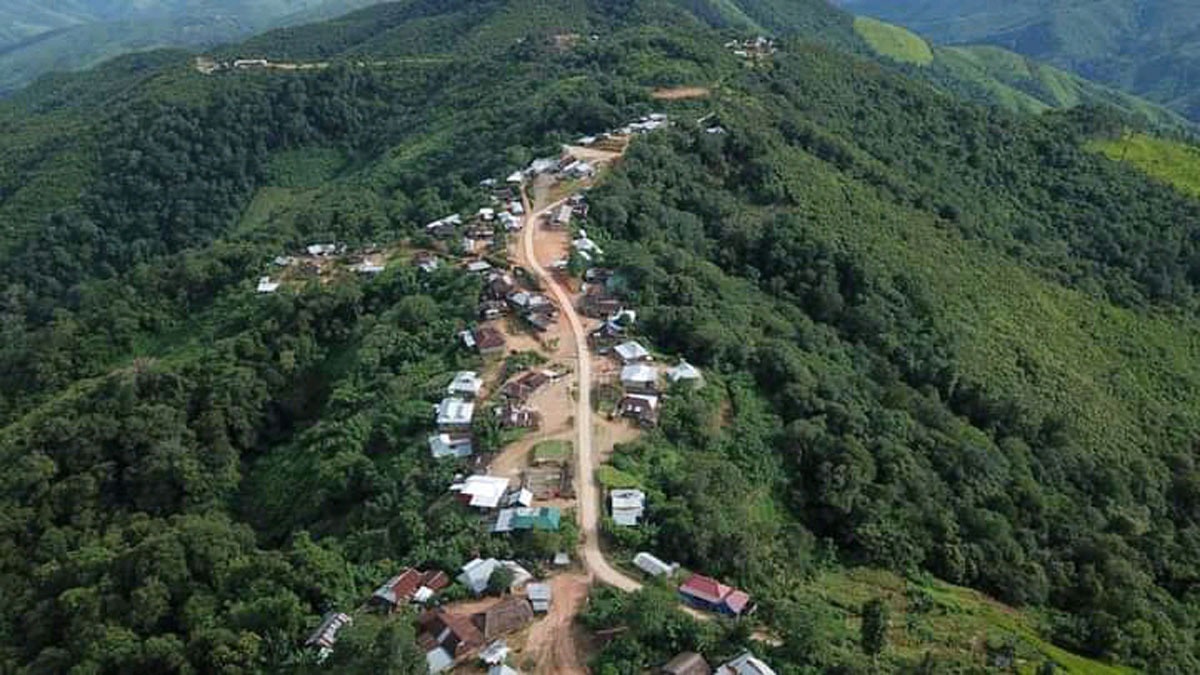
Picture 1
Chehlep village settlement surrounded by forest and jhum fields.
In Longja, they discontinue jhumming and shifted to permanent cultivation systems called kanglei and paddy field as conducive plain landscape are available in the present settlement area. The paddy field existed in few areas and is owned as individual property. This introduced commodification of land rights through informal transaction. Here, the owners identify a suitable area, inform the chief and then convert them. To secure the ownership rights, they make a one-time payment to the chief an amount of rupees one thousand and thirty to hundred tin of paddy which varies according to variation in the field size. The labour and monetary investments conferred them the permanent and hereditary ownership rights. However, if they decided to vacate or sell, they are obliged to inform the chief, where he may purchase or permit others within the village to do so. This limits extensive commercialisation or market competition on landed property by restricting transfer of land to outsiders. The limited space for expansion of the paddy field inevitably necessitates the existence of the kanglei, a cultivation system without a terrace that solely depends on rain. At present each household owns kanglei which is used for cultivation of rice and vegetables.6 In the past, there was no restriction on the plot size. However, with increasing households in recent years, distribution to new members was systematized through a lottery which is thought to be the fairest means possible for distribution. In the case of one or two households, they allotted the uncultivated available land.7 Plot size variation is not an issue as the villagers have the freedom to temporarily cultivate other available cultivable areas according to their needs. The chief delegated the responsibility to the secretary and the phungkhai-upa who coordinate all matters regarding cultivation areas.
The last category is the forest area that remains untouched and preserved to its natural habitat. It is one of the finest instances of traditional conservation system and often lies in the extreme limits of the village territory or in difficult terrain not suitable for cultivation in between. Unlike the state protected area or conservation efforts regulated by legal statutes, it is regulated by customary practice usually associated with their ecological knowledge, land use, or belief system. However, while it remains as being conserved and divorced from the main land use category, there are permissible access rights which relates to their subsistence strategy. For instance, the preservation of the natural ecosystem facilitate “wild animals and birds to flourish and from which they procured their meat” (Guite, 2013:14–15). Therefore, it serves as ideal site for hunting which is considered a valued game since the past. Access to hunting ground is entitled to all the villagers and often shared among neighbouring villages. Part of this area may be associated with their belief system in the form of sacred groves or hills. As believed, “many of the malevolent spirits resided and damage caused to anything was likely to bring the wrath of the reigning spirits upon the whole village community” (Guite, 2013:15). Traditionally, they designate this hill site as housapi/housapu moul literally the hill residence of [fe]male spirits (Haokip, 2023:24). In Chehlep there is a hill called haosapu moul and in Longja called sohlu-moul which are believed to be inhabited by spirits and thus preserved as sacred and revered.8 Profoundly attached with their traditional belief system human intervention or anti-social behaviour is prohibited.
Livelihood Centred Resource Systems and Access Rights
Within the above categorisation, there are utility based resource system classifications that centred on livelihood needs and strategies. It provides provisions for access rights that determine the nature of resource distribution and utilisation as per requirements. No individual including women can be denied under any circumstances the entitlements of access and use to the land and forest, unless it threatens the village common good. Premised within collective provisioning, individuals or households appropriate resource units either through cultivation or harvesting forest resources. Members are free to opt out from exercising these rights, which subsequently deprives them of possible harvest products. Therefore, the prima facie of how resources and rights are organised locates within permissible collective rights. The classification reflects a typical forest resource system based on “existential dependence” (Xaxa, 2008) and “broad set of biophysical variables within which humanly devised rules of the game are situated” (Agrawal, 2007:119). On the one hand, it shapes the resource characteristics such as “size of the resource system, its boundaries, whether the resource is mobile, extent to which resource units can be stored, rate and predictability of flow of benefits from the resource system, and ease of monitoring resource conditions” (Agrawal, 2007:119–120). On the other hand, it structures the scope of access (rights and restrictions) and nature of benefit flows (distribution and utilisation). While the resource characteristics depend on bio-physical conditions, the access and benefit flows are framed by the users under the leadership of the village council. For instance, distribution of household plot, cultivation area, and activities permitted and restricted in other forest areas are based on the village collective decision. The resource systems may be either permanent or temporary depending on the nature of activity. Multiple subsistence strategies such as cultivation, fuel wood, NTFPs, animal rearing, hunting, fishing, production of charcoal and bamboo shoot demonstrate the existence of bundles of rights that correlates with their resource systems.
The access to cultivable land which constitutes the main source of livelihood is an important right among the villagers. Every villager by being a member of the village has the right to claim their share of the cultivable land according to the collective decision. This claim is through the household unit and once allotted they have every right over it as long as they cultivate.
Fuel wood is an important source of energy and therefore provision of access to fuel wood is important. There are two methods of access to fuel wood – individual and collective. The earlier refers to unrestricted collection of dry wood from any part of the forest and from felled trees in their respective jhum fields which is considered the property of the cultivating family.9 The latter is a community affair where occasionally villagers obtain woods from specific forest area through collective decision. Several interviews describe the practice as:
The villagers under the leadership of the village council identify the area and invest collective labour. The trees and its branches are felled and cut into length of about four feet. Then, they distribute equally through a local unit of measurement called kela which is calculated based on the piling of woods in a breadth of about twelve feet and height of about five feet.10
Random feeling of trees in other area is however prohibited. Besides fuel wood, NTFPs which constitute an important component of their cuisine and diet are accessible by all the villagers and often shared among neighbouring villages without any restrictions. The abundant availability sometimes provides them the privilege of trading in the local market although in small quantity.11
Among the Kukis, hunting and fishing rights which are the main source of meat and fish are identical and usually shared among adjoining villages. Since the past hunting is considered a valued game where a man skills and bravery is determined by the number of wild animals killed.12 The capture of elephant, tiger, bear, wild hog, or any savage wild beast, is followed by a feast called sa-ai in propitiation of its man, and the capture obtain a name (McCulloch, 1859:63; Gangte, 2012:179). Although hunting ground exists, hunting rights are exercisable in any part of the forest area. For any animal killed, the hindleg is given to the chief as a token of gratification for the privilege of hunting (Gangte, 2012:135). Fishing right is another privilege shared by all irrespective of the village to which they belong, reflecting an unregulated commons.13 However, in recent years there is prohibition on the use of chemicals due to the detrimental consequences on the river ecology.
Another important activity that has existed since the past is domesticating animals. Colonial accounts recorded the practice of domesticating animals like mithun, (the wild ox or bos frontalis) which are kept for trading and festivals (Soppit, 1887:23; Shaw, 1929:73). Other domesticated animals include pig, cow, buffalo, dog and poultry. This is link to Sharma and Gohain (2024) concept of “border object” where the non-human objects, the Black-necked crane become participants in changing configurations of territoriality, bio-politics and science. Similarly, non-human objects in the form of domesticated animals are important participants in the commons through unrestricted access to graze-able forest areas. The cultural symbol attached to domesticated animal like mithun also exhibited the intertwined relationship between human, non-human objects and the commons.14 Although there are no restrictions on domesticating animals, the owners are responsible to protect them from destroying crops. No strict identification of grazing areas exists due to its abundant availability in multiple locations coupled with only few families rearing animals. However, cattle rearing decline in recent years due to the often cited problem of crop destruction which invites penalty. In such a case, the owners are fined with an equivalent market value of the crops destroyed.15 This reflects how they regulate problems associated with multiple subsistence strategies and how unregulated activities within the commons are regulated through collective consciousness.
Besides livelihood related activities, commons also serves as an important source of employment and income (Jodha, 1990:A-66). Two dominant income generating activities associated with commons are charcoal and bamboo shoot production. Access to wood and bamboo shoot provides them the privilege. In Chehlep village, wood for charcoal production are obtained from trees available in their current jhum field. They retain the large trees during clearing, which are cut and processed to produce charcoal after harvest during winter season and then exported.16 Moreover, the favourable environment for the growth of varieties of bamboo provides opportunities for bamboo shoot production. Few interviewees in Chehlep describe that:
They engage in bamboo shoot production during rainy season (July to September) when shoots are abundant. The shoots are collected by themselves or purchase from others. Traditional fermentation process is followed where the shoots are slice and store in a chamber. The chamber is made of bamboo where the inner circumference is layered with plastic with overlapping bottom layer. This prohibits entry of air while allowing slow exit of liquids that evaporates in the process. To enable compression the top is filled with stones and woods. Although longer fermentation is preferred, it varies depending on market demand from two to six months.17
Any household can engage in the two activities depending on the willingness to invest their labour. Thus, commons provide resources for subsistence as well as income generation.
The above resource systems provide provisions for access rights which are guaranteed as collective rather than isolated individual rights. Individuals or households exercise the liberty to appropriate or harvest resource units within the collective provisioning. The labour invested entitled them to the right over the products harvested either to consume, share among relatives or sell them. “The collection of these products is a subset of use and would only include the removal of products from de facto commons” (Menon and Vadivelu, 2006:136). Harvesting of one product does not restrict harvesting of the same or other resources by others in the area. The only excluding factor is the limitations of a particular product over a particular season if it has already been harvested. After harvest the resource system remains with the village and subsequently to its communal tenure. This significantly contributes to the continuity of protecting and securing their livelihood.
Capitalist Relations and Diminishing of Commons Resources
Although trade is not a new phenomenon the intensity and quantity of goods or resources traded change overtime. Over the years, there is an expansion of trade from NTFPs that seasonally regenerates to resources such as timber which takes longer regeneration and involves huge capital and profit. This shifted commons resources from subsistence to market oriented extraction through commercialisation or “commodification of nature” (Harvey, 2003; Peluso and Lund, 2011). Subsequently, a shift is witnessed from historically-deep rooted commons to exclusive chief rights, creating imaginary boundaries that restrict common claims over such resources that attract the market. It obliterate noncommoditised relations (Li, 2014) nurtured by the pre-existing social hierarchies (Wouters, 2020). In Meghalaya Karlsson (2011:2) observed that, the sacred forest in Shillong peak was cleared in the early 1980s by the syiem (traditional chief of the Khasis) who leased out the peak to timber contractor for logging. Similarly, among the Kukis the chief initiated and intensified such trade through privatisation (MacKinnon, 2018:279). Villagers have no privilege over it and if they wanted to do so they have to abide by the terms of trade as others. In the process few villagers become participants as traders or by selling their labour.
The emergence of trade on highly valued resources particularly timber led to two visible consequences which resulted in diminishing commons resources. On the one hand, it negotiated the primordial free access for house constructions and began to be replaced by monetary payment, although with considerable leniency as compared to the actual market value. This transform villagers rights from guaranteed entitlements to market mediated participation. Puzzled between, few villagers opined that, it is more convenient as it gives them the right over it and can take along if they vacate the house.18 On the other hand, it undermines the customary land systems, encroaching the village reserved and hunting ground which remains preserved and where valued timber like teak and sandal wood flourished. It demonstrates what Nayak and Berkes (2011:133) termed as “decommonisation” that refers to a process where a jointly use resources losses its essential characteristics through privatisation. It also reflects what Ellickson described as “the potential limitations of community norms in the setting of larger-scale issues, or beyond the reach of customary jurisdiction” (1991:103). In a sense, “traditional communities are frequently unable to withstand the pressures of a larger commerce, falling apart when their assets attract the attention of larger-scale economic interests” (Rose, 2002).
The trade introduced capitalist relations or what Rata (1999) termed as “neotribal capitalism”. This works through the chief’s claims of exclusive private rights over highly valued resources legitimised by their customary “authority over land as both proprietary and territorial” (Berry, 2009:30). It introduced “a new process of territorialisation that changes access, authority and control to huge tracts of forests” (Benabou, 2021:401). In the process, villagers common claims are negotiated and translated into exclusive private rights by the chief. They then become the neotribal elites that established trade through network and alliance with the urban capitalist. While trade becomes the chiefs’ discursive strategy to maintain their elite position in the society, it however, transforms their legitimacy from being custodian of collective rights to entrepreneur align with the market. Therefore, the changing role of the chief with the rise of capitalist relations through exclusive private property claim has deconstructed the commons which further worsened social hierarchies rather than protecting the status quo.
The problem associated with capitalist relations or trade on commons is particularly critical in cases where commoning is based on access rights rather than property rights. Amidst unequal ownership distribution and hierarchies of authority, the assertion of exclusive property rights by the chief resulted in compromising villagers access claims, although it might appear to be fair in isolation. It restructures their association and identification with resources and further established the primacy of ‘property rights’ over ‘access rights’. Although land is not commoditised within the tribal closure, yet rampant trade on timber forms the classic case for the rise of capitalist relations and diminishing of traditional commons or apparently tragedy of the commons.
Conclusion
This article marshalled by empirical evidence from the two case villages demonstrate the typical commons situation among the Kukis where commoning is based on chief ownership and villagers access rights. While the paper acknowledged the significant contribution of commons resources for livelihood sustenance and security, it also unravels the challenges and limitations of commons based only on access claims rather than collective ownership. The context of commoning relies on customary ecological knowledge embedded in nature and culture. This produces typologies of land and forest, and also the resource systems classification that structured their social conduct, the scope of access and restrictions. Each category such as the settlement area, thingchang/khotu, cultivation area (jhumland, joulei, and kanglei) and gamtumang provides provisions for appropriation of resource units through rights for cultivation, harvesting of NTFPs, hunting and fishing. The context of excludability and subtractability are governed by traditional institution which is constituted by clan or sub-clan representation. The institutional arrangement through representation and delegation of responsibilities reflect collective efforts in commons governance and nested enterprise.
The paper also demonstrate the challenges and limitations of commons based on de facto access rather than collective de jure property rights amidst state and market domination. While state attempt to imposed uniform legislations are resisted as collective, the market connection becomes critical as the chief who is the property right holder becomes participants in establishing capitalist relations. This produces what Sikor and Lund (2009) described as “grey zone” where the chief appropriate exclusive right over resources such as timber that are with high market demand through “claim making” (Garcia and Dijk, 2019). Subsequently, it negotiated villagers access claims by undermining the customs that once prevail. This essentially reflect that within the fluidity of property and access, property is more rigid as compared to access as property right holder often has the authority to set limits of access claims. Thus, marketization produced uncertainty over the contextual fit, legitimacy and enforceability of collective rights (Marschke, et al., 2012:3) which resulted in “the state of flux with contradictory tendencies within it” (Kurian, 1988: 74). The expansion of resource extraction from subsistence to market oriented extractive relations transformed the villagers entitlement to market mediated participation and legitimacy of the chief from protector of customs to entrepreneur align with market. Therefore, the pressure on local commons induced by the global processes needs strategies with comprehensive approach to mitigate its negative consequences. Otherwise, as evident elsewhere, it will result in diminishing commons which will unequivocally threaten livelihood security among the dependent populations.
Use of Artificial Intelligence (AI) and AI-assisted tools
I have not used any AI or AI-assisted technology in the process of writing this paper.
Notes
[1] Tin is a local unit of measurement which is approximately equal to 15 kilograms used for measuring food grains like rice, beans, maize etc.
[2] Interviews in Chehlep village with the previous chief and one village council member who is in-charge of the thingchang on 19/08/22 and 21/08/22, and in Longja village with the previous chief and one elder on 12/07/22 and 10/07/22.
[3] Interviews with the previous chief and one village council member of Chehlep on 20/08/22 and 19/08/22.
[6] Interviews with the previous chief, village secretary and an elder woman from Longja on 12/07/22, 11/07/22 and 10/07/22.
[8] The haosapu moul is located on the southern border of the village territory near the old settlement area.
[10] Interviews with two elder, the secretary, and the previous chief of Longja village on 10/07/22 and 12/07/22.
[11] During the field visits the researcher observed that men and women fold engage in harvesting NTFPs on regular basis depending on the seasonal availability.
[12] For details on the hunting technique and tools used see; McCulloch, (1859:62–63), and for different types of traps used see; Soppit, (1887:25–26) and Shaw, (1929:88).
[13] For traditional fishing technology and its processes see; Khongsai, L & Babu, M. (2019). Reading the Kuki Traditional Fishing Technology through Ethnoarchaeology. Heritage: Journal of Multidisciplinary Study in Archaeology. 7, 581–595.
[14] See also, Haokip, P. L., Maya, M, & Haokip, D. B. (2023). An ethnographic expose of Mithun-human interrelationship among the Kuki community of Northeast India. Asian Ethnicity: https://doi.org/10.1080/14631369.2023.2275588
[16] Interviews with two youth and an elder who frequently engage in charcoal making from Chehlep on 21/08/22.
Acknowledgements
I expressed my sincere gratitude to the chiefs and villagers of both Chehlep and Longja for sharing their invaluable knowledge. I also thank Dr. Thongkholal Haokip, Assistant Professor at Centre for the Study of Law and Governance, Jawaharlal Nehru University, New Delhi, Dr. Ngamjahao Kipgen, Associate Professor at Department of Humanities and Social Sciences, Indian Institute of Technology, Guwahati, and the anonymous reviewers for their insightful comments and suggestions. Moreover, I also thank the editorial board for granting a full publication fee waiver.