
Introduction
South Africa has one of the highest ranges of biodiversity in the world as a result of the wide range of climatic conditions and variation in topography across the country. Despite its total area being only 1.1 million square kilometres representing only 1% of the world’s total surface area, the country harbours 10% of the world’s total known bird, fish and plant species, and over 6% of the world’s mammal and reptile species (Skowno, et al., 2018). Out of the world’s seventeen megadiverse countries, South Africa is ranked sixth, is rated among the top ten in terms of plant species diversity, and ranked third in marine endemism (Tolley et al., 2018).
In response to the conservation challenges facing Cape Town‘s fynbos1 and fynbos biome, a process of extensive consultation started in 2000 involving various interested parties, resulting in the establishment of a strategic plan in 2000 – the Cape Action Plan for the Environment (C.A.P.E.) (Anon, 2009; CAPE Project Team, 2000), which identified areas that needed to be conserved, and a series of broad programme activities. The C.A.P.E. is a partnership between government and civil society for the conservation and restoration of the biodiversity of the Cape Floristic Region (CFR) (Anon, CAPE Programme, 2023). Although the CFR is the smallest of the world’s six floral kingdoms, it is the richest in terms of biodiversity,2 and the only ‘floral kingdom’ found entirely within one country (Bond & Goldblatt, 1984; Hall & Veldhuis, 1985; Cowling & Holmes, 1992; Rebelo, 1994; Cowling & Richardson, 1995). As a result, the CFR has been identified as one of the world’s biodiversity hot spots (Rebelo, et al., 2011; Frazee et al., 2003; Myers et al., 2000).
The City of Cape Town boasts 24 nature reserves within its boundaries, and these fall within the Cape Floristic Region (CFR) (Swanepoel, 2013; Myers et al., 2000). The fynbos biome had been declared as a World Heritage Site in 2004.3 The internationalisation of the conservation of the fynbos biome (Swanepoel, 2013), through its declaration as a world heritage site has meant increase in tourist visits and greater national and international resources into the preservation of the area (Turpie, Heydenrych, & Lamberth, 2003). Even then, this rich biodiversity of the Cape Town fynbos biome is, according to the South African National Biodiversity Institute (SANBI),4 under threat due to human activities such as conversion of the natural habitat to agricultural land, rapid and insensitive housing and commercial estate developments, overexploitation of ground water resources, infestation by alien species and poor fire management.
According to the Protected-area management policy framework and guiding principles (City of Cape Town, 2017), nature reserves are expected to nurture productive and mutually beneficial partnerships, firstly with their surrounding communities, and secondly with the broader Cape Town community, with the intention of achieving social, economic and biodiversity equity (City of Cape Town, 2011a). This is expected to be achieved through the creation of job opportunities, poverty relief projects as well as other developmental initiatives.
Our aim is to demonstrate that commons governance can be highly contested where there is continued marginalisation of dependent communities, while at the same time, in the right circumstances, the relationship between urban communities and nature could result in a high degree of socio-ecological benefits (Soens & De Keyzer, 2022), particularly if there is cooperation, collective action, multi-level governance and functional enduring informal community-level social institutions (Ostrom, 1990; Euler, 2018). We use Political Ecology to try and explain commoning in an urban setting among communities coming from a history of political, economic, and social marginalisation. We also use a human/nonhuman perspective to accentuate this contestation dynamic. We posit whether Constitutionality (Haller, Acciaioli, & Rist, 2015) could play a role towards positive outcome in this human (marginalised communities) and non-human (nature) relationship. Our interest is around questions of whether ‘urban commons and socioeconomic processes of ‘commoning’ can generate pathways for mutual benefits between communities and nature. (Haller, Acciaioli, & Rist, 2015; De Angelis, 2012; Haiven, 2017; Estalella et al., 2013).
This article is structured as follows; after the preceding introduction, we provide an overview of Cape Town and nature conservation thereof, then we outline the theoretical and conceptual underpinning of the study, which is the ‘political ecology of commoning’; then we present the methodological approach used for the study; this is followed by results of the study; a discussion; and conclusion.
City of Cape Town
The City of Cape Town was estimated to have had a population of just under five million people in 2022 (Stats SA, 2022). The City remains racially and culturally segregated and highly economically unequal (Smit, 2023; Haque et al., 2021; Turok et al., 2021), as a result of the City’s and country’s colonial and apartheid history as well as unfulfilled promises of equitable social and economic growth despite over thirty years of democracy (Gumbi et al, 2024; Breakfast et al., 2019; van Rooyen & Lemanski, 2020; Managa, 2012; McDonald & Pape, 2002). Therefore, one of the key underlying characteristics of Cape Town is the socio-economic and spatial inequities based on historical racialized spatial planning (Spinks, 2001). Related to this is the location of townships away from the main Commercial Business District (CBD) in an area called ‘Cape Flats’ where a network of high-density townships, such Khayelitsha, Michells Plain, Philippi, Manenberg, Nyanga and Gugulethu are located. A number of nature reserves are located next to these high-density economically deprived areas. It is inevitable therefore that communities from these areas look to nature reserves and conservation areas for commoning. By commoning we are referring to the broader ways in which communities/residents of the Cape Flats use urban commons (nature reserves and outside nature reserves/conservation areas)5 to provide for each other and for their own needs. At the same time, such communities rely on informal governance beyond the arrangements instituted by the state (see Wagenaar and Bartels, 2024).
Nature Reserve Management Framework
Each nature reserve has to have an Integrated Reserve Management Plan (IRMP), whose process of development starts with definition of the vision and purpose for the nature reserve by all stakeholders. The purposes of three of the nature reserves (Edith Stephens, Rondevlei (under False Bay Nature Reserve) and Wolfgat used as study sites are foregrounded with the statement that ‘the reserves are located in the Cape Floral Region, an area of global biodiversity significance, and that the reserves, therefore, contribute to the conservation of a unique combination of habitats, ecosystems and species, many of which are either rare or endemic to the area’(City of Cape Town, 2011a; City of Cape Town, 2011b; City of Cape Town, 2011c). The primary purposes of the three nature reserves are stated as being “the conservation of this unique biodiversity and associated ecosystem features and functions” (City of Cape Town, 2011a:22; City of Cape Town, 2011b:22; City of Cape Town, 2011c:36). The study also included the Macassar Dunes Conservation Area (MDCA) as the fourth case study site.
Despite the requirement for stakeholder communities to be involved in the development of the vision and purpose of the reserves, key informants from communities revealed that the nature reserves in the Cape Flats area had largely been proclaimed and established without consultation with the relevant and concerned communities. This is especially the case given that most of the nature reserves were established during the apartheid era, a period when there was no consultation with black communities about the creation and establishment of nature reserves and/or conservation areas, especially on land or natural resources that they depended upon. As a result, the objectives for creating the reserves in such areas might not necessarily align or resonate with the communities in which these occur. A conservation officer stated that even post-1994 following transition to democracy, the mandate for the City had changed from providing open public spaces to conservation of biodiversity, and that there is no real interest to engage with communities around issues of conservation and their use-rights for nonhuman nature (pers. Com, City of Cape Town Official). The National Protected Areas Act No. 57 of 2003 (Republic of South Africa, 2003), provides for communities to complain to national government about being ignored. In this context, the problem is the lack of spirit of the law, rather than letter of the law.
Commons and commoning in Cape Town dates back to the pre-colonial era. Some of the historical commons are the: Green Point Common;6 Rondebosch Common;7 and Noordhoek Common.8 Commons in Cape Town are open nature areas that communities and the public utilise for grazing, recreation, sports, walks, dog walking, community gatherings etc. Just like in Europe (Sevilla-Buitrago, 2022), colonial and apartheid governments systematically dispossessed indigenous and non-white communities of their land and landed resources thereby replacing exiting local management systems and disrupting eco-social relationships communities had with the environment with racialised property rights and regimes (Wach & Hall, 2024; Woelk, 2017). This altered how ordinary people interacted with natural resources like water, forests, and pastures. Given the severe housing backlog, enclosure of areas to create nature reserves and the general persisting spatial apartheid in contemporary Cape Town, informal land occupations and use of enclosed areas represent sites of struggles and contestation for land and other natural resources (Pasgaard, 2025; Scheba et al., 2024; Woelk, 2017) and as crucial acts of urban commoning9,10 (Ikhlef & Palmer, 2013). Historically and currently commons were/are managed by commons committees11 or loosely organised community activist groups such as ‘Friends of Rondebosch Common (Woelk, 2017) or through local leaders in the case of the cape flats (pers, comm, Koi San leader interviewee; Steenkamp, 2026). Through refusal to accept the imposed rigid state regulations and transgression of these, communities construct shared material infrastructures, practice collective self-management, and stake claims to equitable citizenship within the City12,13 (Wach & Hall, 2024; Zapata Campos et al., 2022).
Urban Political Ecology of Commons
Around the world, commoners are coming together in the designing of models of decision-making, social care and distribution to satisfy collective needs and in the mobilisation of responses to acute crises and seeking to address complex systemic challenges and structural vulnerabilities (Armitage, 2008). Amidst evolving global politics of economic ‘alternatives’, diverse ‘new commons’ are theorised as dynamic spaces of community governance, innovation, value production and collective social action to create and defend shared resources and means of social reproduction (De Angelis & Harvie, 2014). The term ‘commoning’ has come to explain the ‘doing’ of the existing commons as active socioeconomic processes (Bollier & Helfrich, 2019; De Angelis, 2017; Scheba et al, 2024). These observations bring new relevance to classic questions about relationships between collective action and grassroots governance. New approaches are needed that can actively differentiate histories of thinking and ‘doing’ the commons; bring out the roles of politics and social reproduction; and make visible the broader societal impacts of commoning processes (Tsing, 2000; Tsing, 2005; Armitage, 2008).
For this study, we use Urban Political Ecology (UPE) as a conceptual framework. UPE is an approach that understands “urbanization as a political, economic, social, and ecological process that often results in highly uneven and inequitable landscapes” (Cornea, 2019, p. 1). The approach seeks to understand the ways in which urban natural environments are produced and reproduced, using questions such as who decides, how they decide, who benefits and who loses (BCNUEJ, 2025). The aim is to interrogate how political, social and economic relations structure access to urban natural environments and imagine more just, equitable, democratic and sustainable political-economic systems. (ibid). Heynen (2016) saw potential for UPE to engage with postcolonial, antiracist, and indigenous theory in order to explore how racialized processes lead to the (re)production of highly uneven and inequitable access to urban natural environments. In addition, UPE introduces the concept of hybridity, which rejects the notion that cities are not natural environments, and also the need for addressing the role of power relations in Urban Political Ecologies (Zimmer, 2010).
Cornea (2019) asserts that UPE scholarship is often characterised by historical and material understanding of the city as an environment where different interests shape and enable the existence and functioning of urban socio-nature landscapes. However, such scholarship does not take into account the historical understanding of how urban populations in developing countries might have experienced nonhuman nature and the environment (natural spaces) given their marginalization since colonialism and apartheid. Marginalisation is still the reality that black residents of the City of Cape Town encounter when it comes to use of nonhuman natural spaces set aside as nature reserves. As such, UPE offers a lens for understanding how such spaces are encountered and contested by different sets of residents who live in and around them. The UPE approach (Cornea, 2019) allows us to examine the intersection between humans and non-humans in terms of their diverse ways of relating to each other and entanglement (Büscher, 2021) in urban spaces.
Scholars and practitioners including, Anderson et al. (2014; 2020), June Bam (2021), Layne (2013), Lawhon, et al., 2014); Erixon and Erristson (2017), Petersen et al., (2015; 2017), Marnie Graham (2017), Swanepoel (2013) and Lance van Sittert (2019) have written on conservation in Cape Town to shed light on postcolonial nature conservation; urban nature and informal economy configurations as well as highlighting different ways in which urban nature is accessed by people on the peripheries of the City’s management systems. Ernstson and Sörlin (2019) provided a critique to the way urban nature is managed, especially in cities with a high level of informal ways of provisioning.
In situating natural resources as commons in an urban setting, we also draw upon commons and commoning scholarship, and also on the ‘othering of nature (as nonhuman component of the ecosystem) (Perkins, 2007) within the broader approach of urban political ecology. Wagenaar and Bartels (2024) offer a framing that is pertinent to our conceptualisation of commons contestations in urban spaces, at least from our experiences in Cape Town. First, they assert that “Commons emerge and operate in resistance to enclosure spurred by an unsustainable political-economic system” (Wagenaar & Bartels, 2024, p. 340). Enclosure refers to the way nature is enclosed both physically, through fences and fines (see Anderson et al, 2014; Graham, 2017), and symbolically, through the denial of access to nature reserves. Taking this perspective necessitates us to take commoning as offering a different way for people providing for themselves outside of and beyond the dominant institutions. We postulate that rather than openly operating in resistance to enclosure (ibid), Cape Town’s residents living on the margins, find ways in which they can operate outside of the impositions of the dominant conservationist and neoliberal ways of provisioning, which are driven by markets and other attendant notions of commoditising public goods and services. Nature reserves are commoditised commons, managed by the city state, under the misplaced notion that when they are governed by the state alone judicious conservation can prevail over their use. In reaction and resistance to this, township dwellers provide for themselves outside of the restrictive management system that continues to be imposed on them. Secondly, Wagenaar and Bartels (2024) assert that commons offer “an alternative form of governance” without necessarily depending on “institutionalized forms of management and governance” (ibid; 340). Cape Town’s landscapes provide means for people organising themselves based on ‘values’, ‘beliefs and practices’ outside of the formal “hierarchical-bureaucratic state organizations” (ibid: 340). Efforts have been made by the City of Cape Town over the last two decades to change the governance practices as a result of public pressure as witnessed, for example, in the case of Princess Vlei mobilization (Ernstson and Sörlin, 2019; Katzschner and Pitt 2022). The resistance to transformation of Princess Vlei into a shopping mall points to a case whereby residents can take up action against the City’s norms of governing nature as commoditised commons. The framing to understanding urban conservation combines a political ecology lens with what we present as commoning using urban nature, given the layered complexities and ambiguities that our empirical material provides in the rest of the article.
Methodology
This article uses insights from key informant semi-structured interviews and focus group discussions with communities living adjacent to three nature reserves, namely Edith Stephens, Wolfgart and Rondevlei and Macassar Dunes Conservation Area, which are located in the Cape Flats area where poor black (African and Coloured) communities had been forcibly re-located or allocated residency under apartheid. Thus, the four conservation areas are in the vicinity of poor high-density townships such as Manenberg and Philippi (next to Edith Stevens), Lavender Hill, Vrygrond, Sea Winds and Capricorn (next to Rondevlei), and Michells Plain (next to Wolfgart), and Khayelitsha and Macassar (next to Macassar Dunes). Inevitably, the communities neighbouring the conservation areas feel entitled to use the natural resources both inside and outside conservation areas whether legally or illegally. It is this use of natural resources inside and outside nature reserves by people from these communities that we refer to as ‘commoning’, since community members view the resources as belonging to all and therefore available for use by all. Thus, the selection of communities (we use the term ‘community’ to refer to residents of these townships) was based on proximity of the conservation areas to these townships. Over 80 key informant interviews were conducted and 8 focus group discussions (2 in each conservation area) were undertaken with selected members of the communities including women and youth over a period of two years (2022 to 2024). Another key methodological approach was the ethnographical method based on insertion and embedding of a research assistant (one of the co-authors) in these communities.14 Under this approach, the research assistant spent a lot of time with and within the communities building relationships, observing and talking to members of the communities about socio-ecological issues in relation to biodiversity conservation and how this relates to socio-economic and spatial justice.
We also interviewed individuals from other stakeholder groups as follows: officials of the City of Cape Town’s Biodiversity Department, which is the mandated agency for managing the nature reserves and conservation areas within the City of Cape Town; SanParks, which is responsible for managing Table Mountain National Park and other national parks within City of Cape Town boundaries; and Cape Nature, which is the Western Cape provincial government management agency. Another category of stakeholders interviewed were academics and NGOs that work and conduct research on conservation in the City of Cape Town. Over 20 individual interviews with stakeholders from these category groups were conducted.
Secondary information such as City of Cape Town environmental management policies and plans, regulatory frameworks, implementation reports and journal articles on the City of Cape Town environmental management, broad urban political ecology and the intersection between people and nature were important sources of information.
All this information was analysed based on the thematic outcomes of the key commoning activities happening in the conservation areas. These themes are used as sub-headings for the findings (results) of the study. For confidentiality reasons, we cannot use names of the people interviewed or quoted.
Results: Urban Nature as Commons
Many Cape Flats residents rely on urban green spaces, such as nature reserves as their primary connection to nonhuman nature. A number of uses of nonhuman nature both inside and outside nature reserves can be identified, for example, grazing of livestock; harvesting or/and collection of firewood; harvesting of medicinal plants; harvesting of wild fruits or vegetables; fishing; cultural activities such as initiation schools, and cleansing or healing. Middle-class and upper-class residents also use urban green spaces (Woelk, 2017) for exercise activities such as walking and jogging; bird watching; hiking, etc. In MDCA, sand mining is one of the key activities by the construction industry. Thus, at a deeper level, non-human nature has an intricate and dynamic relationship with humans and directly or indirectly plays a number of roles; Grasslands within the nature reserves provide grazing for non-human cattle, goats, sheep which in turn provide for human protein. Other forms of non-human nature such as trees and plants provide energy for cooking, heating and medicinal products. Non-consumptive uses such as exercise, and bird-watching, contribute towards wellbeing, health and tranquillity for humans. The relationships also include cultural uses supporting traditional beliefs and practices. All in all, these deeper roles and meanings show that the outcomes of use and provisioning from nonhuman nature transcend the visible acts and activities of human consumptive uses. Some of the key uses and interactions between humans and nonhumans are demonstrated below.
Livestock Grazing and Firewood Collection
In MDCA, livestock grazing by livestock owners from Khayelitsha and Macassar is a common sight (Figure 1). It is also common to see cattle and other livestock grazing along highways and other open natural spaces (outside conservation areas) in townships. As one of the livestock owners argued “we have nowhere else to graze our livestock. Therefore, we have to graze them either within conservation areas or public areas” (key informant from Khayelitsha). As another interviewee pointed out, “keeping livestock as a form of livelihood is a practice that pre-dates the declaration of these areas as nature reserves” (pers comm., livestock owner, Macassar). Thus, livestock owners view enclosures in form of nature reserves as infringing on their historical rights to graze livestock in these areas. From the interviews with the livestock owners, this is an important economic and livelihood activity as they sell their livestock to informal meat retailers in the townships. Similarly, horse owners from Philippi (Sweet home) graze their horses in the Edith Stephens Nature Reserve. The horses are used for pulling carts for collecting scrap, which is then taken to local scrapyards for sale. Also, the carts can be hired out for transportation of goods.
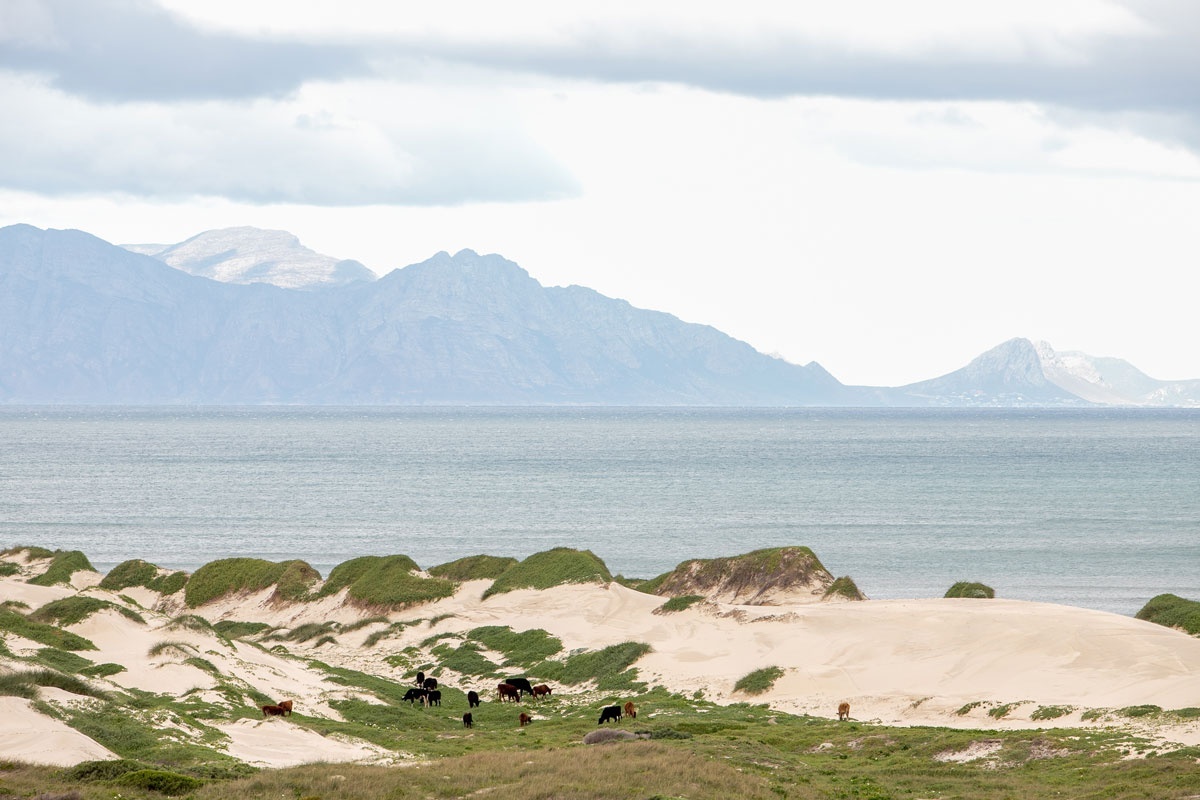
Figure 1
Cattle grazing in Macassar Dunes Conservation area (Photo by Zina Jacobs, 2023).
Grazing of livestock and horses within the conservation areas and other open natural spaces is illegal, implying that the practices by the livestock owners are legally sanctionable (pers. com, conservation official). Livestock and horse owners reiterated that they feel marginalised, since the City does not want to engage with them productively about using nature reserve areas for grazing, nor are they being provided with any support by other relevant national or provincial departments such as Agriculture about this livelihood activity. As one of the interviewees argued, “often, we are reprimanded and told to remove our animals from the conservation areas without being engaged about alternatives” (Horse owner from Phillipi). According to the livestock owners, the solution the City has suggested is that they move their animals to a place that the Western Cape Provincial Government has identified near Malmesbury, 80 kilometres away. This would entail uproot and relocation of livestock owners with their families, which is not a viable and acceptable solution as far as the livestock owners are concerned.
Secondly, people are not allowed to collect firewood, but still do since it is a basic need within some households (Figure 2). Firewood is particularly important for shack dwellers since it is the cheapest and most readily available source of energy (cooking and heating) given that they might not have or cannot afford electricity or gas. As one of the firewood collectors argued “I am unemployed. I do not have money to buy paraffin or charcoal from the shops. I have to collect firewood for cooking at home, and also for sell to buy food” (firewood collector from Khayelitsha). The demand for firewood was particularly greater during the period of load shedding15 Just like grazing, collecting firewood is not permitted in any of the City’s Nature Reserves and Conservation Areas, implying this activity is deemed illegal.
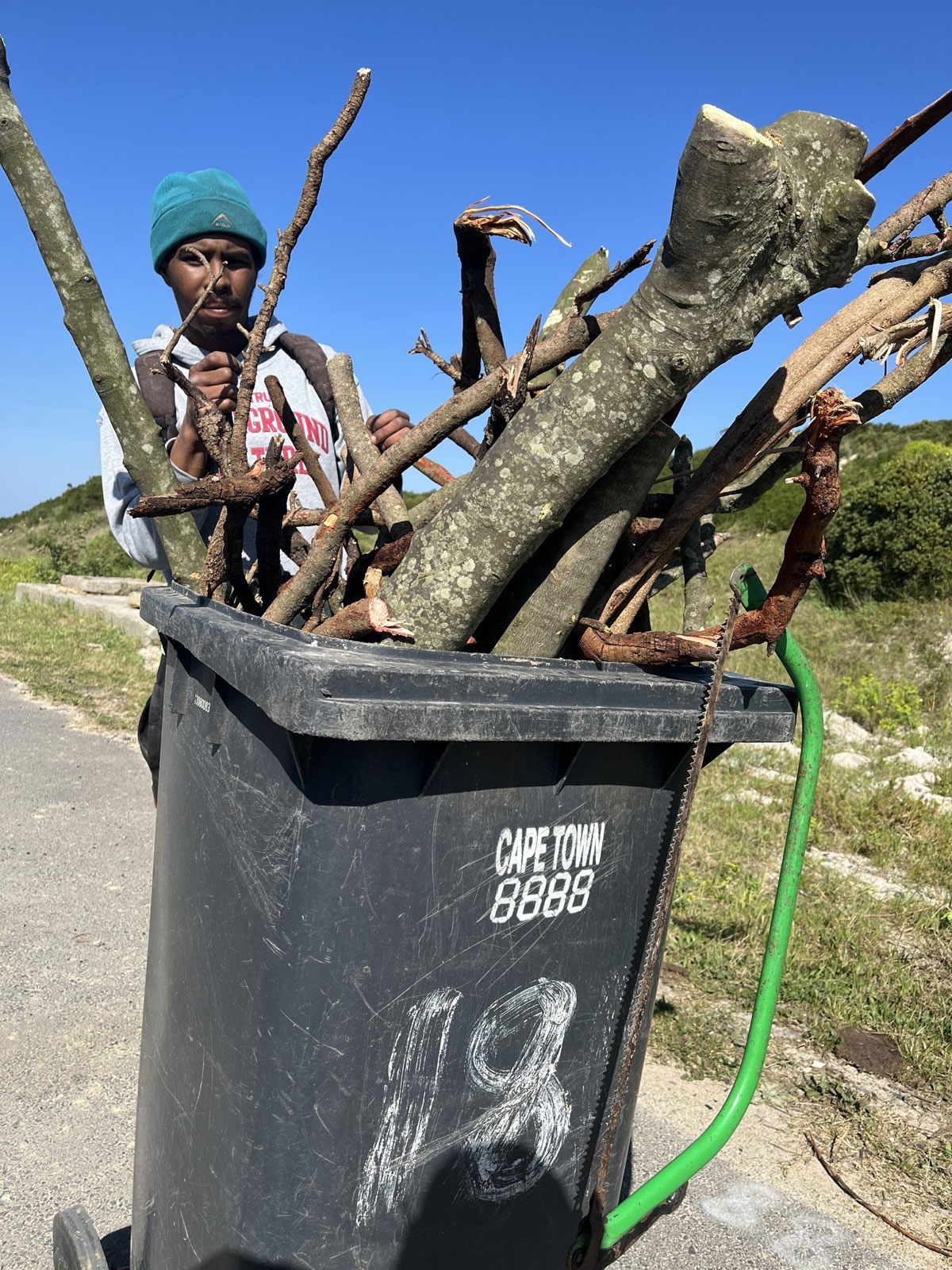
Figure 2
A firewood collector in Macassar Dunes Conservation Area (photo by Zina Jacobs, 2023).
Cultural and Spiritual Use of, and Connection with Nature
Communities have unique ties to nonhuman nature. For example, Bam (2021) argues that the old generation had very close cultural and spiritual ties with nonhuman nature in what is now Rondevlei Nature Reserve. “People used to harvest medicinal plants and conduct rituals in these areas. All that stopped when these areas were forcibly declared as nature reserves without consultation with communities (pers. com, Bam, 2023). Bam (2021) points out that such practices have continued (illegally) post declaration of Rondevlei as a nature reserve in 1952. A sangoma (traditional healer) from Philippi said that he collects medicinal plants from Edith Stephens Nature Reserve. In addition, the sangoma argued; “some of the healing processes I need to conduct with some of my patients require me to spend a week by the waterpoint of the nature reserve pond/dam with the patient (sangoma from Philippi). Similarly, traditional healers from Khayelitsha collect medicinal plants from MDCA and Wolfgat Nature Reserve (Figure 3). There are specific plant types/species the healers collect for medicinal purposes or those that allow their clients to connect with their ancestors, wash and/or cleanse their bodies, purge the spirits and more (traditional healers from Philippi and Khayelitsha). Permits were previously being issued; however, the City no longer issues such permits to healers or anyone for the harvesting of indigenous plants (pers. Comm, City of Cape Town Biodiversity Department Official). Although these practices are not officially allowed and officials frown upon them, they continue to be practiced by community members. Another activity that officials have refused to allow within Edith Stephens Nature Reserve, and also in other nature reserves, is use of these areas for religious practices and gatherings (pers. Com, Zion Christian Church leader). Conservation officials argued that allowing such public activities would open flood gates for other unacceptable public activities within nature reserves.
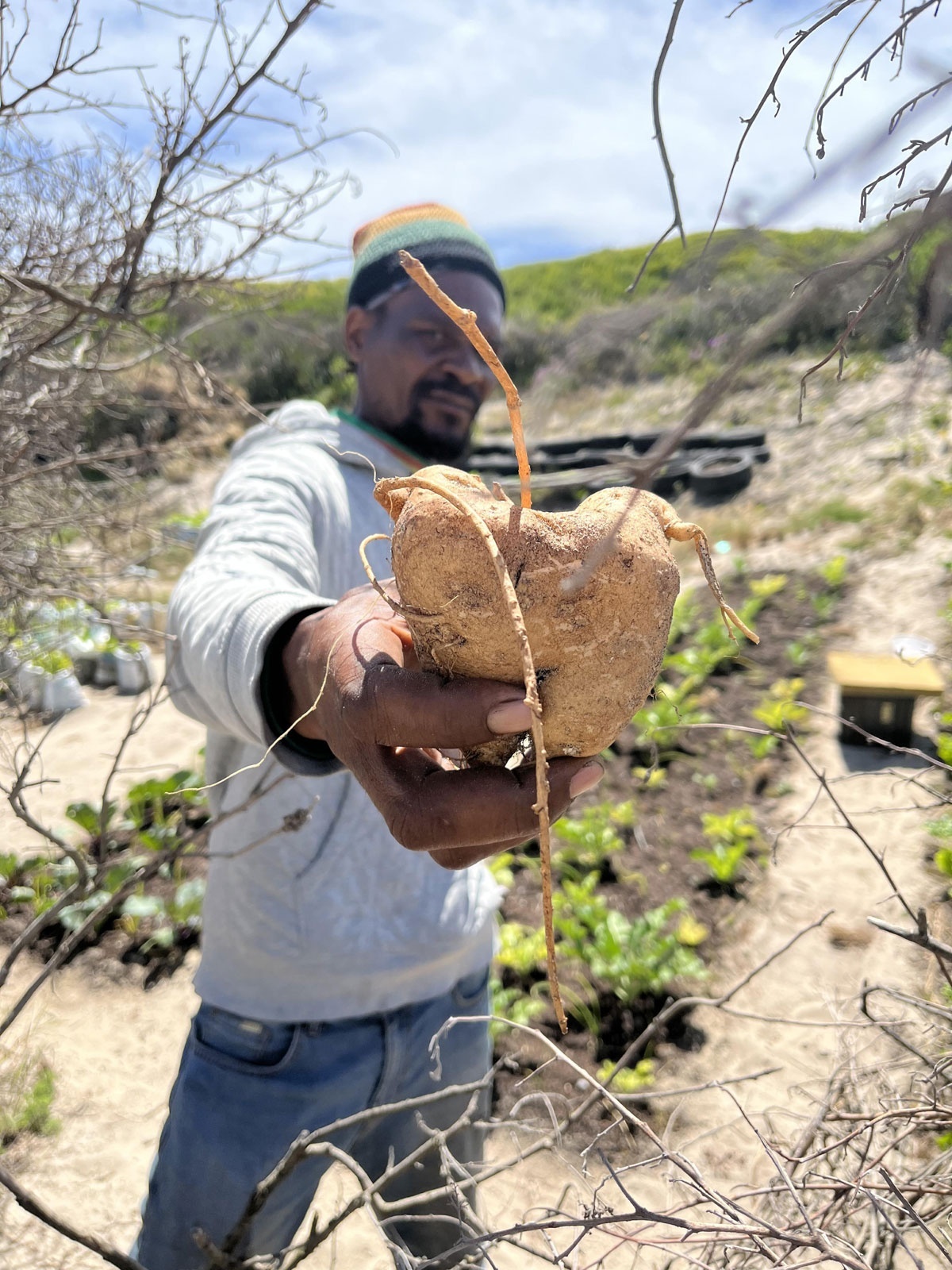
Figure 3
Herbalist with a medicinal plant harvested from Wolfgat nature reserve (photo by Zina Jacobs, 2023).
Initiation, one of whose main rituals is circumcision, is an important practice that symbolises the transition from boyhood to manhood among the Xhosa and other South African ethnic groups. A key aspect of initiations are initiation schools whereby the initiates have to live as a group/cohort away from their families in the bush for about three to four weeks for the circumcision wound to heal and at the same time receive lessons on manhood and the values inherent in their ethnic group in terms of social responsibility, discipline and acceptable conduct. While initiation schools are usually conducted in home areas of the initiates in provinces such as the Eastern Cape, circumstances are such that some of these schools have to be conducted in cities such as Cape Town. Thus, some traditional surgeons try to establish initiation schools in nature reserves, which is not allowed by the City (traditional surgeon from Khayelitsha). Initiation schools within nature reserves are deemed illegal due to dangers of (starting) fires and potential harvesting of resources by the initiation practitioners (pers. Comm, City of Cape Town Biodiversity Official).
In terms of people’s wellbeing, many access the nature reserves for a sense of peace and tranquillity. Thus, people use the conservation areas to get away from public spaces and residential areas in order to ‘get away from it all’ for a few hours. As a woman from Manenberg who volunteers to work at Edith Stephens pointed out “being away from gang-related and gender-based violence, and family problems for the whole day helps to calm me and give me a sense of purpose and tranquility”. Walking, cycling and jogging are also forms of exercise activities that nature reserves are used for, mostly by middle-class and upper-class City residents. Safety issues have been raised though about the use of nature reserves for these well-being activities. For example, City of Cape Town nature reserve rangers in Macassar Dunes, Rondevlei and Wolfgat pointed out that there had been a number of muggings of people undertaking well-being activities within the conservation areas. Interviewees from Michells Plain expressed the worry about the increased use of some areas of Wolfgat Nature Reserve and MDCA for criminal activities by gangs, which makes such areas dangerous for the public.
Land occupations
Because of the pressure communities have for land for housing, communities have been known to occupy land and build informal settlements inside nature reserve boundaries. For example, a part of MDCA next to Nkanini, Khayelitsha had been occupied in 2022 by a group of about 100 people from Khayelitsha overnight (pers. Comm, City of Cape Town Biodiversity Official). An interviewee from the occupier group pointed out they needed land for building shacks as there was no land available where they had been living. It has proved impossible to remove/evict the community so far. A similar occupation happened in the Driftsands Nature Reserve in 2020 during Covid-19.16 Despite attempts to evict the occupiers, it has proved impossible to remove them to the extent that Driftsands Nature Reserve lost its status as a nature reserve.17
Discussion
South Africa’s environmental policy, as in many other countries, perpetuates the historical hard divide between ‘nature’ (nonhuman) and ‘society’ (human), banishing and ‘othering’ of nonhuman nature (defined as intact biomes) to the other side of the fence outside of ‘society’ (Perkins, 2007), a form of ‘basic alienation’(Biro, 2005). The net result is that ‘society’ is governed in terms of lines inscribed in law that humans need to protect helpless nonhuman nature against the excesses of human society, particularly the poor who engage in consumptive and depletive livelihood practices on nonhuman nature. Such laws go to the extent of denying communities access to nonhuman nature in the name of conservation (Büscher, 2021). In effect, nonhuman nature’s materialities are governed in terms of rationalities associated with biodiversity’s financial values or as ‘ecosystem services’, a form of ‘surplus alienation’18 (Biro, 2005). Thus, while non-consumptive activities such as boating, nature walks, picnics, exercising, bird watching and recreational fishing, mostly by the wealthier classes are allowed, non-consumptive activities by poorer classes such as healing rituals, initiation schools and religious gatherings are not allowed, thereby essentialising and re-enforcing class and material divisions within the Cape Town human nature user community.
Despite policy requirements for the involvement of all stakeholders, including Cape Flats township communities, the question is whether this happens in practice, and the communities are able to participate in the development of the purpose, vision and management objectives for the nature reserves they are supposed to have a stake in. Key informants from the communities revealed that in the past, there has been very little consultation with the communities. Even where such consultation occurs, communities have very little influence on the substance of the matters and issues at hand that end up as policy and practice. In practice, the derivation of the purposes, visions and management objectives remains largely top-down, with stakeholder consultative workshops primarily used to rubber-stamp documents that communities hardly understand, nor are given enough time to digest (see also Katzschner and Pitt, 2022). The educated, well-to do and well-organised stakeholders have influence on these policy processes. For example, the sand miners (the building industry) in Macassar are confident that they will continue with that activity, even if Macassar is upgraded from a conservation area to nature reserve status, despite environmentalists raising concerns about the impact of sand-mining on the sensitive dunes and also the health problems that the dust that sand mining generates for surrounding Macassar and Khayelitsha communities. In the False Bay Nature Reserve (which Rondevlei is part of) well-to-do communities from the Grassy Park and Zeekovlei appear to have more influence in terms of the activities they are allowed in the nature reserve. For example, they have permission for boating, bird-watching, walks, etc. Some of this influence is through raising funds for the Nature Reserve; understanding the policy and management processes; and demanding involvement in all these (City of Cape Town, 2011c, p. 36c). In contrast, township communities around the nature reserves do not have these forms of leverage such as funding, nor the level of organization that the wealthier communities have for demanding involvement. As such, the poorer communities around Rondevlei Nature Reserve have little leverage for the use of the nature reserve.
What is notable is that the type of co-management in practice by the City of Cape is ‘instructive co-management’ (Sen and Raakjaer Nielsen, 1996), whereby the state (in this case City of Cape Town) develops and institutes regulations, mostly on its own, on the types of uses/activities that can be undertaken in nature reserves and conservation areas and the prohibition of any uses/activities outside these. Unfortunately, most of both consumptive (for example, livestock grazing, firewood harvesting, etc.) and non-consumptive (for example, cultural activities such initiation schools, religious gatherings, etc.) activities that communities require to undertake fall within these prohibited uses/activities. The class aspect is that some of the activities require paying a fee (which most members of the Cape Flats communities cannot afford), while some of the wealthier users have leverage (for example financial) to influence specific uses of nature reserves that would otherwise not be allowed. As a result, users from Cape flats communities see no option other than undertaking the required nature user-activities ‘illegally’.
The assumption that township communities are bent on destroying what they depend on is a tenuous narrative. If the natural resources are equally important for the poorer township communities, then they would not want to destroy resources that are also beneficial to them. People who use medicinal plants stated that they harvest them in such a way that the plant can re-generate so that they can continue to depend on them in future. Another example is that of grazers, who rotate their animals across different pastures within nature reserves, with the knowledge that this will allow rejuvenation of grazed areas. These examples show that community commoners do have local ‘informal/local’ practices meant to sustain resources. Thus, within nature reserves, amounts of resources that can be harvested for medicinal, grazing or other uses by communities could be jointly worked out between commoning communities and management agencies as a basis for systemising practices that enhance both human and non-human (nature) welfare resulting in a mutually beneficial relationship. In this context, the bottom-up constitutionality principle and approach (Haller et al., 2015; Hara et al., 2009; Colfer & Prabhu, 2023), whereby all stakeholders work together to craft local institutions for management of ‘their nonhuman natural resources’ using their agency, perceptions, attitudes, strategies and experiences could be tried and experimented with. Given that such an approach provides for sense of ownership of the process and outcomes, this would be more likely to result in local institutions that could lead to sustainable natural resource management. The informal commoning practices point to the reality that communities are cognisant of sustainable utilisation principles. A blanket ban of commoning activities for communities can only drive these practices underground and result in ‘open access’, a situation whereby control is usually difficult, if not impossible. City of Cape Town and Cape Nature officials (pers. comm, City of Cape Biodiversity Department Official; pers. Comm., Cape Nature official) accept that there is need for them to better understand the historical traditional rights that people demand around for example Mamre Commons19 and the other commons that the agencies are responsible for managing.
In view of the foregoing, the City needs to work with stakeholder communities in the development of the purposes and visions and the management objectives for the nature reserves. The current ‘illegal’ uses of nonhuman nature allude to the importance of reaching understandings between the City as the responsible agency for management of nonhuman natural resources and the primary stakeholders such as commoning communities for the joint ownership, authority and responsibility for nonhuman nature for its sustainable utilisation before uncontrolled uses reach levels beyond which this cannot be stopped and reversed. Thus, the cooperative type of co-management (joint ownership, authority and responsibilities) (Sen and Raakjaer Nielsen, 1996) for the nature reserves needs to be translated into actual practice with communities, just like it is already happening with the well-to-do sections of the stakeholder community.
Arguing that the City must choose between “nature” (nonhuman) and “people” (human), as some conservationists argue, sets up a false dichotomy (Büscher, 2021) in a country where nature reserves have a negative socio-economic history of land/nature dispossession. Protection of nature should not be used as an excuse for the continuation of colonial and apartheid nonhuman nature and land use inequalities. The City and communities need to find a basis for dialogue, negotiation and compromise for the sustainable consumptive use and non-consumptive uses of natural resources both inside and outside nature reserves, while achieving the City’s mandated goal of conservation and protection of nonhuman nature, including rare and endangered species.
The intertwine and spill over of social issues into the conservation arena, for example, the need and shortage of housing shown by the informal occupation of nature reserves for informal housing by the poor demonstrates that biodiversity conservation is but one issue in a larger list of socioeconomic issues (pers. Com, Official, Biodiversity Department, City of Cape Town), and calls for a multi-sectoral, multi-agency and socio-political approach for solving and dealing with the socio-economic issues afflicting poor township communities in Cape Town. Urban biodiversity conservation cannot continue to pretend that the nonhuman and the human are separate existential phenomena.
Evidence from our engagements with communities and residents around different nature reserves illustrates the different ways in which they provide for themselves regarding their needs and how they relate to nonhuman nature in order to meet these needs. Grazing practices show how residents provide for themselves despite the attempts by city officials to prohibit this activity. Cultural and spiritual practices at Edith Stephens (and in Rondevlei) also illustrate the intimate relations that residents have with nonhuman nature. Provisioning from commons in the case of such cultural practices go beyond material relations.
Conclusions
In providing evidence from lived realities from Cape Town, South Africa, we hope that our contribution offers insights about how urban commons could offer places of conviviality (Büscher and Fletcher, 2020) and redefine practices of commoning for the benefit of both humans and nonhumans in urban landscapes. It is important to note that regulations are often in place to protect the (nonhuman) nature and endangered species, but the same regulations give less regard for the socio-economic uses of poor (human) communities. It is worth exploring how these rules and regulations could be turned around to place communities at the forefront of conservation. However, colonial continuities and neoliberal ideologies continue to create contestations in which powerful actors embrace conservative knowledge systems against local community socio-economic-cultural views, and practice nonhuman nature enclosures in the name of biodiversity protection, which continue to disrupt patterns of and coexistence between humans and nonhumans. The second form of disruption witnessed is in the organizing for the governance of nature in urban landscapes whereby the focus is on the formal arrangements through the City at the expense of the informal arrangements that residents and communities have within and among themselves. There is need for recognition of the plural ways of commoning practices by the various stakeholders, especially communities, and how to jointly (by conservation organizations, government agencies, local communities, and law enforcement) create secure and sustainable commoning for all stakeholders. Exploring bottom-up constitutionality-based (Haller et al., 2015) arrangements could allow moving towards understanding what hinders the City from formulating and implementing socially and spatially friendly and convivial governance of urban nature reserves and conservation areas for the benefit of all the City’s citizens (humans) and nature (non-human).
Notes
[1] The Fynbos (meaning ‘fine bush’ in Dutch) refers to an extensive variety of flowering plants that bloom in the Cape floristic region. Within an area of just over 90 000 square kilometres, more than 9000 known species of flowering fynbos plants exist; 70% of which can only be found in this region alone – making this kingdom one of the most diverse floras in the world (https://www.grootbos.com/en/blog/experiences/fynbos-and-flora-cape-floral-kingdom-south-africa).
[2] The CFR has 8 700 plant species and is characterised by its high endemicity (68% of plant species are confined to the Cape Floral Kingdom) (https://pza.sanbi.org/vegetation/fynbos-biome, (30/09/24).
[5] It is this use of natural resources inside and outside nature reserves by people from these communities that we refer to as ‘commoning.
[14] This approach has also been termed the “slow methodology” under the Living Landscape in Action (LLA) project under which this study was funded.
[15] Periodic switching off of the electricity grid in specific areas in order to ration inadequate electricity resulting from power station breakdowns and/or as a result of shortage of capacity.
[18] Relate to how estranged inter-relations between human and nonhuman natures are (re)produced in and through political-economic systems of instrumentalization and domination” (Büscher, 2021: 3).
Use of Artificial Intelligence (AI) and AI-assisted Tools
We have not used any AI or AI-assisted technology in the process of writing this paper.
Acknowledgements
The authors are grateful to all participants in the research, in particular those from the stakeholder communities. The views and opinions expressed in the article though remain solely those of the authors.