
1. Introduction
The Institutional Analysis and Development framework (IADF) is useful in investigating complexities of social-ecological systems (SES). It helps to conceptually unravel institutional scaffoldings structuring human-nature interactions. A long-standing critique of the IADF and its derivatives is that they fall short of making different workings of ‘power’ explicit, especially those illuminating structural and intersectional aspects (Agrawal, 2003; Kashwan, 2016; Brisbois et al., 2019; Morrison et al., 2019; Kashwan et al., 2021; Mudliar and Koontz, 2021).
In any SES, multiple power dynamics affect ways in which individuals, groups, and more-than-human entities interact and produce outcomes. Power dynamics occurring on a micro-scale (e.g., between two people) are intrinsically tied to those on broader scales (e.g., societies or belief systems). Numerous layers of intersectional power dynamics shape lived realities of individuals. Addressing issues of power is central to understanding what makes commons systems (un)fair, (in)effective, and (un)sustainable, and for envisioning and bringing about just realities. ‘Power’ itself is a contested concept that has been defined and analysed in countless ways (Avelino, 2021). We argue that the IADF holds potential to operationalise a large variety of perspectives on power and visualise how they play out in commons governance regimes – a potential that has been underused thus far.
We build on discussions about the necessity and advantages of integrating studies of institutions and power and engage with their various conceptualisations. We reflect on existing proposals for such integrated analyses, highlighting added value of drawing on a broad range of power theories. We lay out the methodology used for reviewing literature on power theories and identifying related empirical questions, mapping these questions to different IADF elements, and creating the basis for developing a diagnostic tool. In a section dedicated to theoretical framing, we further outline the main approaches to power that inform this paper.
1.1. Why power matters in commons and institutional research
Power, however defined, is fundamental to shaping interactions and outcomes at all institutional levels and should be considered in analysing governance contexts (Agrawal, 2003; Clement, 2010; Kashwan, 2016; Mudliar & Koontz, 2021). This is especially relevant for cross-cutting issues like environmental change that are intertwined with inequalities in multiple social, economic, and political arenas (Ibid.). Institutional design and change, historically shaped and accompanied by social struggles, are political and thus ‘inseparable from power’ (Kashwan et al., 2019, p. 11). Theorising how power and power asymmetries shape design and implementation of institutions could, for example, reveal intricacies of polycentricity, explain the role of political contestation and resistance in institutional development, or yield insights about distributional consequences of different resource management and development approaches (Ibid., p. 10). Power is also an outcome of institutional design and change, for instance through tenures, resource access, or status (Calo, 2020). Understanding power relationships (re)produced by institutions can bring nuanced insights about legitimacy and equity of governance outcomes and potential pitfalls of institutional interventions, such as the unintentional creation of new dependencies or aggravation of existing marginalisation (Bennett et al., 2018; Dunlap & Sullivan, 2020).
Power is key to the work of scholars from the Bloomington School’s tradition, particularly its role in social situations (Ostrom, 2005; DeCaro, 2011; Theesfeld, 2011; Bues & Theesfeld, 2012; Morrison et al., 2019). The tendency to centre analyses at local levels often leads to limited consideration for contextual factors at multiple scales (Brisbois et al., 2019, p. 5). Heterogeneity, power asymmetries, and hidden conflicts in communities remain under-examined in commons and institutional research (Kashwan, 2016; Morrison et al., 2019; Mudliar and Koontz, 2021). While agency-centred power theories align with the basic assumptions underpinning commons research (bounded rationality, emergent properties, focus on individual motivations), the incorporation of broader structural dynamics may at first seem incompatible. This is also a long-standing debate in power scholarship, as many agency-centred theories do not focus on structures analytically while acknowledging their influence in constraining individuals (Dowding, 2008). Scholars argue that an integrated approach enables institutional researchers to examine structural origins of micro-institutional power dynamics or to address complex and multi-layered power asymmetries across time and governance scales, enhancing possibilities for interdisciplinary dialogue (Agrawal, 2003; Kashwan, 2016; Bennett et al., 2018).
Despite efforts of commons scholars to centre interests and perspectives of local communities in their research, there is a notable lack of engagement with scholarship on social and environmental justice, and topics such as gender, race, and inequality only play marginal roles (Kashwan et al., 2021, p. 1). Apart from epistemological considerations, another explanation for the absence of justice-related topics could be that influential commons research is produced from a position of privilege, often by white, male authors affiliated with universities in the United States or Europe (Ibid). Communities in countries of the tropical majority usually serve as subjects of research, while researchers and knowledge holders from these regions are regularly excluded from influencing knowledge production (Martins, 2020). Considering global inequalities (distribution of wealth, access to resources, vulnerability to climate change, etc.) and historic injustices that have led us here, a meaningful engagement with social and environmental justice through explicit analysis of power is warranted in the study of commons.
As a group of early-career researchers, we share experiences of encountering the critical gap between institutional and power literatures in our own work. Departing from different disciplinary backgrounds (sociology, development studies, political ecology and economy, economics, public policy, and biology), yet already using institutional theory, we recognised the importance of power in our field sites, ranging across diverse commons systems in Bolivia, India, Mozambique, Tanzania, and Europe. We were eager to incorporate various considerations of power in our institutional analyses, for instance by taking intersectional feminist perspectives or by exploring relationships between hegemonic international discourses and cross-scale institutional development. However, we felt limited by the approaches and analytical depth of existing attempts towards bridging institutional and power theories. We thus started an immersive collaboration of collectively reviewing a variety of power literature based on our interests and disciplinary strengths. Over time, our approach became more focused and analytical, with the emerging vision to create a diagnostic tool that could be used by scholars at similar crossroads.
We make two central contributions. Previous suggestions to make power dynamics explicit within the IADF have been shaped by ‘classical’ power theories spanning liberal, structural, or post-structural epistemologies (DeCaro, 2011; Clement, 2010; Brisbois et al., 2019; Whaley, 2018). Our first contribution is to expand engagement with the IADF and power bringing the IADF into dialogue with feminist, intersectional, and non-western epistemologies and thus making these theories more accessible for institutional scholars. Drawing from various approaches to addressing power (Section 3), we identify a broad set of empirical questions to explore power issues related to any element of the IADF. Our second contribution is to provide the foundation for a diagnostic tool enabling researchers using the IADF to make power explicit in their analyses. A ‘diagnosis’ systematically unpacks complexities of a SES through asking increasingly specific questions about the system (Cox, 2011; Unnikrishnan et al., 2023). Diagnostic tools are powerful in driving meta-analytical comparisons as well as for bringing into dialogue diverse perspectives around a particular subject or system of interest (Ibid.). As such, they are useful in operationalising the incorporation of power into analysis of any SES. This paper is best understood as the initial step towards development of such a tool.
2. Integrating the Study of Power and Institutions
2.1. Conceptualising institutions in neo-institutional commons scholarship
Bloomington School institutionalism provides a widely used conceptualisation of ‘institutions’ as formal and informal rules, social norms, and shared strategies influencing societal outcomes (Ostrom, 1990, 2005). They are ‘prescriptions that humans use to organise all forms of repetitive and structured interactions’ (Ostrom, 2005, p. 3), existing in nested layers on different levels (operational, collective, constitutional) that determine how institutions on lower levels may be changed (Ostrom, 1990, 2005). Accordingly, institutions are understood as incentive structures in which human behaviour follows a logic of bounded rationality. This implies that individuals with incomplete information of the overall context make individually satisfying decisions based on this limited knowledge (Ibid.). Apart from the focus on rational actors pursuing preferences, other forms of institutional inquiry centre analyses on path dependencies and critical junctures (e.g., North 1990), on mechanisms of gradual change in institutions (e.g., Mahoney & Thelen, 2009 in Pilon, 2021, p. 104), or on ideas and discourses (e.g., Schmidt, 2010; Forsberg, 2018). Institutions can also be viewed as socially constituted and culturally framed rules and norms (e.g., Clegg, 2010), or as shared meanings of structures and constructs (e.g., Schmidt, 2010; Forsberg, 2018). While institutions understood as rationalist incentives, path dependencies, or cultural norms are considered as external, often constraining, structures, perspectives on internal shared constructs centre actors’ abilities to create and maintain institutions, and to critically question or change them (Schmidt, 2010, p. 4). Although the IADF was developed in line with a rational choice understanding of institutions and individuals, we draw on the variety of conceptualisations mentioned here to engage with a broad spectrum of power theories.
2.2 Approaches to conceptualising power in commons scholarship
Although neo-institutional literature seldom engages in explicit theoretical considerations of power, institutions can be interpreted as potential carriers of power, i.e., ‘institutional power’ (Epstein et al., 2014, p. 114). E. Ostrom describes institutional power as a ‘function of control and opportunity’ available to actors in a given situation (2005, p. 50). Attributing degrees of power to each actor indicates that power, while not necessarily zero-sum, is contingent on the costs and benefits of a situation. Structurally, historical institutionalism considers institutional power within historically contingent contexts, in which continuity or longevity of institutions are crucial indicators of power (North 1990; Hall and Taylor, 1996). This allows an exploration of power asymmetries and how they persist through path dependencies in institutional configurations. Sociological institutionalism addresses the role of power for institutional change in constructed social orders, highlighting struggle, conflict, or strategic action among actors (Clegg, 2010; Schmidt, 2010).
Departing from rationalist assumptions, critical institutionalism elucidates power asymmetries in large-scale structures and processes, with lesser focus on smaller-scale aspects of collective action and self-governance (Bennett et al., 2018, p. 334). Critical institutional scholars view outcomes of institutional processes in light of social justice and consider broader governance contexts, i.e., political economy and political ecology, in which local institutional arrangements are situated (Cleaver and de Koning, 2015; Pilon, 2021). The key difference lies in embracing critical social theory and related assumptions about complexity, human nature, centrality of power dynamics, and social justice (Ibid.). Here, (unequal) power relations and people’s complex social identities are considered integral to dynamic and socially contingent institutions, with a relational model of individual agency (Cleaver and de Koning, 2015, pp. 1–2). Institutional formation is considered as ‘interplay between the creative exercise of agency and the often-constraining effects of social relationships, environments and the workings of power’ (Ibid., p. 12). This stresses the importance of uncovering plurality of meanings, world views, and forms of legitimation and authority underpinning multi-scalar social relations and affecting recursive relationships between individuals and institutions.
A starting point toward an integrated approach to studying of power and institutions is the premise of (common-pool) resource (CPR) governance as inherently political, influencing access, use, and formation of human subjects (Agrawal, 2003). Ribot and Peluso (2003) reconceptualise access beyond mere property rights, illustrating it as a bundle of powers and social relations enabling actors to derive benefits from resources, revealing underlying power geometries in resource control. Such understandings of power extend to encompass the ability to influence both conduct and context within social-ecological interactions, acknowledging human-nature interdependencies (Boonstra, 2016). This is also explored by Nayak et al. (2016) who highlight how power and politics are understated yet critical in understanding social-ecological regime shifts, determining whose interests and narratives prevail amidst rapid environmental change. Others illustrate how institutionalised power asymmetries operate across scales in processes of institutional change, with power dynamics and conflicts of interest obscured behind apparent consensus or technically framed reforms in neoliberal development (Kashwan, 2016; Kashwan et al., 2019). Even robust CPR institutions can conceal and perpetuate power asymmetries, leading to injustice through non-participation and silence of non-dominant actors (Mudliar & Koontz, 2021). There is a reciprocal relationship between institutions and power (Bennett et al., 2018). Several approaches have been proposed to investigate these relationships, including a pathway demonstrating how power is embedded within attributes of the SES framework (Epstein et al., 2014), a ‘framework of interlinked institutional arenas’ (Kashwan, 2016), a ‘power in institutions matrix’ (Kashwan et al., 2019), or a ‘relational framework of power’ (Mudliar and Koontz, 2021). Collectively, these papers underscore that effective environmental governance and institutional analysis necessitate rigorous engagement with the multifaceted nature of power, its asymmetries, and its constitutive role in shaping human-environment interactions.
2.3 Approaches to integrating power in the IADF
The IADF helps investigate institutional arrangements and patterns of practice affecting collective action for environmental resource governance and is suitable for analyses of dynamic situations involving diverse actors, commons, and CPRs (Ostrom, 1990, 2005; McGinnis, 2011). It delineates different elements of context, interactions, and outcomes to structure policy analysis, encapsulating the forms in which institutions operate and change over time, and is used in combination with other analytical methods (Ibid.). The action situation, a metaphorical place where operational, collective, or constitutional choices are made, is a central component. Action situations have varying scopes within an overall nested system, ranging from daily practices to organising societies (Ostrom, 1990). Although the framework is often applied to understand micro-politics of local governance, its conception of institutional arrangements existing in nested layers (Ostrom, 1990, 2005) also makes it suitable to understand social dynamics across governance levels. ‘Power’ is not specifically conceptualised within components of the framework.
Despite its utility, the IADF has been criticised, particularly by scholars drawing on political ecology and human geography (e.g., Clement, 2010; Brisbois et al., 2019) who point out two interrelated gaps. Firstly, the IADF only provides snapshots of institutional dynamics at any given point in time. Secondly, because of this, the IADF fails to explicitly account for underlying dynamics of power operating within and across institutional arrangements. Several scholars have attempted to make power explicit within the framework (Ibid.). One example from within the Bloomington School is DeCaro’s (2011) endeavour to distil ways in which power is already (implicitly) represented in the IADF. DeCaro argues that power, when understood broadly as the influence people have over each other, is represented by social interactions and associated rules and norms creating action situations. He concedes, however, that the framework could be strengthened toward other conceptualisations of power (e.g., power-with) to address a broader range of institutional problems, and to improve its ability to capture underlying motives and institutional dynamics of self-governance and solidarity-based economics (Ibid.). Clement (2010) has proposed a ‘politicised’ version of the IADF, which adds political-economic context and discourse as exogenous variables, in addition to biophysical conditions, community attributes, and rules-in-use. These new variables capture diverse power dynamics that may otherwise be overlooked when using the IADF (Clement, 2010; Whaley & Weatherhead, 2014). Pointing to difficulties in operationalising these politicised variables for scholars without a background in power theory, Brisbois et al. (2019) structurally integrate power theory into the politicised IADF. They present an ‘augmented’ framework drawing from various power theories to explain how power operates in each element of the IADF, also highlighting power dynamics related to inaction and non-decisions that may be missed in traditional uses of the IADF (Ibid.) Taking the contribution of Clement (2010) in a different direction, Whaley (2018) has suggested the ‘Critical Institutional Analysis and Development Framework’ (CIAD) as another adaptation of the IADF. The CIAD reflects core concerns of critical institutionalism and allows for investigations of hidden, informal, and everyday dimensions of institutional life, foregrounding the workings of power and meaning in analysis (Ibid).
While we are influenced by the proposals outlined above, especially aligning with Brisbois et al. (2019), and appreciate the possibilities they have created for analysing power, we noted the absence of multiple power theories rooted in feminist, post- and decolonial, or subaltern epistemologies. These perspectives are crucial to capture the multifaceted nature of power and its manifestations in different contexts, to meaningfully address and overcome persistent injustices. Adopting a broader approach to understanding diverse dimensions of power (rather than confining ourselves to specific theoretical frameworks) and bringing them in relation with various components of the IADF, we lay the foundation towards developing a diagnostic tool that can guide institutional researchers to effectively and precisely analyse power dynamics in various settings. We hope to gain deeper insight into complexities of power and its impact on resource governance and make such integrated analyses more accessible to diverse (institutional) scholars. On a practical level, this perspective will allow institutional researchers to develop nuanced strategies for addressing power imbalances while fostering meaningful and sustainable change.
3. Making Power Explicit in the IADF: Toward a Diagnostic Tool
We envision an organised set of diagnostic questions that can serve as orientation and simplification tool for those familiar with the IADF who analyse power dynamics within a specific governance system or empirical case. Our glossary of empirical questions can be used to explore the role that power plays within each component of the IADF. Rather than serving as a definitive or objective basis for analysing institutions and power, the tool provides a glimpse into the complexity of power theories and invites reflexive engagement with underlying values and assumptions.
3.1 Methodology
Our methodology was developed iteratively and departed from traditional modes of collaboration, operating as a collective through fostering solidarity, trust, and dialogue. Labour involved in conducting research and consolidating our findings was distributed according to varying time, space, precarity, and structured opportunities of each member.1
First, we exploratively reviewed literature on power, starting with collections of ‘classical’ power theories (e.g., Haugaard, 2002; Svarstad et al., 2018; Avelino, 2021). In awareness that these approaches predominantly originated in the Global North, we purposefully engaged with scholarship from the Global South and then focused more intensively on critical feminist, decolonial, postcolonial, and subaltern literature. From this review, we identified influential authors and summarised their epistemological approaches, key themes, and definitions, to elicit an understanding of power in SES. We either cited power-related questions directly or formulated empirical questions that one may ask by taking their approach. Our intention was to include an extensive range of scholars, intuitively driven by potential application of questions to the IADF. It should not be mistaken for an all-encompassing review of power theories. Similarly, the small number of questions for each theoretical approach is indisputably reductionistic and not intended for holistic representation. Instead, we aimed to select and formulate questions such that they best highlight distinctive contributions of each scholar. This review resulted in an initial set of 133 questions which we organised by approach and analytical focus (Figure 1). Given our goal to simplify power theories for institutional scholars using the IADF, we chose the most adaptable categorisation of authors possible. We acknowledge that this categorisation is disputable and remains open to adaptation during further development of the diagnostic tool. We deliberately included more authors and questions from post-structural and cross-cutting approaches, as these have been traditionally underrepresented in institutional analyses.
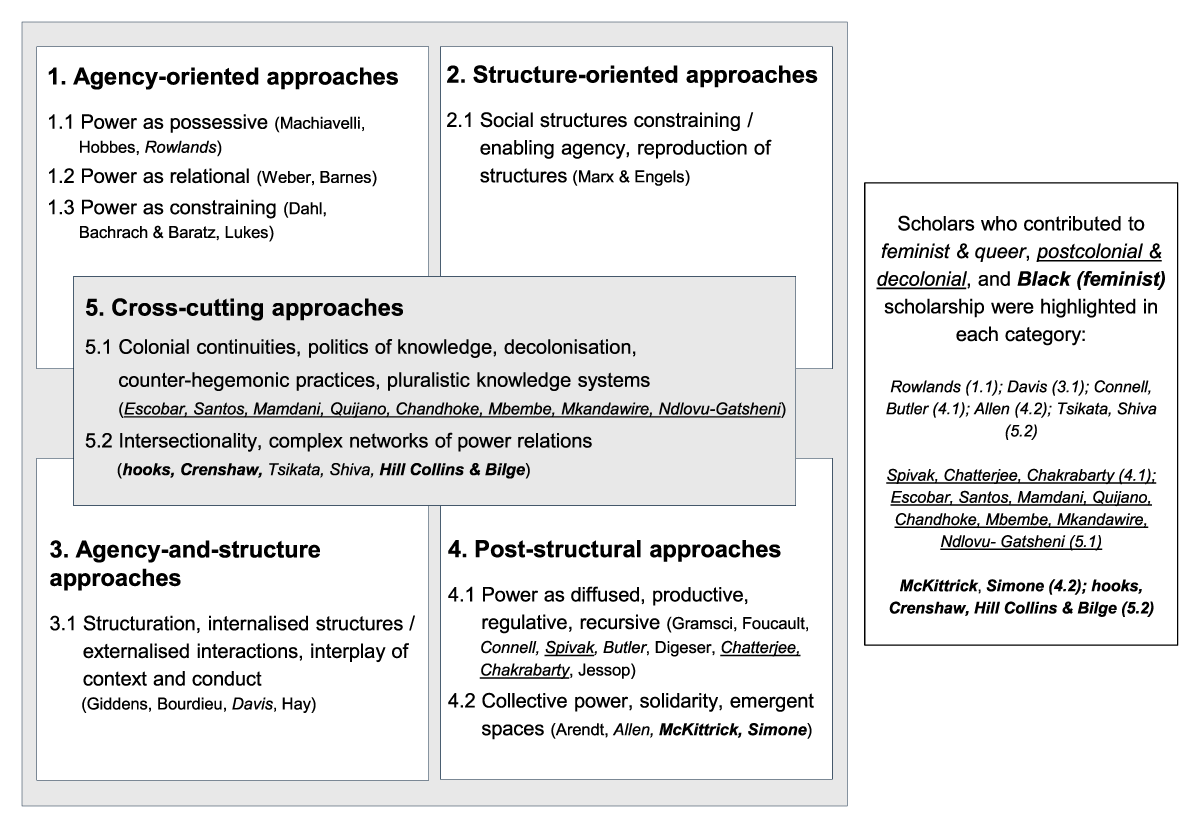
Figure 1
Categories used for organising reviewed power scholarship.
Second, we established linkages to the IADF, considering how identified empirical questions related to the framework and mapping them to its components. To identify and visualise recurring patterns, we systematically coded questions into a matrix structured by IADF components,2 based on definitions in prevalent interpretations (Ostrom, 2005; McGinnis & Ostrom, 2014; Cole et al., 2019). Dividing the questions equally among all authors, each question was then coded onto the IADF using a 0–1 binary, putting ‘1’ when questions related to a specific component and ‘0’ when they did not. For inter-coder reliability, this round of coding was reviewed by another author in a second round. In cases of disagreement with the first coder, affected cells in the matrix were marked. In a third round of coding, a sample of 13 questions3 (10% of all questions) was reviewed by the whole author team with in-depth discussion about meanings and interpretations of power questions and IADF elements. Whenever no agreement could be reached, cells were coded as ‘0.5’ to reflect differences in interpretations. After this, first coders reviewed cells marked by second coders for all remaining questions, accepting or rejecting suggested changes based on discussion of sampled questions, and coding cells that remained ambiguous as ‘0.5’. 49 questions emerged as unsuitable or redundant and were removed. These included 21 questions from institutional scholars and those with an integrated approach to studying power and institutions that were removed as they related to different levels or focus of analysis compared to power-centred theories (Appendix 2). 84 questions remained and were included in waffle charts, consisting of a matrix of black (1), grey (0.5), and white (0) cells (Appendix 3a–e).
Third, we filtered questions marked ‘1’ and ‘0.5’ for each IADF component and transferred them into separate sheets. This resulted in a glossary of 40 sets of empirical questions, one for each IADF (sub-)component, which we envision as the foundation towards eventual development of a diagnostic tool.
3.2 Framing power across diverse theoretical approaches
Our approach to understanding power is deliberately broad, drawing from a wide range of historical and contemporary perspectives to capture its multifaceted nature. The question of whether human action is primarily driven by individual autonomy or by social structures has been a central debate in the development of power theories (Haugaard, 2002; Avelino, 2021). To overcome this dualism, some theorists propose to consider recursive interactions of agency and structure (e.g., Giddens, 1984; Bourdieu, 1989; Davis et al., 1991), while others centre broader systems of knowledge and power underpinning societal realities (e.g., Foucault, 1980, 1982; Spivak, 1988; Butler, 1990; Mbembe, 2001). We organise power literature into agency-oriented, structure-oriented, agency-and-structure, post-structural, and cross-cutting approaches, with further differentiation by analytical focus. We highlight scholars who have made notable contributions from a feminist and queer, post- and decolonial, or Black (feminist) angle, within each of these categories (Table 1). A full list of power literature included in our review is included in Appendix 4.
Table 1
Overview of authors and approaches included in mapping.
| ANALYTICAL FOCUS | AUTHORS | KEY THEMES AND CONCEPTS | HIGHLIGHT | NO. |
|---|---|---|---|---|
| Agency-oriented approaches (1) | ||||
| 1.1 Power as possessive | Machiavelli (1532); Hobbes (1651); Rowlands (1995, 1997) | Power as strategic; power to, power as centred, ‘episodic power’; power within | Feminist and queer scholarship | 1–4 |
| 1.2 Power as relational | Weber (1904, 1921); Barnes (1988) | Domination, rule, authority; power as relational, capacity for action | – | 5–11 |
| 1.3 Power as constraining | Dahl (1957, 1986); Bachrach and Baratz (1962); Lukes (1986, 2005) | Power over, power as constraining; causal conception of power; agenda-setting; intentional preference shaping, conflict, repression of objective interests | – | 12–17 |
| Structure-oriented approaches (2) | ||||
| 2.1 Social structures constraining/enabling agency, reproduction of structures | (Marx & Engels, 1976a, 1976b, 1978, 1979, 1986, 1987, 1996) | Social structures that constrain (and are reproduced by) agency | – | 18–20 |
| Agency-and-structure approaches (3) | ||||
| 3.1 Structuration, internalised structures/externalised interactions, interplay of context and conduct | Giddens (1984); Bourdieu (1989); Davis et al. (1991); Hay (2002) | Structuration (reproducing, enabling, and constraining); power as capital, ‘habitus’; construction of gender; power as conductand context-shaping | Feminist and queer scholarship | 21–25 |
| Post-structural approaches (4) | ||||
| 4.1 Power as diffused, productive, regulative, recursive | Gramsci (1932/1975); Foucault (1977, 1980, 1982, 1984); Connell (1995, 2007, 2013); Spivak (1988); Butler (1990); Digeser (1992); Chatterjee (1993, 2008); Chakrabarty (2000); Jessop (2005, 2008) | Hegemony (domination by consent); subjectivities, power as diffused; hegemony of masculinities, gender relations; subalternity, ‘othering’, resistance, agency; power over and power to as recursive; power as relational, norms and values; class and social hierarchies, colonial legacies; hegemony of Western ideals and concepts (modernity, progress); strategic selectivity | Feminist and queer scholarship; Postcolonial and decolonial scholarship | 26–46 |
| 4.2 Collective power, solidarity, emergent spaces | Arendt (1972); Allen (1999); McKittrick (2020); Simone (2022) | Collective power (power with); power-over (domination), power to (resistance) and power-with (solidarity); interstitial places, anticolonial methods | Feminist and queer scholarship; Black (feminist) scholarship | 47–52 |
| Cross-cutting approaches (5) | ||||
| 5.1 Colonial continuities, politics of knowledge, decolonisation, counter-hegemonic practices, pluralistic knowledge systems | Escobar (1991, 1995, 2015); Santos (1995, 2007, 2014); Mamdani (1996); Quijano (2000, 2007); Chandhoke (2000, 2009a, 2009b, 2021); Mbembe (2001); Mkandawire (2001, 2005); Ndlovu- Gatsheni (2012, 2013) | Politics of knowledge, decolonial, institutions as fundamentally political, resistance through ‘otherness’; counter-hegemonic practices; colonial continuities reproduced by institutions, institutions as containers of power; Western hegemony, pluralistic knowledge systems; power of civil society; power and its relationship to colonialism, race, and violence; institutions embedded in complex networks of power relations, ‘institutional monocropping’; subjectivation, global coloniality | Postcolonial and decolonial scholarship | 53–72 |
| 5.2 Intersectionality, complex networks of power relations | hooks (1981, 2000a, 2000b, 2014); Crenshaw (1989, 1991); Tsikata (2009, 2011, 2016); Shiva (2016, 2019); Hill Collins & Bilge (2020) | Intersectionality; political and gendered nature of institutions; globalization, capitalist patriarchy | Black (feminist) scholarship; Feminist and queer scholarship | 73–84 |
We first acknowledge foundational theories of power, including those from Machiavelli (1532), Hobbes (1651), Weber (1904, 1921), and Marxism (e.g., Marx & Engels, 1976, 1996), emphasising centralised control, class struggle, or legitimate authority within state structures. Our framework extends to theories dissecting dimensions of power, such as Dahl’s (1957, 1986) focus on direct influence, Bachrach and Baratz’s (1962) concept of agenda-setting and mobilisation of bias, and Lukes’ (1986, 2005) exploration of preference shaping and ideological control. This tripartite view unveils not only overt decision-making but also covert ways in which power prevents issues from reaching decision-making arenas or shapes individual desires. Post-structural perspectives, notably Arendt’s (1972) emphasis on power as the ability to act in concert, highlighting its communicative aspect, and Foucault’s (e.g., 1980, 1982) analysis of power as productive and regulative, encompassing discursive practices, discipline, and biopower/biopolitics, broadens our understanding beyond a repressive view to one that recognises power’s role in constructing subjects. Gramsci’s (1932/1975) notion of hegemony, as a system of dominant ideas receiving consent from subaltern groups, illuminates complexities of power dynamics within society. Contemporary views (e.g., Giddens, 1984; Barnes, 1988; Bourdieu, 1989), highlight power’s decentralised, strategic, and contingent character, and its embeddedness within economic and social structures. Bourdieu’s concept of habitus, for instance, illustrates how power operates through subtle social mechanisms and internalised dispositions.
Our work is enriched by feminist and queer scholarship highlighting power within (Rowlands, 1995, 1997), social construction of gender (Davis et al., 1991), hegemony of masculinities and gender relations (e.g., Connell, 1995, 2013), the recursive nature of power over and power to (Butler, 1990), domination, resistance and solidarity (Allen, 1999), intersectional perspectives on the political and gendered nature of institutions (e.g., Tsikata 2009, 2016), and on globalisation and capitalist patriarchy (Shiva, 2016, 2019). Black (feminist) scholarship contributes critical race and intersectional theories (e.g., hooks, 1981, 2014; Crenshaw, 1989, 1991; Hill Collins & Bilge, 2020) and draws on anticolonial methods to explore concepts like interstitial places (McKittrick, 2020; Simone, 2022). Post- and decolonial scholars draw attention to notions of subalternity and othering (Spivak, 1988), social hierarchies and colonial legacies (e.g., Chatterjee 1988, 2008), western hegemony (Chakrabarty, 2000; Quijano, 2000, 2007), politics of knowledge and counter-hegemonic practices (e.g., Escobar, 1991, 2015; Santos, 1995, 2014), colonial continuities (e.g., Mamdani, 1996; Quijano, 2000, 2007; Chandhoke, 2000, 2021; Ndlovu-Gatsheni, 2012, 2013), power and its relationship to colonialism, race, and violence (Mbembe, 2001), or the embeddedness of institutions in complex networks of power relations (Mkandawire, 2001, 2005). These perspectives provide vital insights into how power operates temporally through systems of oppression, marginalisation, and injustices, particularly for historically repressed groups and in diverse global contexts.
A subset of 20 exemplary questions derived from our glossary illustrates the range of questions across categories, analytical foci, and diverse scholarly approaches (Table 2).
Table 2
Examples of power questions included in mapping.
| ANALYTICAL FOCUS | AUTHORS | KEY THEMES AND CONCEPTS | EMPIRICAL QUESTIONS | HIGHLIGHT | NO. |
|---|---|---|---|---|---|
| Agency-oriented approaches (1) | |||||
| 1.1 Power as possessive | Hobbes | Power to, power as centred, ‘episodic power’ | How do actors instrumentalize power to achieve their ends? Which abilities do they possess? | 3 | |
| Rowlands | Power within | How do (or can) individuals increase their internal power (to become empowered)? | Feminist and queer scholarship | 4 | |
| 1.2 Power as relational | Barnes | Power as relational, capacity for action | Who perceives whom as powerful, and why? | – | 10 |
| 1.3 Power as constraining | Dahl | Power over, power as constraining | Who is (visibly/overtly) exercising power over whom, i.e. formally or informally in a position to take decisions that affect others? | – | 12 |
| Lukes | Intentional preference shaping, conflict, repression of objective interests | How and to what extent is consensus oppressive and conflict emancipatory (and vice versa) in process of change? | – | 16 | |
| Structure-oriented approaches (2) | |||||
| 2.1 Social structures constraining/enabling agency, Engels reproduction of structures | Marx & Engels | Social structures that constrain (and are reproduced by) agency | How do structures constrain or enable actor’s power? | – | 18 |
| Agency-and-structure approaches (3) | |||||
| 3.1 Structuration, internalised structures/externalised interactions, interplay of context and conduct | Bourdieu | Power as capital, ‘habitus’ | What are the different types of capital through which actors attain power, and in which ways do they enable/disable the different actors to realise their intentions? | – | 22 |
| Davis et al. | Construction of gender | How are structures and identities produced and reproduced through multi-layered meaning in conversation and interactions (moments of structuration)? | Feminist and queer scholarship | 23 | |
| Post-structural approaches (4) | |||||
| 4.1 Power as diffused, productive, regulative, recursive | Foucault | Subjectivities, power as diffused | How is knowledge mobilised as an instrument for enabling/ constraining change? | – | 30 |
| Spivak | Subalternity, ‘othering’, resistance, agency | Which embedded discursive practices in language, culture, and ideology are used to exclude subaltern voices from dominant discourses and narratives? | Post- and decolonial scholarship | 33 | |
| Butler | Power over and power to as recursive | Which structures are individuals subjected to, how does this affect their capacity to act, and how do these acts in turn influence social structures? | Feminist and queer scholarship | 35 | |
| 4.2 Collective power, solidarity, emergent spaces | Arendt | Collective power (power with) | How do groups wield power collectively? | – | 47 |
| Allen | Power-over (domination), power-to (resistance) and power-with (solidarity) | Under what conditions can (individual) empowerment and (collective) solidarity transform into resistance that can actually challenge dominant power structures? | Feminist and queer scholarship | 50 | |
| Simone | Interstitial places, anticolonial methods | Which institutional arrangements occupy emergent, in-between spaces of power? | Black (feminist) scholarship | 52 | |
| Cross-cutting approaches (5) | |||||
| 5.1 Colonial continuities, politics of knowledge, decolonisation, counter- hegemonic practices, pluralistic knowledge systems | Escobar | Politics of knowledge, decolonial, institutions as fundamentally political, resistance through ‘otherness’ | How do dominant systems of power ‘other’ marginalised groups and ideas and therein regulate social relations, and normalize certain practices and values over others? | Post- and decolonial scholarship | 56 |
| Santos | Counter-hegemonic practices | In which way can counter-hegemonic practices (social movements, legal activism, cultural production) challenge dominant power structures? | Post- and decolonial scholarship | 58 | |
| Mamdani | Colonial continuities reproduced by institutions, institutions as containers of power | How do specific historical and social contexts, in which institutions operate, influence their relationship with existing power structures? | Post- and decolonial scholarship | 60 | |
| Quijano | Western hegemony, pluralistic knowledge systems | How can we decolonise knowledge and shift towards a more pluralist understanding of the world that adequately recognises and appreciates non-Western perspectives? | Post- and decolonial scholarship | 65 | |
| 5.2 Intersectionality, complex networks of power relations | hooks | Intersectionality | Beyond a white, middle-class perspective of feminism, how do intersecting identities, particularly race and gender, influence an individual’s power, privilege, and oppression in society? | Black (feminist) scholarship | 73 |
| Tsikata | Political and gendered nature of institutions | How do patriarchal power relations shape institutions in a manner that disadvantages women and perpetuates gender inequality? | Feminist and queer scholarship | 80 | |
In navigating complexities of power, we do not attempt to integrate this large and diverse array of understandings into one framework to be blindly followed by users without due reflection as to how questions might apply to their own cases. This would be impossible and faulty, as there are too many questions to feasibly incorporate in a single study. Also, not all approaches to power are compatible with others due to ontological and epistemological tensions between them. Our approach does not disrupt the foundations from which each of these theories emerged. Rather, we attempt to bring different power theories (with recognition of their epistemic origins) into dialogue with each other for critical examination of the system under investigation, eliciting nuanced understandings of power operating within each IADF component. Some questions may only make sense if combined with other approaches to understanding power, as individual theorisations do not stand in vacuum but are built on confirming, expanding, or criticising others (e.g., Butler’s feminist expansion of Foucault, or Giddens drawing on Marx, Weber, and Foucault while also criticising them). Power theories cannot be thought of as providing independent variables to consider, instead explaining nuanced relationships and dynamics between them, and between how variables are conceived. We acknowledge that the framework cannot fully account for all aspects of power – for instance feminist and subaltern challenges regarding devaluation of indigenous knowledge, hidden patriarchal dynamics of the domestic sphere, or the enduring colonial matrix of power marginalising non-western social orders (Kashwan et al., 2019; Westman & Broto, 2022).
Explicitly mapping out relationships between power scholars or resolving fundamental tensions between their approaches is beyond this paper’s scope. Instead, this mapping provides a structured entry point for institutional researchers who engage explicitly with nuanced dynamics of power within SES they study. Those with limited capacities for deep theoretical engagement across the vast landscape of power literature may ‘pick and choose’ questions relevant to their specific research objectives and context. While this might not guarantee immediate engagement with theoretical origins of each question, the possibility to trace them back to their foundational literatures allows for deeper engagement. Although our mapping provides a wide array of power theories, it cannot remedy the need for reflexivity, nor does it provide the basis for unbiased engagement with power. We caution readers to consider ‘what interests us when we are interested in power?’ (Lukes, 1986, p. 17), as there are multiple ways to engage with this contested concept. The understanding we adopt remains an epistemological and ontological choice, shaped by our positionalities4 in relation to the research questions and study context, our interpretation of concepts, and how we seek answers.
3.3 Insights
Our research yielded 84 empirical questions, with a preliminary set of questions for each (sub-)component of the IADF, visualised in ‘heat maps’ (Figure 2a–b). The full list of questions for each IADF element included in our glossary can be found in Appendix 5, a detailed visualisation in the form of waffle charts in Appendix 3a–e.
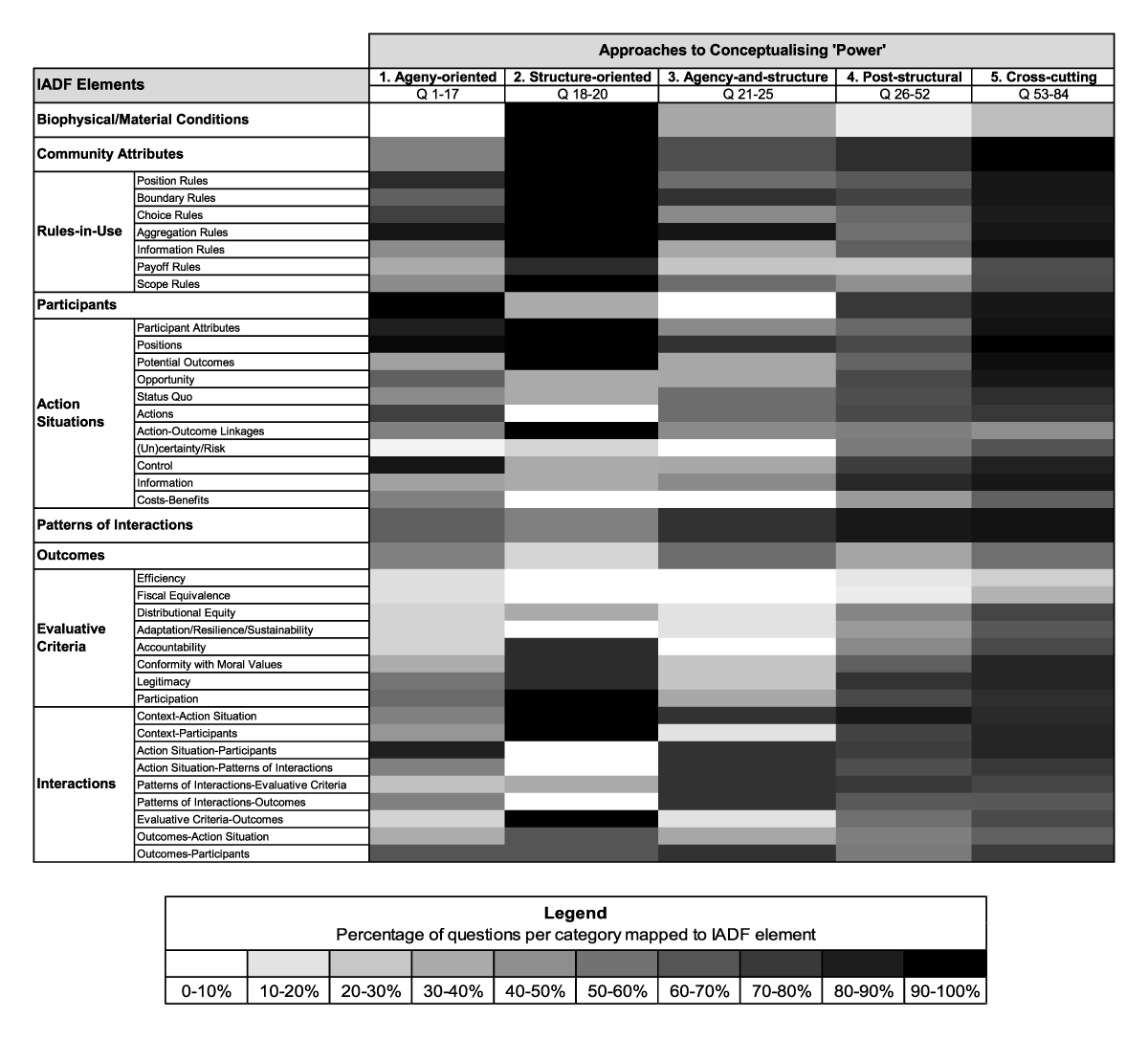
Figure 2a
‘Heat map’ overview of power questions mapped to IADF elements.
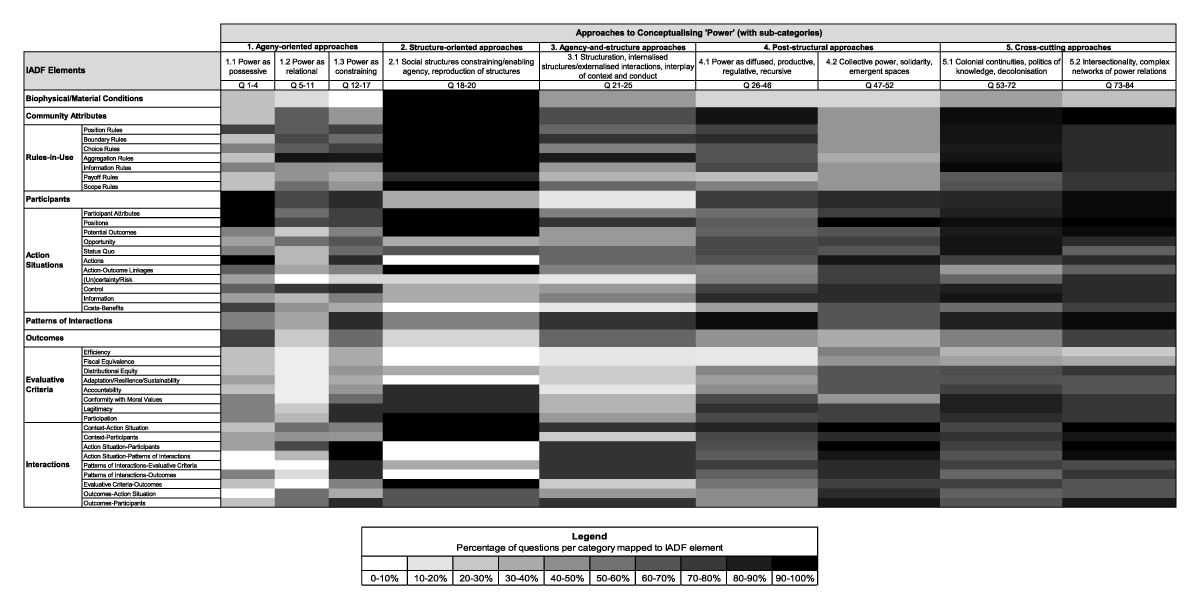
Figure 2b
Detailed ‘heat map’ of sub-categories of power questions mapped to IADF elements.
Figure 2a indicates thematic patterns:5 agency-oriented questions concentrate on micro-dynamics of participants, their attributes, and respective positions within action situations, whereas structure-oriented questions emphasise institutional and environmental constraints of biophysical/material conditions and rules. Bridging these categories, agency-and-structure questions analyse the recursive dynamics of interactions, while post-structural and cross-cutting questions prove relevant across almost all IADF elements. A critical nuance identified in this process is that adopting different analytical foci within these categories reveals how power is not a static variable but continuously (re)produced (Figure 2b).
Questions from various epistemic origins relate to IADF elements differently. We illustrate this through the example of ‘Biophysical/Material Conditions’ (BMCs). Ostrom (2005) defines BMCs as conditions that affect which actions are physically possible, what outcomes can be produced, how actions are linked to outcomes, and which information is available to different actors. Conventional interpretations restrict BMCs to (geo)physical or biological parameters. However, our mapping reveals further complexity in how BMCs can be understood, particularly the social-ecological interrelatedness within which they are shaped and (re)produced. This is illuminated by questions in the tradition of Marx (Q 18-20), centring social structures shaped by material conditions as an object, constraint or enabler of change, Bourdieu (Q 22), focusing on how different forms of capital influence agency, Allen (Q 49-50), investigating collective power and solidarity in relation to emergent spaces, Escobar (Q 53-56) addressing politics of place, Tsikata (Q 79-91) exploring land rights and access to resources in the context of gender, power, and institutions, or Shiva (Q 82-83), linking patriarchy to ecological degradation and commodification of nature. Asking questions inspired by these approaches offers inquiry beyond BMCs themselves, examining how people/institutions relate to and are shaped by them. This allows explicit analysis of how BMCs are (re)produced by broader processes of global interconnectedness and interdependence (e.g., colonialism, globalisation, etc.), alongside associated (un)intentional practices of domination. Similarly, hidden and complex power dynamics operating within other components of the IADF are illuminated through examining them across different epistemological lenses of power.
Most of the mapped questions are relevant for several components of the IADF. It is important to consider these questions separately across components, as each element refers to different features/interactions characterising institutional arrangements, and therefore equally diverse power dynamics operating across them. For example, the agency-oriented question ‘Which strategies are the most effective to achieve certain outcomes?’ (Q 2) can be interpreted in different ways. When applied to ‘Participants’, it asks how they strategically deploy social or symbolic capital to gain dominant positions within negotiations. For ‘Rules-in-Use’, the focus shifts to how actors navigate regulations to serve their own interests rather than simply following institutional designs, while for BMCs, material resources are interpreted as strategic assets leveraged to secure favourable terms.
Figure 2b shows variation within categories of power questions across the IADF. We further illustrate this through four exemplary questions in Figure 3. Although all questions come from a post-structural approach, they differ in analytical focus and are thus not all relevant for the same IADF elements. The various grey shades in both heat maps (Figure 2a and b) indicate that even among questions of similar analytical focus, choosing specific questions can make a difference for each IADF component. This underscores the additional nuance that a thorough engagement with specific authors and power theories can uncover in institutional analyses.
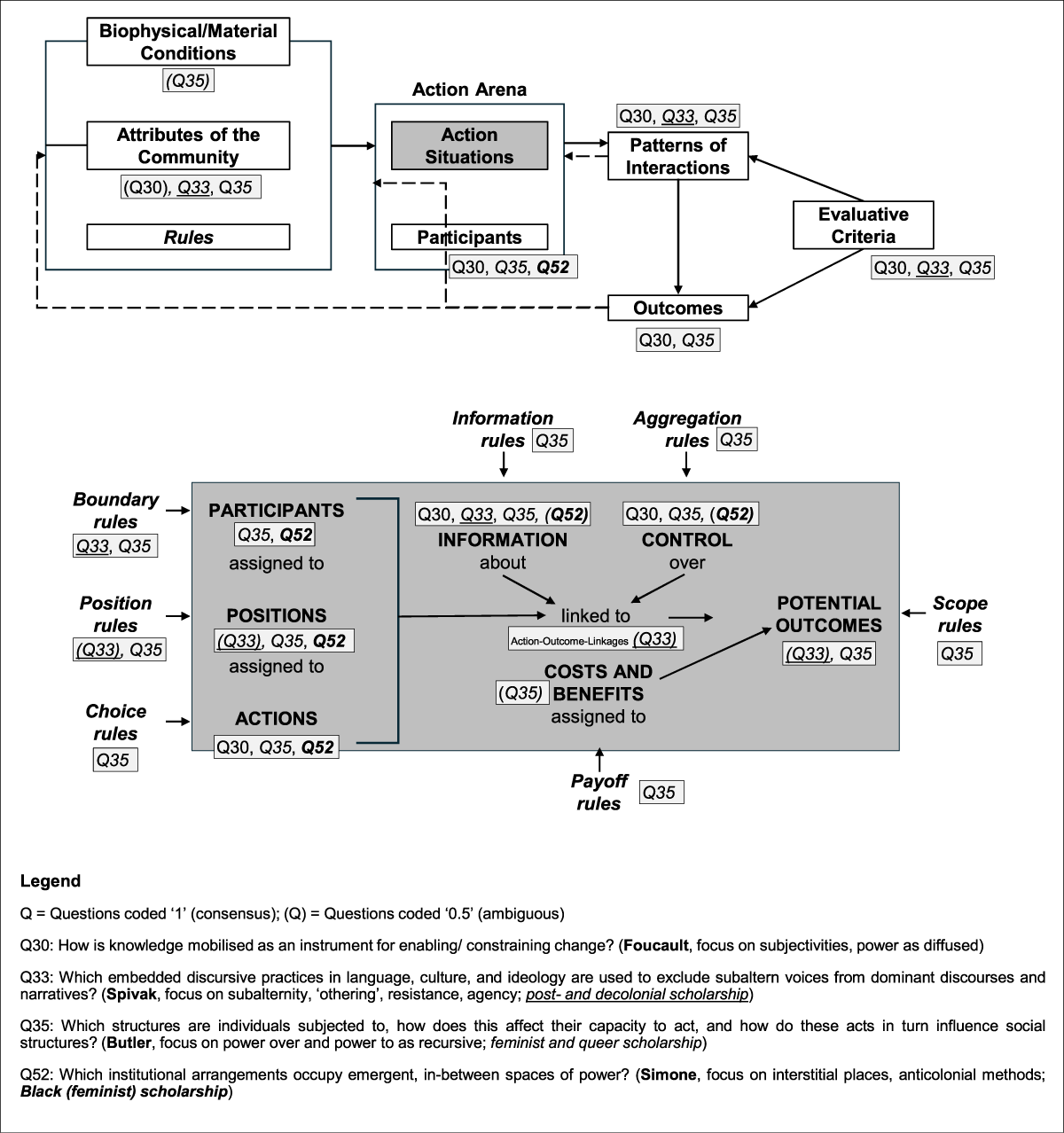
Figure 3
Mapping four post-structural power questions onto the IADF (adopted from Ostrom, Gardner & Walker, 1994 and Ostrom, 2005).
4. Reflections
We advance discussions of engaging with diverse critical power literature in commons research. In a novel approach, we have brought the IADF into simultaneous dialogue with western, non-western, and feminist epistemologies of power, showing that ontological and epistemological divides notwithstanding, it is possible for researchers to engage with diverse understandings of power using the IADF – thus exploiting its strength as a tool for institutional analysis. Examining IADF components in this manner shows that each component is (re)produced by power relationships that have occurred through temporal and spatial scales and affect the system under investigation. This becomes apparent when incorporating intersectional, decolonial, and other post-structural conceptualisations of power. Our results show the importance of including explicit consideration of power dynamics within each element of the IADF, against conventional interpretations that suggest modifying the framework to include a new ‘power’ element (e.g., Clement, 2010; Brisbois et al., 2019).
We recognise several limitations in our work. Our approach, while comprehensive from the perspective of its relevance to various IADF elements, does not constitute an authoritative all-encompassing account of power theories, scholars, or fields, providing scope for expanding our work. Despite our critique of injustices and hierarchies in knowledge production, we continue to participate in (re)producing these structures (e.g., using ‘classic’ power theories from the Global North as a starting point, only engaging with power theories from the Global South at a later stage, and presenting our process through this dichotomy). We further experienced tensions between wanting to simplify power theories and staying true to their epistemic origins.
Our selection and coding of empirical questions was collaborative and transparent, but relied strongly on our subjective interpretations, and should be understood as such. We collectively learned from unravelling disciplinary differences in understanding IADF components and determining (in)direct causal relationships and impact pathways, exploring different approaches to knowledge building. Making and using the framework is and will be shaped by continuous epistemological choices – depending on which approach is taken, one may arrive at different conclusions about which questions are relevant for each IADF component. This is reflected in our decision to embrace ambiguity whenever a unanimous coding decision could not be reached.
We imagine several directions for expansion into developing a diagnostic tool. Our list of questions could be further reduced and simplified, especially questions that address key themes and concepts similarly, while keeping all originating references. A second review could yield questions addressing nuances of power from literature we have not sufficiently engaged with (e.g., postcolonial and decolonial feminism, Dalit, and Indigenous studies6). We see great potential in extending definitions of different IADF components. While we acknowledge and respect disciplinary origins of the IADF, re-interpreting its components from an interdisciplinary perspective could make their (indirect) connections to questions rooted in feminist, subaltern, and post- and decolonial theories more apparent. Power questions from institutional scholars, while relevant, were not yet included in our theoretical framing and mapping. Going forward, these questions could be operationalised for potential applications of power theories to study institutions and environmental governance, enabling critical scholars to engage with the IADF.
Ultimately, we envision the diagnostic tool as a structured flow of specific questions to guide users, incrementally unpacking power dynamics of the SES under investigation. The tool could be further refined by testing its application to empirical case studies. Finally, a suitable format or platform to host the diagnostic tool has yet to be established. We imagine an interactive dashboard to zoom in and out of IADF components and explore power questions that could be asked within them, coupled with a tool to guide users through checkpoints of diagnosis. This way it can be used as a guided approach to engage with power in institutional analyses, both in structured as well as exploratory ways.
Additional Files
The additional files for this article can be found as follows:
Notes
[1] For similar approaches, see for example Urban ECA Collective et al., 2022.
[2] Overall, 40 components were identified, including main elements (biophysical/material conditions, rules, participants, action situations, patterns of interactions, outcomes, evaluative criteria), sub-components, and interactions. See Appendix 1 for complete list.
[3] Due to the initial sorting, this only included questions on agency, structure, and agency-and-structure.
[4] As a collective of interdisciplinary scholars interested in unpacking questions of power within our work, we recognise the privileges afforded to us because of our nationalities or affiliations – 5/7 of our members work in leading European institutions, while 4/7 identify as white people in Europe. At the same time, all of us are subject to at least one form of discrimination based on diverse characteristics including gender, race, and sexuality. These experiences shape our positionalities when working with notions of power within institutional arrangements.
[5] Category 2 only includes three questions from the same authors, whereas other categories include various authors and numerous questions (especially 4 and 5). This explains multiple instances of clear black or white shading for category 2 as opposed to nuanced grey shades in other categories. Thus, dark shades in categories 4 and 5 suggest strong relevance of numerous questions for respective IADF elements.
Use of Artificial Intelligence (AI)
We did not use any tools supported by generative AI in the process of writing this paper.
Acknowledgements
We thank the IASC-ECN for bringing us together, helping us forge strong friendships across diverse geographies, and connecting us to peers and mentors. We especially appreciate Eve Castille’s early ideating contributions to the IASC-ECN Power Collective, Praneeta Mudaliar’s mentorship during the IASC-ECN writing workshop in 2024, and the peer-to-peer feedback we received on early versions of this manuscript at IASC 2023/2025 and WOW 2024. We are grateful for the constructive feedback of our reviewers who helped shape this manuscript into its current form.
Author Contributions
This paper emerged through sustained contributions from each member of the IASC-ECN Power Collective for over two years. DS, LS, TPG, HU, ND, VH, and MG have contributed equally towards ideating, executing, writing, and presenting initial research at various fora. ND and DS contributed towards coordinating activities of the collective during different periods. DS eventually took leadership in drafting this manuscript based on collective input and thus serves as the corresponding author. LS, TPG, HU, ND, VH, and MG have all contributed as co-authors to this manuscript. We would like to acknowledge the barriers for serving as lead/corresponding authors for those without affiliation to western research institutions with journal agreements and funding mechanisms for open access publishing, a limitation that also affected our group.