
Introduction
Since the 1990s, literature reviews have shown that policies and practices related to ‘conservation’ often generate conflicts with ‘local’ communities. Here, ‘local’ is defined as smaller or larger groups who have lived in an area or territory for a long period of time — often centuries — which is now to be conserved by excluding these groups from the area, despite their collective sense of ownership. The term ‘local’ does not imply a homogeneous group, but rather groups of people who share a common sense of belonging and interact with each other, despite their heterogeneity. This is attributed to a lack of local acceptance (see, for example, Brockington et al., 2008; Galvin and Haller (eds.), 2008; and Mbaria and Ogada, 2016), a view that is also endorsed by the convivial conservation approach (see Büscher and Fletcher, 2020). However, the latter approach does not address the fact that the very notion of ‘conservation’ needs to be questioned, a point made explicit in the proposed concept of Convivial Constitutionality. Critical literature on conservation discusses how the separation of humans from the rest of the natural world is a colonial and post-colonial process of neoliberal capitalist extraction and exclusion of local people from ‘nature’ (see Fletcher, 2010). In this paper, I define conservation as both the ideology of ‘pure nature’ to be preserved in all its diversity, which often excludes the idea that humans shaped their environment and its diversity before colonial times, and the strategy of territorially excluding humans from these areas or only partially tolerating them (as with the six categories of the IUCN, three of which are less exclusive but still install top-down state regulation; see https://iucn.org/about-iucn). The problem is that these rules are often not negotiated with local communities, and these institutions (i.e. the rules) often reflect significant power imbalances between commoners and the state, as well as conservation NGOs. This working definition also encompasses the protection of animals, such as predators, outside conservation areas, given that these animals are mobile. However, the criteria for their protection outside these areas are also not established in consultation with the local people who have lived in these areas and been in contact with these animals for a long time, even before colonial times. Based on this working definition of conservation and protected areas, this paper will highlight the fact that the very notion of conservation involves the appropriation of cultural landscapes and their common-pool resources (CPRs, such as pasture, forests, wildlife, fisheries, and water). These resources have been created and managed by local communities for centuries, and are held in various forms of common property, based on ontologies that do not separate nature from culture (Haller, 2019a). Consequently, conservation initiatives encompass not only land grabbing but also the green grabbing of common property, which is legitimised by discourses of ‘pure nature’ and backed up by Western naturalist ontologies. This paper presents a complex theoretical argument incorporating several concepts, and attempts to demonstrate their intersections within the limited space available. First, I address a broader analytical model that combines new institutionalism in social anthropology (NI) with power analysis in political ecology (PE) to form New Institutional Political Ecology (NIPE) (Haller, 2019a, b). NIPE provides the theoretical basis for the empirical analysis of alternative processes to top-down conservation, known as ‘constitutionality’ (Haller et al., 2016, 2018). Coined to challenge Foucault’s ‘governmentality’ and Agrawal’s ‘environmentality’ (see Agrawal, 2005), this term is used to describe cases of successful, bottom-up institution-building processes for managing common-pool resources. These processes generate a local sense of ownership and embodiment. These processes address the colonial legacies of local and external power relations that have undermined local land ownership. At the same time, constitutionality processes incorporate local ecological knowledge to manage the commons, as well as innovations in the institutional development process relating to resource governance. Therefore, this theoretical paper proposes combining the term ‘convivial’ with ‘constitutionality’ rather than ‘conservation’, adopting it to the local development of institutions, including co-living with predators (Haller, Zangger and Weissman, 2020).
This theoretical paper first outlines the differences and similarities between old and new conservation approaches, considering them in the context of predators and critical literature on participation in conservation. Secondly, it discusses the colonial roots of the perception of the environment as ‘pure nature’ and considers the relevance of this perception to green commons grabbing and criminalization in the context of conservation. Thirdly, it contrasts the concept of ‘pure nature’ with insights from ecological anthropology, commons theory, and approaches that focus on local institutions and ontologies related to predators as part of local commons. Fourthly, the paper explains the NIPE approach, on which the fifth section is based. This section refers to a commoners-wolf project in Switzerland and initial findings from comparative research on human–predator interactions with jaguars in Ecuador, wolves in Romania and lions in Kenya. It outlines what convivial constitutionality could mean in these cases.
Conservation models, predator labeling and participation in conservation
Extensive summaries of critical literature on conservation describe both fortress and participatory forms (see West et al., 2006; Brockington et al., 2008; Haller and Galvin, 2011; Mbaria and Ogada, 2016; Büscher and Fletcher, 2020, for example). In their analysis, Büscher and Fletcher identify four main contemporary conservation approaches: a) mainstream conservation, b) neo-protectionism, c) new conservation, and d) convivial conservation. While both mainstream and new conservation are capitalist, the former is based on the nature-human dichotomy, whereas the latter is not. Neo-protectionism and convivial conservation, on the other hand, are anti-capitalist. However, the former is based on the nature-human dichotomy, which the latter rejects (Büscher and Fletcher, 2020). One of the fundamental issues is that all these conservation approaches use a very vague notion of ‘people’. They do not reflect local societies and their cultures, which have been living in and transforming their environments into cultural landscape ecosystems for centuries. Convivial conservation, as proposed by Büscher and Fletcher, differs from the other three in that it is much more nuanced, addressing values of nature other than capitalist and naturalist ones. It also briefly focuses on the colonial roots and ongoing green grabbing (Benjaminsen and Bryceson 2012; Fairhead et al., 2012) carried out in the name of conservation. Ultimately, however, they advocate this concept, and, in my interpretation, they advocate the conservation of nature in a more participatory and democratic manner. Although they advocate for the conviviality of humans and nature (see Büscher and Fletcher, 2019, pp. 286–288), they fail to recognize that nature is co-created and maintained in its current form by the local people’s common property institutions, as outlined in the overview papers (see Haller, 2019a, 2022; see also the sub-chapter on social anthropology and commons theory below). In my opinion, all four positions ultimately advocate for the conservation of nature. In the context of convivial conservation, this is achieved by conserving species such as large carnivores in a more convivial manner than other approaches propose (see Krauss et al., 2025). These predators, including lions, jaguars, tigers and wolves, as well as bears, are considered extremely important for global conservation. This is because they are described as keystone species, which have a significant impact on the ‘health’ of the ecosystem (see Paine, 1995); umbrella species, whose protection also benefits other species (see Simberloff, 1998); indicator species, which reveal the state of the ecosystem (see Caro and O’Doherty, 1999); and flagship species, which attract attention and elicit sympathy and a ‘sense of responsibility’. This is then used to raise funds from donors and to promote tourism, and simultaneously serves as a powerful discourse to legitimize territorial claims to protect these dangerous yet attractive animals (see also Skibins, 2015) – an important issue also addressed by the convivial conservation approach (see Krauss et al., 2025). In local contexts, however, large carnivores do not generate income; in many areas, they can pose a threat to human life and livestock, evoking strong local emotions (see Meroka, 2010; Mbaria & Ogada, 2016). Conservationists often refer to such contexts as human-wildlife conflicts. However, focusing on conflict obscures the fact that, in most parts of the ‘glocal’ world, local societies have lived with these predators for centuries. This fact is not reflected in the dominant conflict narrative (Frank et al., 2019). Rather than describing it as a human-wildlife conflict, if there is one, it could be perceived as an ‘external’ human–’local’ human conflict (see also Büscher et al., 2014; Weissman 2019; Frank et al., 2019; Büscher and Fletcher 2020).
As a consequence of such conflicts, especially those involving state-controlled predators harming local people and their domesticated animals, as well as the general failure of fortress conservation since the 1980s, the need for more inclusive, participatory approaches has been discussed in different academic disciplines. It has been argued that fortress conservation is failing because it is too expensive, and that it needs to be replaced by conservation approaches that are more participatory and take development issues into account (see, for example, Hulme and Murphree (eds.) 2001; Brockington et al., 2008; Galvin and Haller (eds.) 2008). However, critical literature has also addressed the concern that community conservation approaches could be a Trojan horse for the reintroduction of centralized conservation in community form, given that the traditional ‘direct’ fortress approach has failed (see Cooke and Kothari, 2001; Blaikie, 2006; Galvin and Haller, 2008; Brockington et al., 2008; Hara and Haller, 2014; Haller eds. 2010; Haller, 2013). The following five issues can be addressed regarding participatory forms of conservation, as stemming from several interdisciplinary and anthropological research projects conducted over the last 20 years (Galvin and Haller, eds., 2008; Haller, ed., 2010; Hara and Haller, eds., 2014).
1) Divergent understandings of ‘local’ participation: There is a fundamental misunderstanding between NGOs and governments, particularly in the Global South, about what participation means. However, as Galvin and the Haller (2008) demonstrate, local groups often feel merely informed, rather than involved, in decision-making processes concerning the meaning and implementation of conservation.
2) Cost-benefit analysis is often negative. Comparative work has shown that community or joint management generally externalizes the costs of monitoring onto local people, while income from jobs or tourism is generally minimal. Wildlife, both predatory and non-predatory, often moves outside protected areas in the already changing environment of commercial plantations and segregated protected areas based on conservation ideology, causing severe damage to crops and livestock and threatening local people (see Meroka, 2010; Haller et al., 2008).
3) No restitution of local common property: In none of the cases that our team has studied, including those concerning commons in African floodplain ecosystems (Haller, 2010), large-scale land acquisitions (Haller et al., 2020), and commons in southern Africa (Hara & Haller, 2014), has the former common property been returned to the local communities from which it was removed during the colonial and post-colonial periods when the number of protected areas increased substantially (see also Brockington et al., 2008). Furthermore, co-management, community-based natural resource management (CBNRM) and other conservation systems did not allow local communities to make decisions on how to manage common pool resources and protected wildlife, including predators (Haller ed. 2010; Haller, 2013). In the context of decentralization, there is a process of re-centralization, as state officials and NGOs mainly define the conditions for hunting and resource use. Poteete and Ribot (2011) refer to this as ‘repertoires of domination’.
4) Imposed design of participation without consideration of local power structures and elite capture: However, governments and NGOs sometimes claim that ‘local communities’ have participated in collective decision-making and agreed on a conservation agenda. However, a closer look at such examples reveals that local communities are never homogeneous, but rather fragmented, and that there are serious power asymmetries, which are often inherited from the colonial past. In many African contexts with a history of British rule, local chiefs are perceived as traditional, but in fact they were introduced by the colonial administration for the purpose of indirect rule (see Mamdani, 1996; Haller, 2013).
5) Institutional pluralism and the paradox of the state’s presence and absence:
In the cases mentioned in paragraph 3, there is a great deal of local mistrust of the ability of state officials to help with local conservation, apart from the elites (and sometimes including them). This is because, since colonial times, ecosystem resources have been managed separately by different state agencies (e.g. controversies between the ministries of energy and water, and the ministry of wildlife, in several African countries), and these structures have been maintained in the context of post-colonial, so-called independent states. However, even if a state is willing to protect wildlife or fisheries, for example, it is often not present. Several of the areas studied demonstrate that local states in the Global South are facing debt crises and lack the financial means to manage, monitor, and consistently enforce the use of protected areas based on conservation ideology. External users, however, claim to be citizens of the state and to have free access to resources that are no longer part of the local community. They therefore benefit from the discourse of being citizens of a state that is absent and unable to monitor and sanction overuse, as demonstrated in conservation areas in African floodplains (see Haller, 2010).
The colonial legacy of violent expulsions, green commons grabbing and criminalization
These five issues are difficult to raise because of the central and powerful ideology of ‘pure nature in peril’, which is based on the Western notion of conservation and underpinned by the ontological power of naturalism. This ideology forms the basis for both fortress conservation and co-management conservation. However, there are three problems with the concept of conserving pure nature. Firstly, local resource use, which was often regulated over centuries or millennia, has been criminalized since colonial times. Colonial governments often referred to local hunting as ‘poaching’, contrasting it with the ‘wise use of resources’ or ‘sportsmanlike hunting’ of the feudal colonial rulers (see Neumann, 1998). This has led not to conservation, but to the massive loss of wildlife, as sport hunting came at a considerable cost to wildlife. Interest in trophy hunting was high, and wildlife was seen as a threat to plantation agriculture that had to be eradicated (see Mbaria and Ogada, 2016). At the same time, access to communal land and related resources for local groups was undermined (see Haller et al., 2010; Haller, 2013, 2019a, b), and human rights violations occurred, especially in the post-colonial period, as local hunting institutions were eradicated or banned (see Haller, 2013; Ramutsindela, Matose, Frank, & Mushonga, 2022).
Secondly, the creation and expansion of protected areas have led to the massive fragmentation of landscapes that were once managed as part of the commons under common property regimes, but which are now managed by different government departments. These state entities are often poorly managed by governments in the Global South that lack the financial resources to fund law enforcement, resorting to the irregular use of force instead. At the same time, as outlined above, local institutions have been eroded, often leaving wildlife unprotected and creating a context of de facto open access that is overexploited when wildlife prices are high. Alternatively, wildlife is sold as private property, resulting in high profits from tourism (see Galvin and Haller, 2008; Brockington, Duffee and Igoe, 2008; Igoe, 2004), or for the financial and recreational benefit of the super-rich (see Farrell, 2020).
Thirdly, as our comparative research projects referred to above have shown, undermining local resource systems through colonial and neo-colonial green grabbing has led not only to commons grabbing and a loss of local management and maintenance of local cultural landscape ecosystems, but also to increased use by external users, as the state’s capacity to protect these areas shrinks due to financial problems (e.g. debt crises). This means that neither local people nor state actors can respond effectively (Haller, 2019a).
Insights from ecological anthropology including commons theory and ontological turn
These three conservation issues – criminalization, fragmentation, and the undermining of local resource use systems – should be addressed by disciplines other than conservation science. These disciplines include human ecology, social anthropology, political ecology, and commons theory, all of which also address the ontological turn. The conservation of predators is particularly relevant in this context, as it is closely related to criminalization (see Ramutsindela et al., 2022). Three findings from a selection of ecological anthropology literature are helpful here (see also Haller 2019b).
A) Firstly, there is no such thing as pure nature. Ecosystems are what they are biologically because of human interaction, particularly through subsistence activities over the long term (see Ellen, 1982; Fairhead and Leach, 1996; Haller, 2013). The term ‘nature’ encompasses human interactions of various forms and intensities ranging from extensive hunting, fishing and gathering to pastoralism, shifting cultivation and intensive agriculture, including multi-cropping systems such as those found in Asia. While the latter leave clear visible traces, the former are not easily perceived and are only recognizable by their absence. For example, the exclusion of hunters and predators such as wolves, and the prohibition of burning, in the Yellowstone National Park area has led to overpopulation of elk and deer and destruction of tree cover (see Farrell 2015; Stark et al., 2022). This is a misreading of cultural landscapes (Fairhead and Leach 1996). Similarly, the organization of a human-free European Yellowstone in Romania might face the same consequences (Iordachescu, 2018).
B) Not res nullius, but common property. All of our concrete research literature on land and resource use in PA areas (Galvin and Haller, 2008; Haller and Chabwela 2009, Chabwela and Haller, 2010; Haller, 2013 and 2019a) confirms that the colonial res nullius ideology of pure nature, as well as the notion of wilderness, did not recognize local subsistence patterns or local notions of land ownership and land-related common pool resource use based on common property (see Ostrom, 1990) and the related institutions (rules) of local communities for managing these resources. For more information on this, see West et al., 2006; Neumann, 1998; Brockington, 2002; and Haller and Chabwela, 2009, Chabwela and Haller 2010 for African cases, as well as Iordachescu, 2021 for European countries such as Romania. These range from the clear defense of territories and access based on membership rules, to the permeability of resource boundaries and reciprocal access rules. Additionally, many rules apply to the temporal intensity of use, the use of technology, and the coordination of these resource uses. This is not related to sustainability in environmental science and economics, but rather to the coordinated use and distribution of resources (see Galvin and Haller (eds.), 2008; Haller 2010, 2013, 2019a; Hara and Haller, 2014).
C) Non-naturalist ontologies and more-than-human commons: Local commons include humans and non-human species. In many pre-industrial societies, as well as in some remote farming communities in the Global North and many parts of the Global South, the environment is not divided into nature and culture, as in the so-called Western ‘naturalist’ ontology (see Descola, 2013). Instead, it is perceived as being full of non-human and spiritual actors, with whom one must have a good relationship in order to use cultural landscapes and their plants and animals (see Berkes, 1999). It is thus a co-world, or Mitwelt in German (Haller, 2019c), and the notion of the commons is a shared ‘kind of property’, meaning that all activities must be carried out relationally (see Escobar, 1999; Haller, 2019b). This approach acknowledges the consent of the non-human world from a local perspective. In social anthropology, this concept is referred to as animistic, totemistic or analogistic ontologies (Descola, 2013). However, this does not refer to the sacredness of the environment as such, but rather to a particular kind of everyday relationship with the environment, with which commoners feel connected and dependent. Therefore, in a local non-naturalist ontology, the commons are understood more broadly to include non-human ‘actors’. As with human relationships, these relationships are not taken for granted but must be maintained, often through ritual (see Berkes 1999; Haller 2019a, b, c; Bowie 2000). Furthermore, many features of ‘traditional’ or local ecological knowledge (TEK or LEK) are embedded in this view (see Berkes, 1999), helping to reproduce it. This is similar to Escobar’s (1999) view of so-called ‘organic’ nature. It has also been demonstrated that the notion of ‘co-world’ or Mitwelt is alien to conceptions of nature situated within political constructions of the Global North, being related to a capitalist notion of value (see Fairhead and Leach, 1996; Berkes, 1999; Haller, 2013, 2016; Galvin and Haller (eds.), 2008). Berkes (1999) further argues that this co-world could be seen as part of a local, inclusive worldview embedded in underlying layers such as social institutions (e.g. rules, property systems and regulations), land and resource management systems and traditional ecological knowledge (TEK or LEK), including local knowledge about land, soils, landscapes, plants and animals (including predators).
These insights from social anthropology, focusing on predators, make it clear that, from the perspective of different local societies, these predators were part of the pre-colonial resource management context and of the predator–prey system, just as humans were and are. Therefore, these CPRs are not only used by humans, but also by apex predators in the case of other wildlife. These predators are also part of the local commons and are therefore ‘commoners’ from a local emic perspective. While pre-colonial contexts in Africa, Latin America and Asia indicate a regulated, albeit non-harmonious, coexistence between carnivores and humans, conservation measures have often contributed to human–wildlife conflicts, as carnivores are mobile and move out of protected areas (e.g. lions in Africa and tigers in Asia) into smaller areas used by humans. Here, their livestock or loved ones may be attacked without any means of defense (see Galvin and Haller (eds), 2008; Meroka, 2010). Although conservation is a broader term, protected areas are a tangible manifestation of conservation ideology and the naturalist view of pure nature.
New Institutional Political Ecology (NIPE) and Challenges to Convivial Conservation
I argue that the issues of conservation and commons grabbing in the context of predator conservation, as well as anthropological insights, can be effectively integrated by a new model called New Institutional Political Ecology (NIPE). This model provides a pre-analytical framework for developing an alternative to convivial conservation (Haller, 2019a), known as convivial constitutionality (Haller, Käser, F., & Ngutu, M. 2020). It helps us to understand how land transformations that precede new conservation developments are an institutional outcome of not only colonial and postcolonial land grabbing, but also green and commons grabbing, through the use of structural (capital), discursive, and ontological power attached to predators.
NIPE has two elements: First, it draws on the New Institutionalist (NI) approach to social anthropology, as outlined by Jean Ensminger (1992), to help understand the historical processes by which the relative prices of goods and services change (Figure 1). In the context of conservation, the model helps us to consider how external environmental, demographic, and technological features can increase the value of wildlife. Focusing on predators, once they are labelled as ‘flagship species’ for a certain landscape, their relative value rises and this affects the ‘internal box’ in the model. These predators were previously managed by common property institutions. This gives the state, NGOs, and wealthy conservation organizations more bargaining power than local inhabitants when it comes to management decisions or changes to property institutions because the relative price of land for protecting flagship species is higher than for other land uses (e.g. agriculture). In this paper, the focus is on predators, not only as keystone, umbrella and indicator species, but, more importantly, as flagship species in relation to their ‘natural land’ (i.e. their natural habitats without human influence) compared to other land uses by local people. In the so-called ‘internal box’, which is an arena of interaction between local actors, external actors have more bargaining power to change property institutions. From the diversity of previous property types, including state and private property, they select and activate state or private property, especially in the context of predator conservation. This process is referred to as ‘shopping’ in the NI (see Haller, 2010, 2013, 2020). The ideological justification for this is that the former cultural landscape, formed by local common property institutions, is now labelled ‘pure nature’ in danger, including important predators that require large landscapes. The narrative of this legitimacy claims that local people are harming nature, especially predators, and that conservation is needed, often in the form of protected areas or top-down co-conservation. This legitimacy is then used to establish the organization of the territory as a fortress, whether state-, private- or elite-controlled, and to criminalize local groups and societies. This process leads to a specific form of distribution that displaces local societies, resulting in the loss of their commons and livelihoods. This further contributes to local backlash and the criminalization of local people by state and private actors. Consequently, this leads to a further reduction in wildlife and predators, as well as an increase in their value (see Ensminger’s model of institutional change, as extended by author in 2013, as shown in Figure 1).
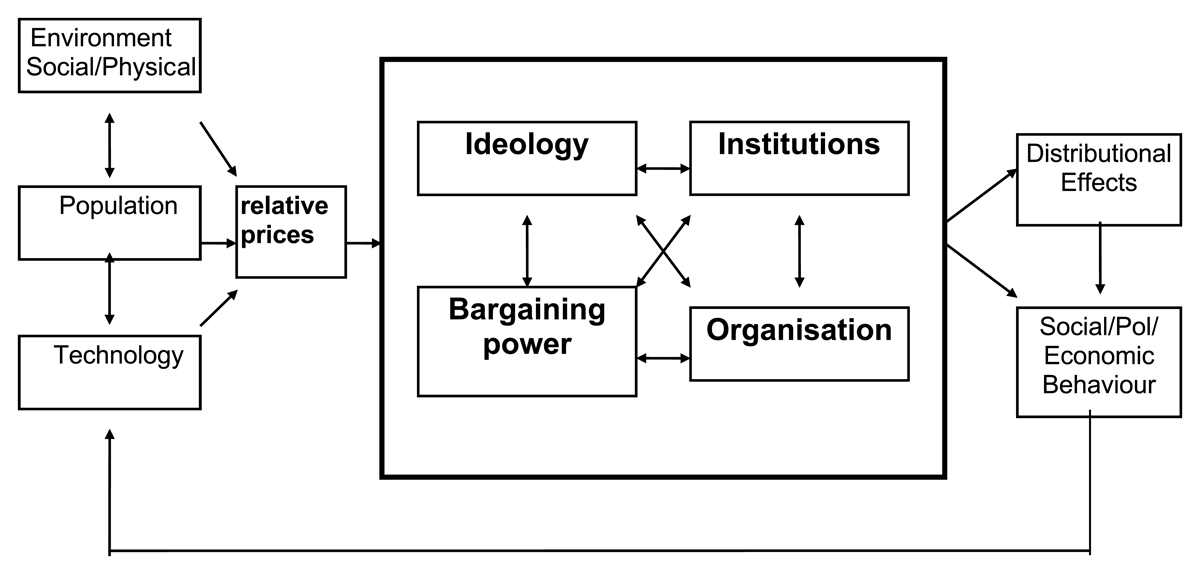
Figure 1
Modelling institutional change.
Source: Ensminger 1992:10, modifications by Haller 2013.
However, the model lacks an explicit discussion of the power dynamics that unfold in this process (see Figure 2), which is a key aspect of political ecology approaches. The analysis of power in three forms is important here: a) structural power (capital); b) discursive power (hegemonic development, pure nature and conservation discourse); and c) the ontological naturalist power of pure nature (Svarstad, H., Benjaminsen, T. A. & Overå, R., 2018; Sullivan, S., 2017; Fabinyi, M., Evans, L. & Foale, S. J., 2014; Descola, 2013, as summarized by Haller, 2019, a, b). In particular, state and private actors heavily exploit the ontological power of naturalism to separate ‘nature’ from local societies and their cultures. This argument asserts that biodiversity is ‘natural’ yet endangered by local communities. This idea is embedded in the general neoliberal conservation trend and in international frameworks such as the Sustainable Development Goals (SDGs), which completely lack consideration of local common property, the institutions that manage common-pool resources, and the non-naturalist context (see Haller et al., 2018; Larsen, Haller, and Kothari et al., 2022). It is also important to note that non-naturalist ontologies can be influenced by naturalist ontologies, and local actors can exploit this power to make strategic claims if it serves their purpose, such as excluding external or internal users by more powerful groups or individual actors, akin to ‘ontology shopping’ (see Comaroff and Comaroff, 2001, or Agrawal, 2005, for discussions of local group positions in India, and Haller, 2013, for a discussion of chiefs in Zambia). Thus, by combining NI and PE, the NIPE model demonstrates how the conservation value of land can be increased and how the naturalist powers of discourse, structure and ontology, which separate nature from culture, can pose a significant challenge to the bargaining power of local societies and their cultures. Once the conservation value of land has been increased, often with the help of predators acting as keystone species that require large areas of land free of humans, powerful actors use all three elements of power to select the tenure institutions of human-free protected areas. This transformation is based on the institutional change from common to state property that occurred during the colonial period, and which is now the private property of conservationists, who use it to conserve flagship predators, for example. This form of protection has value in tourism (structural power), facilitating the conservation of more than just predators (discursive power), based on pure nature assumptions (naturalist ontological power). However, this perspective completely ignores the fact that local societies lived alongside these predators for centuries. Unfortunately, similar processes involving top-down participation occur with different forms of community conservation or co-management organizations, as outlined above. Furthermore, powerful conservation actors use all three types of power to organize and distribute benefits and costs, and influence local strategies, which are often forms of resistance, either open or hidden.
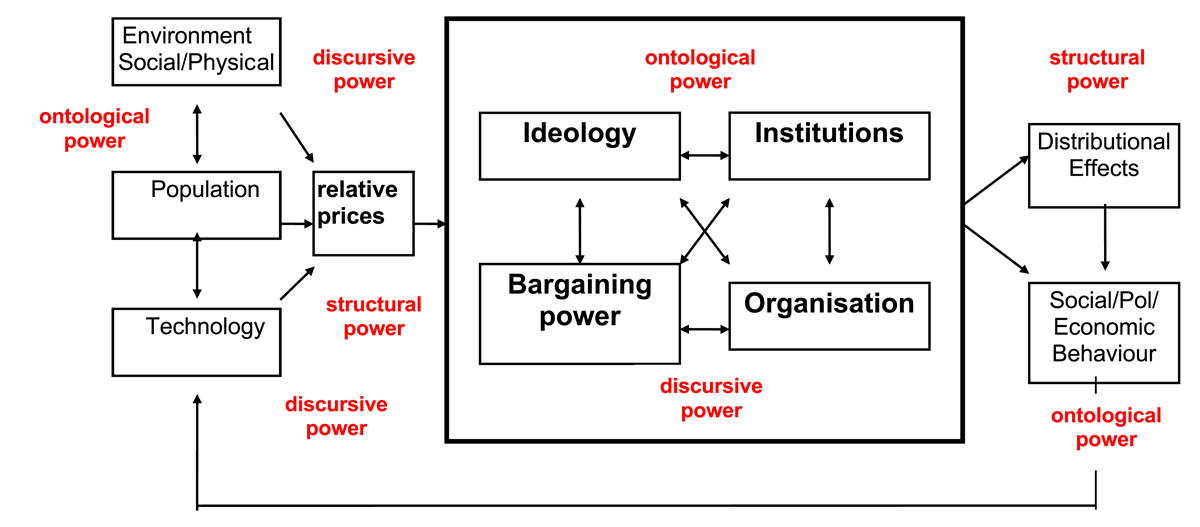
Figure 2
The NIPE Model of Institutional Change: Combining New Institutionalism and Political Ecology.
Based on Ensminger 1992:10, adapted by Haller 2019.
But how can local, emic views of the entire process be incorporated? NIPE provides several elements that are missing from convivial conservation. Despite its reference to ontology, a closer look is needed at the local (emic) perspectives of different societies and their cultures on what are called ‘nature’ and ‘conservation’. As mentioned above, Büscher and Fletcher (2019: 286–288; 2020) argue that nature and culture should not be separated, meaning that predators and humans, for example, occupy the same space and are part of a democratic system and an embodied form of income. Convivial conservation therefore argues for a shift away from protected areas towards promoted areas. However, as explained above, this approach does not take into account the fact that most of these areas are already managed as common property by local institutions with non-naturalist ontologies. Reflecting on ontology leads me to my second point: cohabitation and conservation. Local commons are cultural landscape ecosystems, not just spaces of cohabitation, and they need to be used based on agreed local institutions, not ‘conserved’. This takes us back to the previous issue that the terms ‘conservation’ and ‘nature’ are alien to local societies. While Büscher and Fletcher (2019: 286–7) argue for the integration of ICCAs/Territories of Life and indigenous communities, their ontologies are not really reflected in relation to the term ‘conservation’. This becomes clear as they now refer more to the notion of Territories of Life than to the abbreviation ICCA (Indigenous and Community Conservation Areas). While nature as a spectacle is part of capital power, it must be emphasized that it derives its legitimacy from naturalist ontologies and the conservation discourse. This is only partially acknowledged by Büscher and Fletcher (2019: 288; 2020). Finally, calling for a shift in focus from specialist knowledge based on naturalism to local LEK and TEK is important, but it does not address the problems with top-down participation, which is the central issue of the constitutionality approach. Of the articles in the special issue edited by Massarella et al. (2022), only Toncheva et al. (2022) discuss local power asymmetries and the ways in which the bear co-habitation process has elements of constitutionality (see below). This brings me to the added value of the NIPE model. While convivial conservation discusses how structural power affects conservation, it does not demonstrate how feedback loops work to increase this value.
The NIPE model can, however, explain several issues that go beyond the convivial conservation approach. Firstly, it explains why territories gain value as protected areas in general, and as predator territories in particular. Secondly, it provides a much more concrete analysis of what is referred to as ‘equity’ in the convivial conservation approach due to the issue of participation from various political-ecological power analysis: Although convivial conservation claims not to separate nature from culture, it fails to incorporate local perspectives on areas influenced by pre-colonial common property institutions, perpetuating the notion that these are natural spaces to be protected (see Büscher and Fletcher, 2019, pp. 286–288). Although it critiques the separation between humans and wildlife, especially predators, it still uses the terms ‘conservation’ and ‘nature’, which are not commonly employed in non-naturalist indigenous ontologies (see Büscher and Fletcher, 2020). Interestingly, some of the new literature on convivial conservation concludes that the term ‘conservation’ needs to be reconsidered in light of convivial constitutionality (Toncheva et al., 2022; Toncheva et al., this special collection), or indirectly in relation to elements of the approach (Mabele et al., 2022; Komi & Kröger, 2023; Kiwango et al., 2022, to cite a few; see footnote 1 for further discussion).1 Thirdly, NIPE does not just address humans or people, but also societies and local groups, including the cultures that have shaped cultural landscapes over centuries or millennia. While convivial conservation still uses naturalist ontological power to view the ‘environment’ and predators as part of this environment (see Krauss et al., 2025), it also makes reference to indigenous peoples (through the ICCA/Territories of Life) and the value of nature beyond human capital value interests (see Büscher and Fletcher 2019: 286–288). But NIPE incorporates local animist, totemist, and analogist ontologies more specifically, which shape local people’s relationships with their surroundings from their perspective. Through these ontologies, naturalist ontological power is either hidden or openly contested. Fourth, NIPE recognises that in the institutional governance of commons systems, local perspectives encompass not only local humans, but also the local non-human worlds, which are also commoners (see Haller, 2019a, b, 2022). Thus, NIPE helps analyze what ‘conviviality’ — living together — might mean from an ‘emic’ perspective. It enables a critical examination of debates about participation, moving beyond the concept of conservation which is rooted in colonialism. It also provides tools for analyzing structural, discursive and ontological power, which can be used to define what participation means and how conviviality should function. It also means reflecting on the conditions under which new, bottom-up institutions could emerge and be recognized, based on previous commons property institutions and critically reflected upon locally. My point is that the critique of convivial conservation is that there is a need to reflect beyond the colonial term ‘conservation’ because it does not sufficiently account for local perspectives and emic non-naturalist viewpoints regarding what we term ‘nature’, nor does it consider common property institutions enough. The ICCAs cited by Büscher and Fletcher have reflected critically on the term, referring to themselves as Territories of Life rather than conservation areas (see Borrini-Feyerabend and Jäger, 2025).
Convivial Constitutionality: Local collective ownership of bottom-up institution building processes for co-living with predators
Although many green commons can be shown to have been ‘grabbed’ via conservation, not all of them lead to tragedies. In rare cases, local groups develop alternatives that go beyond conservation issues and incorporate critical aspects discussed in the NIPE approach. For instance, some consider how external processes have influenced the relative prices of a resource or the value of an area to be conserved for predators, which has reduced local bargaining power. These cases demonstrate that raising local bargaining power and enabling local decision-making can combine local views, which are embedded in non-naturalist ontological perspectives, with new ideas on how to manage resources or live alongside predators. I refer to this as the constitutionality approach: an empirically explored sense of local ownership of institution-building processes for common-pool resource management, as seen in rare cases of successful local initiatives (Haller et al., 2016). By ‘success’, I mean that local communities created new rules and regulations themselves in response to the overuse of CPRs (such as fisheries or forestry), due to processes that the NIPE analyses as ‘commons grabbing’ based on a pure nature ideology and naturalist ontological power. The term ‘constitutionality’ was coined as an alternative to ‘governmentality’, a term coined by Agrawal to describe how local people in India embody top-down state rules regarding forestry (Agrawal, 2005). However, with regard to constitutionality, I would like to highlight that there are empirical cases of institutional building processes for common pool resources (CPRs) under pressure that do not follow the top-down environmental embodiment induced by states, but rather constitute a direct and concrete process of local shaping and crafting of institutions. Despite power asymmetries within local groups, all local stakeholders participated in this process and created rules that they later perceived as their own, giving them a sense of ownership of the institution-building processes (Haller et al., 2016; Haller et al., 2018; Haller and Merten, 2018; Merten and Haller 2023). Various research projects since 2005 have shown that an important aspect is paying attention to heterogeneity within local groups. Examples include fisheries in Zambia and Indonesia, local conventions on mixed resource management in Mali, forestry in Bolivia, Israel and the USA (Montana), and hunting in Bolivia. One concrete example is the creation of local by-laws to complement national fishery laws, which was initially successful among the Ila and Batwa societies in the Kafue Flats in Zambia (see Haller and Merten, 2018). As highlighted in this and the other case studies, discussions on new rules were held within different user interest groups, which did not exclude local elites but reduced their power. Often, men and women also discussed separately. Following these initial discussions, the results were primarily compiled by external, neutral agents, ensuring that everyone had a say in drafting the final rules. It was also important to discuss how they wanted to manage the resources in their cultural landscape ecosystems, including non-naturalist ontologies, and to anticipate the destructive changes of the colonial and post-colonial past. All four cases exhibited similar preconditions relating to NIPE. (a) Emic (local) perceptions of the need for new institutions: As NIPE shows, value shifts have occurred in local contexts due to external forces empowering external actors. These actors can use structural, discursive, and naturalist ontological power to undermine local institutions. The absence of the latter, coupled with the inefficiency and injustice of state institutions, requires new rules.
(b) Participatory processes that address power asymmetries. Colonial, state and private capital investments have exacerbated existing or emerging internal power asymmetries. Therefore, there is a need to redress colonial and post-colonial inequalities between external and internal actors, as well as between internal actors (elites), in order to avoid fake participation and instead achieve participation that includes all stakeholders and anticipates power asymmetries. (c) Pre-existing institutions: There is a need to recognize local pre-colonial rules relating to common property, cohabitation and predators. These rules are rooted in local non-naturalist ontologies, forming part of the shared world, the commons and local notions of family, clan and other forms of kinship. These can be helpful in adapting them and introducing innovations at the local institutional level. (d) External catalysts (fair platform): As there are often local and external-internal asymmetries in many contexts, it is necessary to create fair platforms so that everyone is included and elites (e.g. older men who exclude women and youth) do not take over in alliance with the state or NGOs in the name of participation. (e) Recognition of local knowledge (LEK) and innovative co-learning. The ontological issue, as well as the practical and everyday knowledge of LEK and Traditional Ecological Knowledge (TEK), need to be integrated in a locally driven manner, alongside local-level innovations. (f) ‘Higher-level state recognition’. This is important because if state officials do not accept the new, bottom-up institutions, their implementation may be jeopardized (Haller et al., 2016, p. 69).
Although the concept of constitutionality was primarily developed in the context of classic common-pool resource management in the Global South, an interesting Swiss case study by Zangger (2018) has sparked a discussion on combining Conviviality with Constitutionality. Zangger conducted research in the renowned Swiss Alpine village of Törbel, located in the German-speaking region of the canton of Valais. This village was previously studied by Robert Netting (1981) and was one of the primary case studies in Elinor Ostrom’s Nobel Prize-winning work (Ostrom, 1990). Ostrom’s research in Törbel also inspired her to develop design principles for robust institutions. Many changes have occurred in Törbel, and today the commoners are trying to adapt to the industrial world by working as well as farming. They face the strong devaluation of agrarian products by remaining part-time peasants and using the alpine pastures with not only cows, but also local Valais Blacknose sheep. However, wolves, once extinct with the help of the state, have returned from Italy since the mid-1990s and ‘profit’ from being an internationally protected species, as they are said to be good for the ‘wild’ ecosystem by keeping deer and other animals that could threaten forest ecosystems in balance. However, the presence of wolves in the area also resulted in attacks on sheep and posed a threat to the governance of parts of the communal pasture known as Moosalp. The institutional solutions that the commoners were developing demonstrate how Convivial Constitutionality could work. Following several serious wolf attacks resulting in a high number of fatalities, which led to the cessation of the summering season for sheep, the commoners’ organization decided to launch the first shepherd project in 2015. Unfortunately, the project was not a success due to several deadly wolf attacks and high losses of sheep. This was followed by a second project in 2017 with an experienced Romanian shepherd who brought his own Carpathian herd protection dogs and was responsible for installing the night pen. Romania has had wolves for a long time. Despite three wolf attacks, not a single sheep was injured (Zangger 2018: 76ff; see Zangger in this special collection). The case study of Törbel presented here is an example of a bottom-up institutional building process (Haller et al., 2016): the community of Törbel, including the mayor and local sheep farmers, recognized the need to reform their institutions concerning summer grazing on the Moosalp (emic perception of the need for new institutions and pre-existing institutions). As outlined in her paper in this special collection, this project shares many elements with the empirically analyzed constitutionality processes in cases in the Global South presented above.
Discussion: Using NIPE to enhance Convivial Constitutionality with predators
Theoretical discussions around NIPE demonstrate that conviviality should be associated with constitutionality rather than ‘conservation’. This enables an understanding of previous local forms of conviviality that are embedded in common property institutions and related non-naturalist ontologies. It can also address institutional change and ontological contestation (e.g. pure nature versus cultural landscapes), as well as local visions and institutional building processes that foster a sense of ownership — i.e. constitutionality — within this new colonial, postcolonial and state administrative context. Thus, the application of NIPE and constitutionality finally provides a vision of how new, bottom-up institutions for conviviality could be established. Zangger’s (2018) case study of Törbel (see also this volume) serves as an example. It was also one of the foundations of the SNSF-funded project on convivial constitutionality, of which the author was the Principal Investigator (Haller, Zangger and Weissman 2020). For this project, research was conducted in three different settings (see also Alvarado in this special collection), focusing on three animal/area comparisons: Romanian shepherd–wolf relationships in Romania; Kichwa–jaguar relationships in Ecuador; and Maasai–lion relationships in Kenya. The researchers aimed to provide data on: a) local institutions regarding land tenure and human–animal relations, which involve processes for dealing with predators, as with other beings; b) institutional changes in land tenure and property rights, which are related to the grabbing of commons; and c) the kinds of bottom-up institution-building that local groups and actors would propose in an experimental, participatory research approach. The idea of using a constitutional process also came from earlier research in Zambia, where a European NGO wanted to discuss new antelope hunting rules. Although these rules did not come to fruition, the process sparked local debates about new regulations alongside traditional collective hunting practices (Haller, 2013). The research in Törbel and the Zambian experience acted as inputs for the constitutionality experiment in the human-predator project. As the researchers of the convivial constitutionality project took local ontologies and perspectives seriously, it became clear that they were dealing with ‘more than predator relationships’. The detailed PhD case studies will be outlined in a separate paper in this special collection, as well as in other journals, and cannot be fully discussed in this paper. However, it can be said that in all these cases, large predators exist, but they are not the only problem. Rather, they are embedded in the problem of externally defined and shaped human–environment relations within the hegemonic state and ‘naturalist’ conservation ontology. Relationships with predators comprise various ontological elements as well as numerous practical features and clear rules relating to all levels of Ostrom’s design principles (Ostrom, 1990). Changes in the relative value of predators are important and related to processes of ‘commons grabbing’. These changes undermine local institutions, particularly property rights, as predators are no longer part of the more-than-human commons, but rather state property. This is shaped by narratives of pure nature and conservation discourses that are legitimised by the SDGs and the 30by30 initiative. Therefore, all layers of the NIPE model need to be addressed. While the model is based on colonial/post-colonial or socialist/post-socialist institutional transformations, changes in population dynamics (including immigration and emigration) and technology (such as roads and protected areas) affect the value of predator conservation. This affects the local bargaining power of local actors in several ways, leading to different processes of ‘grabbing the commons’ and violations of local ontologies based on naturalist ontologies and the ideology of ‘pure nature’. Consequently, local bargaining power is low in Romania and Kenya due to the negative labelling of local societies and the misunderstanding of cultural landscapes. It is somewhat higher in Ecuador due to the strong current legal status of indigenous peoples. However, conservation NGOs are very vigilant, and local indigenous groups are partly aware of their limited power when human–jaguar interactions become violent.
In summary, when analyzed in the same way as convivial constitutionality processes in other cases, several interesting features emerge. These include informal rules for sharing information about hunting and encounters with predators, and concrete measures to provide predators with space in a pragmatic, non-naturalist ontological sense. These apex predators are seen as part of the cultural landscape commons as a whole. Secondly, local groups discussed the role of animals in the commons as a whole, including the possibility of reducing predator numbers if they do not play by the rules or become too dominant. Thirdly, the Convivial Constitutionality exercise highlighted the need to document the institutions that local groups and societies have developed to facilitate convivial living with apex predators, both historically and prospectively. Finally, there is a concern that local views will not be heard or acted upon unless local people reclaim the commons.
Conclusion
I argue that the discussion on convivial conservation helps us to think through the issue of how to analyze conservation as a colonial term, and how to move beyond this to consider how local societies can adopt this powerful term that is alien to them.
Firstly, in order to understand the alternatives, it is clear that we need to discuss the epistemological and political basis of the term ‘conservation’ itself much more rigorously. I addressed this by examining models of conservation, the inclusion of labelled predators, and the issue of conservation being rooted in a pure nature ideology and naturalist ontologies. Secondly, the colonial legacy of the term ‘conservation’ itself needs to be outlined, as its use for an alternative concept is difficult due to its association with colonial legacies, green commons grabbing, and criminalization in the name of the protection of pure nature based on naturalist ontologies, for which predators and their natural habitats are key.
Thirdly, insights from anthropology, geography and commons studies need to be contrasted with colonial and neocolonial processes, arguing that the concept of pure nature has been scientifically contested, and that in most societies studied, common property systems combine a local sense of ownership with a more-than-human view of the commons and common property. These systems also include predators as Mitwelt.
Fourthly, convivial conservation lacks an integrated analysis of institutional, common property and power systems, which the NIPE approach provides. Although convivial conservation is the only conservation approach that attempts to incorporate notions of power, it does not address issues of common property transformation as part of structural and discursive power, nor does it discuss ontological power. There is therefore an opportunity to combine important elements of the convivial conservation approach with critical issues stemming from the NIPE approach. This would highlight not only structural and discursive issues, but also issues of ontological power, while acknowledging important insights from the commons approach. This means that a participatory discussion about the term and its broader meaning can be initiated.
Fifthly, however, this is needed to develop a bottom-up institutional building approach that goes beyond top-down participatory conservation approaches. We call this convivial constitutionality, and it includes a NIPE analysis to understand the central issues of institutional transformation in human–predator relations, and what would enable the combination of old and new elements for continued cohabitation with predators. This includes local LEK and TEK in a messy, plural, institutionalized world. However, this also considers the possibility that local people’s engagement with predators may not require the development of new institutions, which is also an important aspect of constitutionality. If there is no perceived need for new institutions, it is important that no new institutions are imposed, and that local actors can maintain the institutional and ontological context. However, if local actors recognize the need to develop new rules adapted to external changes, it is crucial that locally embedded ideas of ownership of the institutional building process develop, reflecting structural, discursive, and naturalist ontological power, particularly when the conservation value of predators is high and local bargaining power is low. Empirical studies suggest that the challenge addressed by convivial constitutionality is living together in a more-than-human co-world, or Mitwelt, and setting up rules together for local commons affected by a neoliberal and capitalist world of asymmetric power.
Notes
[1] Toncheva et al. (2022) argue that solving conflicts between humans and bears resemble more convivial constitutionality than convivial conservation. Indirectly, several papers using the term convivial conservation argue for reflections and changes related to the term conservation: Mabele et al. (2022) write that convivial conservation shall reflect decolonial elements such as looking at Ubuntu more than human ontology, which does not include the colonial term conservation. Furthermore, Komi and Kröger (2023) clearly state that it is about co-living with wolves and not conservation from a local perspective and the same is true with most of the other cases, which already show this aspect in their titles: So Pettersson et al…with the title They Belong Here (2022), coining a local view on wolves being part of the landscape. Kiwango et al. (2022) speak about Why Convivial Conservation Needs Complementing and Van Bommel and Boonman-Berson (2022) speak about Transforming Convivial Conservation. This literature actually supports the argument of this paper that the term conservation needs to be reflected critically.