
Introduction: On perceptions of biodiversity and its conservation
The idea of biodiversity in Western science is strongly linked to a hegemonic ideology of ‘pure nature’ free of humans (Ellen, 1982; Orlove and Brush 1996). It includes the related view that the diversity of plants and animals derives from this purity, which is now threatened by humans, as the critical literature outlines (see Ellen 1982; Ellen and Fukui 1996; Neumann 1998; Brockington 2002; Galvin and Haller eds. 2008; Shoreman-Ouimet, Fredlund and Kopnina 2026). This common view was historically labelled by colonial administrations and is still used and developed by international environmental NGOs, celebrities and even billionaires (Fairhead and Leach 1996; West et. al. 2006; Igoe and Brockington 2007; Duffy et al. 2019; Farrell 2017). As these authors argue, biodiversity is labelled as resulting from natural processes without human involvement and must be protected because it is constantly threatened globally by local people. There is therefore a need for a global strategy to conserve 30% of the planet by 2030 (30 by 30), similar to the Half-Earth Initiative (Büscher et al. 2017), based on a naturalist ontology (separation of nature and culture (Descola 2013) and supported by national and international environmental sustainability policies such as the Sustainable Development Goals (SDGs) and similar approaches supported by states, the private sector and large environmental NGOs (Larsen et al. 2022; Pascual et al. 2023; Haller and Soliev 2026). The above-mentioned authors criticize that the underlying ideology of ‘pure’ nature in these approaches excludes humans in general, and therefore also excludes local societies’ common property of common pool resources (CPRs such as fisheries, wildlife, pastures, forests, veld products, etc.) that constitute biodiversity (see Haller 2022; Larsen et al. 2022). As such, pure nature related policies such as the SDGs or the Convention on the Biological Diversity exacerbate the risk of legitimizing the already devastating processes of commons grabbing in many places in the Global South, particularly in Africa. Research on the different above-mentioned processes of pure nature conservation shows that the idea of protecting biodiversity is strongly linked to the strategy of installing protected areas. This global process began with the creation of Yellowstone as the first national park in the USA. While Yellowstone National Park was initially established to protect national wonders from intruders, it quickly became the key model for protecting ‘pure’ nature by displacing local groups, such as more than 20 indigenous hunting and gathering societies, who had used the areas as a large common property for millennia (see also Farrell 2017; Stark, Robinson and Bernhardt 2022). This model of parks that must be free of people and protected like a fortress (Brockington 2002), often not only for nature but also for the elites and the economy of colonial states (wildlife, timber, see Neumann 1998), became widespread and is still growing (Igoe 2004; West et al. 2006; Brockington et al. 2008; Haller and Galvin 2011; Haller 2019b).
What is important in this process of fortress conservation and also more participatory but still exclusionary forms of conservation is that the official colonial narratives of the ‘becoming to be’ of this biodiversity do not take into account that this diversity was there before the colonization of large areas of this planet. This means that local societies who have lived in biodiversity-rich areas for centuries and millennia, using and shaping their areas as cultural landscape ecosystems, must have had a rather positive impact on biodiversity. Data from archaeology, history and anthropology also suggest that this was not simply due to low population densities, as areas of high population density can be found (see Graeber and Wengrow 2021). However, historical research on colonial processes suggests that human use was often not perceived as existing due to ideas of terra nullius, even though local people were present and colonized. However, their impact on landscape ecosystems and their sense of collective ownership as common property was denied (see Fairhead and Leach 1996 for a classic example and Neumann 1998). This view was first challenged by Alexander von Humboldt during his travels in Latin America (see Eibach and Haller 2021) and is widely discussed in the literature of ecological and economic anthropology (see West et al. 2006; Haller 2019b). Nevertheless, naturalistic views of ‘pure’ nature and calls for top-down, fortress conservation remain powerful discourses that fail to recognize that what is being reduced is biodiversity shaped, co-created, and maintained by local groups in the pre-colonial era. On the contrary, colonial processes of land or commons grabbing have continued, leading to resource overexploitation and hence biodiversity loss, as will be shown below using comparative research in African floodplains (Mali, Cameroon, Tanzania, Zambia and Botswana, see Haller ed. 2010). Land grabbing processes in these countries, legitimized by the discourse of pure nature in danger, intensified after the Second World War and have continued to expand to the present day, often to the complete exclusion of local people from these areas, combined with a military-style war on poaching (see e.g. East Africa’s Serengeti and other parks, see also Duffy et al. 2019; Neumann 1998; Brockington 2002; Brockington, Igoe and Duffy 2008). While conservation strategies between the 1980s and 1990s did include some level of local discussion and development projects outside protected areas, but these were often top-down or captured by local elites. Often there is neither genuine local participation nor recognition of local common property institutions for resource governance, as comparative research shows (Hulme and Murphree eds. 2001; Cook and Kothari 2001; Galvin and Haller eds. 2008; Haller 2022).
To address the processes of biodiversity creation and maintenance through common property systems and their undermining, I will first outline some theoretical premises from ecological and economic anthropology based on targeted narrative reviews in these subdisciplines. I will then argue that Ostrom’s design principles (DPs) (1990) and the Institutional Analysis and Development (IAD) framework (Ostrom et al. 1994) might help to show some links between commons and biodiversity. However, both are limited because they do not consider local ontological views and issues of bargaining power, which are also important for analyzing the functioning of commons institutions and their relationship to biodiversity. This is done through the New Institutional Political Ecology (NIPE) approach, which also analyses the relationship between external and internal institutional changes in colonial and capitalist systems. Furthermore, it analyses different forms of power stemming from capital, conservation discourse and naturalist ontology that led to the financing, organization and legitimation of commons grabbing in the name of biodiversity protection, which paradoxically leads to its destruction (Haller 2019a; b). In the results section, following information on methodology, we first summarize the findings of ecological and economic anthropology on different modes of subsistence production in common property systems and their contribution to biodiversity. It is argued that biodiversity is also the result of commoners’ institutions embedded in non-naturalist ontologies, coordination of resource use, and risk reduction (minimax-) strategies related to parametric (climate, topography, etc.) and political (issues of security from other human groups) environments. Research in African floodplain ecosystems then shows that different subsistence modes of CPR use are often combined and contribute to biodiversity based on common property institutions that coordinate resource management in complex cultural landscape ecosystems. The implications of the colonial institutional shift from common property to state property and de facto open access are presented. Following on this change I will discuss green commons grabbing processes legitimized by the power of development discourse and naturalist ontologies used by states, NGOs and wealthy actors mostly from the Global North with their capital from colonial times to the present. The last subchapter of the results section then shows the various new waves of green commons grabbing leading to biodiversity loss. The discussion and conclusion section summarizes the findings and argues that undermining the commons leads to biodiversity loss, but that combating biodiversity loss would mean prioritizing the commons.
Biodiversity and the commons: Three theoretical premises
The field of economic and ecological anthropology is very wide and there are several overview publications but with the link to biodiversity (see Orlove and Brush 1996; Kopnina and Shoreman-Ouimet 2016; Shoreman-Ouimet, Fredlund and Kopnina 2026). They reflect that issues of subsistence production are central to biodiversity but are often quite vague. Therefore, I want to focus on targeted literature which provides a clearer link to how anthropologists have shaped the discussion on biodiversity. First, following the extensive work of British social anthropologist Roy Ellen on the impact of subsistence systems in his seminar book ‘Environment, Subsistence and System. The Ecology of Small-Scale Social Formations’ (1982), there is no such thing as ‘pure nature’. Ecosystems are biologically what they are because of human interaction, especially through strategies of subsistence use through hunting and gathering, nomadic pastoralism, and various forms of extensive to intensive forms of multi- and intercropping traditional agricultural systems. These findings are consistent with the work of Fairhead and Leach (1996) on forest patches in Guinea, where different local groups planted them in a savannah landscape for different human uses. Fairhead and Leach’s research and many other studies (see for summaries Orlove and Brush 1996; Haller 2022) underline the fact that the concept of ‘nature’ is a misreading of cultural landscapes (ibid), which is evident in all cases of African floodplains and drylands, as we show empirically below).
Second, what most of local subsistence systems have in common in African contexts, but also in Latin America, past indigenous North America, and many areas of Asia, is a local notion of collective ownership of land and land-related CPRs, and common property institutions (rules) for the fair and secure management of CPRs. In line with Ostrom’s DPs, the anthropological literature – such as comparative research on floodplains, savannas and drylands in Africa – shows that these include forms of monitoring and sanctioning that result in the maintenance of the resource stock of CPRs in the long term (Berkes 1999; Farrell 2017; Homewood 2008; McCabe 1987; Lansing 1991; Haller ed. 2010; Hara and Haller 2014; Kronenburg et al. 2022). In addition, the issue of equitable distribution and coordination of resource use is an important motivation for designing and adapting institutions, as outlined by Ostrom in her DPs as well as in the IAD model. However, it should also be noted that locally developed institutions have an important impact on the maintenance of biodiversity, which has already been shaped, co-created, and maintained by local groups (Haller 2019a).
Third, much of the large ethnographic literature on resource governance in social anthropology in the global south (for some overviews see Ellen 1982; Ellen and Fukui 1996; Homewood 2008; Berkes 1999; Sahlins 1972) also shows that local subsistence resource use and common property institutions involve a non-naturalist ontology. For all these groups, humans are not the only commoners. In their forms of common property, the non-human world (plants, animals, non-living matter, and the main elements of the environment (wind, rain, fire, etc.) are like humans (have a soul) and/or related to the world of the dead (animism) as well as to other spiritual beings and part of social kinship structures (totemism). This non-naturalist ontology is found in hunter-gatherer, nomadic pastoralist, and traditional agricultural and peasant societies (see also Ellen 1982; Netting 1993; Berkes 1999; Homewood 2008; Descola 2013; Haller 2019a; 2022).
The new institutional political ecology: Beyond the DPs and the IAD
While issue two is integrated into Ostrom’s DPs (Ostrom 1990) and the IAD framework (Ostrom et al. 1994), the issue of a non-naturalist ontology of commoners living with more than human actors is not included but needs to be addressed. If we go further and look at colonial and postcolonial institutional change of the commons – as will be explained below – both approaches do not address external and internal changes related to power issues and the fact that Western naturalist ontology is very powerful and leads to the ideology of ‘pure’ nature with ‘natural’ biodiversity, as outlined in the introduction. Nor do they analyze the discourse of the need to claim control over this pure nature by external powerful actors (state leaders or administrators, elites, conservation NGOs, etc.) who shape conservation and legitimize the exclusion of ordinary people. On the one hand, this powerful ideology is productive to accumulate capital and power, often to the detriment of local actors who shaped, co-created, and maintained biodiversity through their activities, while on the other hand it claims to protect it. Theoretically, the New Institutional Political Ecology (NIPE) approach highlights this paradox and also shows that prioritizing the protection of the commons could help to maintain biodiversity. In this approach (see Figure 1), based on the work of Jean Ensminger (Ensminger 1992; adapted by Haller ed. 2010), institutions created by local commoners (e.g. rules, regulations, norms, values and property rights) are shaped by external environmental, political, demographic and technological aspects that influence the value of a resource or a resource area/context. This shaping of value then has an impact on an internal setting of actors, including their bargaining power constellations, the institutions they select and use, the way they ideologically legitimize their selection (including narratives and discourses). Narratives can be for example that local people overused ‘pure’ nature and the discourse is then that conservation via protected areas, mainly by fortress or other ways (see Haller and Galvin 2011) in centralized forms of organizations (states, NGOs etc.). This then shapes the distribution of resources and the behaviour of actors and feeds back (feedback loops as in ecological systems) on the external contexts and on the value of a resource or resource areas (for example by reducing a resource, its value increases, see Ensminger 1992; Haller ed. 2010; for a concrete example see Haller and Merten 2008 on fisheries in the Kafue Flats in Zambia).
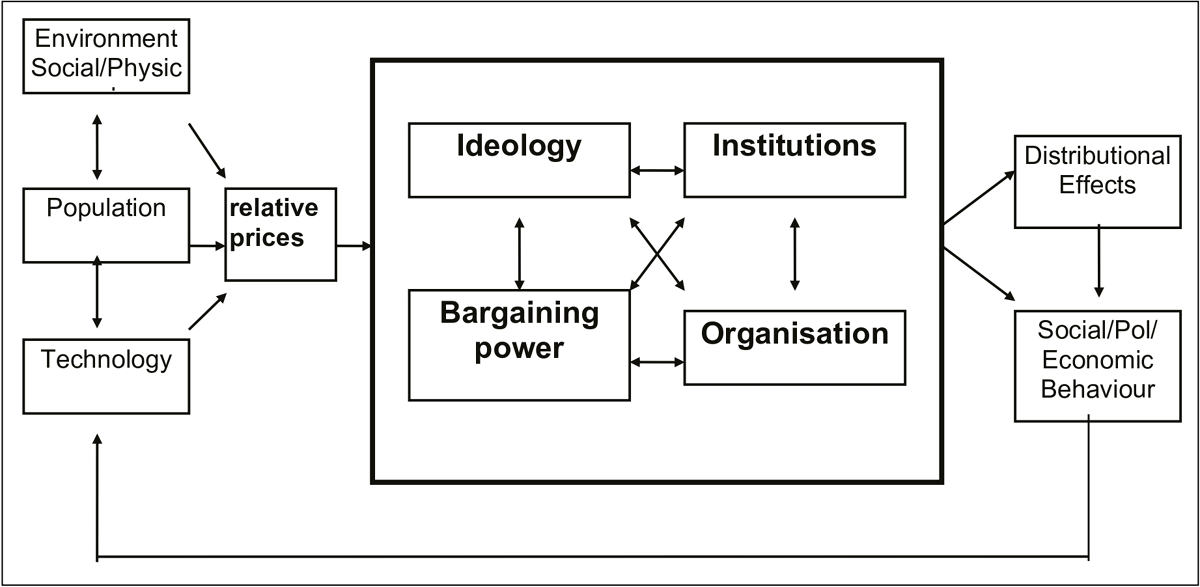
Figure 1
NI-Model of institutional change.
Source: Ensminger 1992: 10, modifications by Haller 2013.
But what is missing in this adapted new institutionalism anthropology model of Ensminger (see Ensminger 1992; Haller ed. 2010) is how power constellation – apart from the idea of bargaining power – have an impact. As several political ecologists highlight, power unfolds in three ways, first as material-structural power (based on Marxian idea of capital power), second as discursive power (based on Foucault’s idea of embodied biopower) and third as ontological power (based on feminist/indigenous views discussing animist/totemist ontologies vs. naturalist ontologies separating nature and culture, see Svarstad, Benjaminsen and Overå 2018; Sullivan 2017; Fabinyi, Evans and Foale 2014; Descola 2013; summarized by Haller (2019a). At all levels of the NIPE model, it helps to analyse which forms of power are used by actors, asking who has the money power, who has the legitimacy power for institutional choice (protected state property vs. common property), and who has which worldview/ontology power to shape the distribution in their favour, but also to trigger the behaviour of others and feed back into the resource stock (see Figure 2; Haller 2019a; b).
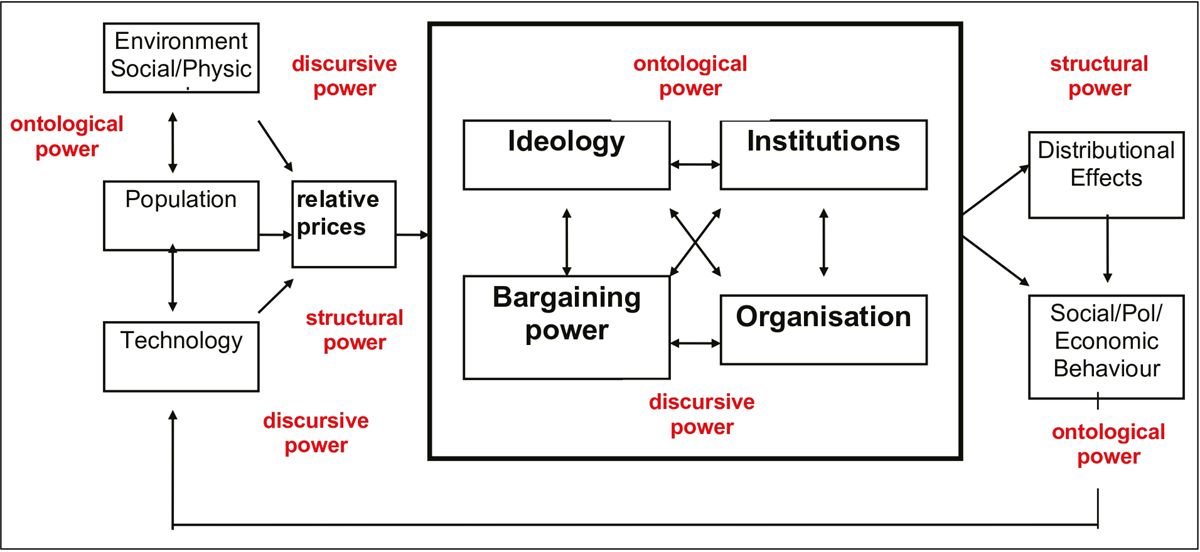
Figure 2
NIPE-Model of institutional change combining new institutionalism and political ecology.
Source: Based on Ensminger 1992: 10, adapted by Haller 2019a.
The NIPE model can be extended to the issue of biodiversity. Environmental factors, including markets that are also shaped by humans, as well as demographic and technological aspects, affect the value of biodiversity. While in most pre-colonial societies biodiversity was constructed and shaped through interaction between the human and non-human world, external demographic pressure and technological change shaped by colonial and capitalist modes of production lead to an expansion of extractive uses and a reduction of biodiversity (Robbins 2004), which now shows an increased – and also and more and more commodified – international value as states, NGOs as well as billionaires get interested (see also Brockingon 2009; Farrell 2020). This increase in value then has an impact on power relations, as actors having structural (capital) power at their disposal, challenge local users, their collective ownership and select state or private ownership institutions and use or pay forms of centralized state or private organization. This is then legitimized by the ideology of wild nature and its included discourse that areas without people are a good way to conserve nature (fortress protection) and the naturalist ontology of pure nature (naturalist view excluding local co-shaping of resource contexts). In this power constellation, access to biodiversity is unfairly distributed and consequently the enforcement of the institution of state ownership, legitimized by the discourse of conservation, leads to the exclusion of local commoners and thus what can be called a commons grabbing process (Haller 2019b; see also Haller et al. eds. 2019). Furthermore, this process affects local behaviour in the sense that some local people are in danger to not care for their cultural landscapes and their biodiversity anymore because they no longer belong to them. Or they try to defend their commons and their biodiversity but are expelled and criminalized by state and private actors using structural capital, discursive fortress conservation and naturalist ontological powers (Igoe and Brockington 2007; Fletcher 2010).
How does now NIPE makes a difference in this debate? Other approaches are helpful as they include living respect for nature (Evans 2012), earth stewardship (Chapin et al 2015), rights of nature (Conway et al. 2002; Gilbert et al. 2023; Soliev et al. 2025a, b), convivial conservation (Büscher and Fletcher 2019) and decolonial approaches (Jimenez et al 2022). But while the first three address some of the elements discussed (ontological aspects), they lack the question of external transformations and questions of power, while the other approaches (convivial conservation and decolonial approaches) include questions of power but lack the ontological question of power. Most importantly, all of them do not refer to how common property is related to the creation and maintenance of biodiversity and do not explain historical transformations. Furthermore, they do not discuss how structural, discursive and ontological power-specific elements in the analysis interact in a systems context. Finally, they do not focus on how local understandings of coexistence are institutionalized and, except for convivial conservation, how they are transformed by external forces. Furthermore, the decolonizing approach will not suffice to shed light on what has happened since colonial times and what local responses and alternatives might be.
Materials and methods
For this paper, I provide a targeted narrative review also seconded by several overview work such as edited volumes by Orlove and Brush 1996; Kopnina and Shoreman-Ouimet 2016; Russell and Claus 2023 and Shoreman-Ouimet, Fredlund and Kopnina 2026) presenting overview literature from ecological and economic anthropology that discusses biodiversity issues in the context of hunter-gatherer, nomadic pastoralist, and agricultural and peasant societies in order to address basic ideas related to economic and political strategies. This literature summarizes the field and the literature presented and support the selection of the targeted review. They are reflecting on the issues of nature-culture divide and pure nature perspective when it comes to discuss biodiversity. All of them emphasize the interlinkage between biodiversity hot spots and cultural diversity and the fact that local societies contributed to the local biodiversity via their subsistence strategies, which often does not get recognitions, especially when it comes to conservation in the sense of pure nature conservation. They also discuss issues of expulsion of local people once biodiversity gets commodified as a colonial legacy of colonialization and neo-colonial perception of pure nature.
In addition, this literature also reflects on institutional change in the mentioned contexts is provided to discuss the issue of commons grabbing and biodiversity loss. The targeted review focuses on new institutional approaches (North, 1990; Ensminger 1992; Haller 2019a; b).
For the empirical part illustrating the anthropological debate on biodiversity as well as the impact of institutional changes from common property to state and private property, ethnographic research projects on African floodplains conducted and led by the author of this paper are used to illustrate mixed subsistence techniques as an adaptation to parametric and political environments, and how common property institutions can be seen as an outcome. This is based on long-term social anthropological research within the African Floodplain Wetlands Project (AFWeP), funded by the Swiss National Science Foundation and the Universities of Bern and Zurich. The research was carried out in Mali (Inner Niger Delta), Cameroon (Waza Logone Floodplain), Tanzania (Pangani River and Rufiji Floodplains), Zambia (Kafue River Floodplain) and Okavango (Panhandle Floodplain), with anthropological research mainly conducted between 2002 and 2008 with 6 to 12 months of intensive anthropological fieldwork. During this time, all the researchers conducted participant observation, living with local families and taking extensive notes, as intensive diary keeping is one of the major methods of collecting qualitative data in social anthropology. After an exploratory phase of several months involving many conversations and open interviews during various economic activities, different forms of structured local interviews were conducted with individuals of different ages, genders, classes and ethnicities (at least 40 in each case). These were supplemented by focus group discussions and oral history biographies, again involving different individuals according to age, gender, class and ethnic subgroup. Additionally, the teams collaborated with local biologists, botanists, agricultural services, wildlife and fishery departments, and conservation NGOs, such as IUCN regional offices. The major topics of all the interviews and focus group discussions were issues such as the governance and institutional changes of common pool resources, such as fisheries, wildlife, grazing, agriculture and veld products, in the context of the period from pre-colonial times to the present day (for example, using oral histories and biographies). Household surveys were also conducted to assess perceptions of resource diversity and decline and focus group discussions were held to explore institutional changes in the governance of common pool resources. Different local data sets were then established from that qualitative data after a rigorous coding process. Short-term visits between 2009 and 2018 were made to control on previous data gathered as well as to record changes. (see also Haller ed. 2010; Haller 2013; 2019a).1
Results
The results section presents the outcomes of the targeted narrative literature review, as well as the authors’ primary research findings on African floodplain ecosystems. These findings illustrate the connection between common property systems and the development and maintenance of biodiversity through concrete examples. It also illustrates the impact of institutional changes on the maintenance of biodiverse cultural landscapes, including the implications of colonial institutional change and naturalist ontologies.
Literature on the creation and maintenance of commons biodiversity
This section shows how from targeted literature key literature in ecological anthropology how biodiversity is enhanced and maintained by people before colonial times, focusing on hunter-gatherer, nomadic pastoralist and agricultural societies: First, hunter-gatherer and fishing societies have had and continue to have important but often unrecognized impacts on the composition of biodiversity, as scholars of this mode of production have argued since the 1970s (see Smith and Winterhalder 1992; Sahlins 1972 and others, see also a review by Ellen and Fuku (eds) 1996; Orlove and Brush 1996; Kopnina, Shoreman-Ouimet 2016; Russell and Claus 2023; Shoreman-Ouimet, Fredlund and Kopnina 2026). Archaeological work suggests that since 2–3 million years ago, groups of Homo species emerging from African contexts, including the second wave, our species, homo sapiens sapiens, have been spreading and interbreeding with earlier Homo groups using this form of resource strategy, including fishing. As foragers and predators, these groups had an impact on the distribution and composition of animals and plants in all landscapes, as hunting and gathering strategies and mobility between resource areas following economic strategies of ‘optimal foraging’ (see Smith and Winterhalder 1992), as well as issues of food security linked to local ecological knowledge and planning, always altered the composition and environments for plants and animals. All of these were common-pool resources (CPRs) governed by various types of common property systems, with their institutions ontologically embedded in animistic and totemic rituals, which also served coordination resource governance purposes as ritual activities led to gatherings and exchanges (see also Ellen and Fuku, 1996; Smith and Winterhalder 1992; Sahlins 1972; Berkes 1999; for archaeological discussion see Graeber and Wengrow 2021; for Yellowstone see Stark et al 2022). Sahlins, as well as Smith and Winterhalder, argue that economically, the reduction of prey leads hunters to be mobile and use other areas before its resources were overused. Research shows that a previous resource is not fully exploited because the expected hunting success, including travel costs, is better in the new area, helping the old area of use to recover (Sahlins 1972; Smith and Winterhalder 1992). Furthermore, common property institutions of regulated culling of large numbers of animals from herds through rules of collective hunting, mobility of hunters, and use of fire for hunting maintain the balance of different resource stocks and allow for diversity not only of hunted or fished animals, but also within cultural landscape ecosystems, as it reduces overpopulation of one species (ibid, Ambrose 1986; Haller 2013; Graeber and Wengrow 2021).
Second, there are historical strategies of domestication and associated biodiversity, particularly of domesticated animals. In general, archaeologists argue that strategies of plant and animal domestication are much older than the expected 10,000 years or so, but perhaps not the dominant strategy. Nomadic and transhumant pastoralists worldwide are central to preventing overuse and also repeated use over seasons and years, with the consequence of creating a diversity of grasses and grass-dependent animals, as grazing by domesticated animals produced options such as McCabe’s seminar paper on the Turkana (Kenya) on diversity of domesticated animals as a risk reduction device, sharing of herds and highly grass-diversified pastures in common property governed by mobility institutions between different seasonal areas as well as drylands and wetlands (1990), echoed by more comparative research (see Ellenbroek 1987; Homewood 2008; Haller 2020; Kronenburg et al. eds. 2022).
Third, during the same period, between 10,000 and 12,000 BC, agriculture becomes increasingly important in several places around the world at the same time (so-called Vavilov centres in Mesoamerica and its highlands, East Africa, several regions in Asia and around the Mediterranean). As outlined, the innovation of cultivating plants is very old, older than 12,000 BC, but not really used or even ignored as hunting and gathering became more productive again (see Graeber and Wengrow 2021). However, this period marks an extraordinary creation of biodiversity of semi-domesticated crops by indigenous peoples around the world. The important story of not only the domestication of plants but also the creation of diversity within plant varieties in sub-varieties is another innovation after the diversification of domesticated animals and the selection and creation of animal breeds. Pat Roy Mooney and others have estimated the plant genetic diversity often found in indigenous areas around the world (Mooney 1990; Toledo 2001). A good overview is provided by Schiefenhoevel, who outlines which domesticated plants are shaped, co-created, maintained, and diversified by local societies and illustrates this in the context of Oceania and Papua New Guinea (Schiefenhövel 2013). This process of creation appears to be universal and underpins enormous diversity: To give just one example of the creation of biodiversity by small farmers, consider the sorghum-producing groups in the Mandara Mountains of northern Cameroon. There, small groups of less than 10,000 people have a diversity of more than 20 varieties for just one staple crop (sorghum) (Haller 2001). If all 40 groups in the area are counted together (Nelson 2007), we have potentially 800 for sorghum sub-varieties alone. If all intercrops and varieties were counted, the number would be much higher. This means that on a very small patch of the globe, Meyer et. al (2012) estimate of only about 2500 domesticated species compared to about 380,000 ‘natural’ plant species worldwide may be much too low. Often seeds are also a kind of common property of local groups, co-created and shared collectively.
Interestingly, in all three subsistence groups, there is ample evidence of local perceptions of the environment as more than human and part of the local commons, based on animistic and totemistic ontologies. Most of these groups used ritual activities to contact the more than human world, often prior to collective hunting, fishing, mobility and grazing, as well as agricultural field use and seed sharing. Many of the ritual activities have the outcome of helping to coordinate and organize the use of common pool resources.
Commons and biodiversity: Illustrative case study of subsistence mixing in African floodplains
An important aspect is the fact that a ‘pure’ subsistence resource use strategy is not the case for many local groups, who combine hunting, gathering and fishing, as well as nomadic pastoralism and various forms of extensive to intensive agriculture and horticulture, to reduce the risk of the parametric and political environment and also to increase the resilience of their commons. Interestingly, the outcome of this risk minimax-strategy leads to a high contribution of diversity (see Haller 2022). To empirically illustrate this ‘subsistence-mix-and-mash’ strategy that enhances biodiversity, this sub-section summarizes findings from a comparative anthropological study in six African floodplains between 2002 and 2018 (see Haller ed. 2010; Haller 2013; 2016; 2022). This work shows two main aspects. First, floodplains, and in particular the ones we studied, have conditions that contribute to the diversity of the areas, as they are located in drylands that are flooded for several months of the year and provide a high degree of change between aridity and humidity as a combination of terrestrial and aquatic conditions for plants and animals (including birds), and are thus also hotspots for conservation (see also Ramsar Wetlands Convention 2014). However, the way in which diversity is composed is strongly influenced by highly differentiated human use, whether within or between different professional ethnic groups, which can be divided into first comers, later comers, visitors, etc. In the Kafue Flats, Zambia, the first to arrive were the Batwa hunter-gatherers and fishers, who have been in the area the longest, followed by the transhumant agro-pastoralists of the Ila and Balundwe Tonga. All the mentioned groups take advantage of the cycle of flooding and receding water, combining in different ways their perceived and ascribed dominant economic activity (hunting and gathering, fishing, pastoral or agricultural activities). The use of CPRs then adapts to the inundation (more fishing, agricultural activities) to the receding, when wildlife is attracted from otherwise drier areas to water ponds with fish and nearby veld products and lush pastures that domestic animals share with wildlife. This seasonality of very different constellations allows for a wide combination of uses of CPRs, which in turn – as we have indicated above – transforms their areas and makes them diverse because humans with their hunting, gathering and fishing activities shaped, co-created, and maintained a specific cultural landscape. There are many similarities in the other floodplains, sometimes with specialized groups in terms of economic strategies, but also combining all the strategies in Mali, Cameroon, Tanzania and Botswana (Haller ed. 2010; Haller 2016).
The second aspect concerns institutional issues. In the Kafue Flats in Zambia, resource areas called chichi were managed by big man leaders as common property for the whole community. As leaders, they were responsible for distributing and coordinating access to the commons, which was adapted to the dynamics of inundation and retreat, and to which members had access to grazing, wildlife, fishing and agricultural land. All the CPRs were perceived as the common property of a local sub-group associated with a chichi with a specific name. Within this territory, there were rules for individual use, but also for collective use of grazing (access to cattle camps), fishing (collective fishing events) and hunting (collective hunting events), organized and coordinated by these chichi leaders with regard of timing, duration and membership. In line with Ostrom’s design principles (DPs) (Ostrom 1990), membership and clear rules for access to CPRs, as well as monitoring and sanctioning, can be found in this and all the other five case studies. Only the first DP of ‘clear boundaries’ is not evident, as in the floodplains there are more permeable boundaries and sharing of resources between groups according to institutionalized agreements, while there are clear membership rules and notion of territoriality also ontologically (spiritual beings and relation to fauna and flora). Thus, in all six cases we find both animistic and totemistic ontologies involved in the perception of resources as actors themselves. Of central importance are the institutionalized relations that must be maintained with this co-world from the emic perception of humans when using CPRs, as they are from a local non-naturalist perspective also co-commoners in this sense. Therefore, ritual and spiritual activities embedded in a non-naturalistic ontology are a central part of the institutions that help to coordinate the use, maintenance and diversity of CPRs (Haller et al 2010; Haller 2016; 2019a).
Implications of colonial institutional change and naturalist ontologies
In this section, I would like to highlight the threat of global commons grabbing processes through large-scale land appropriation and green grabbing through protected areas imposed by external colonial powers. As described in several publications (see Haller 2019a; b; Gerber and Haller 2020), the main institutional transformations that have taken place, albeit in several different historical waves in different areas of the Global South, can be summarized as follows using the NIPE framework: It is necessary to analyse how colonial and postcolonial institutional transformations in the study areas have reduced biodiversity, also based on a different ontology of the separation of culture and nature (called ‘naturalist’ ontology by Descola 2013). Based on the colonial res nullius perception arguing that local ecosystems such as savannahs, forests and floodplains were ‘pure’ nature, similar institutional forms of state ownership were created so that the areas could be appropriated by colonial and post-colonial states. This was also based on an institutional misreading of the areas being open access, a view later on captured by Garret Hardin’s ‘tragedy of the commons’ (Hardin 1968). As colonized landscapes were perceived as unprotected commons (see also Peters 2013; Haller 2019b), large areas were cleared from local inhabitants during both colonial and post-colonial independence. The basis for this was the institutional shift from common property to state property, which undermined many previously existing local institutional frameworks and that constellation was carried over into the post-colonial period after the 1960s (see also Robbins 2004; Zimmerer and Basset 2012; Haller 2019b, see also Kopnina and Shoreman-Ouimet 2016; Russell and Claus 2023; Shoreman-Ouimet, Fredlund and Kopnina 2026).
To illustrate this process, I will show how this has affected the biodiversity of fisheries, wildlife and plants in the floodplains. During the colonial period, the institutional transformation from communal to state ownership was accompanied by several forms of disconnections. A)Interesting areas for intensive monoculture plantations came under direct state rule and were given to white settlers; uninteresting areas came under indirect rule (‘chiefs’) with ‘customary tenure rights’, increasing the power of local individual elites and providing the basis for de facto elite privatization of the commons at later stages as these colonially created elites were then able to use the resources for their own interests. In addition, based on the narrative of over-exploitation of wildlife (due to the culling events of the annual collective hunt, see above) conservation was institutionalized via protected areas that were installed in the form of fortress conservation, which excluded the local use of fisheries and wildlife and hindered transhumance and adaptation to flood patterns. B) At the same time, a separation into agricultural and natural (or protected) areas led to spatial divisions of cultural landscapes, undermining the previous coordinated use of these interlinked areas based on common property institutions. C) The third separation took place in the state’s administrative system, where CPRs were allocated for management in different state administrative departments & legal systems, where coordination of the different CPRs could not take place and which led to legal and institutional pluralism, allowing elites to select rules as they saw fit (see institution-shopping in the NIPE model). During independence, these three processes intensified. As the independent states undermined local management and its common property institutions on which local biodiversity was based, the new states became increasingly mired in financial crisis and could no longer maintain their conservation institutions. And because the state administrators had undermined the common property institutions, neither these nor the state property institutions, which had no financial resources, were operational in the sense that they could monitor and sanction the use of the wildlife, fisheries as well as pastures. This loss of key elements of the DPs led – and continues to lead – to de facto open access to CPRs in the Kafue Flats. Using the NIPE approach, it can be shown that in the external context (see Figure 1), the external environment in the form of markets and financial crisis for the state led to unemployment, increased immigration and also the use of new technologies for hunting and fishing and new infrastructure (such as roads and dams) increasing the option to get access to the CPRs by migrants. The external processes increased the relative price of fish and game relative to employment but also made the area more valuable. This led to the loss of local bargaining power by migrants, the undermining of common property institutions by referring to the area as state property and using the ideology that this is pure nature and the discourse that common pool resources should therefore be used by all citizens. This then led to unfair distribution and overuse of CPRs. With regard to the political ecology aspect of the three power analytical elements, the capital power to invest in protected areas, as well as the discursive power of conservation and the naturalist ontological power as the main source of legitimacy, led to many top-down and so-called participatory conservation projects that did not include local institutions or their associated ontologies: The result is a massive decline in fish and wildlife species since the 1980s, the spread of so-called invasive plant species in a country that the first colonial administrators once called the ‘land of milk and honey’, referring to the abundance of resources and its diversity of fish, wildlife, wild and domestic plants and animals (see Haller 2013).
Our comparative research in all six floodplain areas in Africa has allowed us to collect data that show similar processes leading to massive over-exploitation and thus biodiversity loss, both from a scientific and a local perspective (see Haller ed. 2010; 2016). Not only CPRs, but also the diversity of domesticated animals and agricultural plants has been reduced by the processes of the Green Revolution with very few high-quality seeds and also the reduction of animal breeds (ibid).
Further commons grabbing is exacerbating biodiversity loss: Some recent trends
The cases from the African Flooplains show a trend which can also be seen in other areas studied in ecological anthropology and political ecology. However, since the institutional shift from commons to state ownership and then de facto open access described above, there have been three new waves of global commons grabbing in the last 20 years.
First wave of land grabbing as commons grabbing, shown in the Land Matrix based on colonial legacies. Following the 2008 food, fuel and financial crisis, large-scale land grabs occurred as the relative price of agricultural land rose. A land cover analysis of 139 deals (Giger et al. 2019). These deals show that investors compete with farming communities, who often have high agricultural diversity, keep livestock and rely on hunting and fishing. Geiger et al. report from the Land Matrix that 79% of deals in Africa are within a day’s travel and not in remote, unused areas, as investors often claim, following the narrative that investments do no harm because they are on unused land. These deals are taking place in cultural landscapes, often under previous communal ownership, as the categories show. 35% mosaic cropland, 34% forest land, 25% scrub and pastureland, 6% so-called marginal land. Giger et al. show that all of the open categories are common property or at least include communal uses and institutions (Giger et al. 2019).
The second wave of commons grabbing and biodiversity degradation due to the rising relative prices of green energy (biofuels, solar, wind, hydro) as mega-infrastructure projects (MIPs). Based on this colonial legacy of state ownership and later on neo-liberal privatization supported by national and international taxpayers’ money, green energy projects are proliferating. Similarly, biofuel, solar and wind energy projects (wind parks, mining for green energy minerals, hydro and thermal power in East Africa (see the The Lamu Port-South Sudan-Ethiopia Transport (LAPPSET) and the Southern Agricultural Growth Corridor (SAGCOT) large scale infrastructure projects, but also in North Africa, while mining for green energy takes place in Southern Africa) are planned and established. Cases are summarized in a new comparative study by Haller, Nguntu and Käser eds 2020; Achiba 2019; and Haller and Weissman (2024), including destruction of grasslands by windmills and solar projects in Morocco, Egypt and Kenya, fisheries by modern international ports (Kenya), windmills on pastoral land (Kenya), hydropower (Senegal, Zambia), biofuels (Sierra Leone and Tanzania), green mining (several countries, see also Kronenburg et al. 2022). This is based on the discourse of states and their governments in the Global South, as well as investors worldwide, that they are investing in wastelands, producing green assets that mitigate climate change (wind, solar, hydro energy projects) and thus bringing «green development» to the local poor in a participatory way, paying fair wages, providing employment and additional development programs (corporate social responsibility (CRS)) programs (Marfurt et al. 2016; Lanz et al. 2018; Ryser 2019; Dolan and Rajak (eds.) 2022). All these discourses come with a powerful enchantment discourse of development for employment and modern infrastructure as well as green energy production, but they massively reduce local commons and have and will also have a detrimental impact on local biodiversity. They act as ‘anti-politics machines’ that mask power asymmetries, commons grabbing and biodiversity loss not only in African contexts but also globally (Haller and Weissman eds. 2024).
A third wave of commons grabbing through relative prices goes back to new forms of the discourse of biodiversity conservation, often linked to climate change mitigation and ecotourism enterprises and supported by international frameworks. In many of the areas studied in African floodplains (Haller 2016), but also elsewhere in Africa (see Brockington et al. 2008; Haller and Galvin 2011; Kronenburg et al. 2022), there is an external push for the expansion of protected areas by international organizations and national initiatives, as well as by billionaires in the context of neoliberal processes, including neoliberal conservation schemes (see Igoe and Brockington 2007; Fletcher 2010; Farrell 2020), and the channelling of conservation capital towards the grabbing of former commons (for example, for Kenya, see Weissman 2019). The discourse here is that biodiversity conservation can be enhanced by commodification for tourism enterprises and or by using extremely rich philanthropists (Farrell 2020; van Beemen 2024). But also the Sustainable Development Goals (SDGs 14 and 15) (Larsen et al 2022) and the 30 by 30 initiative (conserve 30% of land by 2030; Büscher et al. 2017) are important international frameworks that do not mention and exclude the commons, through which the removal of commons and the local maintenance of cultural landscapes can be justified by governments and investors, ironically by using the very discourse of biodiversity conservation. The same is true of various biodiversity conventions and climate protocols (REDD and REDD+, see Cabello and Gilbertson 2012; Soliev et al. 2021). Many of such conservation initiatives, as well as national and international initiatives and legal frameworks, are carried out in alliance between governments and corporations, using naturalistic ontological powers to justify dispossession processes of common property.
Discussion
In this section, I consider the theoretical concepts introduced in the introduction and literature review and discuss their relevance to the analysis of floodplain biodiversity dynamics and changes during colonial and post-colonial times. I demonstrate how Ostrom’s work helps to explain how biodiversity is shaped and maintained, while NIPE contributes to the analysis of institutional change and the reduction of cultural landscapes and their biodiversity, via different elements of power dynamics drawn from political ecology.
First, the paper shows that Ostrom’s design principles are important for understanding how pre-colonial and subsistence societies contribute to cultural landscape ecosystems in the mentioned floodplain areas and their biodiversity through their common property institutions. However, the DPs’ embedding in the IAD framework is not sufficient to analyse the role of commons for biodiversity. It does not discuss how local communities organize their resource governance in relation to parametric and political environments and how they embed their institutional coordination of the commons and its biodiversity into their non-naturalist ontological frameworks, the more than human world and practices related to animism and totemism helped to coordinate resource governance. The link between commons and biodiversity is also a historical one, leading to the argument that commons have contributed to biodiversity worldwide, as suggested by the ecological anthropology literature on adaptation and risk reduction strategies in hunting-gathering, fishing, and nomadic pastoral and agricultural societies. I have illustrated the combination of these strategies in more detail using comparative research on African floodplains. This research shows that the diversity of common pool resource management has been implemented through common property institutions that have transformed areas into cultural landscape ecosystems with their specific biodiversity over centuries and even millennia. Furthermore, DP and IAD cannot reflect on how external and internal elements are interrelated and influence value generation, power relations and legitimacy issues through ideology and resource distribution, triggering feedback loops.
Second, the NIPE approach with its New Institutionalism part is able to show how the colonial and post-colonial externally driven naturalist biodiversity discourse with its separation of nature and culture is very powerful and excludes commoners and their common property as well as their contribution to biodiversity. The political ecology part of NIPE then addresses issues of power. External forces and power dynamics during the colonial period had the effect of exploiting and changing the local environment, reducing the local population and increasing the external population, and introducing new resource technologies and infrastructure that promoted mining and damming and increased the use of fishing and hunting. And it also promoted new monoculture agricultural technologies that reduced biodiversity. Under the structural power of capital, as the main force for nationally controlled elite wealth accumulation, the territories have increased in value, supported by the discourse of modern development and the now ‘naturalist’ ontology that separates culture from nature. This naturalist ontology proved to be very powerful for the colonial masters and the new elites, as it increased their bargaining power to install state and private ownership of the former commons. It also helped to dismantle the local institutions of coordinated collective use that had previously maintained biodiversity. In addition, the colonial and post-colonial actors continue to use the discursive power of development AND protection of pure nature, which is further legitimized by the ontological power of naturalism. The claim to animistic or totemistic power has been greatly reduced and is not recognized as having any value. This was accompanied by a defragmentation of organizational forms between different sectors under colonial control and an extremely high level of hierarchization and militarization of control over pure nature, leading to an unfair distribution of resources. As a result, the local view that the commons are no longer owned at the local level also leads to local groups overusing resources and reducing diversity themselves as a consequence of the institutional change from commons to state ownership and then the de facto open access or reprivatization strategy in some contexts of protected areas.
Finally, this process was externally accelerated at independence by three waves of further colonial land and commons grabbing. Increased commons grabbing by external investors after the economic crisis of neoliberal development (Fletcher 2010), a second wave of MIPs that even increased this trend and brought marginal areas into the interest of capital, even more so in times of green energy transition, and the third wave of old conservation ideas in a new form that brought more and more areas under national control using capital/structural power, the discursive power of green development and conservation extensions (SDGs and 30 by 30 initiatives).
Conclusion
In conclusion, the paper presents evidence that the commons contribute significantly to biodiversity, and that undermining them has a negative impact. Regarding biodiversity policy, the paper argues that it is necessary to consider whether local alternatives exist and how they are formulated by local communities. Research in the study regions of African floodplains, Latin America and Asia has shown that it is possible to reintegrate the commons into resource management and thus enhance biodiversity from a bottom-up perspective when external powers are challenged. Such processes can emerge when local communities and societies regain a sense of ownership of the institution-building process after the massive undermining of their rules since colonial times. This is not a tragedy, but rather a drama of the stolen commons (Gerber and Haller 2020), and an option for the potential development of new institutions based on former common property rules, if local groups are recognized in the governance of their territories. When this happens, we speak of ‘constitutionality’ (Haller, Acciaioli and Rist 2016; Haller, Belsky and Rist 2018), not the ecological version of governmentality such as Agrawal’s ‘Environmentality’ (Agrawal 2005). As cases from floodplains in Zambia for fisheries and Mali for forest conservation have shown, local people can rewrite the rules if they are given the power and opportunity to do so: In Zambia, men and women drafted new bylaws for fishing; in Mali, groups developed a local convention to protect forests, fishing and grazing. In both cases, this process contributed significantly to biodiversity conservation (see Haller, Acciaoli and Rist 2016; Haller, Belsky and Rist 2018), which is also highlighted in other cases (see Kimengsi et al. 2019). In all the case studies, state recognition was the main challenge for local people. However, the non-recognition of commons in the SDGs and the 30 by 30 agenda implemented by states also points to a major obstacle to the protection and enhancement of biodiversity produced by commoners and their common property institutions. These international frameworks can also, paradoxically, be used as a tool to further promote commons grabbing and undermine the institutions of cultural landscape ecosystems and their maintenance by commoners.
Therefore, states should create good conditions for commons and recognize common property as one important way to protect biodiversity, which was shaped, co-created, and maintained in many parts of the world by commoners. While the Convention on Biological Diversity (CBD), might provide a basis for such conditions, it does however not fully recognize the link between cultural diversity and biodiversity and is actually also based on a pure nature perception of biodiversity (Boisvert and Vivien 2005; Corson, Gruby, Witter, Hagerman, Suarez, Greenberg and Campbell 2014). This lack is shared as well by other environmental international agendas, especially the 30 by 30 agenda or the more extreme halve earth idea. Also, these do often not recognize the problem of green grabbing and evictions of local people, who were living in these areas for centuries. This is also criticized in publications by political ecologists (Büscher et al. 2017; Lockie 2023; Büscher 2025). These authors also argue that the focus on biodiversity loss lacks not just discussing root causes but also excludes actors who contributed to the biological diversity. A positive step is seen in the Kunming-Montreal Global Biodiversity Framework. Especially the COP 15 declaration provided an opportunity, which is seen positively by indigenous people’s representatives and their global organizations such as the ICCAs/Territories of Life. They were able to draw attention to the fact that they are the hosts of biodiversity and that view is included in the COP15 agreement (see https://www.cbd.int/doc/decisions/cop-15/cop-15-dec-04-en.pdf; https://www.iccaconsortium.org/2023/02/09/global-biodiversity-framework-social-environmental-justice/). But there are still challenges, which a more concrete NIPE analysis could help overcome. To link biodiversity to conservation and not to embed it in local common property governance, undermines the claim of the commoners who coproduced biodiversity. In addition, international agreements are criticized to be driven financial solutions to the problem rather than to provide a collective framework for participation (Lockie 2023). This is an issue which is also addressed by Büscher (2025) arguing that the meetings such as COP are finally still too much embedded in capitalist framings without really dealing with root causes and bottom-up solutions. Similarly, such framings can also be seen in the SDGs. As Larsen et al highlight (2022), themes such as common property rights as a basis for biodiversity co-created by local communities and indigenous peoples are not integrated in the SDGs, especially not in SDG 15 dealing with biodiversity. Finally, there are numerous challenges to COP15 declarations, despite the acknowledgement of indigenous people’s territories. It is unclear how and if national governments will really engage in collaboration with indigenous peoples based on this soft law context as transparent accountability and the call for common property on the land and related resources under and above the land is lacking (see Niederberger 2026). In addition, adapting the national goals to the 30 by 30 and SDGs targets to ensure inclusive governance with and the empowerment of local communities, will be challenging (see Zhang, Cao, Ma, Liu and Mao 2025). This is especially the case because local indigenous groups’ bargaining power is limited as they are not recognized as co-creators of biodiversity based on their common property. The main issue is that the very notion of common property is lacking in the SDGs and also many states do not recognize this form of property (see Larsen et al. 2022).
This leads us to further considerations stemming from the concept of ‘homo ecologicus’. This concept offers an opportunity to translate theory into policy, as it highlights the normative relationship between humans and nature. This relationship is also reflected in frameworks such as the SDGs. Borrowed from ecological economics, this approach looks at humans in relation to themselves, their community, and human-human and human-non-human relations, translating the analysis into a political and policy framework. This would mean creating institutions in which people are seen as ‘homo ecologicus’, interested not only in their own self-interest, but also in maintaining human–environment interactions. This should be reflected in policy-making and practice, as it could help translate respect for the environment into respect for the people who have helped shape it (Becker 2006). Therefore, policies should recognise not self-interest, but co-interest in cultural landscape ecosystems. Collective ownership and co-created institutions for maintaining these landscapes should be granted to local collectives in policy and practice, and this should be supported by international bodies and nation states. However, power asymmetries between states and local, external and internal interest groups within local communities must first be addressed, as proposed by Soliev et al. (2025a, b) in their Reflexivity-Situatedness Matrix (RSM). This is an intervention-centred analytical framework that allows for the simultaneous and critical discussion of desired transformations and the means to achieve them, including in policy. For that to happen, however, it is essential to recognise that, in these contexts, humans are often commoners who co-create and maintain biodiversity, rather than being self-interested individuals. It is also crucial to acknowledge that they often lack the power to be recognised in policymaking and institution creation. This should therefore be addressed as a shared meta-analysis of what biodiversity is from different perspectives, reflecting on how collaborative partnerships could be created between commoners, the state, interstate actors, and scientific actors (see Soliev et al., 2025a, b). However, it is also necessary to understand the historically rooted power asymmetries in these partnerships when negotiating biodiversity maintenance in practice, which brings us back to NIPE.
Analytically, the NIPE model clearly shows that the loss of biodiversity is driven by external effects related to economic, technological and demographic changes. These increase the value of land isolated from its cultural landscape and furthermore increases the bargaining power of external actors. The latter are then pushing for the institutional change of privatization of previous state property, which was already during colonial times undermining local common property and thereby also exacerbated the loss of biodiversity. Very important in this context is the political ecology analysis of power in the NIPE approach, showing that the naturalist ontological power (pure nature), discursive power (protection via conservation and development) and structural capital power, attracts external funders, leading to further grabbing and undermining biodiversity processes. However, this does not happen automatically, as local actors also resist in various ways (Gerber and Haller 2020). And if their bargaining power is strengthened in a participatory bottom-up process, they can craft new common property rules as demonstrated by processes of constitutionality in Zambia and Mali. In this way, local commoners then contribute to the fight against the loss of biodiversity.
Note
[1] As space is limited to provide more detailed information on the methods used please check on peer reviewed comparative book publications (Haller ed. 2010; Haller 2013).