
1. Introduction
In Central Asia (CA), groundwater (GW) is a vital water source for society at large with various purposes, including irrigation, domestic, and industrial uses. Water availability and quality differ between CA countries (Kazakhstan, Kyrgyzstan, Tajikistan, Turkmenistan, and Uzbekistan) dependent on several factors – geology, precipitation, and human activity (SIC ICWC 2000). In many areas, GW overexploitation and contamination negatively impact the environment and local communities. As water availability is limited in the region, GW is important to monitor and protect as an alternative water source (Gafurov et al. 2020). The availability of GW allows for greater regional adaptive capacity against water shortages or droughts.
In our study, we adapt the social-ecological system (SES) framework (Ostrom 2007) to further include informational governance (Mol 2006) perspectives. This framework captures the complexity of groundwater governance (GWG) while exploring the role of GW information and knowledge in CA. Uzbekistan offers an illustrative case of such interactions that appear across CA. We hypothesise that the provision of GW information is particularly important, as the resource has low visibility both for local users and between states. Furthermore, low GW information provision between governing bodies in the region signals a potential soft limit to adaptation at local, national, and regional levels.
This article presents a systematic review of the scientific and grey literature on GWG in Uzbekistan and analysis of the role of informational governance in overall governance. The literature review aims to: i) qualitatively explore what we know about GWG in Central Asia and specifically Uzbekistan, and ii) analyse the informational governance of GW to find how it may affect interactions and resulting outcomes.
This article is structured as follows. In the next sections, we introduce our analytical framework which incorporates informational governance themes into the SES framework and present the systematic review method. In the subsequent results section, we describe GW resources, environmental problems, and governance systems in Uzbekistan. Furthermore, informational governance of GW is analysed as part of the SES. Finally, the conclusion section summarises and discusses our findings, topics for future research and policy recommendations for GWG in Uzbekistan.
2. Analytical framework
2.1 The social-ecological systems framework
The literature acknowledges a key contribution of the SES framework to study GWG by adopting a complex system approach (Rica, Petit, and López-Gunn 2018). As such, it structures interactions between human and ecological elements, at varying temporal and spatial scales (Rica, Petit, and López-Gunn 2018). The framework decomposes system complexity, differentiating the first-level core subsystems to be analysed: Related Ecosystems, Economic and Socio-political settings, Resource systems, Resource units, Actors, Interactions, Governance systems, and Outcomes (Ostrom 2007). Most importantly, the SES framework highlights the role of governance systems that mediate the relationships between actors, their interactions, and natural resources, and guides institutional analysis. Governance systems include constitutional rules which “[…] are outputs that establish the meta-rules of the game; the policy-making level, where laws and regulations, enacted in compliance with the constitutional rules, are outputs that establish rules designed to affect individuals’ interactions at the operational level” (Cole 2017: 831).
The role of information is identified in original SES second-tier variables that affect actors’ interactions, their collective actions and lead to the Outcome: Actors – “Knowledge of the SES/mental models” and “Technologies available”; Interaction – “Information sharing among users”; Governance – “Constitutional, collective choice and operational rules” and “Monitoring and sanctioning processes”. Our selection criteria for the second-tier SES variables include their relevance for information and knowledge, which is the focus of this study. They highlight the critical role of information and knowledge in different subsystems of SES. The literature review results applicable to Uzbekistan were read to identify text segments relevant to original SES framework second-tier variables. Any original second-tier variables that were not used in our analysis did not appear to have clear and repeated relevance to the GW SES in literature results.
It is assumed that resource overexploitation can be avoided by actors’ collective actions when they can communicate and participate in decision-making, and when monitoring and sanctioning are in place (Ostrom 1990). In a more recent extension of the SES framework, social dilemmas related to knowledge commons have been explored (Hess & Ostrom 2007; Frischmann, Madison, and Strandburg 2014; Gotgelf 2022). To further explore the interplay across these important dimensions, we incorporate insights from the informational governance literature.
2.2 Informational Governance
Informational governance highlights the transformative role of knowledge in the Information Age, characterised by improved information collection, processing, transmission, and use capacities (Mol 2006; Soma et al. 2016). The literature identifies critical issues relevant to our study: while a strong reliance remains on natural science-based information, there are also growing uncertainties related to increasing world complexities. New modes of environmental governance may replace conventional powers of the state in environmental information management. Due to globalisation processes, developing countries are confronted with international requirements on information products, processes, and monitoring.
The literature also recognises a need for further research on four informational governance themes. The first theme is related to the dynamics and mechanisms of informational governance. The literature highlights a lack of understanding of the new monitoring systems and mechanisms which can appear independent from the conventional “state-run, expert-led, and natural-science-based” monitoring systems (Mol 2006: 509). The second theme focuses on structural uncertainty and multiple knowledges. The question raised here is how to deal with inherent uncertainties and multiple sources of environmental knowledge (i.e., uncertainty which cannot be resolved and epistemic uncertainties which may differ between monitoring methods). The third theme is related to power constellations – potential inequalities and monopolies in the environmental information-handling capacity (e.g., information-generation and transmission capabilities, access to information and publications). The fourth and final theme, the form and design of informational reform, can facilitate effective and democratic governance systems and requires further attention from scholars.
2.3 Informational governance of groundwater as an SES
In our study, we apply the SES framework to conduct an institutional analysis of GWG and the role of information and knowledge on GW. To do so, we incorporated new second-tier SES variables in relation to four research themes identified in the informational governance literature (Figure 1).
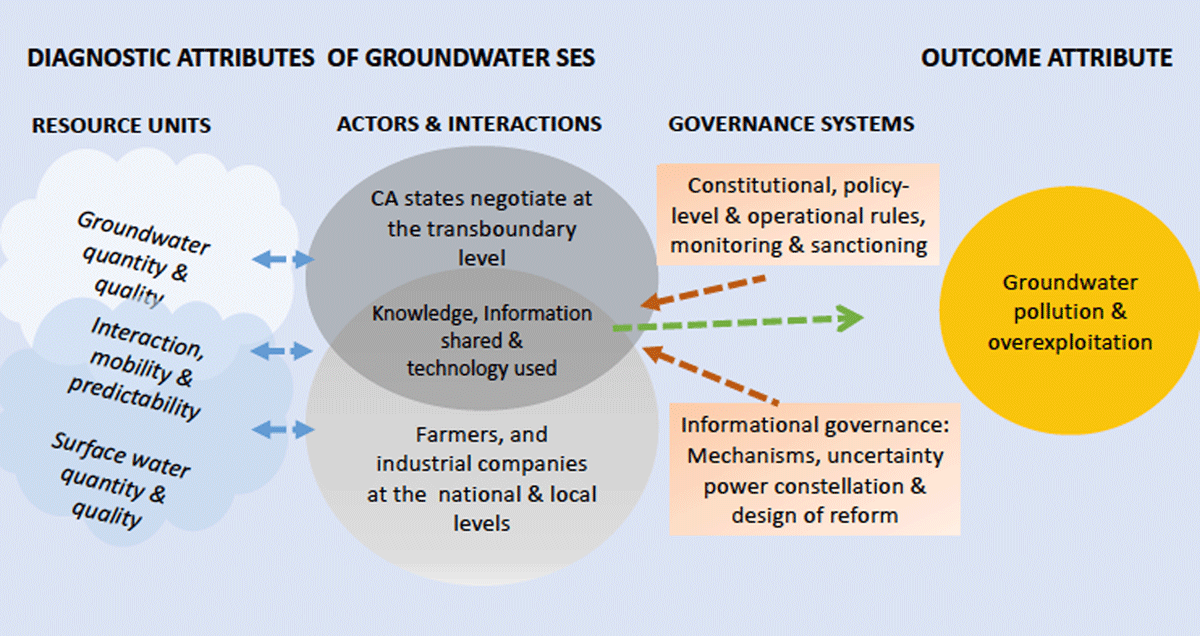
Figure 1
Analytical Framework to study informational GWG (Source: Adapted from Ostrom (2007). The colours differentiate between the SES diagnostic and outcome attributes as well as diverse subsystems such as resource units, actors and interactions, and governance systems.
We assume that:
GW users interact while making strategic choices regarding resource use and management at the local, national, and transboundary levels.
Their interactions and lack of collective action result in outcomes related to GW overexploitation and pollution.
Governance systems, such as constitutional, policy-level, and operational rules, and informational governance shape actors’ interactions and outcomes. Specifically, informational governance (i.e., mechanisms, uncertainty, power constellations, and reform designs) influences actors’ interactions and collective actions which affects their GW knowledge, how they share information, and technology use.
3. Methods
A systematic database search of peer-reviewed articles was conducted to explore GW as a SES in CA. The systematic review method was selected due to a relative lack of studies on GWG in CA compared, for example, to studies on surface water. The systematic literature review method offers the opportunity to synthesise findings across multiple units of analysis, to understand transboundary perspectives as well as country-specific contexts and settings (Berrang-Ford, Pearce, and Ford 2015).
Literature searches were made in October 2022 on Web of Science and Scopus databases. Keywords were set broadly to “Governance AND ground water OR groundwater OR water OR aquifer” with the inclusion of geographic terms such as “Uzbekistan OR Central Asia”. The general term “Water” was used to include papers which focus on surface water, but include some GW relevant information. Articles and book chapters published during the post-Soviet period (1992–2022) were considered. The systematic review considered only English language results but was able to consider citations within papers which often originated from studies published in local languages. In their analysis, the authors relied on their extensive expertise in water resource management in CA.
Our general search for CA returned 146 original articles and book chapters. The titles, abstract, and contents of results were reviewed to ensure GW details in CA were mentioned. Initial title and abstract review, as well as later content review, dramatically thinned results to 26, seven results specific to Uzbekistan.
To bolster these 26 results, snowballing methods were used which reviewed citations to identify additional relevant literature. Papers were reviewed for inclusion if referenced regarding statements on GW or if the title or text included words “groundwater”, “ground water”, or “aquifer”, and were available in English. Snowballing methods allowed for an additional 16 sources, including both academic papers and grey literature. Three of the additional 16 sources were directly relevant to Uzbekistan.
Regional expert recommendations led to the inclusion of available UN Environmental Performance Review reports, which added an additional 12 CA grey literature sources and three Uzbekistan-specific sources. This brought the total number of articles, reports, and chapters to include 54 entries overall, 14 for Uzbekistan, that were quantitatively and qualitatively analysed (see bibliometric and content analysis of publications in Supplementary materials: Appendices A and B). Next, we present the results of the qualitative content analysis focusing on the Uzbekistan case which is illustrative for the CA region.
4. Results
As presented in Section 2, the SES framework decomposes the complexity of the social-ecological system, differentiating the first-level core subsystems to be analysed.
Groundwater resource systems in the Aral Sea Basin (one of the key basins in CA) are developed by natural flow from mountains, water catchments, and rainfall. More than 70% of water recharge in CA occurs either in Kyrgyzstan or Tajikistan – upstream countries (Sehring 2009). GW interacts with surface water. For example, GW is recharged from infiltration in hydro-technical structures (e.g., reservoirs) and irrigated land. In total, there are 339 identified aquifers with estimated reserves of 31.2 km3 (14.7 km3 in the Amudarya basin and 16.4 km3 in the Syrdarya basin) (CAWater-Info). GW stress along the Amudarya River is classified as very high and moderately high along the Syrdarya River, as shown by the reduction of the Aral Sea and in Figure 2. GW aquifers are not distributed equally within or between CA states due to climatic, topographic, and surface water distribution differences.
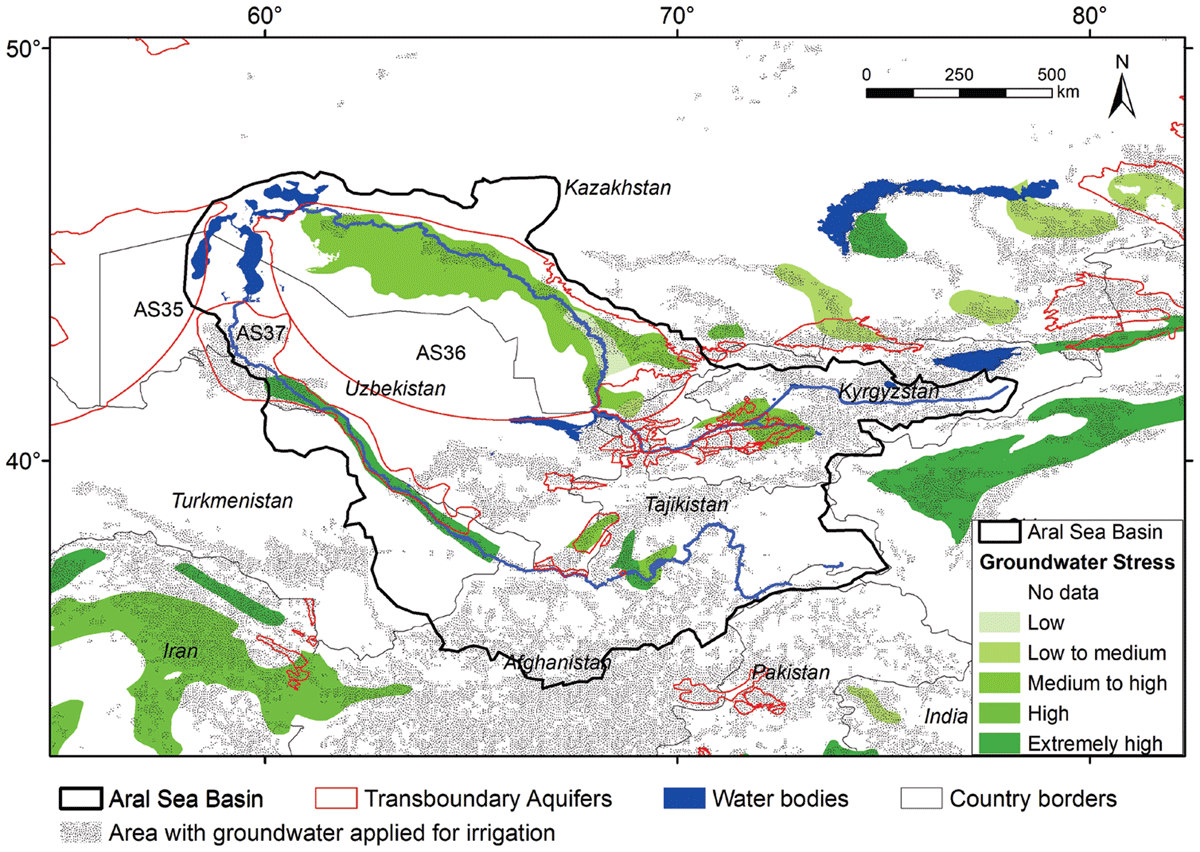
Figure 2
Map of GW stress in CA countries (Gafurov et al. 2020).
4.1 Resource units in Uzbekistan
Uzbekistan’s vital GW resources have estimated reserves of 18.5 km3, while actual abstraction is 7.7 km3 per year (CAWater-Info). The Institute of Hydrology and Engineering Geology reports values of annual GW recharge 23–27 km3 (Alikhanov et al. 2021). Depending on the source, GW reserve and recharge estimates differ, without clear indication of how or when the numbers were collected. Around 99 major aquifers have been identified in the country, out of which 77 contain fresh GW suitable for drinking water supply (Kazbekov et al. 2007). Furthermore, there are over 25,000 GW wells in Uzbekistan (Kulmatov et al. 2021). GW recharge includes surface inflow, infiltration from rivers and lakes, and precipitation (Alikhanov et al. 2021). The predictability of dynamics, storage and location is challenging due to strong GW mobility and temporal fluctuations. While some GW changes may fail to appear for decades, temporal changes are observed within agricultural growing seasons (Anarbekov et al. 2018). Figure 3 presents the hydrogeological map of Uzbekistan.
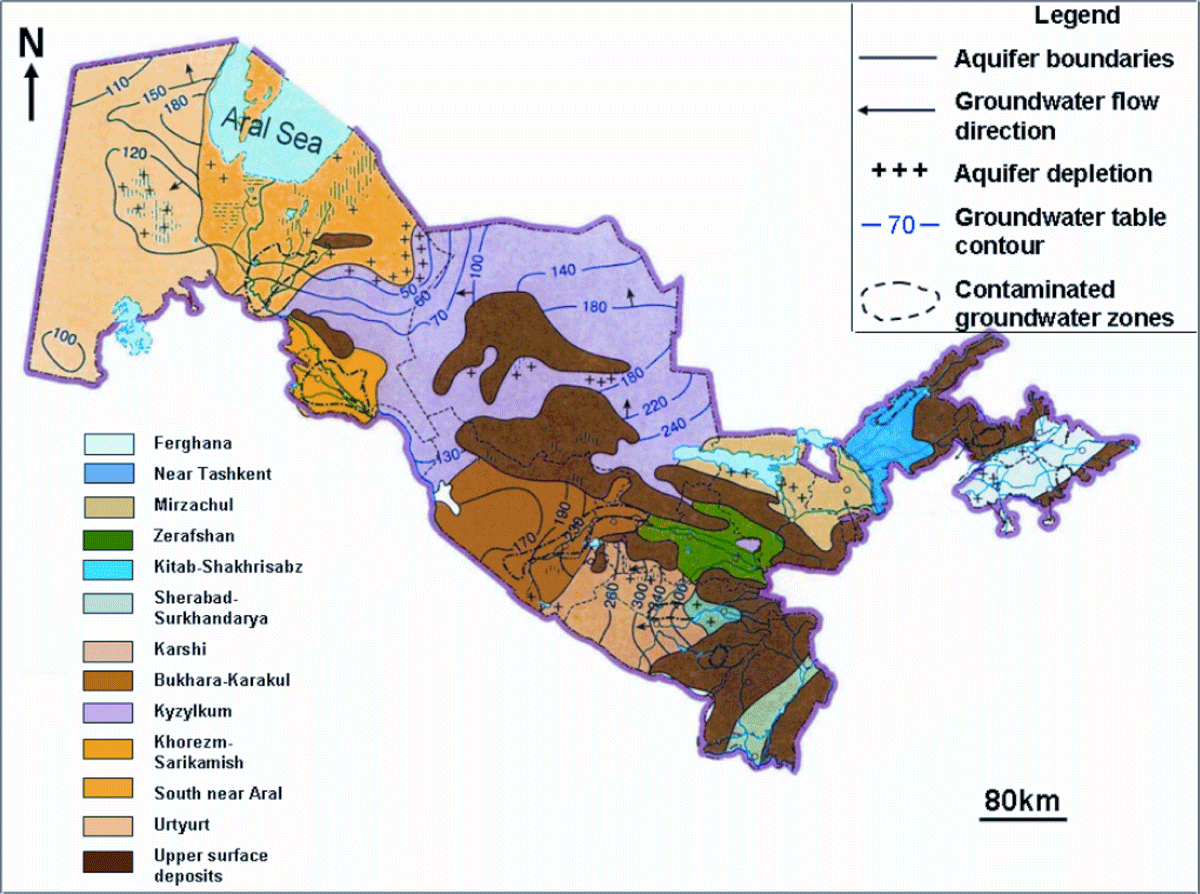
Figure 3
Hydrogeological map of Uzbekistan (Source: Rakhmatullaev et al. 2012).
4.2 Actors and interactions
Actors and their interactions are another key subsystem highlighted by the SES framework. In the groundwater context, actors include households, farmers, former Water Consumer Associations (WCA) replaced by “special services”, and industrial companies that use GW for domestic water supply and, to a lesser extent, irrigation, industrial and recreational uses:
GW provides 50% (about 3.4 km3 per year) of drinking water demand to households (SCNP 2013).
Households and farmers interact regarding the use of around 2.1 km3 per year of GW (ca 28%) for irrigation (CAWater-Info). GW is often an alternative source for irrigation in response to limited surface water availability. Recent and recurring droughts in Uzbekistan have diminished the volume of river water flows, resulting in new water resources being required for irrigation (SCNP 2013).
Some sources report industrial companies using the least GW of major user groups. Industrial use is estimated at 0.7 km3 of GW per year (ca 10%) (CAWater-Info). Industrial users vary greatly, for example, the tourism industry utilises GW for recreational purposes. It is reported that 119 GW wells contain physiologically active components (i.e., bromine, boron, silica, iodine, radon, hydrogen sulphide, and iron, salts, and gas mixtures) used by resorts, sanatoriums, dispensaries, rest homes, physiotherapy clinics, and mineral water plants (Kulmatov et al. 2021).
The literature states that local indigenous knowledge is more commonly utilised by rural water users compared to external (technical) knowledge due to access issues (Hornidge, Oberkircher, and Kudryavtseva 2013). At the community level, local “masters” (such as “wise men” in mahallas1) and family-based modes are described as being central to local knowledge reproduction (Hornidge, Oberkircher, and Kudryavtseva 2013). It is also noted that local knowledge “lies at the interface with formal, university-taught knowledge” characterised by a “linear, top-down approach to knowledge diffusion […] with little mutual exchange of ideas” (Hornidge, Oberkircher, and Kudryavtseva 2013: 269).
GW is used to meet crop water demand during water scarcity. Recent studies present evidence that GW irrigation practices secure timely irrigation, but require more intensive labour, agrochemicals, and increased energy inputs, compared to gravity irrigation (Karimov et al. 2022). Farmers are incentivised to efficiently use GW to reduce the high electricity costs of pumping water.
4.3 Governance systems
The SES framework highlights the role of governance systems that mediate the relationships between actors, their interactions, and natural resources. Governance systems include constitutional rules, policy level and operational rules and monitoring and sanctioning processes described below.
4.4.1 Constitutional and policy-level rules
The Water Sector Development Concept for Uzbekistan 2020–2030 (approved on 9 July 2020) is the main policy document relevant to GW use and management (Decree of the President No. 6024 “On Approval of the Water Sector Development Concept of Uzbekistan for 2020–2030”). The following objectives are outlined in the concept:
Reduction of irrigated areas with a critical GW level (0–2 metres) from 1,051,000 ha to 773,000 ha.
Development of an information system on the reclamation status of irrigated lands, GW level and salinity.
Research irrigated land salinity reduction, efficient leaching of saline soils, maintaining optimal GW levels and their salinity, studying advanced international technologies in this area and their use.
Development of a system for conservation and sustainable use of strategic GW resources, primarily suitable for drinking, through integrated management of surface water, GW and return water.
The Law on Water and Water Use (adopted on 6 March 1993) is another key policy document related to water management (including GW) in Uzbekistan. The main objectives of the law are to ensure more sustainable use, protection, improvement of environmental conditions, and to establish as well as enforce water property rights.
Additionally, the Uzbek government passed multiple legislative documents on GWG (Knorr, Theesfeld, and Soliev 2021). For instance, Resolution No. 430 (2017) regulates well establishment and GW withdrawal and Resolution No. PP-3823 (2018) differentiates GW prices for user groups. Furthermore, new formal rules on monitoring and limiting GW withdrawal have been introduced in three pilot districts (Resolution no. 855 (2019)).
Formal access and withdrawal rights exist in the form of drilling permit (i.e., special water permit) requirements for boreholes deeper than 25 m or expected extraction higher than 5 m3 per day. The permits can be issued by the State Committee for Geology and Mineral Resources to drilling companies. The State Committee on Ecology and Environmental Protection assesses the ecological status of GW reserves. Based on the State Committee for Geology and Mineral Resources’ evaluation of the applying drilling company, the level of GW withdrawal, ecological status of the resource reserves, and the applicant’s need for irrigation water, a quota or maximum GW abstraction amount is assigned to water users. The formal price of GW for irrigation is UZS 124.8 per m3 (about US$ 0.01). Water users must pay for actual water use if a water meter is installed or a flat price for water equal to the price per m3 of water multiplied by the maximum volume of GW specified in their permit (Knorr, Theesfeld, and Soliev 2021).
Furthermore, the government grants the status of specially protected natural territories to fresh GW formation zones to protect reserves. The State Committee on Ecology and Environmental Protection, in cooperation with the State Committee for Geology and Mineral Resources, Ministry of Agriculture, and Ministry of Water Resources (MWR) of the Republic of Uzbekistan, are responsible for the identification of potentially ecologically dangerous objects located within the boundaries of protection zones and developing measures to prevent pollution and depletion of fresh GW (Resolution of the Cabinet of Ministers of the Republic of Uzbekistan no. 23 “On assigning the status of special protected areas to zones of sources formation of fresh ground waters” of 16 January 2002).
4.4.2 Operational rules
Different institutional arrangements and practices have been identified in using GW for irrigation in a purposive sample of diverse locations by Knorr, Theesfeld, and Soliev (2021):
Only a few GW abstraction wells have been registered with the State Committee for Geology and Mineral Resources. Instead, most are registered with the local administration (hokimyats) and the state-run electricity supplier. Registration with electricity providers is necessary to receive a physical electricity connection from the electric grid. Furthermore, wells less than 25 m deep and with a capacity of fewer than 5 m3 per day are formally unregulated, without permit requirements.
While commercial farms (large land users) used one or more wells individually and received a subsidised electricity quota to run pumps (depending on their land size and cultivated crops), dehkan farms (small land users) have used GW for irrigation collectively in times of scarcity. The latter developed informal rules to share technical maintenance of GW infrastructure and technology, electricity costs, and GW evenly during an irrigation season.
4.4.3 Monitoring and sanctioning processes
Article 113 of the Law on Water and Water Use of 6 May 1993, describes the GW monitoring system: observation of water conditions and changes and prevention of negative dynamics. The monitoring structures, maintenance and procedures are determined by the Cabinet of Ministers of the Republic of Uzbekistan.
The State Committee for Geology and Mineral Resources, the State Committee on Ecology and Environmental Protection of the Republic of Uzbekistan, and the Ministry of Water Resources are the main agencies responsible for the assessment and monitoring of GW in Uzbekistan.
The provincial Hydrogeological Reclamation Expeditions (HGRE) under the Basin Irrigation System Administration (BISA) of the MWR maintains a database of GW field measurements, mineralisation, and soil salinity levels. There were 1,465 GW monitoring stations in the country in 2017. Field experiments and remote sensing methods are organised to assess and monitor water parameters, such as GW level and water salinity.
The President’s Decree No. 2954 “On Measures to Strengthen Control and Accounting for the Rational Use of Groundwater Resources for the period 2017–2021” (issued on 4 May 2017) initiated the assessment and monitoring program of GW reservoirs for 2017–2021. The program included a package of measures to access and monitor the commercial use of GW water, targeted growth rates for 2017–2021 GW inventories, expansion of the GW monitoring station network, and measures to strengthen the material and technical base of the State Committee for Geology and Mineral Resources of the Republic of Uzbekistan. For instance, it is forbidden to use GW without confirmation of reserves (Article 15 of the Law on Water and Water Use), the damage caused by GW use is subject to compensation by users (Article 39); the use of GW of drinking quality for purposes other than drinking and domestic water supply is generally prohibited (Articles 43 and 58); if GW aquifers are discovered during drilling and other mining works, it is necessary to inform responsible authorities and take measures to protect the resources. GW users must monitor the quantity and quality of used water for mining purposes, and drilling boreholes on porous soil for discharging industrial wastewater is prohibited to avoid pollution of GW aquifers (Article 101).
However, the literature states a lack of monitoring for agricultural GW use, as only a small number of water users installed water meters (Knorr, Theesfeld, and Soliev 2021). Despite formalised rules on well registration and metering, agricultural participants interviewed by Knorr, Theesfeld, and Soliev (2021) suggest that no participants had received sanctions for their noncompliance with such regulations.
The literature also notes reports of GW contamination by cyanide and other accompanying toxic substances. Detailed data on sources, types and volumes of pollution and waste discharges are lacking (UNECE 2020).
4.4 SES Outcomes
In this subsection, we present the SES outcomes that include overexploitation and pollution of GW in the study area. In Uzbekistan, about 70% of irrigated lands do not have a free outflow of GW and are exposed to salinisation (SCNP 2013). As a result of GW use for irrigation, the literature reports an increase of salinity in the GW table in irrigated areas. For instance, according to SCNP (2013), the irrigated areas with a water table between 2 m and 1 m have increased from 743.5 thousand ha (17.4% of the total area) in 2008 to 1182.9 thousand ha (27.5%) in 2010. It is assumed that GW levels above 1 m can lead to soil salinisation. The highest levels of soil salinity were observed in conditions where the GW was close to the surface, as there is a strong relationship between GW and mineralisation levels. With more evaporation from the soil surface, salt accumulation and soil salinisation occur faster (Kulmatov, Adilov, and Khasanov 2020). According to the Land Reclamation Monitoring Service of the State Committee for Land Resources, Geodesy, Cartography and State Cadastres (Uzgeodezkadastr 2015), more than 46.6% of irrigated land is affected by salinisation (2.5% strongly saline, 13.3% moderately saline, and 30.9% slightly saline).
Open drainage is used by farmers and agricultural companies to control GW levels. However, due to malfunctioning drainage conditions, rising GW levels may cause secondary salinisation of irrigated lands (Matyakubov et al. 2020). The national land inventory conducted in 2009 reports that irrigated land quality deteriorated by about 1 million ha (24.6% of the total area). Downstream provinces particularly experience problems aggravated by insufficient drainage (Kulmatov et al. 2015; Rakhmatullaev et al. 2012).
This problem has consequences not only for agriculture but also for population settlements. For example, high GW levels with high salinity damage structures, basements, and green spaces. Sherov and Soliev (2020) report that losses may range between 2.5 and 10 million US$.
Overexploitation and pollution of GW are other important outcomes. It is reported that GW resources have continuously decreased – by 40% between 1965 and 2002 (Kazbekov et al., 2007). According to Rakhmatullaev et al. (2012), in the arid western and southern provinces of Uzbekistan, GW use is twice the officially approved limits, leading to water shortages. Furthermore, the discharge of collector-drainage water into river systems and the chemical substances from agriculture contribute to GW pollution by nitrates and pesticides (Gadalia et al. 2005; Rakhmatullaev et al. 2012; Tookey 2007). As a result, fresh GW used for drinking water in Bukhara and Khorezm provinces and the Republic of Karakalpakstan does not meet state drinking water quality standards (Kulmatov et al. 2021).
The government acknowledged such problems stating that during the last 30–40 years, about 35% of GW reserves have been lost (President’s Decree No. 2954 of 4 May 2017). GW availability significantly decreased as a result of the intensive withdrawal in the zone of field distribution within Nurata, Koshrabad and Zamin districts, in Navoi, Samarkand and Djizak provinces (President’s Decree No.342 of 2 August 2022 “On Measures to Implement the Projects “Improvement of Drinking Water Supply in Chust, Pap, Namangan Districts and Construction of Sewerage Systems in District Centres of Chust and Mingbulak in Namangan Province” and “Improvement of Water Supply in Muzrabad District of Surkhandarya Province through Construction of a Water Pipeline from Groundwater Deposits “Oktosh” and “Poshkhurt” with the Participation of the European Bank for Reconstruction and Development). The government acknowledges the failure to monitor GW use and enforce the legal protection framework. This resulted in 59% of GW use occurring unregulated and an increased risk of losing the majority of national GW reserves within the next ten years.
Increasing GW use is deemed to be likely based on Uzbekistan’s reliance on irrigated agriculture and in response to projected water scarcity triggered by climate change. Indications of increasing GW use suggest a greater importance in improved provision of GW-relevant information to current and future users. Uzbekistan appears to display increasing interest in GWG through the recent development of GW rules and regulations.
5. Discussion
5.1 Dynamics and mechanisms of informational governance
In this subsection, we evaluate the performance of the conventional “state-run, expert-led, and natural-science-based” monitoring systems described earlier and argue that there is a high uncertainty over groundwater status in Uzbekistan (i.e., quantity and quality).
For instance, the reviewed literature reports several shortcomings in GW assessment and monitoring with close connection to informational governance mechanisms and practices. These include a lack of information on industrial GW use, overlap without proper coordination among the state bodies responsible for GW, and reductions in the number of observational wells used to monitor GW throughout Uzbekistan. We acknowledge that from the polycentric governance perspective such “overlap” can support the achievement of solutions tailored to local conditions, and thus, more effective governance. However, in terms of informational governance, this may contribute to high uncertainty regarding GW’s status. It is also noted that the existing observational wells are not evenly distributed.
Furthermore, a GW database operated by the State Committee for Geology and Mineral Resources publishes annual bulletins on the state of GW. This bulletin report is distributed to an estimated 40 government agencies involved in GW. However, bulletins are not publicly available outside of those 40 agencies (UNECE 2020).
The literature also describes two separate monitoring and reporting systems – formal and informal systems. A formal reporting system coordinates data and information exchange between the BISA (at the provincial scale) and the Ministry of Agriculture and Water Resources (MAWR) (currently renamed as MWR at the national scale) and is used for official water use planning. An informal reporting system, at the same time, coordinates information and data sharing between the Main Canal Management, BISA (at the provincial scale), and/or municipalities and is used for daily decision-making and problem-solving purposes (Hornidge, Oberkircher, and Kudryavtseva 2013).
Finally, international development agencies active in the country complain about a lack of GW-related research and publications (Wegerich et al. 2015). Nevertheless, we identified some scientific publications which assessed GW table and mineralisation and identified potential drivers, such as irrigation, salt leaching, climatic conditions, and drainage conditions (Eshchanov 2008; Kulmatov et al. 2013; Wahyuni et al. 2009; Kulmatov, Adilov, and Khasanov 2020; Matyakubov et al. 2020).
5.2 Structural uncertainty and multiple knowledges
The question raised in this subsection is what uncertainties and multiple knowledges exist in relation to GW and how they affect use, interactions between actors, and outcomes. Our findings suggest governance complexities at various levels due to multiple knowledges.
Specifically, nugget variance (i.e., small-scale variability) was found in the readings between close monitoring wells, implying possible measurement errors. This suggests that while such observation wells are useful at national and regional levels, the observations are not sufficiently site-specific for local-level use and management decisions (Ibrakhimov et al. 2007).
This connects with another critical factor – methods used for GW assessments that provide a high level of epistemic uncertainty. The poor distribution of observation wells and a lack of precise user information contribute to this, as does the existence of parallel reporting systems and separation of local and state-collected knowledge on GW status, suggested by the lack of information exchange between such bodies.
Parallel formal and informal reporting systems, as noted above, create inefficiencies and uncertainties. Infrequent information sharing between ministries suggest poor coordination and information exchange, which is then further complicated by the amount of state authorities with GW responsibilities. This creates multiplicity and related uncertainty when records by separate organisations do not match. Different bodies being aware of registered wells also points to uncertainty between different governance levels (Knorr, Theesfeld, and Soliev 2021). Multiple knowledges, where sources record different GW relevant numbers, negatively impact the confidence of actors in reporting. Multiple conflicting knowledges existing within individual states suggest even greater uncertainty regarding transboundary status and effects. Without clear notation of reporting differences and proper guidance as to best use of data, uncertainty is increased. Comparisons between all knowledge and methods would be ideal.
GW availability or physical property information appears to be unavailable to many users. Low public communication of environmental problems is noted in literature several times. A lack of publicly available aquifer data introduces users to unnecessary uncertainties pertaining to nearby resource availability and quality, while offering low impetus for local action where users are not aware of issues. Information provision is needed to support collective action. While local knowledge is cited as available to users, it could be inclined toward epistemic uncertainties. More research on aquifer relevant local knowledge is needed, as little detail on knowledge employed by GW users exists. Further insight into the breadth of local knowledge shared between users may point to certain areas where external and local information disagrees.
Uncertainty related to GW use and management is furthermore increased due to a lack of awareness among users of relatively new formal procedures and processes. Insufficient technical knowledge and expertise among users increases lack of formal process awareness. While local knowledge is most often cited as available to users, academic literature does not discuss local conditions in detail to understand the extent of “local” GW knowledge.
However, some cases note that information sharing is greater at local levels. Knorr, Theesfeld, and Soliev (2021) found that wells were more likely registered with local authorities than the state government body. The authors also reveal the potential for knowledge sharing between new bodies, such as state bodies and local electricity providers, could offer lower investment GW abstraction monitoring information.
Low assessment and subsequent difficulty in future planning was noted in literature, in connection with current information gaps and information provision issues. Of course, a lack of future assessment implies a decreased ability to adapt to future climate conditions and societal changes.
5.3 Power constellation in information governance
Inequalities and monopolies in environmental information-handling capacities (e.g., information-generation, transmission capabilities and access to information) are explored in our analysis. The key findings are that existing power constellations and a lack of cooperation suggest increased uncertainty about groundwater use and status.
The distribution of bulletin reports on GW to a select group of government organisations implies some hierarchy in power constellations between government organisations. Hierarchy is present in WCA interactions with state organisations. While WCAs have a formal responsibility to deliver water to farmers, the delivery is controlled and monitored by state organisations (e.g., BISA). BISA staff are involved in water delivery and monitoring for irrigation areas WCAs cannot supply. While WCAs were created to allow for local-level interactions, they have weak decision-making abilities regarding water supply and monitoring. WCAs face frequent interventions by local administration leaders (Hornidge, Oberkircher, and Kudryavtseva 2013).
The authoritarian system of state control over information acquisition that existed during the Soviet period may have led to self-censorship in local information production. Such a hierarchically organised society, with coercive reciprocity, also led to limitations to formalising informal practices. The current system has kept the centralised vertical knowledge management procedures that restrict creativity and agency development (Hornidge, Oberkircher, and Kudryavtseva 2013). The dominance of the state in the water sector may limit others’ ability to engage in GWG. Self-organisation has been noted as lacking by some studies as decisions are made at higher administrative levels (Knorr, Theesfeld, and Soliev 2021). Restructuring of the water management system concentrates on the formal sphere, which interviewees often referred to as “upper people”, responsible for water delivery (Hornidge, Oberkircher, and Kudryavtseva 2013).
Expert dependence appears multiple times in the literature. Researchers, for example, must acquire insight from experts to determine locations for GW studies (Knorr, Theesfeld, and Soliev 2021). Dependence on experts implies hierarchy. When users need publicly unavailable information, they may seek it through unofficial channels if unaware of accessible formal processes. Additionally, local hierarchical structures are suggested through reference to local wise men, who act as leaders available for local conflict resolutions. Gender is also relevant in this aspect, in consideration of traditional local leadership norms.
Hierarchical local structures (e.g., large farmers as well as agricultural and mining companies) can have a connection to competition and conflicts for access to GW between different users, especially in water-scarce areas. Though these receive little explanation, further elaboration in future research would be useful.
5.4 Design of reforms
In this subsection, we describe the design of reforms in Uzbekistan that facilitate more effective informational GWG. We argue that interest in informational GWG reform is displayed, but paths toward more effective governance remain unclear.
Interest in reform is likely influenced by global shifts in relation to the increase in information accessibility through the internet and new information technologies. Furthermore, compared to other CA countries, Uzbek policymakers are well aware of the importance of the resource and GW degradation risks. Government and donor coordination meetings take place at the national level on Integrated Water Resource Management (IWRM), including GW use and management and there is a legal framework for IWRM. The Uzbek government also pays great attention to the improvement of GW monitoring, planning of use and protection (Presidential Resolution No. 439 from 07.12.2022 “On Additional Measures to Protect and Streamline the Sustainable Use of Groundwater Resources”). For instance, a moratorium on well drilling and GW use has been introduced in the territories with a decreasing GW level. In territories where the water level has decreased by more than 5 m, issuance of hydrogeological land irrigation licences, agricultural production, drilling for wells and use of existing wells for irrigation without water-saving technology application (e.g., drip and sprinkler irrigation) are prohibited.
Furthermore, all GW users are obliged to be equipped with metering facilities and provide a report on the annual amount of water used to responsible authorities. Past environmental performance reviews stated interest and vision for the development of a centralised environmental database and purchasing of additional pollution source monitoring equipment. Meanwhile, there has been increasing interest in the observation of transboundary aquifers (UNECE 2020).
The interest of policymakers, NGOs, and international development agencies in informational governance reform is clear in studies and grey literature. For instance, the institutional design has been recommended to consider power relations between authorities and WCAs (Djumaboev et al. 2017). Hamidov and Helming (2020) suggest the introduction of digital agriculture concepts to provide updated information on the water table and depth of regions. Wegerich et al. (2015) refer to the development of Geographic Information System (GIS) capacity and the creation of transparent water flow information within the project activities of the German Agency for International Cooperation (GIZ). Karimov et al. (2015) explores alternative GW management strategies – the Managed Aquifer Recharge concluding that transboundary cooperation in using this strategy may increase GW storage and provide benefits at the local and national levels. Awareness building and knowledge transfer would be important for the adoption of new water-saving technologies, as well as awareness of the impacts of salinity issues (Hamidov et al. 2024). New resolutions include regulations to issue permits for drilling water wells in attempts to regulate and monitor GW (UNECE 2020).
5.5 Impact of informational governance
The literature indicates increasing use of GW, which we assume is locally unorganised due to the ease of establishing GW access and lack of clear collective action examples. While Knorr, Theesfeld, and Soliev (2021) describe the finding that agricultural users have coordinated GW use in times of drought, few other details are provided on how this occurred and other examples did not appear. The invisibility of GW generally complicates its collective action, but a lack of public information and communication of environmental issues further exacerbates this. Users would benefit from GW monitoring information access, to allow for comparison between monitoring results, local knowledge, and expert advice. Communication of GW issues to local communities could offer additional impetus for collective action and local monitoring, as current communication is described as inefficient. Increased information provision could help to combat status-quo local hierarchies, removing the need for informal coordination with powerful actors and dependence on experts for more basic information.
Actors’ interactions are also affected by governance disorganisation. Multiple responsible bodies infrequently share information, which is further aggravated by lack of accessible data. Regulation enforcement should be scalable and monitoring results should be shared among governance organisations to be effective. Gaps in information availability can complicate regulation enforcement, where the enforcing agency cannot access information collected by others. Some instances in the literature suggest formal information sharing could be improved between local levels to higher governing bodies, suggesting difficulties in establishing graduated sanctions. Governance would also benefit from information sharing to identify measurement issues and streamline related processes.
6. Conclusion
National governments often encounter issues in compiling and sharing information. There is added importance to improve such informational governance in Central Asia considering water availability concerns, societal transformations, water-energy-food security tensions and related interdependencies.
Our content analysis of the reviewed literature with a focus on Uzbekistan reveals a strong impact of informational governance on actors’ GW interactions, their collective actions, and outcomes at the local, national and transboundary levels (GW overexploitation and pollution). Currently, it appears that monitoring methods affect GW information and knowledge by contributing to uncertainty over status (i.e., resource quantity and quality). Meanwhile, GWG at the national, and subsequently transboundary level, are hindered by this uncertainty and multiple knowledges that sometimes directly conflict with one another and offer little guidance to users, the public, and policy makers over how to understand data and best select information for their needs. Power constellations and a lack of cooperation around GW use have a strong impact on resource pollution and overexploitation. Interest in reform (e.g., in line with the Integrated Water Resources Management and Basin Management approach), largely inspired by global trends of further data transparency and stakeholder involvement, is displayed. However, paths toward more effective informational governance are unclear. Available literature leaves a similar impression in relation to the split of governance responsibilities between local to national level agencies with documented information sharing issues. This suggests limitations on current perspectives for transboundary GWG coordination, as inaccurate or one-sided national information is unlikely to result in the best aquifer decision-making between CA countries.
Our review suggests topics for future research. For instance, not enough is known about GWG and local knowledge. Therefore, specific research on local users, their knowledge, practices, and opportunities to better support cooperation in resource use and increase awareness regarding GW overexploitation and pollution can help clarify best practices toward these goals at the local level. Local communities’ roles in informational GWG could be clarified across states. Informal reporting systems, which are used for daily decision-making and problem-solving also deserve focus in future research. Areas explored that could use more reflection include enforcement responsibilities, GW collective choice options, management across CA region, comparison of economic instruments, exploration of informal reporting systems, and industrial GW use.
The findings of this study are important for reference to local, national, and transboundary organisations to improve governance and information provision in Uzbekistan. At the national level, implementation of IWRM and Basin Management approaches should be further strengthened by improving informational governance. Information sharing between responsible agencies, co-management, and engagement of civil society, as well as integration of local, technical, and science-based GW knowledge in national policies across sectors, should be promoted. Monitoring and sanctioning of GW pollution in the mining sector (i.e., gas and oil extraction) is urgently needed. At the local level, the reviewed literature highlights the potential of renewable energy for GW irrigation and the importance of enforcement of existing regulations (e.g., registration of wells and payments for GW use, and installation of water meters to estimate resource use for different purposes). Finally, at the transboundary level, better comparability between CA country data can be supported through establishment of best methods, data guidance and coordination, prediction of future transboundary trends, and increased capability to plan adaptation according to potential future conditions.
Additional File
The additional file for this article can be found as follows:
Notes
Acknowledgements
We thank the guest editors and anonymous peer-reviewers for their valuable comments and recommendations. This study was undertaken as part of the One CGIAR Initiative on NEXUS Gains: https://www.cgiar.org/initiative/nexus-gains/, supported by funders who support the CGIAR Trust Fund. Special thanks to Kakhramon Djumaboev from the International Water Management Institute (IWMI) for supporting the implementation of this study in Central Asia. As this article was based on research from Sylvia Schmidt’s master’s thesis, we therefore thank Professor Klaus Eisenack from Humboldt-Universität zu Berlin for his feedback and recommendations. Furthermore, the authors also express gratitude for the helpful feedback received during the presentation of an earlier version of this paper at the WEFUz Project Workshop, held at ZALF, Germany (14 December 2022). The research conducted by Ahmad Hamidov for this paper received support from the German Ministry of Education and Research (BMBF) within the frame of the SusWEF project (FKZ: 01DK22002) and from the German Research Foundation (DFG) through the RebUZ project (GZ: HA 8522/2-2).
Competing Interests
The authors have no competing interests to declare.