
1. Introduction
Natural resource conservation policies aim to protect ecosystems and strengthen the sustainability of the services they provide to human beings. In this context, community-based natural resource management has recently garnered interest and is perceived as a vehicle for decentralizing and democratizing conservation governance (Roe et al., 2009; Roussel, 2005). According to the International Union for Conservation of Nature (IUCN), a community area is a delimited area, protected or not, which is endowed in most of cases with management plans and terms concerning governance by or with communities or indigenous peoples (UICN/PAPACO, 2009; Woodley, 2008). It is in this context that this study tries to understand the opportunities and challenges of community-based management of natural areas. Specifically, based on the notion of community-based natural resource management in literature, analysis of its practical application and institutional interactions is useful for understanding the diversity of stakeholder logics.
The emergence of community-based natural resource management is supported by arguments based on the needs and interests of the local community in protecting the ecosystem they know and inhabit (Agrawal & Gibson, 1999; Duguma et al., 2018). Using the principle of subsidiarity, which is based on the idea of efficiency by privileging the execution of policies at the lowest level, the local community emerges as the appropriate level of management (Ballet, 2007). Correspondingly, the poor performance of state management and market intervention in conservation has led to the questioning of the centralization of natural resources management (West et al., 2006). From these observations, building self-organized institutions that control the use of resources through collective action and are managed by local communities, emerges as a solution (Borrini-Feyerabend et al., 2004; Franco et al., 2021). Several studies illustrate how local communities or indigenous people’s have used naturals resources sustainably through various arrangements. Moreover, the commons’ governance literature identifies a solution other than privatization or state control for common resources’ management using the principle of negotiation between communities of individuals (Ostrom, 2010; Yelkouni, 2005; Zaga-Mendez et al., 2020).
Nevertheless, the capacity of communities to self-manage local natural resources is challenged by complex, multiscale conservation management structures with power asymmetries (Belsky, 1999; Cleaver & Whaley, 2018). To explore these issues, the political ecology approach, among others, studies processes, discourses and social inequities inherent in sustainable natural resource management. In this approach, governance analysis takes into account stakeholder interactions in the decision-making and policy development processes (Le Galès, 1995). Moreover, the analysis of stakeholder coordination processes reveals institutional arrangements consisting of both formal and informal (based on social relationship, cultural and traditional) agreements upon which those responsible for natural resource governance rely (Cleaver, 2002, 2017).
Our study takes place in Benin, which is confronted with natural resource management issues and a high rate of deforestation. Benin lost almost 85% of its dense forest and 30% of its vegetation between 1978 and 2010 (Sinsin et al., 2018). As a result, it adopted many environmental policies at both international and regional levels. Our study focusses on the bilateral agreement between Benin and Togo that lead to the creation of the Mono Transboundary Biosphere Reserve (MTBR), which comprises many discontinuous conservation sites. Biosphere reserves were created in 1974 within the Man and Biosphere (MAB) framework of the United Nations Educational, Scientific and Cultural Organisation (UNESCO). Their objectives consist of reconciling biodiversity conservation and socio-economic development objectives in protected areas by identifying central zones reserved for conservation and research, and buffer and transition zones where certain activities are allowed (Saleh, 2012). Several MTBR sites have been assigned to community biodiversity conservation areas (CBCA). However, few studies have explored their management processes, although some studies have described features of the Bouche du Roy CBCA ecosystems (Sinsin et al., 2018; Teka et al., 2018). Implementing conservation plans for CBCA ecosystems requires a focus on understanding their social-ecological challenges, particularly from an institutional analysis perspective (Arumugam et al., 2020).
To understand the opportunities and challenges of community-based management and governance of natural areas, the main question raised by this research is: how do stakeholders organize themselves to set up and manage a community area? To answer this question, we analyze interrelationships between stakeholders, and the underlying arrangements and power structures that help or hinder institutional arrangements for the Bouche du Roy CBCA’s management. The relevance of an institutional analysis in a context of common resources lies in its ability to appreciate better the organization and agreements that stakeholders can make to align independent actions towards coordinated or collective action (Ingold, 2008; Ostrom, 2010; Yelkouni, 2005). Institutional analysis allows our case study to illustrate the complex and interrelated transformations of the socio-ecological aspects of community area management and conservation strategies. Similarly, the different arrangements and socio-cultural and ecological characteristics identified by institutional analysis can expand conceptual horizons and further the application of scientific knowledge to biodiversity conservation in community areas.
The remainder of this paper is organized as follows. Section 2 presents the theoretical framework underlying the analysis. Section 3 discusses the methodology used for data collection. Section 4 presents the results of our institutional arrangements analysis of the management of the Bouche du Roy CBCA. In Section 5, we discuss the main findings of this study and their potential implications.
2. Theoretical Framework
This paper mobilizes Cleaver’s (Cleaver, 2002, 2017) institutional bricolage (IB) theory as it pertains to institutional arrangements in the context of environmental management. We also use Mitchell et al.’s (Mitchell et al., 1997) stakeholder theory-grounded framework, which focuses on the typology of stakeholder in management through the analysis of their importance and influences. Both of these frameworks use an institutional perspective and are complementary in our analysis.
IB theory borrows Levi-Strauss’s concept of intellectual bricolage, which refers to the creative adaptation of readily available tools or designed for the purpose at hand (Lévi-Strauss, 1962). Cleaver (2017) adapts this idea to the institutional analysis of natural resources management. IB theory falls within the field of critical institutionalism, a school of thought that explores the dynamic and interlocking institutional process of relationships between people, natural resources and society (Cleaver & De Koning, 2015). IB allies hybrid and polycentric arrangements of institutions that are characterized by multiple centers of power and authority (Cleaver & Whaley, 2018; Prado et al., 2021; Renou, 2009).
Institutions are understood as the set of formal (laws, regulations., etc.), informal (habit, belief, etc.) norms and rules that emerge from social dynamics and shape individual and collective behavior in a decision-making process (Cleaver, 2017; Douglas, 1987; Sakketa, 2018). Thus, IB refers to “the creative piecing together of different arrangements, styles of thinking and sanctioned social relationships to produce new or adapted institutions” (De Koning & Cleaver, 2012, p. 277). An empirical application of IB theory analyzes the process by which governance mechanisms are structured around local realities and specificities (Bissonnette et al., 2020). Such a process brings together different interlocking elements to form governance structures that are not necessarily static or robust (Prado et al., 2021; Sakketa, 2018). Power asymmetries occurs in IB when the ability of stakeholders to control societal resources (tangible or intangible) is unequal (Giddens, 1984; Sakketa, 2018). IB is characterized by five key elements that address temporal changes and adaptations whose discursive process can result in either aggregation, alteration, or articulation as summarized in Table 1.
Table 1
Typical characteristics of institutional bricolage in natural resource management (NRM).
| KEY ELEMENTS OF THE IB | POSSIBLE IB PRACTICES |
|---|---|
| 1- Innovation and adaptation of existing systems to meet the daily challenges of NRM 2- Versatility and dynamism in the functioning of NRM institutions 3- Recognition of emerging institutions that reconcile modernity and tradition 4- Adaptation of institutions to formal and informal norms 5- Inevitably unequal power relations in the functioning of NRM institutions | Aggregation: complementary and harmonious recombination of different arrangements Alteration: detour or reinterpretation of formal institutions Articulation: a decline or discord between different types of institutions |
These IB elements and practices served as the basis for our data collection and analysis. However, to analyze the influence of actors, stakeholder salience theory was also used to better explore the influence and agency of stakeholders involved in community management.
Stakeholders are individuals or groups that are or will be affected by the achievement of an objective (Freeman, 2004). Thus, the stakeholder salience theory (SST) proposes to take into account three relationship attributes, power, legitimacy, and urgency, to analyze stakeholder influence (Alcouffe et al., 2013; Mitchell et al., 1997). Stakeholders have power if they have the means to impose their will in the construction of solutions and interaction dynamics. Legitimacy is associated with stakeholders whose intervention is desirable or socially appropriate. Finally, urgency reflects the time-sensitivity and the importance of a stakeholder’s claim (Mitchell et al., 1997). SST is mobilized in many environmental studies (Alcouffe et al., 2013; Kolinjivadi et al., 2015; Leroux, 2010) and facilitates the analysis of stakeholder influence in community management. Understanding the dynamics of stakeholders’ influence in CBCA management requires an analysis of stakeholders’ three relationship attributes.
SST theory allows for a typology of stakeholders who are challenged by any of the attributes of power, legitimacy, and urgency (Alcouffe et al., 2013; Khurram et al., 2019). The full typology includes 8 possibilities: 1) definitive (power, legitimacy and urgency); 2) dependent (legitimacy and urgency); 3) dangerous (power and urgency); 4) dominant (power and legitimacy); 5) demanding (urgency); 6) discretionary (legitimacy); 7) latent (power) or 8) non-stakeholders (for a full description see Mitchell et al., 1997 and Section 4.4 below). These typologies help understand the influence of each stakeholder group in multi-stakeholder natural resource management. However, in a management context, attributes may embody multiple features, are not static and can change from one entity to another (Alcouffe et al., 2013; Leroux, 2010).
IB theory and SST are complementary in this study: the former favors the analysis of interrelationships and arrangements while the latter helps understand the influence of each stakeholder. They are relevant to the CBCA, where several stakeholders are involved, and agreements and arrangements are used to manage the community area. They provide a framework for structuring the collection, analysis and interpretation of data on the interrelationships between stakeholders and the institutional organization of the CBCA. Thus, while the IB allows for the analysis of the institutional arrangements underway in management, the SST facilitates the identification of the influence of different categories of stakeholders. In an operational way in this study, the organizations, arrangements and power relations of the stakeholders that constitute the institutional bricolage will be identified and described by the attributes of power, legitimacy and urgency that characterize stakeholders interactions.
3. Methodology
3.1 Study area
The Bouche du Roy CBCA, located in the south of Benin, is a marine and coastal area of about 9,678 ha, which is crossed by many types of waterways such as the Mono River, Lake Ahémé, the Grand-Popo Lagoon and the Atlantic Ocean and swamps as illustrated in Figure 1. It is one of the rare areas of the country primarily covered by mangroves which are tropical forests and grow between terrestrial ecosystems fresh water and swamp waters (Ndour et al., 2012; Sinsin et al., 2018). Mangroves are known for their high carbon absorption capacities, contribution to coastal protection and supply of ecosystem services (Hugé et al., 2016).
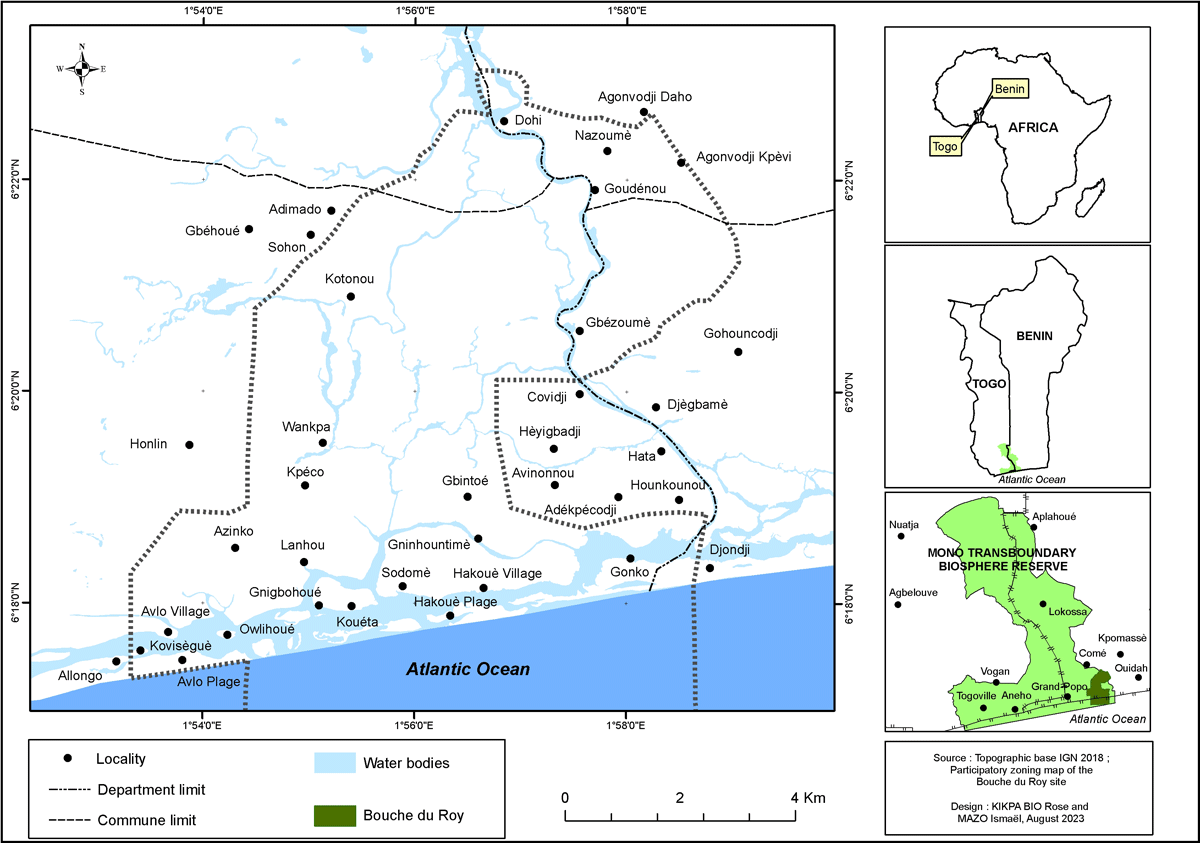
Figure 1
Map of the geographical location of community area Bouche du Roy.
The Bouche du Roy CBCA includes 17 villages and hamlets with an estimated population of 9,814 residents (RGPH-4, 2013). CBCA inhabitants belong mostly to the Xwla and Xwéda socio-cultural groups, two related ethnicities of the Adjatado cultural area (Nonvitcha, 2006). Their settlements date back to the time of conquests and tribal wars, when they took shelter from invaders and practiced fishing (Sogbossi, 2019). Their principal activity is artisanal continental and maritime fishing, but also crab and oyster fishing and fish processing and marketing. Other activities such as salt farming and rush exploitation predominate in certain villages of the CBCA. Agriculture is merely a secondary activity practiced by only 7% of the inhabitants in some peripheral villages (RGPH-4, 2013). In addition, some inhabitants practice fish farming, market gardening and the transformation of local products.
We chose the Bouche du Roy CBCA as a case study area because of the socio-ecological characteristics of its environment and its governance dynamics. Apart from strategies such as reforestation and mangrove maintenance, local management institutions resort to socio-cultural and spiritual arrangements consisting of sacralizing certain spaces by entrusting them to deities for their protection and the preservation of their ecosystems (PAGS, 2017; Sinsin et al., 2018). Also, the Bouche du Roy CBCA is characterized by complex shoreline and wetland management issues, especially with the construction of hydroelectric dams and an unstable river mouth (Amoussou, 2015).
3.2 The creation of the Bouche du Roy community area
The establishment of the Mono Transboundary Biosphere Reserve (MTBR) and the CBCAs was marked by the interplay of various approaches initiated by state and municipal institutions, the intervention of NGOs and the technical and financial support of international agencies (RBTM, 2016). The first phase consisted mainly of the identification of the area as a Ramsar site no. 1017 in 2000. This classification originates from the Convention on the Protection of Wetlands of International Importance signed in 1971 in Ramsar, Iran (Depraz, 2008). Since 2005, Benin has initiated the implementation of community programs such as the Beninese Project for Community Management of Marine and Coastal Biodiversity (see Figure 2). The second phase consisted of the delineation of community biodiversity conservation sites and the development of a site development and management plan. For this phase, Benin and Togo collaborated in establishing local management associations in the different community areas (PAGS, 2017). The reserve is thus made up of the sites of the Togodo complex, the Afito pond, the fetish forest of Godjè-Godjin, the sacred forest of Akissa, Lake Togo and the Gbaga channel in Togo and the sites of Lake Toho, the Naglanou forest, Dévé, Togbadji, the Adjamey complex and the Bouche du Roy in Benin. Thus, all the community areas on both sides of the two countries were registered in 2017 and constitute the MTBR.
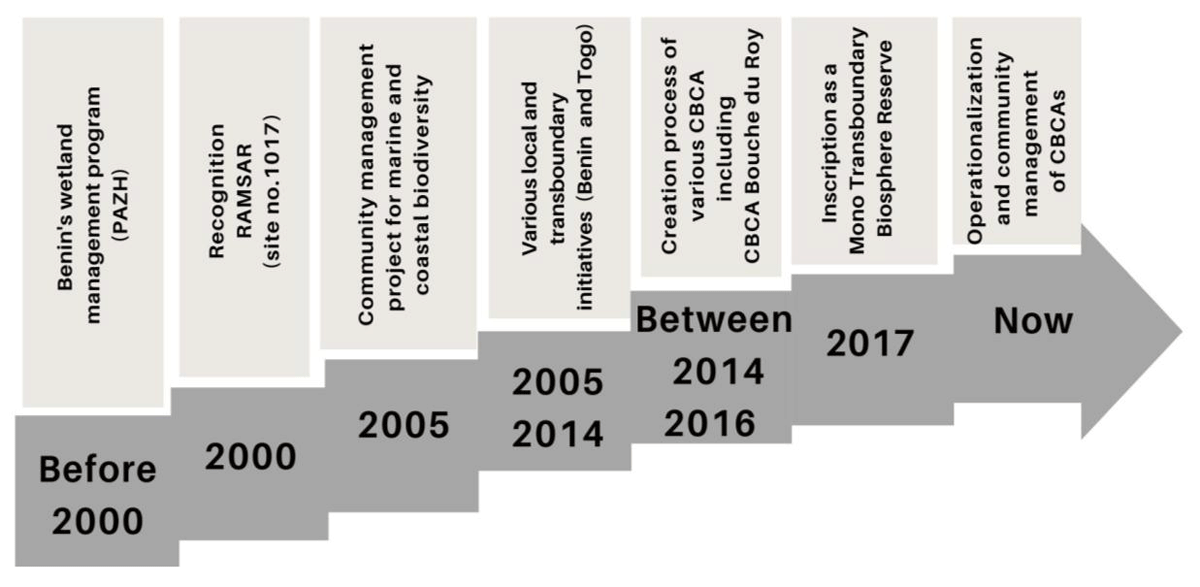
Figure 2
Trajectory of the Mono Biosphere Reserve and Bouche du Roy Community Area.
The Bouche du Roy CBCA, which is part of the discontinuous sites of the MTBR is also designated as an International Union for Conservation of Nature (IUCN) Category VI protected area, which is defined as an area of sustainable use of natural resources (PAGS, 2017; Woodley, 2008). It had also been identified by the Beninese government and the municipality of Grand-Popo for the creation of a protected area and the development of ecotourism (PDC, 2019).
3.3 Data collection techniques
The research began with a field exploration in the summer of 2018 that took in different zones and CBCAs of the transboundary biosphere reserve. The Bouche du Roy CBCA was chosen because of the involvement and interaction of different categories of stakeholders, but also because of the different arrangements and socio-cultural aspects and ecological characteristics of the biodiversity management and conservation strategies being developed there. This CBCA thus represented an excellent natural resources governance case study.
The data collection phase thus followed in winter 2020. The main data collection technique consisted of semi-structured interviews, which is a form of interaction that lets researchers focus on specific issues while allowing participants to express themselves freely (Savarèse, 2006; Savoie-Zajc, 2009). Participants were selected using non-probability sampling. The technique starts with intentionally selecting key participants (purposive sampling), followed by the snowball method of asking first participants for references of people who would be interesting to consult for the same study (Beaud, 2009; Campenhoudt et al., 2017).
We were thus able to recruit participants with varied profiles and a diversity of perspectives and classified them into two categories. The first category designated “professionals” (P) was composed of government employees, municipal employees, researchers, and NGO representatives who are or have been involved in the study area. The second category, referred to as “community members” (CM), was composed of leaders and members of the Association de conservation et de valorisation (hereafter CPA), which is responsible for managing the Bouche du Roy CBCA, local representatives, and the local population. A total of 73 semi-structured interviews were conducted, with 19 of the participants in the first category (P) and 54 in the second (CM) as described in Table 2. We interviewed 3-5 CM participants per village in all 17 villages in the CBCA. We interviewed P participants at various other locations, since many do not reside within the CBCA.
Table 2
Characteristics of study participants.
| CATEGORY | CHARACTERISTICS | NUMBER | TOTAL |
|---|---|---|---|
| Professional (P) | NGOs employees | 10 | 19 |
| State actors | 3 | ||
| Municipal employees | 3 | ||
| University researchers | 3 | ||
| Community member (CM) | Village leaders or elected officials | 15 | 54 |
| Doukpo members | 6 | ||
| Local population | 33 |
The interviews covered three main aspects: a) the history and creation process of the CBCA, b) the characteristics of the local communities and their natural resource management strategies, and c) the institutional organization and power relations. Interviews were undertaken together with an analysis of the main planning documents and through three activities that were carried out during our stay, including an open house session, a quarterly session of the Doukpo CPA members and a mangrove reforestation activity. These observations were made on the basis of an observation grid, which allowed “[…] a permanent back and forth between your perceptions, their mental explicitness […]” as described by Beaud and Weber (2010, p. 130). This was essential to contextualize and understand participants’ roles and interrelationships in the CBCA’s management.
Verbatim transcription and recordings made during the semi-structured interviews were used to carry out a thematic analysis with NVivo12 software. This type of analysis consists of synthesizing interview data by identifying relevant themes that inform research objectives (Campenhoudt et al., 2017; Paillé, 2007). A coding grid was developed using key concepts from the IB and SST theories and the themes that emerged from our data analysis as described in Table 3. Certain verbatim excerpts were coded as P for the professional category or CM for the community member category, followed by an interview sequence number to differentiate study participants.
Table 3
Terms of reference for the thematic analysis.
| THEMATIC | SUB-THEME |
|---|---|
| Local community | Practice culture, social ties, local system, activity, use, sacredness, support, collective strategy. |
| Interrelation | Stakeholder, natural resource management, agreement, adaptation, innovation, administrative level, tension, conflict, collaboration. |
| Power relationships | Decision-making, influence, legitimacy, diverse power, unequal resource, dependence. |
4. Results
The case study of the Bouche du Roy CBCA reveals a process of institutional bricolage that we illustrate by first describing the main stakeholders and their roles, and then describing the characteristics of the local community. We then discuss the natural resource management strategies and analyze stakeholder interactions and the influence of the different categories of stakeholders on the management of the CBCA.
4.1 The different categories of stakeholders and their roles
The governance of the Bouche du Roy CBCA, despite it being a community area, involves the participation of multiscale actors, mainly those in the five (5) categories listed in Figure 2 and described below. The process of creating and protecting the CBCA led to the establishment of the Conservation and Promotion Association (CPA) at the local level, whose mission is to conserve and promote the Bouche du Roy CBCA. This umbrella association is made up of village committees, grouped into three zone committees, and is responsible for managing the Bouche du Roy CBCA. It is a legally recognized local association that has signed a management contract for the CBCA with the municipalities of Grand-Popo and Comé. At the inter-communal level, Beninese NGOs such as Nature Tropicale and EcoBenin, which are active in the area, have mobilized and facilitated relations between the population and other actors. For example, the Grand-Popo municipality and the NGO EcoBenin signed a partnership agreement for the implementation of the CBCA management plan and the accompaniment of the CPA. At the inter-municipal level, the neighboring Comé and Grand-Popo municipalities, which are responsible for the territory, issued municipal decrees in 2016 for the creation of the CBCA and delegated its management to the CPA. At the regional and national levels, different ministries and agencies intervene in the protection and development of the area, in particular the Centre National de Gestion des Réserves de Faune (CENAGREF) which is the state entity for biosphere reserves in Benin. Finally, at the international level, technical and financial partners (TFPs) such as the German Society for International Cooperation (GIZ), IUCN and the World Bank (notably through the West Africa Coastal Areas, WACA project), contribute to the protection of CBCA ecosystems.
Table 4 describes the roles of the five main categories of stakeholders. Figure 3, on the other hand, illustrates the interrelationships among these stakeholders involved in governance. In particular, the data analysis reveals that the CPA, the NGOs (mainly Ecobenin) and the municipalities are implementation leaders that organise CBCA meetings every three months to program activities and extended reflection sessions with all state actors, TFPs and other stakeholders. In addition to formal agreements between some of the stakeholders, the analyses also reveal informal relationships, such as negotiations, self-monitoring and support from other organizations or state structures.
Table 4
Bouche du Roy Community Area stakeholders and their roles in its governance.
| STAKEHOLDERS | ADMINISTRATION LEVEL | RÔLE |
|---|---|---|
| TFPs | International | Partners that provide technical and financial support |
| State Structures | National | Decentralized state services to accompany policy implementation and supervise activities |
| Municipalities | Intercommunal | Territorial authorities that develop policy and regulatory frameworks to support policy implementation |
| NGOs and Association | Intercommunal | Consultants for the implementation and organization of community and institutional initiatives |
| CPA Doukpo | Local | CBCA manager with zone and village committees |
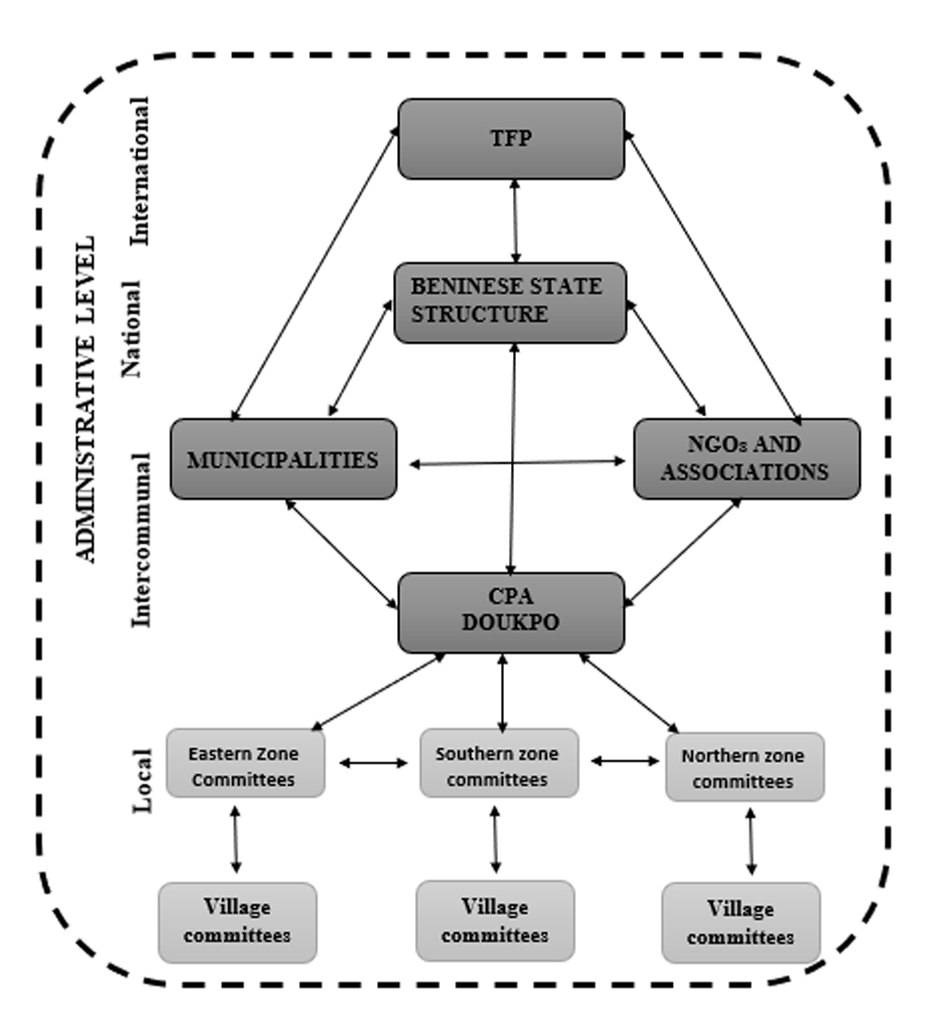
Figure 3
Interrelations between Bouche du Roy Community Area stakeholders involved in its governance.
NGOs’ contributions have been essential in facilitating stakeholder consultation and the implementation of the action plan. According to a statements from a state representative, they played an intermediary role between the local population and municipal and state representatives:
“All these sites were carried by the NGOs, which were accompanied by the municipalities that took decrees in an inter-communal dynamic. And since this was part of the objectives of the State, which had conducted feasibility studies, we accompanied the process” (Professional 16).
Nevertheless, some interrelationships complicate the responsibilities and prerogatives of stakeholders, for example, between the CPA, which has a management contract, and one of the NGOs, which has a support contract. Interviews with participants reveal that the low level of education they received at school of CPA members and the lack of an operating budget for the organization limit its dynamism. Conversely, the NGO is among the initiators and mobilizers of funding for ecosystem conservation. This leads the CPA to be dependent on the decisions of the NGO and the municipalities. The management of the CBCA is therefore led by the NGO, while the role of the CPA is currently limited to that of symbolic cooperation. Some participants noted the dominance of the NGO, which is at the forefront of the conservation and management process of CBCA. One employee expressed such a view:
“They (NGOs) are the ones who mobilize most of the funding with their partners, for the activities to be implemented, but there is a feeling that they want to make the reserve their private thing… there is also a quarrel that does not say its name between them” (Professional 7).
This issue, which was raised by several study participants, would have implications for the limited collaboration of the CPA with certain NGOs or organizations in the management and conservation process of the CBCA.
In summary, our analysis of the roles and interrelationships between stakeholders in the management of the CBCA reveals that its multi-stakeholder and multi-scalar governance style. Thus, although the focus is on the community, this category is only one layer in a network of interacting stakeholders. However, in the case of the CBCA, the contribution of the local community presented in the next section remains essential.
4.2 The characteristics of the local community and the creation of the CBCA
The historical and socio-cultural characteristics of the CBCA community play a determining role in the establishment of a new governance arrangement that is interwoven with the pre-existing context. The administrative villages are each headed by a village chief, but traditional and religious leaders also participate in village decision-making and in the management of the CBCA, particularly in the implementation of cultural and spiritual practices aimed at protecting ecosystems. Secondly, there are linguistic similarities (xwla and xwéda) between villages (Nonvitcha, 2006; Sogbossi, 2019), and family ties between small villages. Practices and beliefs are also similar across villages and there are mutual aid activities depending on the needs of a resident. In addition, it is a rural region and most of the localities are only accessible by water, thus limiting residents’ mobility, who are therefore mostly natives of the area. These socio-spatial characteristics favor the sharing of values and the concerted efforts of residents in the development of the CBCA development and management plan. According to several study participants, these characteristics ensure that the protection of the area’s ecosystems will be almost exclusively for the benefit of the local population. The statement of a village chief, in response to the ecosystem use regulations promoted by the authorities, illustrates this:
“Everything they (interveners) tell us, even if it is difficult to respect, is for our own good. They will not settle here; it is our children who will benefit” (Community members 31).
Then, the local CPA association brings together the people, association representatives, and leaders at the local level. The CPA was formed from the village and zone committees and is called Doukpo, which in the local language means Xwla: to eat and leave for others. According to several participants, the establishment of the CPA has brought a community dimension to the management of the CBCA. However, the number of CPA members is small in relation to the population. According to the interviews, about thirty out of a population of 9,814 (RGPH-4, 2013) are regular members of Doukpo. Membership requires the payment of a monthly fee, which discourages many from becoming members, hindering the representativeness of the population and the diversity of opinions in decision making. Similarly, according to interviews, public support for the conservation process and principles remains mixed. In particular, the reforestation of the mangrove would result in the filling of rivers that are already silting, thus reducing the population of certain fish species already under anthropic pressure. As one participant’s comment illustrates:
“From the beginning it (public buy-in) was a little difficult. Little by little they tried to convince us. At some point we realized that the initiative was good. But now, some voices are still being raised. Everybody knows the necessity of mangroves and their usefulness. The population is against planting mangrove because the (shallow) depth of the river does not allow for it” (Community members 51).
Participants in this study also stated that there are disagreement and dissatisfaction among some segments of the populations with the current CBCA regulations regarding the removal and prohibition of fish traps installed on rivers in the region. This regulation has met with resistance in several localities and is perceived by some residents as depriving them of their main income-generating activity. Conflicts between environmental protection and the economic and cultural activities of local people hinder policy adherence and reduce the effectiveness of various arrangements for the management of the CBCA.
In addition, although not very developed, incentive measures help to support and encourage the adoption of practices that are less destructive of ecosystems. These include the establishment of village savings and credit associations or women’s associations that receive support and financial assistance for the development of socio-economic activities such as the exploitation of rushes and the processing of local products. There are also training opportunities for tourist guides, restaurant operators, and for the development of community ecotourism associations to support and highlight key benefits of biodiversity conservation and related community activities. These accompaniments and support in kind or in cash also help to create a dynamic and collective action around conservation objectives.
This section revealed that the village committees and the Doukpo CPA provide a forum for exchange and consultation between the local community and various stakeholders. The interactions that influence the CBCA’s management include the adherence to or non-compliance of the population with conservation policies and negotiations with other organizations, local leaders and religious leaders. Thus, while village administrative structures supported the creation of the CBCA and continue to support its management, our analysis reveals important challenges such as conflicts between conservation objectives and local livelihood needs or financial barriers resulting in mixed support from the local population.
4.3 Natural Resource Management and Hybridization of Protection Strategies
The protection of the Bouche du Roy CBCA includes complementary management and conservation strategies inspired by local practices and beliefs that either protect or regulate the use of natural resources. Among the strategies retained in the CBCA management plan is sacralization, a practice that consists of entrusting part of a mangrove or waterway (such as spawning grounds) to the supervision of Zangbeto deities, who are greatly feared in the region. This spiritual practice already existed in the area and the idea of resorting to it would have come from the observation of the non-respect of the texts and principles of biodiversity conservation by the riparian population. Currently, all the core areas and certain zones of the CBCA have been sacralized (approximately 503 ha). The consecration is made by religious leaders and the violation of the established laws leads to the payment of a fine in cash or in kind, and in case of recurrence, the sanctions can go as far as the expulsion from the village. This ecosystem conservation strategy used in the CBCA gives a central place to religious and traditional leaders in the functioning of the CPA. Participants were unanimous in saying that there has never been a violation in these areas. One local elected official explained it in these terms:
“No matter what your religion is, everyone here knows that you don’t mess with the Zangbeto (divinity). If you are caught, the Zangbeto can depending on the case, ask you to pay money, locust legs, midges, sheep, and if you continue, you may even be expelled from the village” (Community members 31).
Thus, informal self-monitoring precautions and agreements are also common to ensure compliance with laws to protect the conservation area. This led some participants to view sacralization as the highest form of reprimand and an exclusion of people from the resources on which they depend. However, others believe that it will be necessary to move toward voluntary responsible use in the future rather than being forced to sacralize areas to conserve natural resources.
Our analysis identified other measures based on practices and beliefs that are involved in the regulation and management of natural resources in the Bouche du Roy CBCA. These include the organization of collective and seasonal targeted fishing such as the “Aloohê”, which identifies zones and fishing periods as well as zones that must be put to rest to avoid overexploitation and to promote the gradual renewal of fish. Similarly, according to custom, fishing is prohibited on certain days such as Sundays and market days for various local reasons. Secondly, the totems, taboos and venerations of certain species in the area contribute to the protection of biodiversity. In this category, the black catfish (Clarias sp) is a totem for the inhabitants of the area. Also, the hippopotamus (Hippopotamus amphibius), the leatherback turtle (Dermochelys coriacea), which is said to have saved the ancestors from the sea, and the hundred-year-old trees that shelter deities, are venerated in the area. These considerations help to save certain species from local use and thus reduce anthropic pressure.
Apart from strategies inspired by local knowledge and practices, protection and restoration activities include the reforestation of mangrove areas, of which 100 ha are underway. This activity requires the voluntary participation of the populations for the nursery and planting of mangroves in collaboration with the NGO that accompanies the process. There are also hatchery sites, where marine turtles’ eggs are collected and cared for until they hatch, before releasing the hatchlings into the sea. Furthermore, in addition to the representatives of the local Doukpo association, eco-guards are appointed in each village to contribute to the awareness, self-monitoring and mobilization of community members. Finally, the development of the management plan and the various zoning measures contribute to the reduction of anthropic pressure and the protection of ecosystems.
The strategies implemented for the protection of the Bouche du Roy CBCA ecosystems demonstrate a hybridization of locally anchored and “technical” strategies. These aiming at multiple objectives and knowledge are involved in a complementary and interactive way. The use and valorization of initiatives inspired by local practices and beliefs for the conservation and management of the CBCA contribute to the implementation of collective strategies for the management of common resources. The data thus reveal an institutional bricolage that uses innovation, adaptation of existing systems and practices, local tradition, and agreements to meet the daily challenges of NRM.
4.4 Power Relationships and Stakeholder Mapping
The previous sections presented the roles of and interactions between the 5 main stakeholders: TFPs, state structures, municipalities, NGOs and PCAs. In addition to the legitimate recognition of these categories of stakeholders in the management and implementation of management and conservation strategies, the results show that the importance and influence of each category of stakeholders are unequal and variable. In particular, the influence of power among stakeholders is linked in the case of CBCA to political and administrative status, which grants greater authority especially to municipalities and state actors. Also, the dynamism of stakeholders and their ability to make decisions and finance activities favor their predominance, as is the case for NGOs or TFPs. Indeed, the CBCA’s management and conservation faces a financial challenge due to insufficient municipal and state funding for conservation actions, limiting activities to those supported by external funding. Consequently, activities financed by TFPs, such as mangrove reforestation, are being carried out despite low support in several villages. Thus, the CBCA’s biodiversity conservation plan is largely the product of various local, national, and international influences which are beyond the local populations.
Based on stakeholder interactions and following Mitchell et al.’s (1997) typology, each of the five main categories of CBCA stakeholders combines two or three of the stakeholder influence attributes of power, legitimacy, and urgency (see Figure 4). In this context, the NGO and municipal categories can be considered definitive stakeholders given that based on their mandates, they have legitimacy, and that they also have the power to influence the management and urgency of implement interventions. On the other hand, the CPA category has the legitimacy and urgency to influence an intervention but lacks sufficient power to be classified as a fully definitive stakeholder. This category is closer to dependent stakeholders for the time being. State actors and TFPs, not only have the power to influence a decision, but also the legitimacy to intervene, according to the institutional framework of the Bouche du Roy CBCA. These actors can be considered dominant stakeholders.
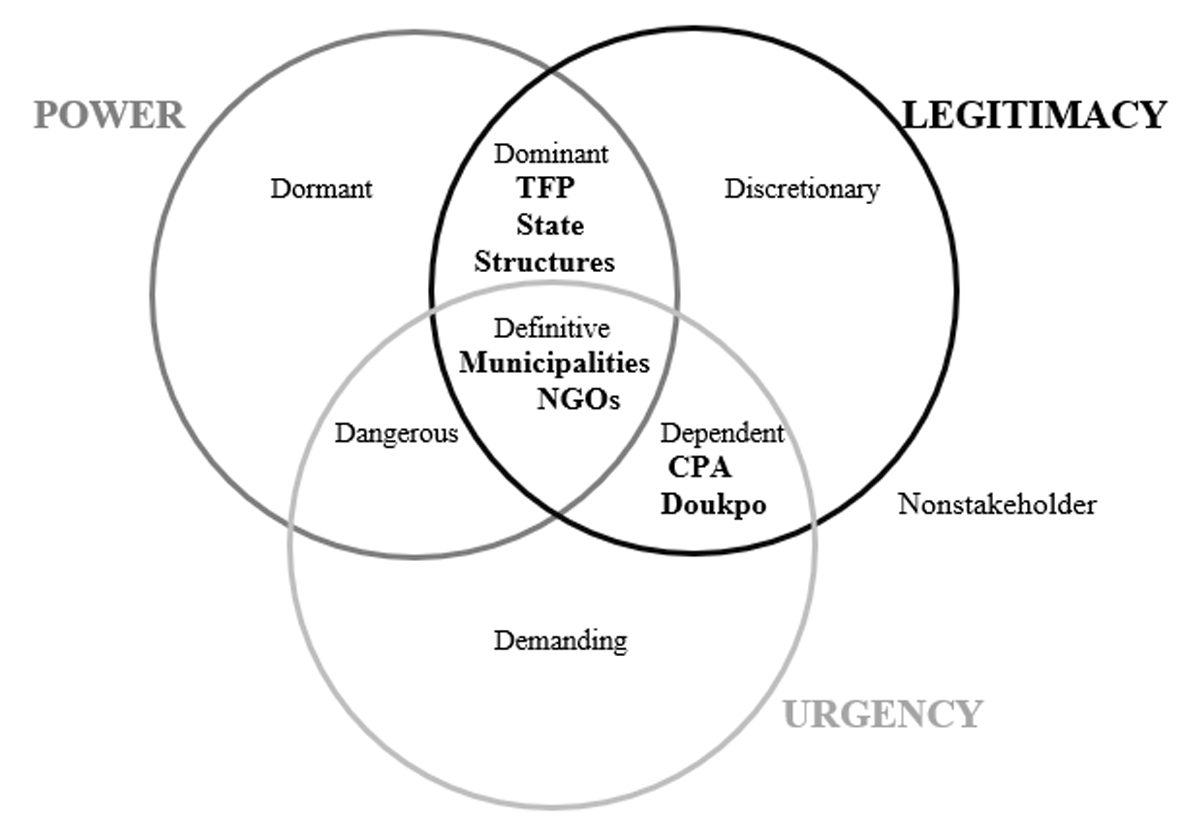
Figure 4
Stakeholder Mapping of the Bouche du Roy Community Area Adapted from Mitchell et al. (1997).
This classification of stakeholders according to attributes demonstrates that they do not influence the CBCA management and conservation process in the same way. However, these attributes are transient, resulting in a dynamic classification of stakeholders during over the life of an evolving process.
The results of this analysis of the CBCA management and conservation strategies illustrate its institutional arrangements, providing an understanding of stakeholder attributes, and highlighting the role of traditional customs and the hybridization of conservation strategies. Our analysis reveals the interrelationships between stakeholders, identifying the influence and importance of each, and revealing the existence of asymmetrical power among them while exemplifying IB elements.
5. Discussion
We have described and analyzed the interrelationships of stakeholders and institutional arrangements used to manage the CBCA’s ecosystems. We now discuss how these characteristics and stakeholders’ attributes reveal institutional bricolage in the Bouche du Roy CBCA.
Firstly, our analysis exposes various stakeholder interrelationships undertaken to address a complex natural resource management context that requires institutional reorganization and adaptation (Cleaver, 2017; Sakketa, 2018). As proposed in Cleaver and Whaley (2018), vertical and horizontal interrelationships among stakeholders can generate unequal relationships in which the local community is often pressured by external stakeholders and lacks sufficient power to influence decisions. Our findings align with those of studies that note the influence and dominance of stakeholders at the hierarchical level and complicate the community management process (Brockington et al., 2012; Duffy, 2008). In particular, using IB and SST theories, our study provides more detailed and nuanced evidence that the attributes of stakeholders influence their salience in the institutional bricolage process in a multi-actor, multi-scale context. For the power attribute of CBCA stakeholders, the determining factors are related to political and administrative status, dynamism and capacity to make decisions and to finance conservation and management activities. According to SST theory, these factors fall under the three types of power (Leroux, 2010; Mitchell et al., 1997): coercive power (prohibitions, restriction of areas, etc.), utilitarian power (dominant technical and financial contributions), and normative power (symbolic recognition and influence). SST notes that stakeholder legitimacy is equally important (Alcouffe et al., 2013; Khurram et al., 2019). Legitimacy, which refers to stakeholders whose intervention is desirable or appropriate, is beyond the legal framework, reflecting a “socially constructed system of norms, values, beliefs, definitions” (Mitchell et al., 1997, p. 869). This attribute allowed us to consider the different socio-cultural arrangements of CBCA stakeholders in a process of institutional bricolage. Thus, combining IB and SST for our case study facilitated the identification of the varying contribution and influence of the five stakeholder categories. Nevertheless, the organizations, arrangements, understandings, and stakeholder attributes in conservation management are rarely static and vary over time. As IB and SST theories argue, the influence and interrelationship of stakeholders evolves as does the process of institutional bricolage, making it dynamic and intermittent (Cleaver, 2002; Mitchell et al., 1997).
Secondly, the evolution of the CBCA’s management reflects an IB process that promotes the use of relevant traditional knowledge and practices implemented by religious leaders and local communities such as the “right way to do things” (Cleaver, 2017, p. 48). This has occurred in community management contexts in Zimbabwe (Cleaver, 2017) or Indonesia (Acciaioli, 2008), where arrangements are aligned with ancestral or customary values of local people or less conflictual decision-making processes (Cleaver, 2017). As in Amoussou (2004), our results illustrate the value of bricolage strategies that incorporate sacralization and other cultural and collective practices to help safeguard biodiversity and regulate spawning grounds for fishing. Cultural practices and traditional ecological knowledge (TEK) are part of a strategy used in environmental policy to limit pressure on many sacred spaces and resources in Benin (Juhé-Beaulaton, 2010; MEPN, 2009). However, support for the use of particular cultural practices or TEKs by communities or authorities is not unequivocal, because while these tools can be used to reduce management problems and conflicts in a do-it-yourself process, they can also exclude stakeholders through retaliation (Ballet, 2007). The results obtained in the CBCA partly illustrate this aspect concerning the sacralization of spaces, which facilitates the protection of ecosystems by excluding them from anthropic pressure, but which is perceived by some participants as a coercive and exclusionary measure. The nuance in the sacralization of the CBCA is that a formal agreement has been integrated into the management plan and most of the sacralised spaces are central core areas intended in principle for full protection. Nevertheless, its implementation affects access to and use of resources that raise issues of exclusion often encountered in community-based natural resource management (Brockington et al., 2012; Hall et al., 2011; Rufin-Soler et al., 2020). Thus, in an IB, practices, norms and agreements give rise to power issues despite the various arrangements that may arise.
An IB theoretical lens proves useful in understanding the institutional change and adaptation that occurs in natural resource governance (Prado et al., 2021). Our research demonstrates that the development of Bouche du Roy conservation institutions fits well into IB’s key elements. IB processes can result in different configurations depending on how hybrid institutions have been combined or modified in context and over time (De Koning, 2011). The IB practices of articulation, alteration, or aggregation (see Table 1) demonstrate how institutions might respond (De Koning & Cleaver, 2012). The Bouche du Roy CBCA’s IB practice corresponds to aggregation, given the complementary recombination of different arrangements and some traditional norms. Indeed, despite some reluctance and disagreement from the local community, the management and conservation strategies of the CBCA exemplify the coexistence and complementarity of formal (decree of creation of protected areas, management, regulations…) and informal (belief, habit, self-monitoring and collective strategy…) rules in a NRM context. This coexistence favors an adaptive process aligned with local norms to respond to the challenges of managing natural resources according to local standards (Franco et al., 2021). Our findings align with the creative institutional recombination used in the management framework for collective timber extraction in Bolivia, which allowed the community to add other elements to the forest management plan (De Koning, 2011).
Nevertheless, despite the existence of institutional arrangements seeking to ensure greater adaptation to local contexts, there are inherent contradictions in the implementation of CBCA conservation. Our results highlight conflicts between conservation objectives and the population’s livelihood needs. Similarly, the coexistence of multiple institutions with power asymmetries (Prado et al., 2021) and the weak autonomy of the local association complicates the CBCA’s governance. Participant responses also reveal the existence of discontent following the various restrictions and the reluctance of some inhabitants to adhere to the implementation of certain projects such as the reforestation of mangroves. All these aspects demonstrate the instability of the aggregation of the IB process in the CBCA, which could experience a reshaping of the process. Thus, the IB process could result in an alteration of the roles and power of the local association, NGOs or other stakeholders or an articulation of the process by a refusal or distancing of the local people (Sakketa, 2018). To maintain and improve institutional arrangements, it is therefore necessary to recognize the ongoing bricolage process as suggested by Prado and al. (2021), and to then strengthen the dialogue between the different stakeholders in order to establish a bricolage process that is more consistent with local realities (Hugé et al., 2016).
Finally, using BI and SST, the data from this study points to the implementation of natural resource conservation strategies that required institutional organization and collective agreements. The results from the CBCA Bouche du Roy case demonstrate an opportunity for collective coordination of the territory’s resources. Issues of unequal power relations and reconciliation between conservation objectives and the subsistence needs of the local population also emerge as challenges facing community areas.
6. Conclusion
The CBCA case study provided an in-depth analysis of the management and conservation of this community area. Using a combined IB and SST theoretical framework, the analysis sheds light on how stakeholders are organized at various administrative levels and the possibility of institutional arrangements for NRM. The emerging IB is characterized on the one hand by arrangements that govern the organization of stakeholders and the creation of the local management association and on the other hand by the hybridization of conservation strategies that include cultural practices.
This study sheds light on the implementation of biodiversity protection policies by highlighting the adaptation and innovation of stakeholders in the management of common pool resources, but also the unequal influences that a discourse of community-based management might conceal. In particular, the use of critical institutionalist perspectives helps to uncover and address the multiple challenges faced by local stakeholders due to multiple interactions and the challenges of reconciling conservation objectives with their livelihood needs.
The CBCA management would benefit from capacity building of local actors and synergy of action between the different stakeholders to better balance the power and responsibilities between them. The results also underline the importance of improving dialogue with local communities and reaching compromises to strengthen people’s commitment to conservation goals. Future research could study the influence of power relations in the construction of compromises between conservation and socio-economic objectives.
Ethics and Consent
Researchers obtained ethical approval from Université du Québec en Outaouais (UQO) on the Tri-Council Policy Statement: Ethical Conduct for Research Involving Humans before the research began.
Acknowledgements
We appreciate the contribution to different stages of this article of Lynda Gagné, Vijay Kolinjivadi and Alejandra Zaga-Mendez.
We would also like to thank the anonymous reviewers and the editors of this journal for their contribution to the improvement of the manuscript.
Funding Information
This work was supported by: Social Sciences and Humanities Research Council of Canada (Canada research Chair in Ecological Economics); Les Offices jeunesse internationaux du Québec (LOJIQ); Fonds de recherche du Québec – Société et Culture (FRQSC) through a doctoral grant.
Competing Interests
The authors have no competing interests to declare.