
1.0 Introduction
At its heart, the study of commons governance involves the study of institutions. By institutions, we mean “shared concepts used by humans in repetitive situations organized by rules, norms, and strategies” (Ostrom, 2010, 263). These rules, norms, and strategies take the form of institutional statements, which are defined as “shared linguistic constraints or opportunities that prescribe, permit, or advise actions or outcomes for actors” (Crawford and Ostrom, 1995, 583). Institutional Analysis, or the study of institutions, their design, and their effect on individual behavior, is the basis for many types of research in the collective use and management of resources (Ostrom, 2005). One method of Institutional Analysis uses the Institutional Grammar Tool developed by Crawford and Ostrom (1995) to systematically break down institutional statements into their core components for comparison and analysis. The main goal of this article is to review how scholars have used the Institutional Grammar Tool as a method to engage in Institutional Analysis.
Crawford and Ostrom’s purpose in creating the Institutional Grammar (hereafter IG) was to provide a conceptual tool for consistently and systematically identifying rules, norms, and strategies that would allow for interdisciplinary conversations and accumulation of knowledge between scholars of institutions addressing questions such as: How do norms and rules incentivize behavior? How does institutional design influence outcomes? and How are patterns of interactions among actors influenced by rules, norms, and strategies? Of more than 50 papers that have applied the IG in some form, many focus on answering these questions in the context of common pool resource management. The IG has proven to be a powerful tool in disentangling the complex web of rules, norms, and strategies governing behavior and interactions related to a collectively-managed resource, providing insights for rule-making and the design of institutions.
Given the increasing numbers of studies in the past decade in which authors have empirically applied the IG, it is a worthwhile exercise to assess the value of the IG as a methodological tool for empirical analysis through a review of the literature. We aim to complete this exercise by assessing 1) why and how analysts have used the grammar; 2) what theoretical concepts authors find important in this literature; and 3) how IG is used to help operationalize those concepts. Previous reviews on this topic have provided valuable insights on the questions and methodologies that have guided IG scholarship, as well as theoretical and empirical challenges faced by researchers doing institutional analysis based on the IG syntax (Dunlop et al., 2019; Siddiki et al., 2022). Our review provides a systematic analysis of all empirical articles that have utilized IG from 1995 to 2021, building upon and expanding previous works in the field.1 While Dunlop et al. (2019) have criticized earlier empirical applications, pointing out the limitations of counting the IG components as a means of analyzing institutional arrangements, we have observed that more recent empirical applications are moving away from frequencies of grammar components and instead creating theoretical variables and inputs for modeling. In contrast with Siddiki et al. (2022), our focus is less on the development of the IG tool and more on demonstrating its contributions towards measuring challenging concepts such as polycentricity, discretion, and compliance.
Thus, our review first provides a brief introduction to the IAD framework and describes the IG and its value for analyzing institutional arrangements. Second, we describe our methods for conducting the literature review. Third, we summarize the results of this inventory, including a summary of the geographic and scholarly footprint of IG scholarship, the extent of the use of IG analysis, and how it has been applied. Fourth, we discuss the dominant theoretical concepts and variables analysts have operationalized using IG. We conclude the paper with some reflections on the next steps and opportunities for continuing to develop IG analysis for research on management of collective resources.
2.0. Background on Institutional Analysis and the Institutional Grammar
Institutional analysis and the IG are theoretically based in the Institutional Analysis and Development framework (IAD; Ostrom, 2005), which provides multiple, related conceptual tools for systematically analyzing institutional arrangements in context (Schlager and Villamayor-Tomas 2023). Two related IAD framework conceptual tools allowing analysts to carefully measure and analyze institutional statements are the Rule Typology and the IG (Ostrom, 2005). The Rule Typology categorizes rules by the components of the action situation they directly affect. As per the IAD framework, the action situation consists of participants, holding positions, who engage in choices or actions affected by information the participants possess, as well as how their actions are linked, or aggregated, and the costs and benefits of actions and outcomes. The italicized words identify types of institutional statements that constitute the Rule Typology. Position and Boundary statements identify how individuals enter and exist in specified positions. Choice statements authorize individuals in positions to take specified actions. Information statements prescribe who shares what forms of information with whom. Aggregation statements specify how choices by individuals are linked. Payoff statements assign benefits and costs to choices and outcomes. Outcomes are often prescribed by scope statements specifying the states of the world that individuals in action situations are prescribed to achieve.
The IG takes analysis of institutional statements beyond categorization, offering institutional and policy analysts a strong conceptualization of the syntactic form of institutional statements to explore their roles in supporting or undermining collective action in myriad settings from local to global, and contribute to the accumulation of knowledge of institutional arrangements by sharing a common language and syntax. Institutional statements can adopt two functional forms: regulative statements prescribing actions for specific actors within particular constraints, and constitutive statements parameterizing features of a governed system (Siddiki and Frantz 2022; Bushouse et al., 2023). The IG has primarily been used for analyzing regulative statements. Regulative institutional statements can be broken down into five components, known by their acronym ADICO: Attribute, Deontic, aIm, Condition, and Or Else (Crawford and Ostrom 1995). An additional component, the oBject, was added by Siddiki et al. (2011) to designate a receiver of an action by an Attribute, resulting in ABDICO syntax. Table 1 summarizes these components, which comprise IG Version 1.0 (IG 1.0).2 The combinations and organization of these components into institutional statements allows for differentiation of rules, norms, and strategies.
Table 1
The Institutional Grammar version 1.0.
| A – Attribute | The actor who carries out the action specified in the aIm |
| D – Deontic | May, must, must not, should, should not |
| I – aIm | The action to be taken (or not) by the attribute |
| B– oBject | The receiver of the action |
| C – Condition | The where, when, and how conditioning the aIm |
| O – Or Else | The consequence for noncompliance |
[i] (For more detailed discussions of these elements, see Siddiki et al. 2022.)
An example of a strategy is “Longer distance travelers drive in the left lane of the freeway”, where the Attribute is longer distance travelers, the aIm is drive, and the Condition is the left lane of the freeway. An institutional statement is a norm (ADIC), and not a strategy if it also contains a Deontic: “Drivers may drive in the left lane of the freeway if there are one or more passengers in the car.” An institutional statement is a rule (ADICO) and not a norm if it additionally contains, or is subject to, an Or Else: “Drivers may drive in the left lane of the freeway only if there are one or more passengers in the car, or else they will be subject to a fine”. Each of these institutional statements has a different meaning and likely a different effect on behavior.
As Ostrom (2005, 152) recognized, “No one will want to spend time learning the intricacies of the grammar of institutions … without a sense that it is useful for at least some purposes.” One purpose is in game-theoretical analyses, exploring the implications of structuring games with different combinations of strategies, norms, and rules on players’ decisions and outcomes (Crawford and Ostrom, 1995; Ostrom, 2005). By exploring the effects of the addition or subtraction of a syntactic component, or the content of a component (such as the level of penalty for rule noncompliance, or the level of specificity of a condition), institutional scholars may contribute to a richer theory of collective action (Ostrom, 2005, 166). A second application of IG-based analysis is in “synthesizing findings from the different subfields that relate to each type of institutional statement” (Ostrom, 2005, 166). Given the diversity of terms used to reference institutional statements, it is difficult to draw conclusions both within and across literatures. Examples of this type of application include studies of the effect on behavior by the legitimacy of institutional arrangements (Siddiki, 2014) or the design of credible commitments (Olivier and Schlager, 2022; Schlager et al., 2021). Legitimacy, cooperation, and commitment are much-studied concepts across disciplines and the grammar provides a means for synthesizing this knowledge.
A third area of IG-based analysis is empirical field research. Here, “the researcher’s task is to discover the linguistic statements that form the institutional basis for shared expectations and potentially for the observed regularity in behavior” (Ostrom, 2005, 171). Empirical field research using the IG covers a variety of grammar applications that systematically generate data used to explore the design of institutional arrangements, the influence of institutional arrangements on perceptions and behavior, and the impacts and outcomes of varying institutional designs. Most studies rely on laws, statutes, regulations, and policy documents as sources of institutional statements and combine or match institutional data with surveys, interviews, analyses of texts (including meeting minutes, public speeches, and hearing testimonies), and media stories to explore and test theoretically-grounded expectations on the interplay of institutional arrangements and behavior. In the following sections, we provide a systematic review of peer-reviewed empirical field studies grounded in the IG to shed light on the extent of papers applying IG-based analysis, why and how it has been applied, and the empirical contributions of the grammar with implications for future research.
3.0 Methods
3.1 Identifying literature to review
To create and organize an exhaustive corpus of articles focused on IG 1.0, we conducted a forward search (Webster and Watson 2002) using Web of Science to gather a list of publications citing three pioneer articles on the use of IG: Crawford and Ostrom (1995); Basurto et. al (2010), which is the first application of the grammatical syntax to institutional statements; and Siddiki et. al (2011), which revises and extends the application of the IG to the study of policy design. We chose a forward search to provide a more relevant list of results than a simple keyword search and because it would be unlikely for a paper to properly attribute a specific discussion of the IG without citing at least one of these three articles. In September 2020, at the start of this project, there were a total of 475 citations to these three articles after removing duplicates, with 403 of these citing only the original Crawford and Ostrom (1995) article. Most of the articles citing Crawford and Ostrom (1995) only reference IG as an institutional analysis approach rather than applying it for empirical analysis. For this reason, our first step in the coding process after compiling this list of papers was to determine the relevance of an article to our purposes based on two criteria:
The article was published in a peer-reviewed journal; no book chapters, conference papers, or working papers were included; and
The article either applied the IG 1.0 for the purpose of the research or focused on the improvement of the IG 1.0 or its application. Papers referencing the IG but not empirically applying it were not included.
We subsequently determined which of the 475 articles identified above satisfied these two criteria. For the 67 articles citing either Basurto et al. (2010) or Siddiki et al. (2011), we read the abstracts and skimmed the articles to determine if the article applied the IG 1.0 or discussed improvements. For the 403 articles citing only Crawford and Ostrom (1995), we did a search of all abstracts as listed in a spreadsheet for the term “grammar”, to discard any article that made no reference to the IG. This resulted in nine articles which we reviewed against our two criteria.3
We then compared our list of relevant articles to the Institutional Grammar Research Initiative (IGRI) website (https://institutionalgrammar.org/resources/published-research/) list of published research relating to the IG, discovering 2 additional articles to review for relevance: one cited the Crawford and Ostrom (1995) article but did not reference the grammar in the abstract; the other was in a journal not indexed by Web of Science. This process left us with a total of 42 articles meeting the two criteria specified earlier. In July 2021, a final review of the list of articles on the IGRI website led to the addition of 9 more articles to the list, for a total of 51 articles for inclusion in our review. Appendix C contains a full list of the articles considered.
3.2 Coding the articles for review
Following a coauthor-created codebook (Appendix A), information was coded from the articles into a spreadsheet. This information included standard citation information such as author(s), publication dates, and publication outlets, as well as several content review categories, as seen in Table 2. The goal of these categories was to gather information on the extent of usage of the IG 1.0 across research fields, types of studies, variety of concepts and variables, methodologies, and data sources. More detailed descriptions are in Appendix A with the codebook and the intercoder reliability assessment. Appendix B contains full citations of all articles used in the analysis and coding for selected categories.
Table 2
Content review categories for coding articles.
| ARTICLE CONTENT REVIEW CATEGORY | DESCRIPTION |
|---|---|
| Publication outlet | Name of journal publishing the article |
| Location of study | Geographic area where study and data are focused |
| Jurisdiction | Governing system level associated with the data, i.e. local, national, organizational |
| Research question(s) | Policy or methodological question(s) motivating the article |
| Hypotheses | Research expectations derived from research question(s) |
| Variables | Concepts analyzed, measured, or created using IG 1.0 |
| Coding scheme | Description of how IG 1.0 was applied in the article |
| Methods of analysis | Description of how variables were analyzed in the article |
| Analysis approach | Design of the study, i.e. single case, comparative, longitudinal |
| Purpose of analysis | Motivation for the research question, i.e. policy analysis, developing new methods |
| Data source | Source material IG 1.0 was applied to, text or otherwise |
4.0 Results
In this section, we examine the characteristics of the IG 1.0 literature, including the distribution of study locations (Section 4.1), the jurisdictional scale (4.2), and publication outlets (4.3). Our results demonstrate how usage of the IG 1.0 is expanding across the globe and scholarly disciplines, but most research is concentrated in the contexts and publications of the Global North. We also examine why (4.4) and how (4.5) the IG 1.0 has been utilized. The purpose of analyses using IG 1.0 includes descriptive reconstructions of institutional arrangements, policy analyses, and methodological improvements, with substantive purposes focused on explaining institutional design, evaluating institutional effectiveness, and mapping interactions within action situations. Multiple types of research designs were used for these purposes, including case studies and modeling strategies, with methodological strategies largely depending on the use of frequencies and other descriptive statistics. Finally, several scholars have used the IG 1.0 to develop variables and measures of complex institutional concepts such as polycentricity or compliance (4.6).
4.1 What is the global geographic footprint of IG 1.0 scholarship?
IG 1.0 has been used by researchers around the world to explain institutional settings under different contexts. Although U.S.-focused research is still dominant – 49% of the reviewed articles focus on institutional systems within U.S. territories (see Figure 1) – a substantial number of projects have taken place elsewhere, demonstrating the usefulness of this tool to describe and explain policy institutions beyond the contexts of the Global North. There is a burgeoning literature on sustainable remediation of contaminated environments and water-resources management in Australia (Prior, 2016; 2018; 2020) and Latin America (Abebe et al., 2019; Novo and Garrido, 2014) and small-scale tribal or communitarian systems of governance over common-pool resources in South Asia, such as in the Punjab region in Pakistan (Kamran and Shivakoti, 2013). This illustrates not only the influence of the IG but how the IAD framework is a popular approach for guiding institutional analyses across different settings (Schlager and Villamayor-Tomas 2023).
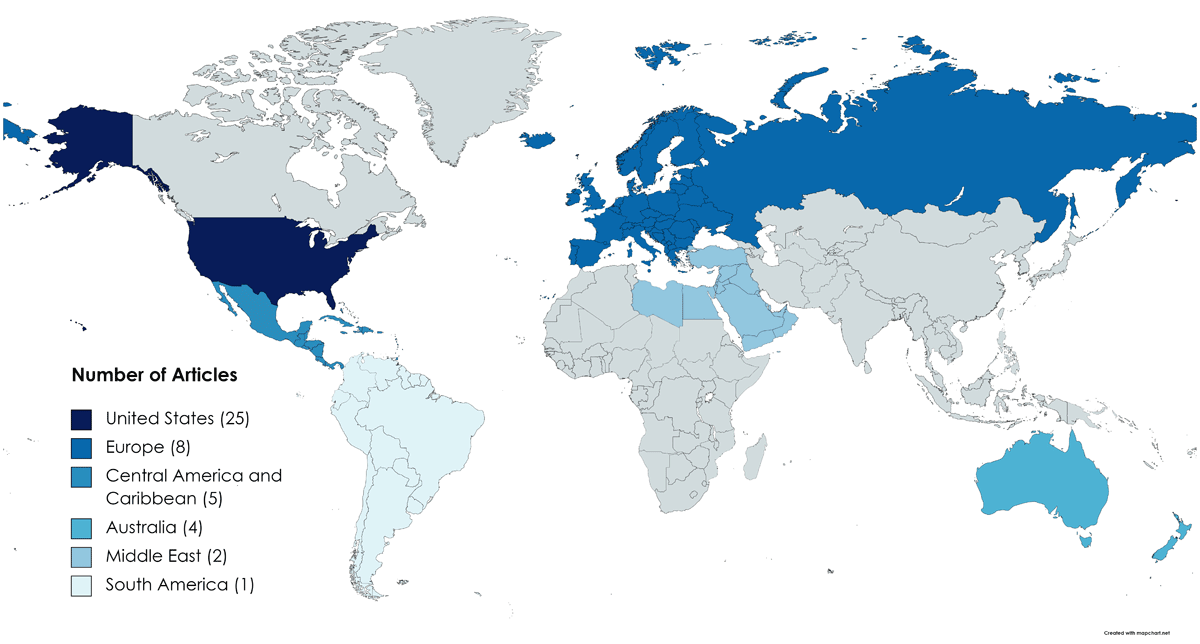
Figure 1
IG 1.0 journal articles by country of study.
Note: Six of the 51 articles were not included on the map: 3 articles studied multiple countries and 3 used modeling simulations.
4.2 At what jurisdictional “scales” has IG 1.0 been applied?
Diversity regarding the “jurisdictional scale” at which IG-based institutional analyses were carried out is also present. Most U.S-centered research focuses on state and local environmental regulations and natural resource governance policies (e.g., Heikkila and Weible, 2018; Truer et al., 2017; Watkins and Westphal, 2016). As Table 3 shows, more than half of the articles focus on the sub-national and local level, while 23% focus on national or federal level dynamics (see codebook in Appendix A for descriptions of jurisdictions). At the national level, recent research has used IG 1.0 for comparative analysis, including to assess the policy outcomes of both similar and divergent institutional arrangements (Section 4.6.1 for more examples). For instance, Dunajevas and Skučienė (2016) conduct a comparative analysis of institutions around mandatory pension systems across Baltic nations and report how the greatest distributive effect is produced by the mandatory pension institutions of Lithuania. Likewise, Dörrenbächer and Mastenbroek (2019) use IG 1.0 to map and explain the extent to which national legislators constrain discretion contained in European Union directives during the transposition of several provisions of the Asylum Reception Conditions Directive.
4.3 Where is IG 1.0 research being published?
Previous reviews have shown how journals in Public Policy and Public Administration stand out as central outlets for IG-related research (Dunlop et al., 2019). These are still common publication outlets among the 36 journals with articles in this study (see Table A2 in Appendix A). However, the International Journal of the Commons is the top publication outlet for IG research with 6 articles, followed by Policy Studies Journal and Public Administration with 5 and 3 articles, respectively. The International Journal of the Commons has become a prominent publication outlet for IG research topics such as the management of common-pool resources, common property institutions, and commons knowledge. Moreover, a growing concern about water governance and water preservation has sparked several IG-based publications in journals such as Water Resources Research, Water Policy, and Water International. Additionally, we are now beginning to see IG articles published in non-US journals such as the Central European Journal of Public Policy and Convergencia: Revista de Ciencias Sociales, illustrating how geographically expansive the research community using IG has become in the last decade.
4.4 Why have analysts used IG 1.0?
Following the coding described in Section 3.0, we divided the reviewed articles into three broad categories concerning the main purpose of the research:
descriptive analysis,
policy analysis or program evaluation, and
advancing IG-based research methodology (Figure 2).
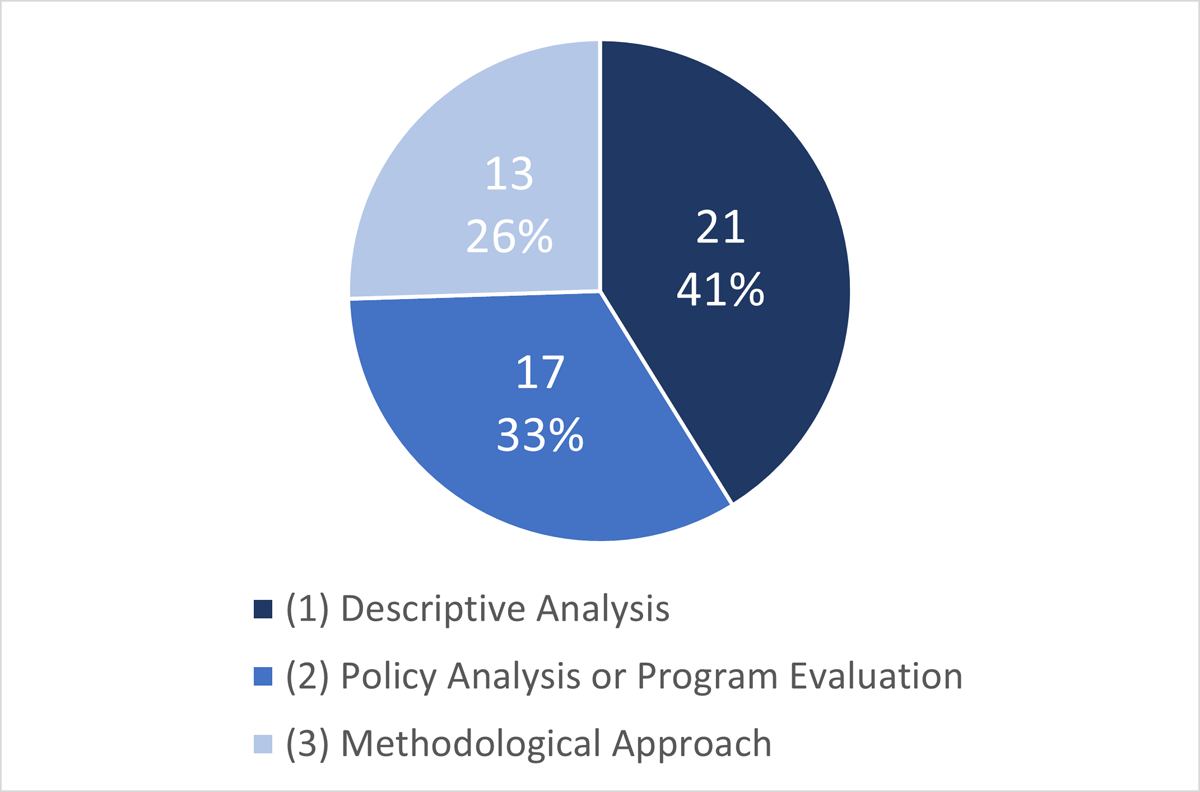
Figure 2
Journal articles by purpose of analysis.
Many studies (41%) fall under Category 1, providing in-depth descriptions of specific institutional systems and the specific elements of institutional statements. These descriptive studies often rely on complex reconstructions of Action Situations through extraction of institutional statements, categorization according to the type of institution, and deconstruction into components, as seen among the first articles making use of IG 1.0 (e.g., Prior, 2016; Siddiki, 2014; Watkins et al., 2015; Witting, 2017). The IG tool is useful for these types of studies because it provides a systematic way of breaking down and mapping both basic institutional features and complex institutional designs. Most of the descriptive analyses focus on questions regarding components of action situations at different levels (e.g., Garcia et al., 2019; Prior 2020; Turner and Stiller 2020; Witting 2017). For example, Siddiki (2014) uses the standard ABDICO syntax to determine the design of policies governing the behavior of aquaculture participants, specifically exploring the relationship between perceptions of policy legitimacy, coerciveness, and enforcement in shaping individuals’ interpretations of regulations.
Unsurprisingly, most of the 17 studies focused on policy analysis or program evaluation aimed to assess the extent to which formal institutions have had the desired effect (e.g., Angulo-Cazares, 2018; Dunajevas and Skuciene, 2016; Espinosa, 2015; Roditis et al., 2015; Stupak, 2020; Tschopp et al., 2018). For instance, Roditis et al. (2015) used the IG 1.0 to examine how university campuses implement regulatory tobacco policies via strategies, norms, and rules and identifying the type of Deontics used to determine compliance with the American College Health Association’s tobacco-specific recommendations. As we will discuss in Section 4.6, most of the studies based their assessments on variables or measures created from various combinations or adaptations of IG components.
Studies in Categories 1 and 2 often do not move beyond description due to difficulties in aggregating the large amount of micro-level data coded, as Siddiki et al. (2022) also notes. No one strategy has emerged for aggregating IG-coded data in studies across multiple empirical and theoretical areas of research. It is not unexpected, then, that 13 articles focus on Category 3, the methodological improvement of the IG 1.0 and the ADICO basic structure. These studies tend to use single-case data to demonstrate the potential for the IG to encompass more complex institutional systems and deepen the granularity of components of institutional statements, such as by adding new components to the syntax (Siddiki et al., 2011), creating nested structures of multiple institutions connected by conditions (Frantz et al., 2015), or formulating agent-based models to explain the multiple interactions within action situations (Ghorbani and Bravo, 2016).
4.5 How have analysts used IG 1.0?
To answer this question, we divided the analysis approach category into five different types:
single case studies,
comparative case studies with a small-N,
comparative case studies with a large-N,
longitudinal case studies, and
modeling.
Most of the studies focus on single-case samples and small-N comparisons (Figure 3), which follows the logic of the “purpose of analysis” described earlier; single-case studies largely focus on the description of institutional systems and the elements of institutional statements (e.g., Olivier and Schlager, 2022; Prior, 2020; Witting, 2017), while the small-N comparisons aim to evaluate institutional designs with different policy outcomes (e.g., Dunajevas and Skuciene, 2016; Kamran and Shivakoti, 2013; Olivier, 2019). Although a large portion of the analyses use quantitative metrics based on the ABDICO syntax (e.g., Heikkila and Weible, 2018; Rice et al., 2021; Roditis, et al., 2015), qualitative approaches still dominate (e.g., Angulo-Cazares, 2018; Pacheco-Vega, 2020; Siddiki, 2014). Appendix B provides more detail on the methods of analysis for individual studies.
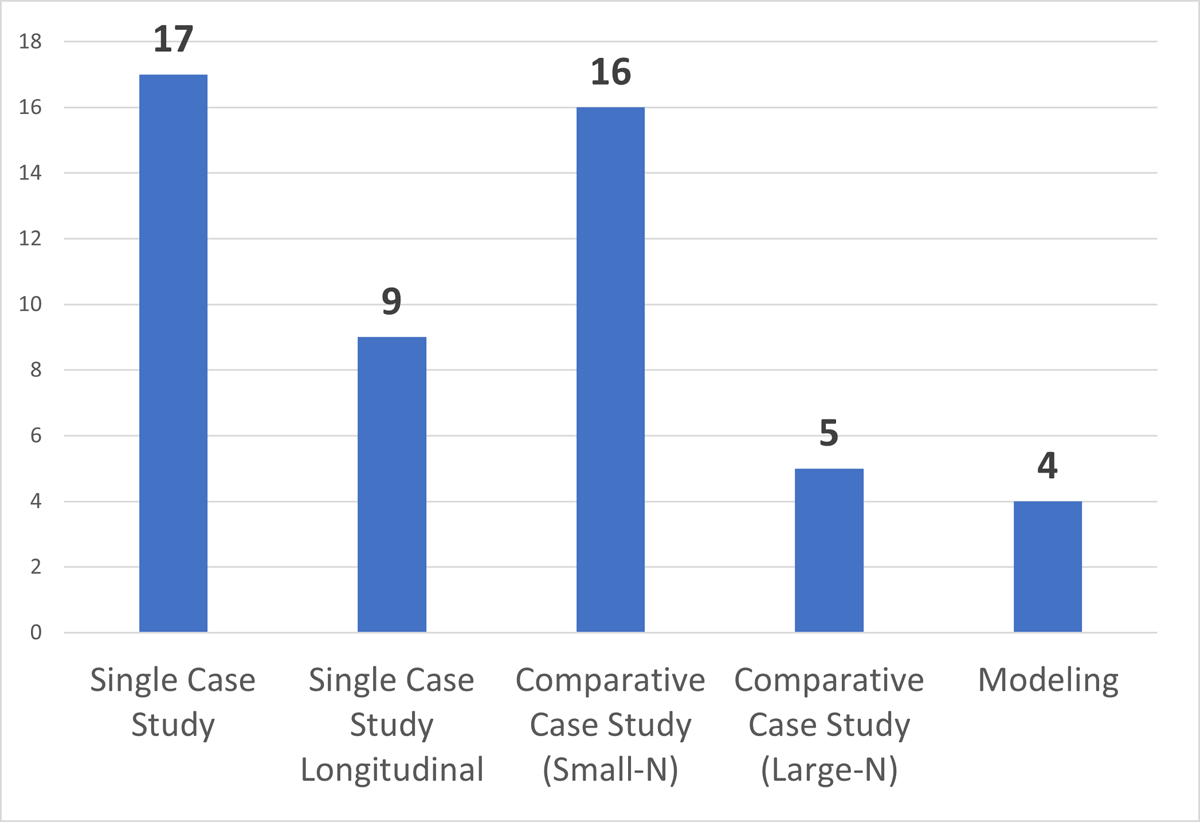
Figure 3
IG Literature organized by analytic approach.
One common measure used throughout the literature, regardless of approach, is the frequency of various components of the IG 1.0, such as the number of strategies, norms, and rules in an institutional design or policy document (e.g., Novo and Garrido, 2014; Roditis et al., 2015; Watkins et al., 2015). Over half (27) of the papers applying IG 1.0 use frequencies in some form. For instance, Clement et. al (2015) explains how responsibility is determined and allocated throughout the Tasmanian Midlands and the Australian Alps’ conservation policies by analyzing the frequencies of types of institutional statements and types of Deontics. Listing or categorizing Attributes are also common measures used to understand actors involved in different action situations (Clement et al., 2015; Heikkila et al., 2021; Siddiki and Lupton, 2016). Treuer et al. (2017) use the standard IG 1.0 ABDICO syntax to identify the frequency of Attributes across the state constitution, statutes, and water management implementing orders for the Miami-Dade Water and Sewer Department, to explain when windows of opportunity occur for utilities to transition toward more sustainable water management. While frequencies alone provide insights into institutional characteristics, many scholars have taken the information from these simple analyses to develop more sophisticated measures of institutional design variables, as we discuss next.
4.6 Empirical contributions of IG 1.0
As described earlier, IG 1.0 has been mainly employed to identify the components of institutional statements, providing insights on the design, structure, and performance of formal and informal institutional arrangements. This section synthesizes the empirical advances made through the application of the IG 1.0. Specifically, empirical field research combined with the IG 1.0 has been used to 1) engage in comparative institutional analysis; 2) examine patterns of interaction among actors within policy domains; 3) explore the actors and their prescribed actions specified within policies and governing arrangements; 4) investigate levels of compliance or noncompliance with institutional arrangements and the consequences of non-compliance; and 5) engage in further specification and clarification of the grammar. The list of articles in Appendix B indicates the category of empirical advancement made by each article.
4.6.1 Comparative institutional analysis
By far, the most common application of the IG 1.0 is for comparative institutional analysis, systematically comparing two or more sets of institutional arrangements. Of the 51 articles evaluated, 19 engage in comparative analyses. While only four studies (Abebe et al., 2019; Carter et al., 2015; Dunajevas and Skuciene, 2016; Dunlop et al., 2021) compare policies at the national level, the most common comparisons focus on the subnational and local levels such as organizations, communities, and local governments. For instance, Roditis et al. (2015), as mentioned previously, evaluate campus tobacco policies using the proportion of rules, norms, and strategies combined with Deontic type to demonstrate that a lack of rule statements or enforceable penalties will prevent compliance with the goals of the American College Health Association tobacco guidelines. Subnational and local level studies typically examine institutional variation and its implications for governance (e.g., Feiock et al., 2016; Schlager et al., 2021). For example, Siddiki (2014) conducts a comparative analysis of aquaculture policy documents from Florida and Virginia to demonstrate the ways perceptions of policy interact with policy design. Frequencies of Deontics and Or Else statements operationalize policy coerciveness ‘on paper’, as well as degree of coerciveness towards actors with the addition of Attribute data.
Agent-based models can also be used for comparative analysis, such as to model effects of distinct sets of institutional statements. Abebe et al. (2019), for instance, examine the performance of three different flood protection rules used by the government of the Caribbean Island of Sint Maarten on flood risk reduction of households. The authors vary the rate of actor compliance with each rule and vary attributes of the built environment (e.g., numbers of homes). They find that fewer houses are flooded (i.e., flood risk is reduced) by policies covering the entire island rather than targeting specific regions, and with higher levels of rule compliance. Thus, comparative institutional analyses are common and are conducted by scholars using the IG to systematically identify and explore the differences between comparable programs and policies and the implications for processes and outcomes. In general, scholars find that IG 1.0 supports robust, systematic institutional comparisons.
4.6.2 Interactions among actors
The second most common application of IG 1.0 is exploring patterns of interactions among actors as established by institutional statements, as seen in 10 articles. Eight articles focus on interactions among individuals or organizations in different action situations, with interactions identified using the Attribute and Object components of the grammar. Institutional statements create linkages between animate actors, and Attributes (the ‘doers’) and Objects (the recipients of actions) allow analysts to identify how these statements prescribe relationships between individuals or groups of actors. For example, Olivier (2019) assesses the effects of collective-action problems on the design of formal institutional arrangements for the provision of high-quality drinking water in New York City and Boston. To identify how institutions provide solutions to collective-action problems, Olivier created dyads between the Attribute and Object for each institutional statement and aggregated them into a “Network of Prescribed Interactions” (NPI), measuring the number of nodes, density, and degree centralization. Olivier and Schlager (2022) extend this work through a survey to measure perceptions of collaboration among actors and relations prescribed by institutional statements. Bringing together institutional data (i.e. grammar components) and survey data allowed the scholars to more clearly conceptualize and measure interactions between actors to thoroughly examine the influence of institutions and perceptions on collaborative networks.
Another line of research exploring the interactions among actors centers on polycentricity, which refers to the multiple and overlapping centers of authority in a governance system (Andersson and Ostrom, 2008). As Aligica and Tarko (2012) note, despite the extensive theoretical and empirical interest in polycentric governance, scholars still struggle to find consistent, systematic operationalizations and measurements of the concept. IG provides a valuable tool to understand the Attributes (actors) within policy statements and their interactions through rule types, deontics, and sanctions to determine the allocation of authority within different policy subsystems. For example, Heikkila and Weible (2018) apply a semiautomated approach to identify and analyze polycentricity in the Colorado oil and gas policy subsystem (see Weible et al., 2020 for another example). Based on Attributes, Deontics, and rule types, they explore the frequency and variance of actors and authorities, the linkages between the actors, and their different levels of authority. Though conceptualization and measurement present a continual challenge, the application of the IG is a powerful tool in this area, as it allows institutional arrangements to be explicitly incorporated into the study of actor interactions, including social networks and mapping of polycentric systems.
4.6.3 Actors and prescribed actions
Nine of the 51 articles explicitly focus on actors and their actions, as prescribed by institutional statements, where the Attribute component identifies actors and the aIm component identifies prescribed actions. For example, Garcia et. al. (2019) identify the actors engaged in water management and their assigned actions as one of multiple sources of evidence used to identify water sustainability transitions of U.S. cities. Similarly, Weible et al. (2017) analyze the Colorado information disclosure rule on hydraulic fracturing fluid, examining who discloses what types of information to whom. Espinosa (2015) takes a different approach by focusing on Attributes, Deontics, aIms, and Or Elses to assess the likelihood of whether the actors exercising their prescribed authority in Mexico’s consumer tobacco regulations will realize their intended outcomes. Scholars have also used grammar components to identify levels of discretion provided to actors by rule configurations (e.g., Stupak, 2020). For instance, Turner and Stiller (2020) examine the sources of authority that govern Homeowners Associations and the discretion provided to HOAs regarding landscaping, including yard maintenance, aesthetics, and environmentally sensitive forms of landscaping. Using Deontics to identify discretion, they find that HOAs were granted little discretion in regulating yard maintenance and aesthetics. Scholars have also begun to explore how constraining, or how lax, institutional statements are in guiding prescribed behavior. These research questions relate to long standing issues studied in public administration, such as the behavior of street level bureaucrats, and policy design and analysis (e.g., Espinosa, 2015; Molenveld and van Buuren, 2019; Stupak, 2020; Weible et al., 2017). Studies using IG 1.0 add a fine-grained analysis of institutional arrangements to complement studies focused on perceptions of behavior.
4.6.4 Compliance and non-compliance
A smaller grouping of six articles focus on compliance and non-compliance with rules. These studies often combine the analysis of rule components with interview and survey data (e.g., Prior, 2016; 2018; Siddiki and Lupton, 2016). As Siddiki et al. (2012) explains, the level of compliance with institutions is affected by the perceived appropriateness or legitimacy of regulations, participation in designing them, and perceptions of guilt and fear of social disapproval, making interviews and survey research essential to understanding contrasting levels of compliance. For instance, to examine compliance with aquaculture regulations in Colorado, Siddiki et al. (2012) uses the IG 1.0 to code the written regulations and organize a Q-sort exercise where each participant was asked if they “must,” “must not,” “may,” or “may not” perform the activity described. This allowed the scholars to measure the percent alignment between the content of actual regulatory statements and interviewees’ description of their activities for a comparison of reported behavior with what is prescribed by rules. In another use of interviews and surveys, Tschopp et al. (2018) measure farmers’ compliance with quinoa quota rules established by cooperatives in Bolivia, finding that the cooperatives were able to establish needed production rules to protect the resource in a context with uncertainty over rules and boundaries and difficulties enforcing sanctions. Angulo-Cazares’ (2018) IG analysis of Mexican education policy from 1941–1963 demonstrates an alternative to the use of perceptions or self-reports of compliance through a descriptive analysis of text, finding an agency problem in the form of a moral hazard created by the regulations on teacher behavior led to a lack of compliance with the regulations. As these studies demonstrate, the IG offers a way of measuring compliance through both descriptive textual analysis and comparison of actual rules to perceptions.
4.6.5 Grammar development
A final group of seven articles use empirical applications to further develop and clarify grammar components or engage in theory and variable development using the IG. Siddiki et al.’s (2011) addition of the oBject component, which is the receiver of the action specified by the aIm, allows analysts to capture additional information from institutional statements and provides greater validity and reliability in using the grammar, as demonstrated in an exploration of the linkages among actors in the Colorado aquaculture policy domain. The oBject is now considered a standard IG component, contributing to research in areas such as examining patterns of interactions among actors (e.g., Olivier, 2019; Pacheco-Vega, 2020).
The IG has been limited up to this point due to the necessity of manual coding of documents, requiring significant commitments in time and training of coders. Heikkila and Weible (2018) use a semiautomated coding procedure in Automap to code actors, rules, and rule deontics to examine the degree of polycentricity in Colorado oil and gas regulations. While promising, the semiautomated procedure still requires manual work to create a coding dictionary and format the regulations for the automated procedure. Another approach by Rice et al. (2021) demonstrates the utility of an R package, grounded in natural language processing, that allows machine coding with the grammar through an application to food system regulations (see Vannoni, 2022 for an alternative). Realizing the full value of the grammar requires the development of lower cost means of coding, and the work by Rice et al. (2021) is promising.
In sum, Section 4 describes the extent of IG 1.0 applications in the literature and synthesizes the empirical contributions, summarized in Table 4. While the IG has only started to expand outside of the North American and European academic and geographic context and a handful of key journals, there is growing variety in the ways the IG can be utilized and applied. Analysis is no longer limited to descriptive methods, single case studies, or small-N comparative studies; IG has been used in policy analysis, program evaluation, and across larger numbers of cases. Despite the dominance of frequencies to construct variables, the IG is increasingly used to operationalize and measure more complex theoretical concepts, including polycentricity, discretion, and compliance, contributing to advancement in the study of institutions in the areas identified in Section 4.6 and Table 4.
Table 4
Areas of empirical contributions and operationalizations by the IG.
| EMPIRICAL CONTRIBUTIONS | EXAMPLES OF CONCEPTS OPERATIONALIZED |
|---|---|
| Comparative institutional analysis | Policy coerciveness (Siddiki, 2014) Rule performance (Abebe et al., 2019) |
| Interactions among actors | Networks of Prescribed Interactions (NPIs) (Olivier, 2019) Polycentricity (Heikkila and Weible, 2018) |
| Actors and prescribed actions | Information sharing (Weibleet al., 2017) Discretion (Turner and Stiller, 2020) |
| Compliance and non-compliance | Legitimacy of regulations (Siddiki et al., 2012) Self-reported rule compliance (Tschopp et al., 2018) |
| Grammar development | Links between actors, through the oBject (Siddiki et al., 2011) Rule classification, through machine coding (Rice et al., 2021) |
5.0 Conclusion
At the time of this writing, 51 articles have empirically applied the IG as a methodological tool to develop knowledge of how rules, norms, and strategies incentivize behavior, influence patterns of interaction, and shape outcomes, beginning with Basurto et al. (2010). Over that period, the IG has been used to study institutions across the globe and across policy areas, from the environment to education. While many studies still utilize descriptive analysis and single cases studies, a growing number are using IG to conduct policy analysis, program evaluation, or comparative policy analysis by either exampling policy change over time or using the IG to compare institutional configurations across different and larger sets of cases.
Moreover, a growing number of scholars are coding institutional statements according to IG syntactical standards and using the resultant structured databases of institutional designs to operationalize and measure concepts they deem important. Examples include the operationalization of concepts such as levels of discretion provided by rule configurations (Turner and Stiller, 2020), rule legitimacy or compliance/non-compliance (e.g., Siddiki et al. 2012; Tscopp et al., 2018; Angulo-Cazares, 2018), polycentricity (e.g., Heikkila and Weible, 2018) and interactions among actors in response to rule configurations (Oliver, 2019). These examples hint at the utility of IG for systematically measuring important theoretical concepts of interest to institutional analysts, and we can think of others not yet deployed. For instance, a measure of “representation” might combine the Attribute component with rules on participant selection for positions and venues to explore different forms of representation across venues. Power dynamics could also be measured with the IG through a focus on Attributes, aIms, and oBjects to identify the relationship between those who hold power and those who do not.
However, this synthesis also demonstrates the limits of IG 1.0 in moving beyond exploratory and descriptive studies to contribute to knowledge and build theory about institutional design. As discussed in Section 4.6 and shown in Table 4, IG 1.0 as a methodological tool clearly provides utility for the understanding, operationalization, and measurement of some individual theoretical concepts. But when it comes to making inferences and generalizing about institutional design, the IG has yet to support significant theoretical explanations. This will require scholars to follow up their initial exploratory and descriptive studies with efforts to develop and test theoretically grounded hypotheses. In addition, more care needs to be taken in matching research design and method. Coding each institutional statement may seem to generate a sizeable amount of data, but the unit of analysis for many studies is at a higher level than the institutional statement, and scholars have struggled to meaningfully aggregate this data in a systematic way. Relatedly, the coding of IG 1.0 does not capture the links or relationships between individual statements, leading to a loss of the context and richness from the original document.
The recent development of IG 2.0 (Siddiki and Frantz 2022) addresses some of the limitations of IG 1.0. Advances include a systematic method for coding constitutive statements. This method promises to open a new line of research on how institutional settings are brought into being. In addition, IG 2.0 allows additional data to be captured from institutional statements, such as the vertical and horizontal nesting of institutional statements, and additional information about attributes and objects. Finally, IG 2.0 makes the grammar accessible and useful for disciplines outside of the social sciences, including computer science. However, the application of IG 2.0 will likely exhibit several of the same issues as IG 1.0. The most used components – Attributes, Deontics, aIms, and oBjects – change very little between IG 1.0 and IG 2.0. While IG 2.0 opens new lines of inquiry (e.g., constitutives and nesting) and invites greater interdisciplinarity, as a method, IG 2.0 cannot resolve the challenges of theory development and cumulation of knowledge. That requires scholars and analysts to take the next step and develop and empirically test theories of institutional design and institutional change. Both IG 1.0 and 2.0 are valuable methods to use, depending on the research questions to be addressed.
Finally, after an examination of 51 articles applying IG 1.0 and more than 10 years of work, one might conclude that the utility of IG for advancing theory and generating generalizable knowledge is questionable. We hope to offer an alternative perspective. Our world and our daily lives are guided by rules and norms, and yet the way we document them is through rich description, if they are formally documented at all. Imagine a future where digital rich text describing institutional designs are run through software that extracts out the rule configurations and stores them in a structured database like what IG 1.0 or 2.0 provides. This is no easy task and could take another decade or more to realize, but the article by Rice et al. (2021) demonstrates some progress using natural language processing techniques. Moreover, readers undoubtedly are aware of the rapid advances being made in machine learning and artificial intelligence. These advances could also be applied toward developing a software tool that extracts institutions embedded in rich descriptive (digital) text and into a structured format like what IG 1.0 and 2.0 provide. Once this is achieved, new and exciting opportunities will emerge for institutional analysis, where social scientists can capitalize on structured databases of rules or norms to look for underlying patterns of institutional design or to measure important theoretical concepts for institutional analysis. In other words, we may very well be on the cusp of an emergent new field we might call “Computational Institutional Science” and an “open standard” for the storage of rules, with IG 1.0 and 2.0 as foundations toward building such a new field.
Additional Files
The additional files for this article can be found as follows:
Notes
[2] We analyze nearly twice the number of articles of existing reviews; 51 articles compared with 26 articles analyzed by Dunlop et al., 2019, and 20 articles by Siddiki et al., 2022 – indicating significant growth in research and development of the IG in the past few years.
[3] A new derivative of ABDICO with a more granular breakdown of institutional statement syntax has recently been advanced by Frantz and Siddiki (2021) called IG 2.0. At the time of our literature review search, there were no applications of the IG 2.0 yet published. Consequently, we focus only on papers that utilize IG 1.0.
[4] It is important to note that although the first publication on IG by Crawford and Ostrom was published in 1995, there were no actual implementations of the IG until Basurto et al. 2010. This explains why our dataset of relevant articles, according to the explained criteria, spans from 2010 to 2021.
Acknowledgements
We would also like to acknowledge the three anonymous reviewers for their insightful comments to improve this paper.
Funding Information
This material is based upon work supported by the National Science Foundation under grant numbers 1917908 and 2020900.
Competing Interests
The authors have no competing interests to declare.