
Introduction
This paper studies how people acquire expanded forms of citizenship by taking responsibility of their communal forests and engaging in commoning. Commoning can be understood as a process of making and remaking of the commons—including all the negotiations needed to establish the rules and protocols to share resources in common, as well as all practices of care that sustain communal forms of life (Linebaugh, 2008; Bollier and Helfrich, 2015). Drawing on feminist theories around commons and citizenship, our case shows how communal practices of care for forests forge care-tizens, an expanded form of citizenship performed by engaging in mutual care and care for the commons (Casas-Cortes, 2019). The etymology of the English word citizenship refers to “city-dweller, town-dweller”.1 Thus, by replacing the word city (ciudad in Spanish) by care (cuidado), a care-tizenship (cuidadania) contrasts with current top-down oriented and neo-liberal systems of representative democracy characterized by growing inequities, precarities, unsustainability, and a model of ‘passive’ citizenship.
Despite the acknowledgement that commons and citizenship are related issues (Bloemen and de Groot, 2019; Ostrom, 2000), the study of how the political context shapes commoners’ actions, the political motivations/claims of commoners themselves, and the type of citizenship that commoning nurtures is not well developed.
Recent work on the social movements associated with community-state conflicts over rights to resources has helped to recognize commoners beyond resource managers, looking at their actions as counter-hegemonic civic initiatives that stand against extractive developments and propose modes of living aligned with local ecosystems, identities, and cultures – including democratic and educational governance models and structures (Černík and Velicu, 2023; Mingorría, 2021; Nieto-Romero et al., 2019; Villamayor-Tomas and García-López, 2021). Indeed, some have proposed the commons – with its self-governance and equitable sharing of social/natural resources – as a political principle for radical democracy (De Angelis and Harvie, 2014). Yet the ways in which commons practices can develop new understandings about and practices of an expanded citizenship is less developed.
In this paper, we understand citizenship as a political subjectivity shaping how people exercise rights and responsibilities within the community they belong to (Lund, 2016). This implies that citizenship is performed, always changing, and evolving through time with citizens’ actions and struggles to exercise and achieve rights (Llano-Arias, 2015). As such, this understanding of citizenship includes everyday resource struggles, but also practices of care, affective relations, and spaces of creativity and social reproduction where people come, share, and act together (Casas-Cortes, 2019; Clement et al., 2019). Moreover, we build on recent discussions that recognize the need for more engaged and ecological forms of citizenships as necessary for sustainability transformations (Macgregor, 2016, 2014).
Community forests are arenas where expanded forms of citizenship can emerge, as they do not only give people the access to land rights and resources but also allow people to have a say upon the fate of their environment. Commoners take citizenship responsibilities a step further, beyond just voting for governmental representatives to also engage in decision making processes on matters that affect them (Rutt, 2015). This focus provides a novel angle with which to look at collective actions: showing how commons (and commoning as an emergent process) create new political subjects, that is, new “commoner” subjectivities of “being-in-common” (García-López et al., 2021; Singh, 2018). Ultimately, this approach links to deeper questions between commons and the continued democratization of our societies (De Angelis and Harvie, 2014).
To this aim, this paper traces the forest commoning process in a peri-urban neighborhood in the city of Vigo, located in Spain’s northwest coast within Galicia, an autonomous region in Spain. Using interviews and historical records of the city and the neighborhood such as newspapers, we provide a qualitative exploration of how ecological sensibilities develop through taking care of a local forest while also evolving in a conflictual dialectic with the dominant (top-down and neoliberal) citizenship logic of the city. Our analysis of forest commoning as part of the citizenship struggles of the city – and especially the practices of care involved therein – enrich academic knowledge on how democracy is performed as “rooted[ness] in particular problems and places” (Escobar, 2001). Within this view, conflicts between governments and communities should be understood not just as a clash between neoliberal and care-based/commons citizenship forms, but as a force that shapes the commons citizenship.
In the following section 2, we review the concept of citizenship, commoning, and subjectivity, as well as their relationships within the context of community forests. Section 3 presents the study case, providing a more detailed description of the community forest in Galicia, the choice of Teis community forests and their relation to the city of Vigo as a case-study, and an explanation of methods used. Section 4 presents our results. In section 5 we discuss our results in light of debates on commons and community forests in their relation to the democratization of our societies and the development of ecological citizenships through which people become responsible for their environments.
Commons and citizenship: from ostrom to feminist commoning scholars
Commons as schools for democracy: within or beyond the state?
The conceptualization of the relationship between commons, citizenship, and democracy can be traced back to Elinor Ostrom’s definition of commons systems as schools of democracy, where commoners “experiment with diverse ways of coping with multiple problems” and “learn from this experimentation over time” (Ostrom, 2000, p.13). For her, the most desirable form of citizenship was when citizens were co-creators of their environment, contributing to the identification and solution of their problems and in the coproduction of public services through collaborative “civic initiatives” (Levine, 2011; Ostrom, 2000). She thus claimed the importance of an active/engaged citizenship for democracy (Ostrom, 2015), arguing that top down and expert-led policy designs are not only inefficient and ineffective but also “dangerous for the long-term sustainability of democratic systems of governance” as they “crowd-out citizenship” (Ostrom, 2000, p.13).
While giving evidence on how collective action in commons’ governance builds citizen capacity, Ostrom was not sufficiently explicit on the political (normative) reasons for supporting commons as democratic practices (Levine, 2011). Critical studies on democracy and civic studies have further theorized communal forms of managing resources/public services as forms of ‘direct’/‘radical’ democracy (Holston, 2019; Howarth and Roussos, 2022; Tully, 2013). This research explicitly calls for a deepening of democracy beyond the representative/‘liberal’ Western model. While participation (or even co-production) is often performed in ‘invited spaces’ (Goodwin, 2019; Leighninger, 2014), – i.e. where time, norms, and processes are imposed by the state agents and structures – a deepening of democracy entails designing alternative bottom-up governance structures of participation beyond the state (Starr et al., 2011). The call for a new democracy is a normative one seeking to incorporate the diversity of forms for doing democracy and achieving social and ecological justice (Tully, 2013).
As a result, citizenship is defined here as being beyond the nation-state, encompassing all the practices through which citizens create the conditions to exercise, materialize, and achieve rights (Llano-Arias, 2015), as well as all the practices at the various scales of becoming political ‘claim-making subjects’ (Isin, 2008, p. 16 in Tsavdaroglou et al., 2019). This definition distances itself from legalistic definitions and homogenous categories of citizenship. Citizenship is a type of subjectivity establishing the rights and responsibilities of individuals towards a community (Lund, 2016). Subjectivities are generally understood as the ‘subject positions’ in which individuals are drawn by the effect of different vectors of power (gender, class, ethnicity, identities). As explained by Rose (1996 p. 37, in Grant and Le Billon, 2019), everyday practices shape these vectors of power and thus subject positions, as each experience is incorporated into an evolving subjectivity.
As a subjectivity, citizenship is thus an embodied category performed by “concrete people who are differentially situated in terms of gender, class, ethnicity, sexuality, ability, state in the life cycle, etc.” (Yuval-Davis, 2007, p. 562 in Macgregor, 2016); and struggles for citizenship are generally struggles for the recognition of membership in a particular community, of being a “subject of rights”, having the “right to claim rights”, and of being political (Gilbert and Phillips, 2003; Isin, 2009).
Citizen claims and state responsibilities: a dialectic relationship
Works on ‘insurgent citizenship’ take the above definition of citizenship further and are particularly useful because they provide a frame to understand the dialectic relationship between citizens and state agents. Literature on insurgent citizenship looks extensively at the processes of commoning emerging in the urban space in reaction to neoliberal policies, marked by the shrinkage of state responsibilities, limited access to basic services (housing, healthcare, education, employment, etc.), and powerful economic actors occupying a privileged place in the city. This literature critically analyzes how dominant (neo)liberal citizenship severely limits democracy by framing citizens as self-interested private rights-holders, consumers, and entrepreneurs and by giving the market a central role in the delivery of rights. Citizen action is mainly reduced to voting, complying with laws, (sometimes) participating in very limited state-defined spaces, and adopting individual lifestyle choices such as ‘green consumption’ (Schindel Dimick, 2015). In contrast, ‘insurgent citizens’ take upon themselves the satisfaction of rights by self-organizing horizontal structures and relations that are performative of rights and duties beyond the typical passive citizenship of liberal democracy.
This insurgent citizenship typically involves engaging in organized (usually illegal) actions against the governmental/state structures and neoliberal policies that oppress citizens (through for example illegal demonstrations, occupying empty houses and the public space, giving shelter and care to illegal migrants and refugees, etc.), but also horizontal peer-to-peer commoning actions around care (Černík and Velicu, 2023; Holston, 2019; Lamarca, 2015; Tsavdaroglou et al., 2019). By engaging in self-organized practices of mutual care and care for the commons, citizens create new political belongings as part of a community of practice made by ties of caring relationships. To describe this, Lamarca (2015, p.171) speaks of “insurgent acts of being-in-common” against neoliberal policies that threaten the common urban space and exclude and marginalize certain citizens. In this sense, Casas-Cortes (2019) refers to these practices as performances of care-tizenship, a term coined in the Spanish anti-austerity movement. By replacing “city” by “care”, the concept helps to describe how insurgent citizenship is performed beyond the state by attending to basic needs (through mutual care and care for the commons) in a context of increasing vulnerability – precarity. Care here refers to the (gendered) work of social reproduction: a form of commoning that looks out for human and nonhuman others, practicing reciprocity and deepening more-than-human relations (Bauhardt and Harcourt, 2018). Feminist scholars thus speak of “earthcare”: the collective defense and sustainment of human and non-human webs of interdependency (Barca, 2020; Barca et al., 2023; Merchant, 1996).
These self-organized and insurgent forms of citizenship (composed of care-tizens) are in conflictual relation with the structural powers of the (neoliberal) state and co-exist with other forms of nation-state citizenships. Referred to also as ‘exchange-based citizenship’ (Rutt, 2015), a nation-state citizenship is built through mutual recognition and often on material exchange between citizens and governmental authorities (Lund, 2016). Rather than a one or the other relationship, national citizenship exists simultaneously with other more active, engaged, and self-organized forms of citizenship: in other words, insurgent citizens continue to participate in political parties, elections, etc. and continue to benefit from and demand state services.
Yet these two forms of citizenship (national top-down vs. commons self-organized) are in tension and contradiction in what we could call a dialectic.2 The very same structures of state power, domination, and social inequality are those which usually produce insurgency (Holston, 2009). Tensions between these two forms of citizenship are seen in the wave of grassroots anti-austerity and direct democracy movements that have emerged over the last decades across the world.3 These movements “have questioned the institutions and practices of representative democracy, as well as its notion of citizenship, while proposing different forms of democratic politics, which emphasize direct participation, horizontality, deliberation, equality and inclusivity” (Howarth and Roussos, 2022, p.2).
Demands for a deepening (or as they call it, ‘radicalization’) of democracy, are often attached to claims over territorial autonomy supported by Indigenous or autochthonous identities (Côte, 2020; Hecht, 2011). Yet, while appearing to ‘rival’ national citizenship, claims for autonomy are also ways to claim the “rights to have rights” (Arendt, 1968) as these are struggles to be recognized a member of a political community in which one can have rights (Côte, 2020). From this perspective, citizens are strategic in their social struggles, mobilizing different and contradictory claims to demand rights from the state while satisfying their needs by seeking territorial autonomy.
Becoming care-tizens: forests as sites of learning democracy
Citizenship is not only shaped by decision-making/negotiations and struggles in the policy-making realm. As recent work suggests, commoning also creates new practices of care and new political subjectivities of “being-in-common” (García-López et al., 2021; Singh, 2018, 2013), which also imply new forms of citizenship. Singh (2013, p. 190) suggests in her studies how the daily practices of communal care for the forest (e.g. patrolling and other everyday activities of gathering in the forest and assisting the forest to grow) produce affective ties with nature that are similar to those with pets or family (see also Singh, 2015, 2013); and how these affective ties foster a subjectivity as commoners characterized by feelings/practices of being-in-common (Singh, 2018). ‘Becoming a commoner’ involves seeing the environment as a common to be cherished, shared, and cared for and seeing themselves as part of the more-than-human entanglements that make life in the community/forest possible. It thus involves acquiring responsibilities towards other humans and non-humans, where responsibilities are not understood as legalistic obligations. Rather, they are the result of our relationality with others, and thus can be best framed in terms of response-abilities or abilities to respond to others (Haraway, 2010). That is, “the more we engage in relations [of care], the more we feel both responsible and able to respond to the needs previously noticed” (Moriggi et al., 2020, p.4). These new “commons senses” put into question dominant ideas and practices of democracy; being a commoner entails making collective decisions about territories and in turn enacting ‘rights and duties’ for a politics of life “that is not at the expense but rather in support of other (human and non-human) lives” (García López et al., 2017, p. 96).
The above shows how care is not only a performance of citizenship emerging in contexts of vulnerability – precarity (insurgent care-tizens), but can be generative of new subjectivities of being-in-common that disrupt the static nature-society dualism that underpins current societal models, generating ecological models of democracy. Forest commoning re-shapes the idea and practices around what a community is, what a forest is, and who should take care of these (for whom and for what purpose). This inevitably shapes (authority) relationships between citizens and the state (and thus citizenship), since it changes who is authorized and capable to govern local resources/territories such as forests (Nightingale, 2018).
From this, we can draw a theoretical framework defining (forest) commoning as a socionatural practice that involves both ‘social’ and ‘natural’ objects and relations, and affects eco- and social systems simultaneously (Nightingale, 2018). That is, commoning does not only shape forests but also shapes citizenship, authority relations, and subjectivities. This framework is instrumental to analyze how expanded forms of citizenship emerge within conflicts and mobilizations related to rights and responsibilities towards forest use/management, as well as in the communal affective labor and care for the forest commons.
Case study, materials, and research methods
Community forests in Galicia (Spain)
Historical community forests (CF) in the autonomous region of Galicia still hold a prominent place today. They cover around a fourth of the Galician territory (Figure 2) and have been since time immemorial inserted in the traditional agro-silvopastoral system, where the gorse shrubs (a nitrogen fixing plant dominating many common lands in the past) were crucial for the fertilization of subsistence crops (mostly cereals) (Brouwer, 1993; Barros and Sánchez, 2018). Unlike other historical community forests in Europe, which tend to have Roman origins, these have a Germanic origin.4
Galician community forests have endured the historical path of many other historical community forests in Europe involving nationalization and reforestation. During the Spanish fascist dictatorship, a national reforestation program (1941–1971) was implemented, shifting the ownership of commons to the municipalities to plant tree monocultures- mostly pines (Pinus pinaster) and eucalyptus (Eucalyptus globulus) (Rico Boquete, 1995; Serra et al., 2015). This impeded peasants’ subsistence agricultural activities such as grazing, growing cereals, collecting firewood for cooking and heating, picking gorse shrubs for animal bedding, making manure, and using other resources for medicinal herbs or building materials (Balboa López, 1990), all of which provoked conflicts and occasionally led to deaths (Brouwer, 1995; Rico Boquete, 1995; Bauer, 2005; Freire Cedeira, 2011). Over the years, this reforestation program, transformed the rural economy into one focused on monocultures of eucalyptus as these plantations started to generate easy incomes especially for people not associated with the primary sector, through consortiums or rental contracts to third parties (Cidrás and González-Hidalgo, 2022). The expansion of monocultures have been responsible for the increased fire risk as well as the loss of biodiversity and cultural heritage due to landscape homogenization (Bassi and Kettunen, 2008; Cidrás et al., 2018; Cordero Rivera, 2017).
Only in 1968 was community ownership again recognized. Law 52 of 1968 and Law 55 of 1980 legally reconstituted community property as ‘communal woodlands in joint ownership’ (montes veciñais en man común) belonging to residents of specific areas (most often parishes). Importantly, these laws established the main governance structures of common lands, which could be managed either autonomously or in co-management with state forest services.5 They also required common lands to be categorized as such (via an administrative process requiring historical proofs) and for the creation of a governing board elected by the community, which would be responsible for convening and facilitating two annual assemblies gathering all formal commoners (one per family). As a result, the parishes became arenas of a renegotiation of citizenship. Parish residents have contested the duties of the municipal councils, claimed their citizen rights over collective ownership and governance of the lands, which have many times funded essential public services (Meijer et al., 2015). More recently, because of extreme wildfire events, citizens initiatives have emerged to fight against eucalyptus monocultures, taking direct action for ‘de-eucalyptising’ commonlands and regenerate the native forests (Cidrás and González-Hidalgo, 2022).
We selected as a case study the community forest of Teis neighborhood, located in the periphery of the city of Vigo, because it is a neighborhood where the struggle against eucalyptus and other invasive species as acacia has started very early (in 1995) linked to their citizenship struggles and claims in the city. While before the mid-20th century Vigo was a peripheral city in Galicia (Álvarez Bázquez, 1979 as cited in Martínez, 2011), it developed rapidly as the main industrial pole of Galicia from 1960 to 1980. During this period, Vigo doubled its population, receiving migrants from rural Galicia and urbanizing peri-urban areas such as Teis. Although Teis officially accounts for 2.265 inhabitants (out of 287.912 inhabitants of the municipality of Vigo), local associations claim a population of around 30.000 inhabitants (10% of the population of Vigo), arguing that the city of Vigo expanded into territory that historically belonged to Teis. Today, Teis is among the many neighborhoods of Vigo. It has experienced high industrial growth and has an extended history of citizen mobilizations, mainly during the last decades of the 20th century (Martínez, 2003).
Data collection and analysis
Fieldwork was conducted between February 2017 and February 2019 and focused on tracing the forest commoning process from its start and in relation to broader and historical citizenship struggles and mobilizations. Following a progressive contextualization (Vayda, 1983), the fieldwork included field visits (interviews and participative observations) alternated with desk research (qualitative analysis and theoretical reasoning) until a contextualized theoretical framework was defined and no new information was gathered. Although the last field visit was in February 2019, we maintained contact with people in Teis until August 2021 to improve our theoretical reasoning by clarifying empirical interpretations. In our first field visit, we interviewed the three commoning leaders who were part of the governing board and had been involved since the initiative’s start in 1995. The interviews provided an overview of the CF project’s objectives, activities, and historical trajectory. They also revealed the CF’s relations with other institutions and actors. We also interviewed 15 official members of the community forest (out of 39), analyzing their involvement and attachment to the initiative. In selecting respondents, we aimed for diversity in terms of sex, age, and place of residence within the parish. Finally, we interviewed six relative outsiders, namely the actors that were identified in interviews with the commoning leaders collaborating or hindering the flourishing of their initiative and activities. Among them was a hired worker, a representative of the Teis community plan, the Teis neighborhood association, a law firm, the Municipal Association of commonlands of Vigo (Montes de Vigo), and two technicians of the regional forest services. The different respondents are referred to in the empirical material with the following codes: CL for commoning leaders, RC for official members of the community forest and CN for the relative outsiders in the commoning network. Interview data was complemented with historical records of the city and neighborhood and with information from the municipal council’s website, the Teis neighborhood association, as well as research on the city’s history of mobilization (Martínez, 2001, 2003, 2011, 2014).
For the analysis of the transcripts of the interviews, we used Nvivo (QSR International, 1999–2021). We first divided the material into key elements of the process of commoning that we sought to understand (emergence, forest regeneration, property conflicts, educational project, etc.). Within each element, we developed codes of trees under the three concepts of the framework (i.e. visions/sensibilities around forests, practices in forests, citizenship performances/claims) to gather inputs for understanding the commoning process. The same was made for the municipality project for CFs of the city. The coding served to order the material to identify interrelationships and thus causality.
Citizenship and Forest Commoning Practices and Struggles in Teis
When we first visited Teis, we were surprised to find that forest health was at the center of the community’s discourse and agenda. Starting fieldwork before the emergence of de-eucalyptising civic initiatives (see section 3), we had visited and studied other cases in Galicia where forestry activities were used to fund community activities and services in the parish or the subsistence of their neighbors. In those cases, the predominant focus was related to the forests’ (economic) contributions to communities’/peasants’ economies, funding also public services, and community festivities. Instead, the significance of forests in Teis was around the native forest ecosystem regeneration and care. We soon realized that it was linked to citizenship struggles when Manuel, the former president and current secretary of the community, described the Teis community forest project as a “train crash”: it had ‘crashed’ against the project of the city of Vigo, which was characterized by a neoliberal policy of housing and economic development, as well as against the regional forest services, who “could not conceive of planting trees without logging them” (CL3).
This section will provide the empirical evidence explaining how forest commoning emerged as a political project that evolved in relation to – and because of – the political forest’s projects of other state agents. Specifically, we will show how commoning started in the struggle against the construction of a highway that was threatening people’s quality of life including their forest, but also in reaction to a democratic regime, which did not provide them with sufficient social and political rights. The communal management of the forest was first a means to cultivate the commoners’ authority as citizens and, through time, to engage in practices of caring for forests, changing their subjectivities and also shaping their performance of citizenship to one centered on care (care-tizenship).
Insurgent citizenship: standing up for decent livable conditions
Our analysis of the forest commoning process starts in 1995. By then, a threat to the CF was posed by the construction of a highway that would traverse the Madroa community forest. At the time, this forest still belonged to the municipality and most people did not even know that it had been a communal property before having been expropriated during Franco’s dictatorship (1936–1975). While in the hilly area dynamite explosions used to build the highway started damaging people’s homes, soon protests were extended into claims to save the forest. Citizens went to the streets in large demonstrations, which were violently repressed by the police. When the forest hill started collapsing, residents started demanding the construction of a “fake tunnel” replacing the high and instable slopes excavating the forest hill for the highway. As one of the commoning leaders described, the ‘knife into the forest’ awakened social awareness and a movement to protect and recover it arose. They created the ‘Asociación de Afectados do Monte da Madroa’ (Madroa forest association) and organized a first community assembly with the neighborhood association’s support. Later, when leaders of the mobilization realized that the area had been a community property in the past, they immediately decided to reclaim ownership. In 1998, 52 ha of the Madroa forest were declared community forest. In the first community bylaws, commoners already defined their orientation towards improving the health of the forest, linking the forest and residents’ wellbeing:
The amputation of a very important part of the forest due to the construction of the highway […] had terrible consequences for the future of the forest and the neighbors in general […] This predetermines the focus of the community on the tenacious struggle of restoring and regenerating the forest, being this the main objective to accomplish by the commoners and by those who represent them- Bylaws of Teis community, 1998
The word ‘amputation’, usually used for body parts, denotes an understanding of the forest as a living being and an integral part of residents’ lives who had grown with the forest, picked firewood (illegally, as it was forbidden during the dictatorship), and spent time there with family and friends. The forest was ‘their playground’ (RC2) and part of their life story (RC3). Although significant, these affective relations alone do not sufficiently explain the massive mobilizations and intense conflicts that the threat of the highway produced. In the words of a commoner, the mobilization against the highway ‘was like a war between Romans and tribal populations’ (CL1), an expression of unequal power relations between authoritarian rulers seeking to expand control over the territory and the autochthonous citizens resisting colonization.
These mobilizations were in fact political performances linked to the local cultural identity of Teis residents. Residents of Teis felt a stronger sense of belonging to their neighborhood in contrast to those in Vigo where, for example, residents ‘speak Spanish or a more delicate Galician’. Teis residents defined themselves as a ‘tribe’ that ‘resists the ruling power’ and ‘struggles’ to speak Galician (forbidden during the military regime) and live in this area (e.g. practicing self-construction, subsistence agriculture, and having unstable economic conditions of living). While there was a significant increase in the standards of living after the Second World War, living conditions for Teis residents were marked by a lack of basic social infrastructures and by degraded public spaces. The economic boost of Teis, linked to the establishment of industries6 in Vigo, was ‘unplanned’ and came with the ‘fragmentation’ of the parish that separated different settlements and included two train lines, two highways, and high voltage lines. Also, the self-constructed houses were not connected to basic infrastructures such as electricity and water, taking water from the springs of the commonland, and building their own septic tanks. The forest was also occupied by municipal infrastructures such as a zoo and by high voltage lines. Some parts were rented for private use, but the rest became an open access ‘landfill’ where residual waters or residues of the city Vigo were discharged.
When in 1975 the military regime came to an end, residents of Teis went to the streets to claim social rights such as water supply, drainage, road construction and asphalting, and political rights related to the democratization of institutions and social life, as the following reflects:
We felt a lot of political unrest; we were young and we wanted to break with everything, we wanted freedom […] We fought in the streets for a sewage system and water…. The only thing we asked for was social life improvements. We didn’t get involved politically, although I was part of the Galician nationalist party, but there were others who were part of the Communist Party. We all fought for a common cause which was freedom- Teis commoner 3, male, 50–60 years old.
While protesting their lack of decent living conditions, the young residents of Teis called for freedom; in the decades to come, this continued with mobilizations against the highway and for the recovery of the community forest. It was the context of oppression and social inequality that provoked insurgency. Teis inhabitants felt ‘discriminated’ in Vigo, as all unwanted infrastructures were installed there (polluting industries, highways for the city) and access to basic city services such as public transport, infrastructure for safe pedestrian mobility, parks, etc. was limited to absent.
Caring for forests: strengthening residents’ capacities and their authority as citizens
Building on their focus on forest health, over the years Teis CF implemented projects for regenerating the habitat for native species. This work was possible in part due to a compensation for the expropriated land occupied by the highway, which enabled them to hire permanent workers to work in the forest every day. In the words of a commoner: “the highway destroyed a part of the forest but joined neighbors and funded the regeneration works” (CL2). Notwithstanding, the highway alone cannot explain the tedious struggle to fight to regenerate a forest eco-system. As we will show below, a focus on the communal regeneration of the forest was a way to improve the conditions of what they considered their “home”, as the forest was invaded by acacia (an invasive species) and treated as a ‘landfill’. Moreover, in a context were arenas for direct democracy and participation were lacking, this affective earthcare labor was also a means to reveal the failure of the government in caring for the common forest and a way to perform and enact their authority as citizens by reasserting their community identity through their socionatural relations to the forest.
While receiving funding for biodiversity conservation from non-governmental bodies such as Greenpeace and La Caixa Foundation, the Teis CF project was not simply about planting native trees, but it involved the recovery of their collective local identity, which they associated with their Celtic Galician past. They regenerated the habitat for native fauna which was associated with a rich Galician Celtic symbology, such as the gold-striped salamander (Chioglossa lusitanica) and the European stag beetle (Lucanus cervus), which is associated with magical properties and present in numerous songs and legends. This socio-natural Galician identity was a means to be in contrast with public authorities that had focused on planting commercially-productive forestry species, and were responsible for the loss of these species “due to poor [state] management of our forests” (RC1). The regeneration of native Galician species was a way of creating “a visible spot” (CL3) in the middle of government-led plantations of pines and eucalypti. Creating a different forest that could be identified as a native forest that changes with seasons7 allowed them to show people their authority over forests and their ability to care for forests, in contrast to the state. By becoming visible as actors through their practices in the forest, they sought to denaturalize public forestry and demonstrate that “someone had planted them [the pines, eucalypti and acacia]” (CL3).
In a context where arenas for direct democracy and participation were lacking, commoners of Teis started to take decisions collectively8 “in a property system that is open, where any new resident can join” (CL3). Observing, being in, and acting upon the forests allowed them to develop their ‘own ways’ of managing forests and response-abilities towards them by learning the skills, capacities, and knowledge that enabled them to become and act as commoners:
One has to know a little about everything [as a commoner]. In the community forest, one learns a lot about life … For example, here, you have to know more or less how a tree behaves, … how a brush cutter works, reading texts… […] You realize when the years go by that you don’t have specific training, but you know the things, you realize that you have many “flight hours”. To know when we can work, when we can’t, when the benefits are superior to the costs, …this is the experience …. seeing how the ecosystem changes over the years, observation … – CL3.
Forest regeneration (including the fight against acacia) did not follow general technical procedures and standards but was fed by observing nature and grounded in the belief that “nature is wise and gives you the solution for everything” (CL2). For example, they started using the conventional method with biocides to remove acacias, but they progressively realized that biocides were against the ecological processes they were intending to regenerate. Thus, they developed a method that included self-designed tools to pull out acacias mechanically and to plant native trees in high density to shadow the acacias (reproducing natural species’ competition). Likewise, while public subsidies promoted native tree plantations in separated rows to allow machinery, Teis plantations imitated natural ecosystem regeneration processes with higher densities to create a forest more friendly to fauna.
These claims for and performances of authority by citizens were sustained by an ongoing conflict with the council municipality. The clash started as a property conflict over 70.000 m2 of the Teis CF, which were occupied by municipal infrastructures. This involved a legal dispute that lasted for more than ten years. Commoners asked the municipality for a rental fee for the area occupied – a solution that was implemented in most of CFs in the city – yet for a decade the municipal council ignored the request, silently blocking Teis financially and institutionally. As we will show in the next section, the Teis CF project heavily contrasted with the municipality’s neoliberal and top-down policies and forest management strategies. The CF thus represented a threat to the municipality’s way of understanding citizens’ rights and responsibilities and public space, as the following reflects:
A project of this type rubs directly against this [the economic developments of the city] and begins to unravel your eyes […] This is a small CF, a peri-urban CF; there are few options here; everyone should agree with our project [regenerating the native forests], right? And it’s not like that. Why? Because there are some interests, not everyone agrees…landscape should remain grey, uniform, monolithic… And a project such as ours, which is almost histrionic, makes certain groups of powerful, economic actors nervous. So, there is no direct denial, but there is a silent but very effective lack of support. All this is difficult to prove when you are in a distance zone; when we go to a friction zone, it begins to tear down walls. It’s like a cow arriving at the slaughterhouse. When we start to cut the meat suddenly, we see the guts, it seemed like muscles, but no, these are the guts– CL3.
Using the metaphor of a slaughterhouse, the commoner above explains how his involvement in regenerating forests politicized him, as it allowed him to enter into conflict with the structures of power behind the economic developments of the city.
Becoming care-tizens: expanding care, deepening democracy
The clashes with formal government structures described above did not result in the activism in Teis being blocked or hindered. On the contrary, these clashes became a force that further propelled Teis citizenship practices around communal forest management. While conflicts politicized the community’s practices of forest care – linking to claims for citizen rights and deepening democracy – the affective ties reinforced over time are central to explaining why these practices progressively extended to those marginalized and excluded by the neoliberal democratic regime.
Over the years, the Teis CF has built an organizational model around social and environmental care. The forest became a space where those citizens marginalized by society, such as people with disabilities, depression or drug addiction, would have a place to heal in the sense of solidifying values, self-esteem, skills and knowledge, participating as hired workers or volunteers and being in contact with the forest’s beauty. In the words of the president of the CF:
Before, the commonland could be used by a farmer who had a cow and was poor, and they had the same right to use it so they didn’t die of hunger. Today, these benefits change; today, society needs more quality spaces that can give people a reference to help them walk. So that they know that not everything is bad, that there is beauty, that there are things that can help […] We believe that this space can help other people with their lives, increase self-esteem, feel useful, and be held by values. Because, well, beauty is like this, beauty usually does this… Sometimes beauty is what softens the hardest person in the world- Eduardo García, president of Teis CF.
The CF’s main hired worker, an ex-drug consumer and homeless person, referred to his pleasure in working in the woods every day and seeing the fauna that he used to see in his childhood but that had since disappeared. In other words, Teis CF became a space of healing where the health of the forest was also contributing to the health of those most in need, a space in which to practice a care-tizenship for both forests and people. This caring politics was fully embodied in 2010, right after the economic crisis and austerity policies, when they started a collaboration with the association Community Plan of Teis, which had emerged through the self-organizing efforts of residents and health and education professionals to fight against the prominent problem of drug addiction among the local youth in the 1990s. The association focused on drug addiction prevention by strengthening the social tissue and networks of support for residents in the parish, and with time became the main transversal organization articulating all the civic demands and needs in Teis. Together, Teis CF and Community Plan developed a socio-educational program involving all the schools in the parish. They first worked with children in an elementary school, including a guided sensory trail through their forest. Later, as the main worker of the Community Plan of Teis explains, they decided to focus on teenagers within professional schools (formación profesional). As the main worker of the Community Plan of Teis explains, these students “have been excluded from the [regular] educational system” (CN1). Considered bad students, and incapable of behaving well, they never had school outings. In line with the aims of Teis CF, the program sought to empower these excluded students through their experiences in forests, caring for them in equal manner. Contrarily to the expectations of teachers, these students showed up attentive and interested during the field-visits (Figure 1, left picture).
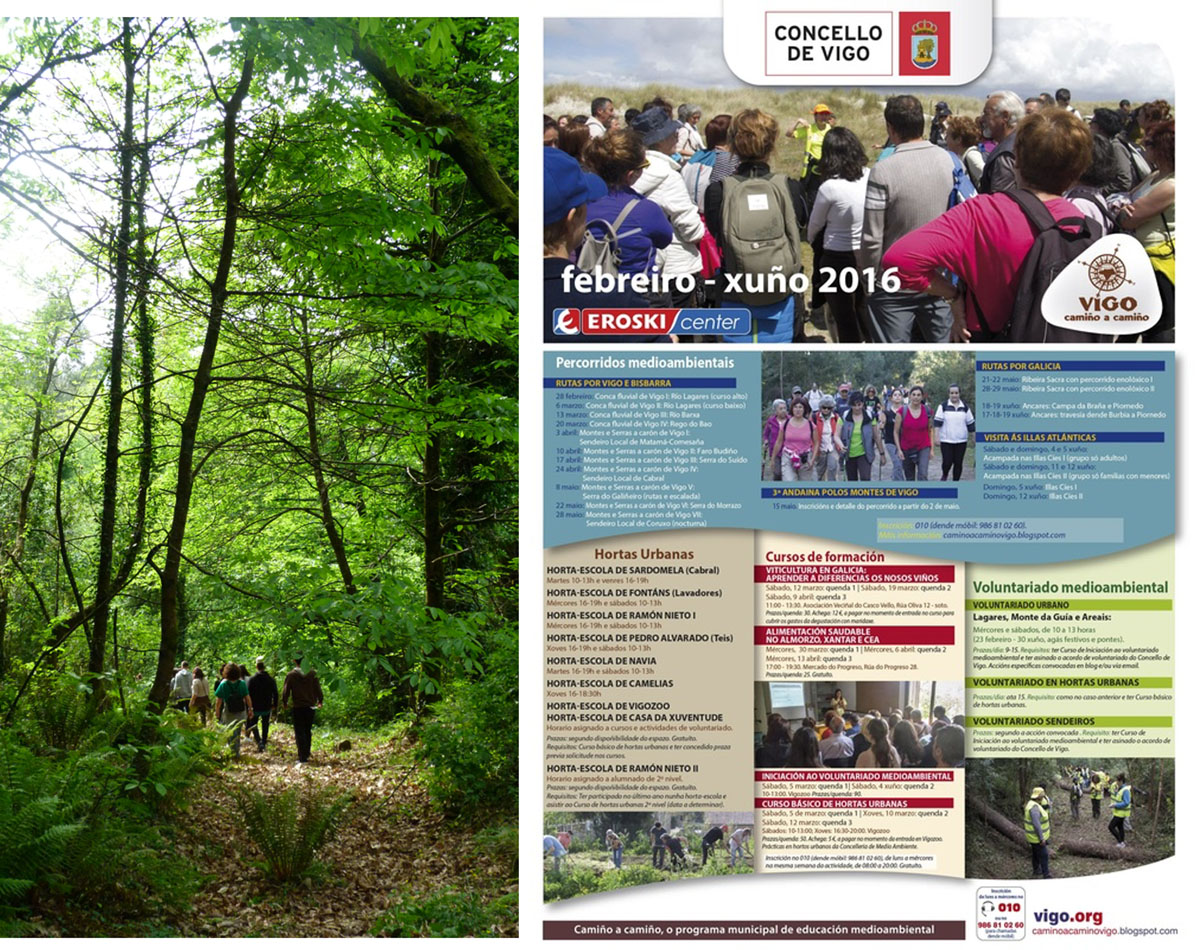
Figure 1
Photograph (left): a walking guided tour for teenagers of professional schools in the Teis CF. Source: M. Nieto-Romero. Image (right): flyer showing the Camiña Camiño program of Vigo municipality (Council and Mancomunidad). Source: https://www.caminoacaminovigo.org/.
Teis CF came to be a space where commoners could perform their authority by implementing their own ways of managing and caring for the forest and the community, and by doing so, nurturing new political subjectivities based on earthcare and being-in-common (care-tizenship). The wonders of nature – e.g. discovering how trees grow, how they help other species to grow and are transformed by animals – were described as key to reaffirming their “values” and acquiring the necessary “self-esteem” (CL1) to be a commoner. They started to see themselves as being part of the forest’s ecosystem network (the ‘web of life’), participating in caring for the ecosystem as other beings did (e.g. the oak that gives habitats and food to other beings in the forest). They also expanded their caring practices to other humans and non-humans far beyond the boundaries of the Teis CF: they saved trees that had been cut in other places, cared for harmed animals by giving them a home, and became custodians of neighboring private forest patches that were in a state of abandonment.
The Teis community and the municipality council: a dialectic relationship
The educational project in Teis described above was accompanied with a municipal recreational-educational project for all community forests in the city of Vigo (‘Camina Camiño’ translated as Walk the Trail) (Figure 1, right picture). Funded by the post-crisis municipal ‘Employment Plan’ which aimed at addressing the situation of unemployment in the city, this project gave funding to CFs to hire personnel for forestry and path maintenance and for planting native species; it aimed to render the forest more accessible and pleasant for citizens, developing guided trails and educational walks and organizing mass recreational events for Vigo’s citizens. While being implemented in partnership with the umbrella organization of CFs in Vigo – the Mancomunidad of Vigo (hereafter referred to as Mancomunidad) – the municipal project contradicted Teis communal practices in terms of what a forest is, its use, and who is authorized/able to use and govern it. As we will show below these different understandings reveal conflicting visions of citizenship and, over the years, it became a municipal strategy to gain political visibility and authority over forests and citizens.
Through their collaboration with CFs, the municipal government developed different strategies to strengthen its authority over CFs and citizens in Vigo, anchored in hiding the work of commoners while giving visibility to the municipality’s. First, in the context of the project, the name of the Mancomunidad was changed to “Montes de Vigo” (which translates as Vigo’s Forests), erasing the word ‘community’ from the original name of the CF umbrella organization Mancomunidad. By doing so, the municipality incorporated communal forests as part of the parks of the city while giving visibility to the city (Figure 2), blending all CFs in one “forest of the city” (CN2).
Figure 2
Logos showed at the website of the umbrella organization of CFs in Vigo – the Mancomunidad of Vigo. Source: https://www.montesdevigo.org/.
Second, the support of native species plantations and arrangement of trails reinforced a passive view of citizenry. The project was anchored in a view of citizens as consumers of the “natural and cultural heritage”9 that had been previously marked and categorized by the municipality. The arranged trials were also used to host big events of 300 to 1000 people co-funded by big companies (Eroski, Decathlon, Corte Ingles, etc.). As the following quote from a person from the umbrella organization of CFs in Vigo explains, the municipal project was a successful advertisement for companies and for the municipal government itself:
Because they [the municipal government] realize that it is profitable […]…because we had already 350 and 700 people [in events], and we have already spent more than a million euros….” [the project it’s profitable] In the sense of the visibility that is given to the forest, the work that is being done in the sense of forest fire prevention, forest management, footpaths… So from 2012 on we have seen steep growth [of visitors-participants], which we’re maintaining […]So we all are under the umbrella of the Mancomunidade de Montes de Vigo, and it is very beneficial for all the parishes. […] Because the forests are a jewel, it is the jewel of the city.”- CN2
While accepting the council’s funding for hiring their forest worker, Teis commoners did not allow the council to organize municipal events in their forest. Teis commoners opened the CF to commoners of the parish and generally to particular “persons with interest in knowing it” (CL1). The massive influx was considered a threat to the forest ecosystem and their autonomy, as they disagreed with the values and politics of the council’s project:
“We can’t open the forests [to any citizen of Vigo] because this is what they [the municipality] are doing or want to do with the others [other CFs in Vigo]. And to simply go to take a picture – because everything is politicized. Everything is connected. And above all, if one wants to present a serious project, it’s very hard to move on but if it’s to launch one of these 21-day projects, everything will go smoothly. Because what is at stake is that the gentleman [the president of the municipality] does the opening with the flag, and he can take the picture”- CL1.
Through their collaboration with CFs, the municipality has become over the years a legitimated actor to manage forests and fight against wildfires in the city while inviting commoners to participate in the governance of the city as invited actors. Indeed, this collaboration between the municipality and CFs led to the commoners of the Mancomunidad being invited, for the first time in the history of the city’s democracy, to participate in the Economic and Social Council of the city where the main economic actors are consulted. In parallel, the municipal government has furthered its visibility and authority over forests and citizens- i.e. in May 2019, the mayor of Vigo, Abel Caballero, started his fourth consecutive mandate in Vigo, winning an absolute majority for the second consecutive mandate.
Among other strategies that are out of the scope of this paper, we believe that the municipality’s involvement in the management of forests and wildfires also influenced this elections’ results. In October 2017, when a wildfire burnt 600 hectares of forest in Vigo causing panic among Vigo’s citizens, the mayor proposed the installation of a green corridor of native species as part of its collaboration with the Mancomunidad. He identified the non-native tree species as the cause of the fires, literally referring to them as “gun powder” in public communications, presenting the green corridor as the solution that would “save” its citizens. Five years later, the corridor has yet to be implemented, but the council has become a key actor in the political debate around forest management. The project has catalyzed a political dispute between the municipal government and the regional forest services, who have accused each other in the media: while the council accuses the regional government of blocking the project, the regional forest service claims that the council should first comply with basic responsibilities of supporting forest biomass clearing in private properties in Vigo. What is clear, is that the municipality has gained the battle for attention and popularity, in a very sensitive topic for citizens (wildfires), and in a terrain where the regional forest service had been until now the only legitimated authority.
Regarding Teis CF, commoners’ request of a monthly fee to be paid by the municipality for the occupied forest area was fully dismissed in 2019 by the mayor. Yet, Teis commoners continue to demand financial support from governmental authorities, while claiming full autonomy to decide where and how to invest it and practicing a care-tizenship that rubs against the values and practices of the municipality, exhibiting a dialectic relationship with the municipality.
Discussion and Conclusions
The case of Teis CF underlines the mutually reinforcing relationship between commoning forests and citizenship, suggesting the importance of CFs as arenas to nurture alternative, expanded more direct, and ecological forms of democracy. Our case showed how Teis struggles to recover and regenerate the Teis community forests were linked to citizenship claims to be recognized as right claimants and right holders by state agents. Yet, over time citizenship performance in Teis went much beyond claims to rights, performing an ecological and self-organized form of democracy sustained in acts of being-in-common with forests. Commoners became care-tizens – actively engaging in the communal care and care for the common – when they realized their interconnections within the web of life of forests, and acquired the response-abilities to care for their forest and their community. Their acts of being-in-common included practices of care that transcended CF borders and human-nature boundaries, as for example, caring for marginalized or excluded persons, such as those in less privileged positions or with drug addiction problems, as well as with injured ecosystems and species such as the salamander, beetle, and native tree species. These practices of care were both insurgent – emerging in reaction of governmental authority’s incapable of caring for forests and its citizens- but also healing- strengthening commoners’ self-esteem and providing them with values, being a space of healing for those most in need.
Our results resonate with recent research depicting how ecosystem’s regeneration and care is not an impersonal or technical endeavor, but it is a lived-in and embodied community practice linked to our own (personal and societal) healing; this literature points how there is no such thing as ecosystem restoration, but it should be rather referred to as “reciprocal restoration” as it involves restoring the relationality between nature and people (Haggerty et al., 2018). In line with other scholars (García López et al., 2017; Hecht, 2011; Starr et al., 2011), our results shows how commoners’ socionatural relations to forest were at the core of their identity and culture, as well as of self-organized forms of democracy. Seeing the wonder and beauty of the cycles of growth and decay in forests helped them to gain authority as citizens, nurturing the necessary self-esteemed and values to become commoners (Singh, 2018) and care-tizens.
Thus, our analysis of forest commoning as part of the citizenship struggles of the city – and especially the practices of care involved therein –enrich academic knowledge on how democracy is performed and rooted in particular sociopolitical regimes and socionatural relations (Escobar, 2001; Grant and Le Billon, 2019). Within this view, conflicts between governments and communities about who manages forests, how, and for whom, are usually understood as a clash between different citizenship forms, both subjecting and fueling environmental action and insurgency. Our research showed that, rather than in opposition, Teis exhibits a dialectic relationship with the municipal and other state actors. While the neoliberal and undemocratic system politicized their practices of forest care – being consistently political claims for deepening democracy – they also reclaimed their autonomy to practice their own self-organized forms of citizenship through forest care, while asking for the (economic) governmental support.
While describing Teis commoning practices as acts of insurgent citizenship, this paper has also showed how top-down native plantations are being implemented as technical fixes that erase commoners, while inviting them to participate in a neoliberal system of democracy. This, we argue, is part of the global neoliberal turn of environmental governance which is characterized by (false) consensus and apolitical technical interventions in nature (Nightingale, 2018; Swyngedouw, 2010). To reach ‘consensus’, the municipal mayor proclaimed nature the cause of the crisis (e.g., the non-native species are causing wildfires), while offering apolitical technical fixes for it (e.g., planting native species as technology that will save citizens). While obtaining absolute majority in the elections, the democratic party governing the municipality has ignored Teis commoners’ petitions to negotiate to resolve their ongoing conflict. Instead, they have maintained a latent conflict with Teis commoners- hidden and silent to not disturb the apparent consensus but deleterious for democracy (Buizer and Kurz, 2016; Idrissou et al., 2013).
In the current global inter-linked crises – characterized by increasing inequities, the weakening of democracy, ecological destruction, and devastating climate changes – there is an urgent need to unveil the interlinkages between the nature, human well-being and democracy. While trees as usually posit as the best technology to climate change mitigation and adaptation, history has showed us how planting trees can be harmful to local populations, when disrupting local democratic socio-natural arrangements (Brouwer, 1995; Peluso and Vandergeest, 2001). By unveiling the ways through which forest contributes to democracy, this paper showed how it is not just forests/trees, but our acts of being-in-common – with forests, trees, and other species- which is at the core of healing and democracy.
Planting (native) trees can be part of democratization process, when it is chosen and controlled by local communities in a quest for improving their well-being (Cidrás et al., 2018; Cidrás and González-Hidalgo, 2022; Serra and Allegretti, 2020). The current social mobilizations against eucalypti in Galicia and in the world, is an example of a democratization processed build through self-organized bottom-up structures that comes along with environmental action (Cidrás and González-Hidalgo, 2022). We thus call for more research that unveils how ecosystems/forest commoning processes shapes citizenship and ultimately how these contribute to democratization as well as ecosystems and human health.
Notes
[2] By dialectic, we refer to “a process of change in which a concept or its realization passes over into and is preserved and fulfilled by its opposite” (https://www.merriam-webster.com/dictionary/dialectic).
[3] A first wave including the Zapatista movement for territorial autonomy and the Bolivian water wars (among many similar movements across Latin America and other global South regions); a second wave including the Indignados/Squares/Occupy movements, mainly in Northern cities but also in the Middle East and Eastern Europe.
[4] Property rights under Germanic nature recognize communities’ ownership as long as they live in the areas where the commonland is ascribed.
[5] Under the co-management option, the regional government returns 70% of the logging revenues to the communities, communities decide in assembly how to invest the percentage of earnings given to them by the state forestry activities. Generally, earnings are reinvested in the parish/forest, although the law allows communities to divide maximum a 60% of earnings among households (Ley 7/2012).
[6] Industries included a cannery industry – one of the wealthiest in Spain – shipbuilding industries, and in 1958 a Citroen factory that boosted the development of iron and steel industries.
[8] Teis CF functioned through the activity of a highly active governing board that held weekly or monthly meetings (8 persons) and by two community assemblies per year, joining all representative commoners (38 formal commoners representing around 100 commoners). During general assemblies the governing board reported on the activities done in previous months and next steps, which were usually accompanied by an account of successes and challenges. There was great consensus during the assemblies, as well as in the interview transcripts that generally coincided with the visions we present in the main text.
[9] From the council’s website: https://hoxe.vigo.org/movemonos/mabiente_camino.php?lang=cas#/.
Acknowledgements
We are very grateful to all commoners of Teis who provided their time during this research project. This paper was the results of a collaborative process where Author 1 was the primarily responsible as it followed directly from her PhD research. Author 2 and 3 have been involved in the conceptual interpretation of data analysis, contributing significantly to the theoretical framing of the article. Author 4 is the senior author, promotor of author 1. We also acknowledge Dr. Sandra Valente from Forestwise, as well as the journal’s reviewers for their useful comments and suggestions.
Funding information
This project received funding from the European Union’s Horizon 2020 Research and Innovation Programme under the SUSPLACE Marie Skłodowska-Curie grant agreement No. 674962 during 2016 to 2019, and under the eGrounwater PRIMA Programme grant agreement No. 1921 from 2020 onwards. This work was also supported by FCT, I.P., the Portuguese national funding agency for science, research, and technology, under the Project UIDB/04521/2020 (author 1) and under the Individual Stimulus Program for Scientific Endeavors (CEECIND), contract CEECIND/04850/2017/CP1402/CT0010 (author 2), as well as by the care and support of many friends, colleagues, and family.
Competing interests
The authors have no competing interests to declare.