
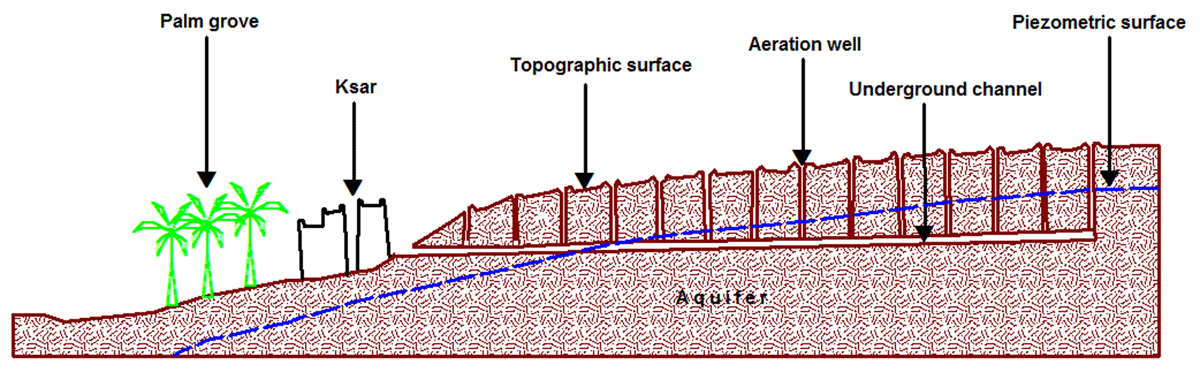
Figure 1
Longitudinal section of a Foggara (adapted from Remini et al., 2014).
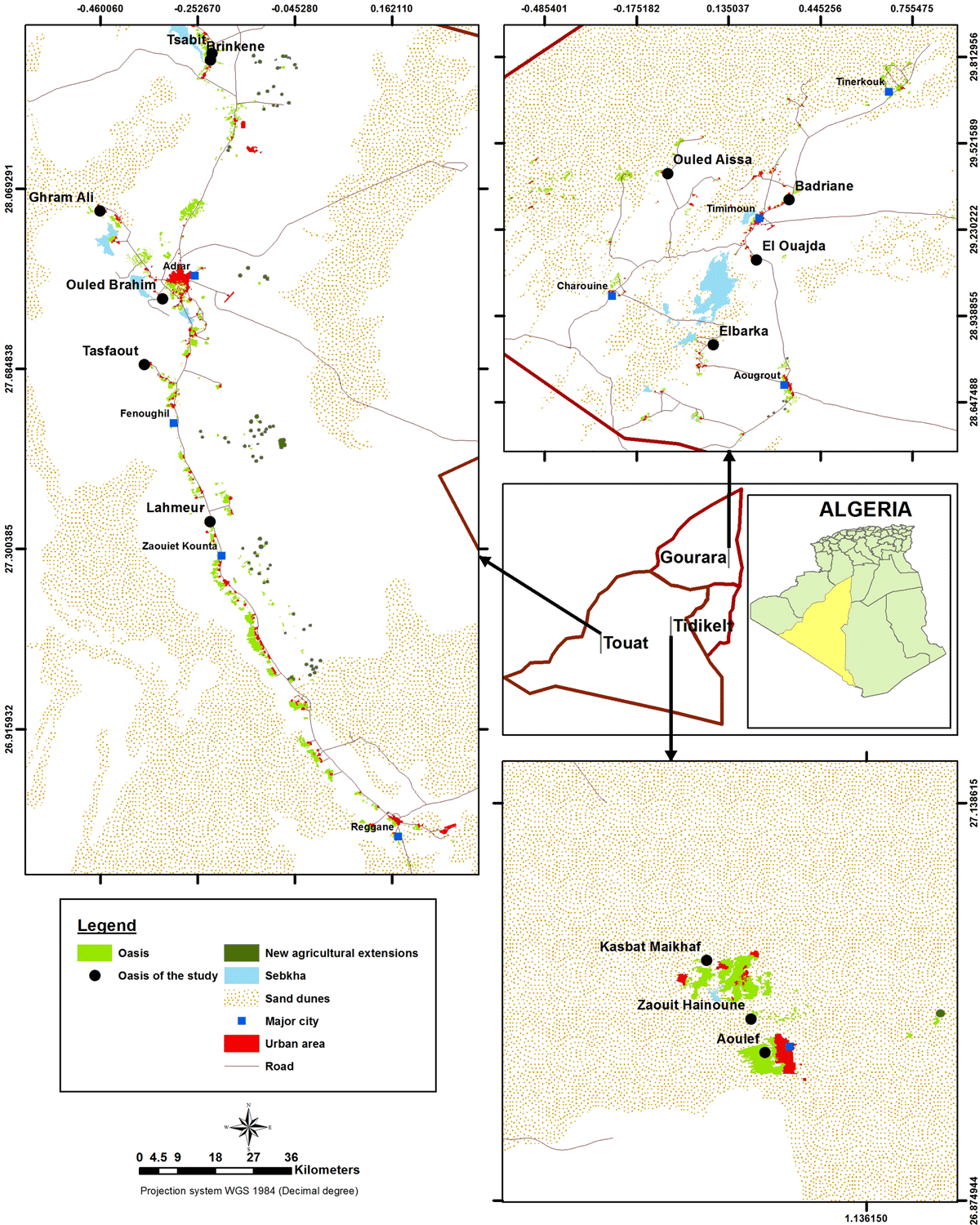
Figure 2
Map of the study area.
Table 1
Challenges faced by and adaptions made in the studied foggaras.
| FOGGARA | OASIS | REGION | CHALLENGES FACED | ADAPTATIONS MADE |
|---|---|---|---|---|
| – Cheman | – Tasfaout | – Touat | – Individual wells in catchment area – Exclusion of sharecroppers from water rights | – Formal ban on wells – Sharecroppers provided with water rights – Maintenance carried out by owners and sharecroppers |
| – Ouled M’hammed | – Brinken | – Touat | – Individual wells in catchment area – Exclusion of sharecroppers from water rights – Sharecroppers refuse to carry out maintenance | – Formal ban on wells – Foggara owners learned how to do maintenance |
| – Saiba | – Tsabit | – Touat | – Exclusion of sharecroppers from water rights | – Waiting for court decision |
| – Akhabi | – Badriane | – Gourara | – Exclusion of sharecroppers from water rights | – Waiting for court decision |
| – Guermekker | – Ghram Ali | – Touat | – Exclusion of sharecroppers from water rights – Diminishing discharge | – Sharecroppers provided with water rights – Maintenance carried out by owners and sharecroppers – Borehole installation |
| – Amrane – Takareft – Abbou – Aït Wamane | – Lahmeur | – Touat | – Exclusion of sharecroppers from water rights – Diminishing discharge | – Sharecroppers provided with water rights – Maintenance carried out by owners and sharecroppers – Borehole installation |
| – -Ben Drâou | – Kasbat Maikhaf | – Tidikelt | – Attractivity of jobs in tertiary sector – Labor shortage for maintenance | – Paid labor, mainly carried out by students of owners’ families |
| – Ighjar | – Zaouit Hainoune | – Tidikelt | – Attractivity of jobs in tertiary sector – Labor shortage for maintenance | – Paid labor, mainly carried out by students of owners’ families |
| – Arkes | – Ouled Brahim | – Touat | – Conflict over water shares with sharecroppers – Sharecroppers refuse to carry out maintenance – Reduction in discharge | – Owners collect money – Maintenance carried out by paid labor |
| – Elfidilia | – Elbarka | – Gourara | – Reduction in state subsidies for maintaining foggaras – Sharecroppers refuse to carry out maintenance – Reduction in discharge | – Owners collect money – Maintenance carried out by foggara owners and by paid labor |
| – Tourfine | – Aoulef | – Tidikelt | – Flood damage foggara | – Owners collect money for rehabilitation, calling on village community solidarity – Oasis community solicits state support |
| – Boussaid – Mahri – Goujdil | – Ouled Aissa | – Gourara | – Sharecroppers & owners invest in agricultural extensions, abandoning foggaras – Reduction in state subsidies in extensions | – Rehabilitation of foggaras and adaptation of rules – Installation boreholes |
| – Kbira | – El Ouajda | – Gourara | – Sharecroppers refuse to carry out maintenance – Attractivity of jobs in tertiary sector | – Foggara owners learned how to do maintenance – Formal ban on wells |
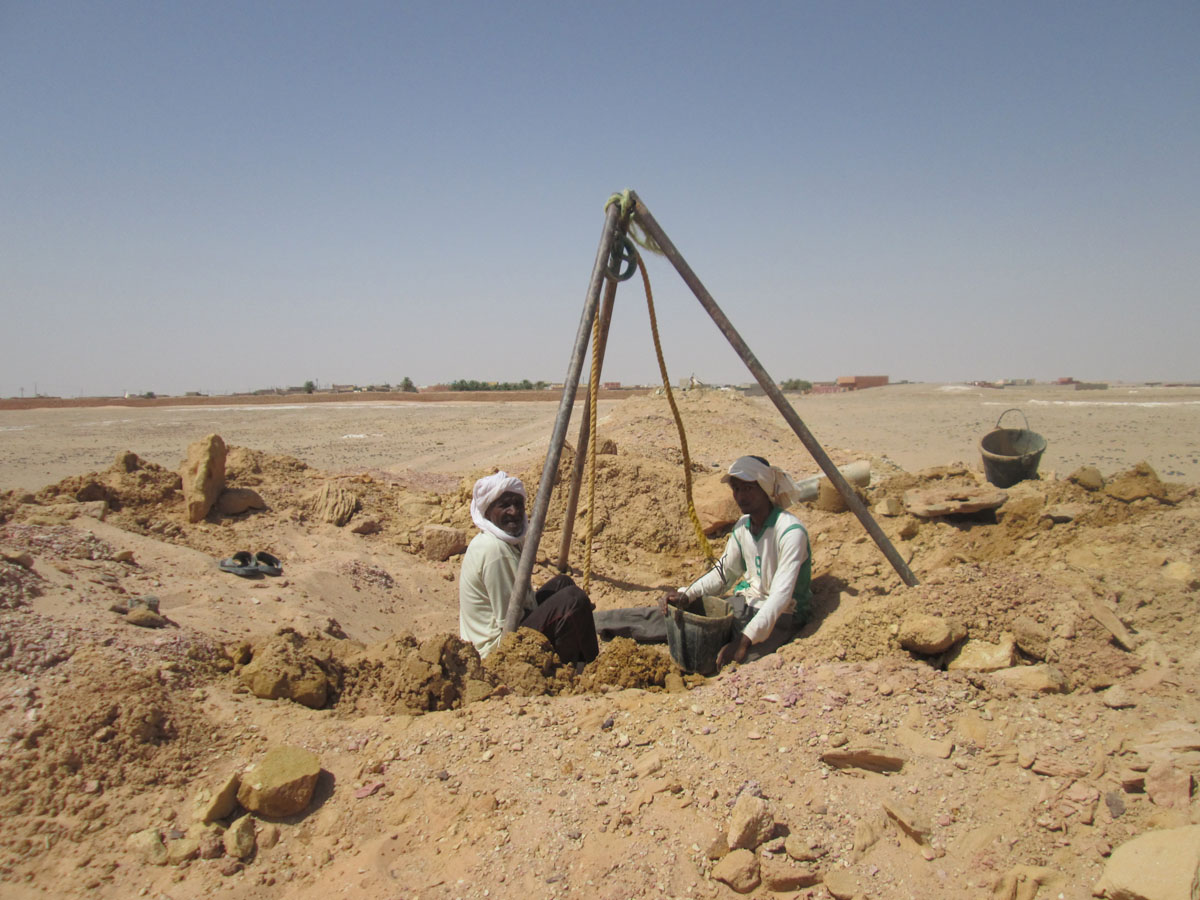
Picture 1
Two young men (one inside the well, not visible in the photo), accompanied by an elder, on duty maintaining a well (August 2016).
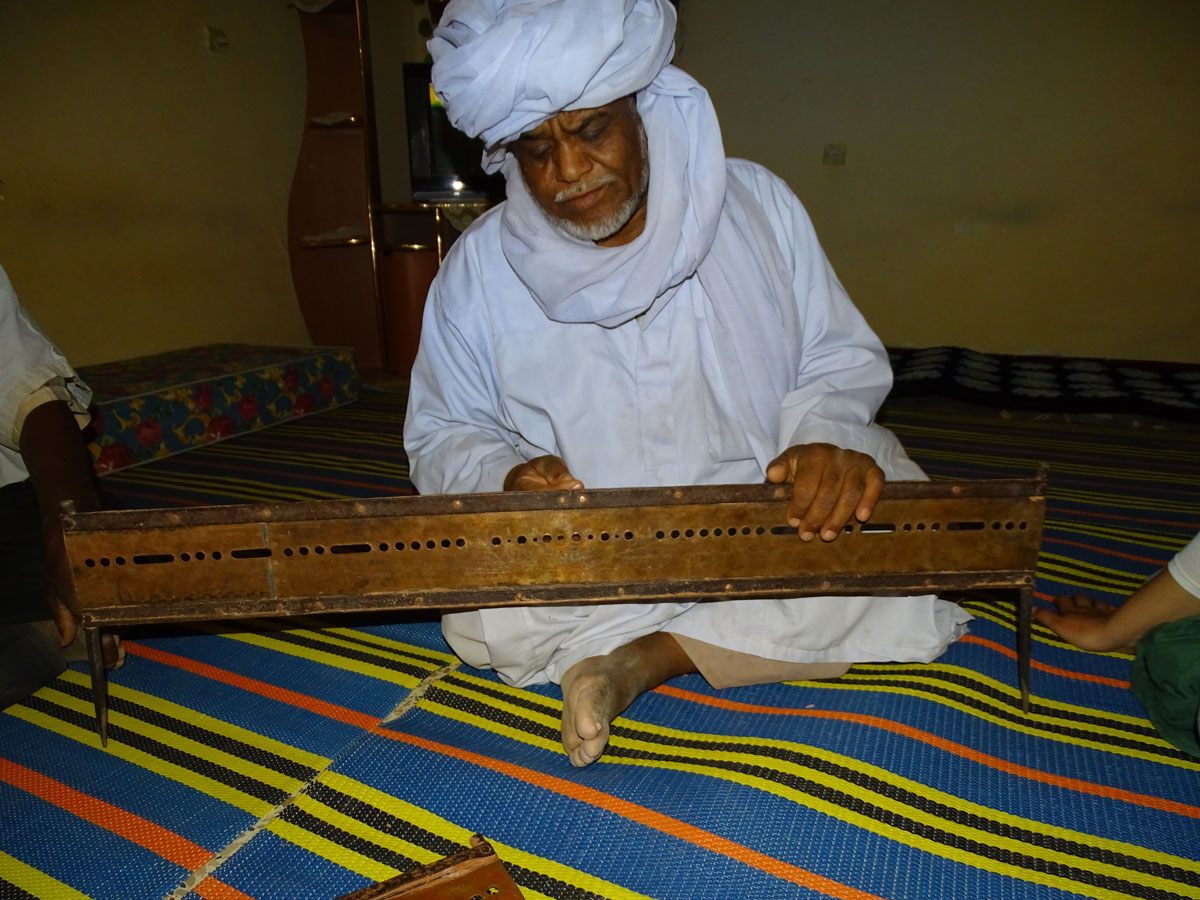
Picture 2
The flow measurement device (louh) is used by the water master to check the water shares of different water owners of particular foggaras (April 2017).
Table 2
Synthesis of the challenges to design principles and institutional adjustments to these challenges by the community.
| DESIGN PRINCIPLES | CHALLENGES TO DESIGN PRINCIPLES | INSTITUTIONAL ADJUSTMENTS |
|---|---|---|
| 1. Clearly defined and continually adjusted boundaries | Installation of individual (often state-sponsored) boreholes in catchment areas of foggaras | Ban on boreholes Including sharecroppers as foggara owners |
| 2. Congruence between appropriation and provision rules | Providing pumped groundwater to foggaras, breaking the link between available water resources and use | Favor frugal irrigation by sharing water over several foggaras Ban on installation of other boreholes |
| 3. Collective-choice arrangements | Sectoral approach to water by the state separating drinking water supply from irrigation | Maintain the community interest in foggaras |
| 4. Monitoring | Physical rehabilitation changing the hardware of the foggara | Preserve water distribution device for monitoring |
| 5. Graduated sanctions | Local norms related to social reputation weakened by state judiciary | Social reputation remains important, but the community has difficulties to apply graduated sanctions |
| 6. Conflict-resolution mechanisms | State legal power weakening community conflict-resolution mechanisms | Creation of formal associations crafting new rules that are socially constructed and recognized by the state |
| 7. Minimum recognition of rights to organize | The state does not recognize community institutions and requires users to create a formal association | Users take the official framework of association to continue crafting rules |
| 8. Nesting | Ageing of regional water masters and potential loss of their knowledge and capacity of arbitration | For the time being, the water masters are still called upon, but their succession is not assured. |
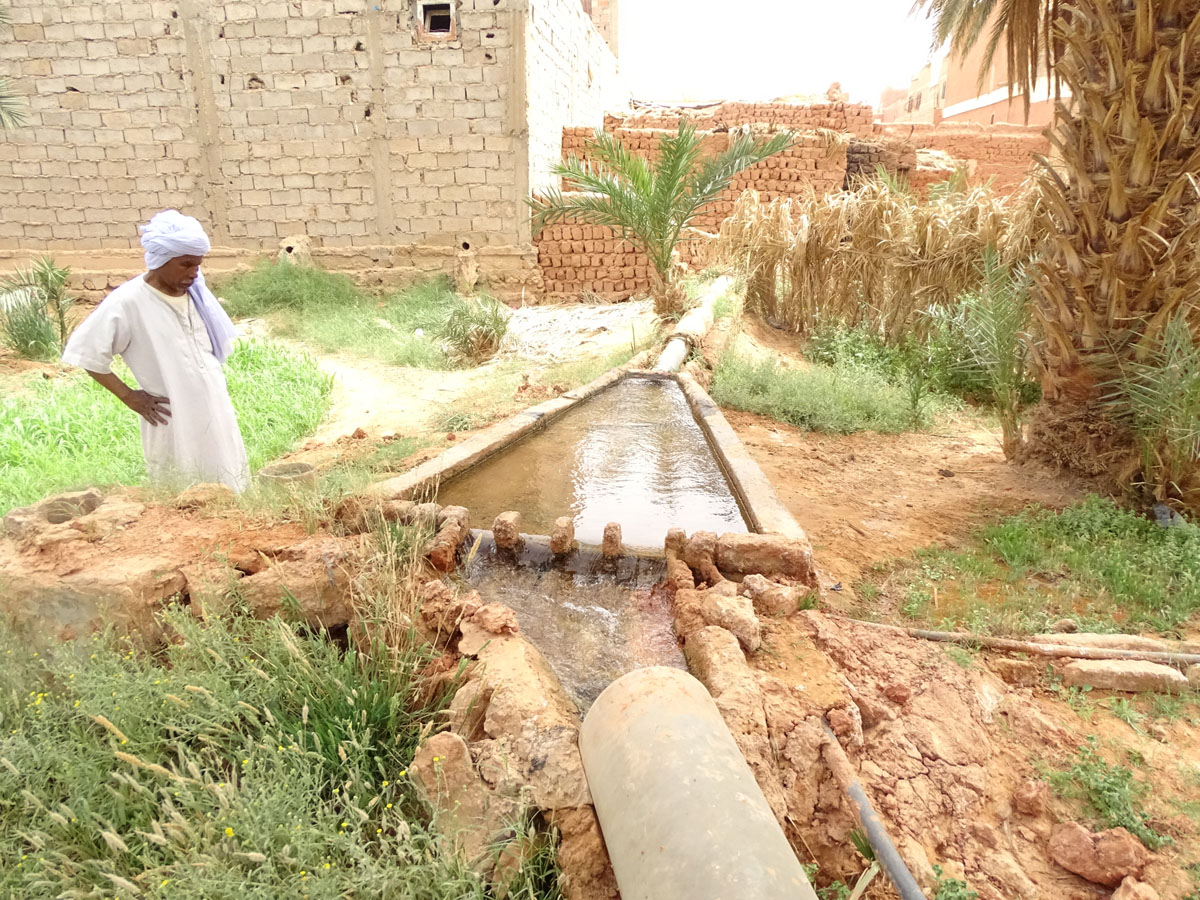
Picture 3
Replacing traditional channels by modern pipes while keeping the use of the water sharing basin (kesria) to ensure the visibility of water distribution for all. On the picture, the channel upstream of the kesria (top of the picture) has been replaced by a concrete pipe carrying all of the discharge of the foggara. In the kesria, part of the foggara discharge is diverted to smaller pipes that go left and right on the picture. What is remaining is the combined discharge of several water owners that will be transported in the big concrete pipe further downstream, where there is another kesria to sub-divide between these owners. (April 2017).