
Figure 1
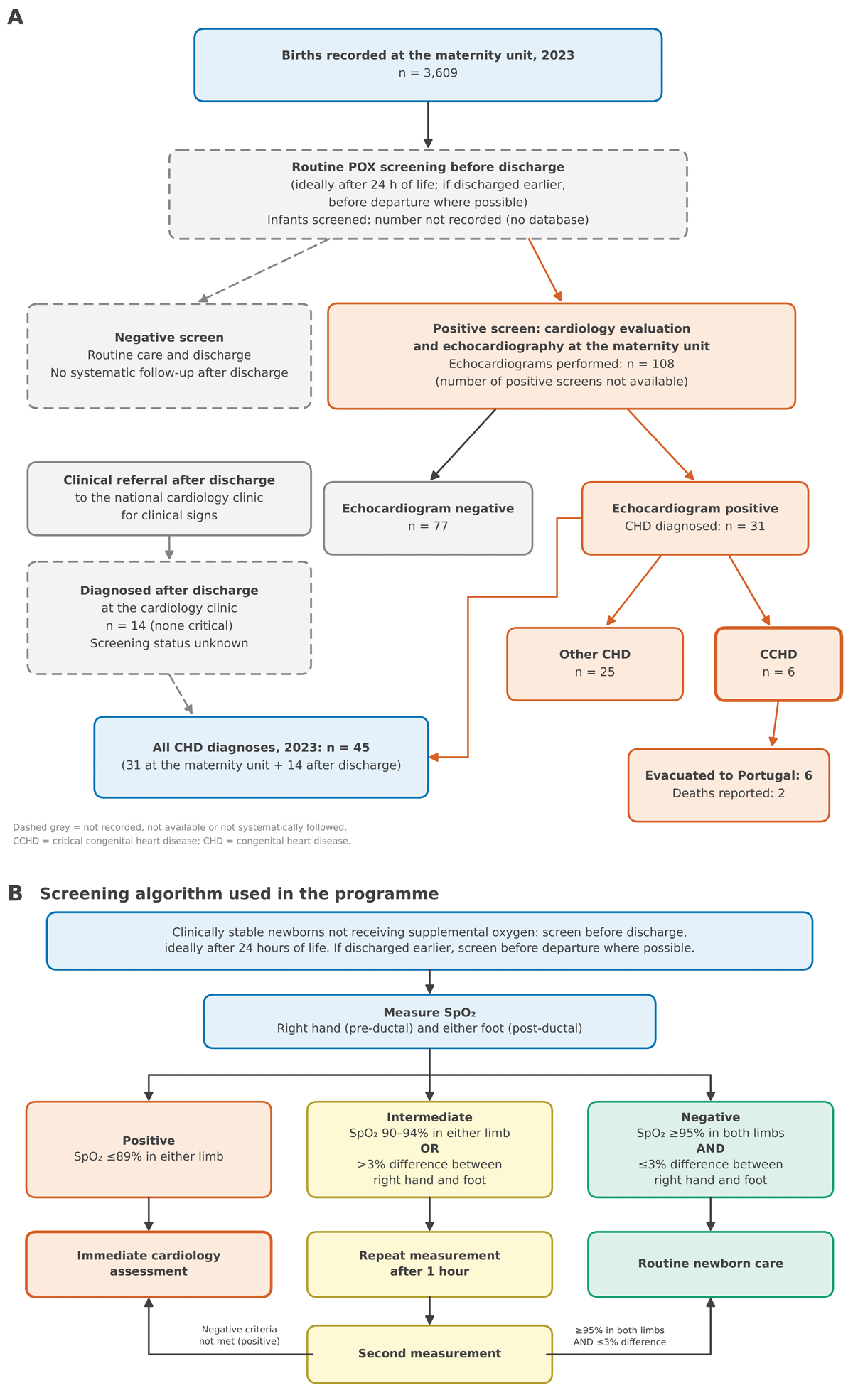
Flow of newborns, screening algorithm and echocardiography results in the pilot pulse oximetry screening programme for CCHD at Hospital Ayres de Menezes, São Tomé and Príncipe, 2023.
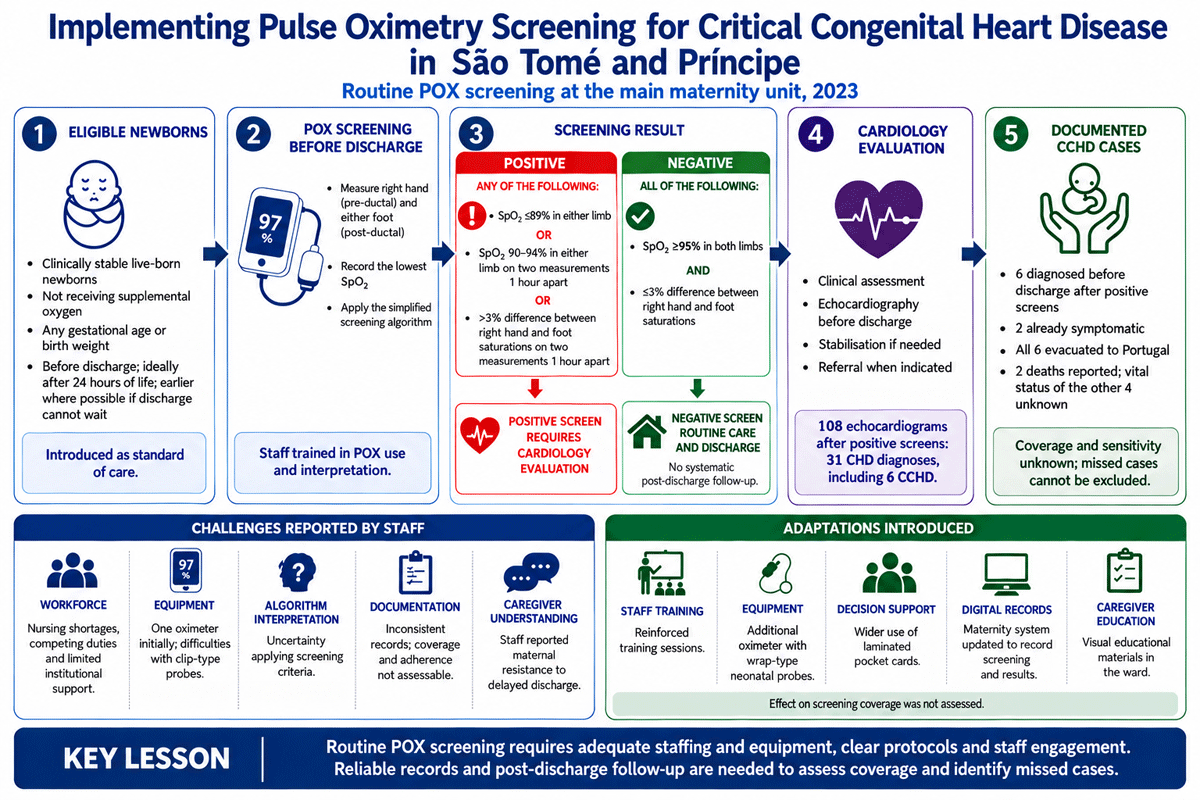
Boxes show numbers of newborns or echocardiographic examinations, as indicated. Dashed grey boxes indicate quantities or outcomes that were not recorded or were unavailable: the number of newborns screened, the number of positive screens, and post-discharge outcomes among newborns with negative screens. Cardiology records documented 108 echocardiograms performed at the maternity unit, of which 31 identified CHD and 77 showed no CHD. Fourteen infants were diagnosed with CHD after discharge following referral to the national cardiology clinic for clinical signs; their screening status was unknown.
Screening targeted newborns before discharge, ideally after 24 hours of life. Infants discharged earlier were screened before departure where possible.
Panel B shows the screening algorithm used in the pilot programme. A positive screen was defined as any of the following: SpO2 <90% in either limb at any measurement; SpO2 90–94% in either limb on two measurements 1 hour apart; or a difference of >3 percentage points between the right hand and foot on two measurements 1 hour apart. A negative screen required SpO2 ≥95% in both limbs and a difference of ≤3 percentage points.
CCHD, critical congenital heart disease; CHD, congenital heart disease; POX, pulse oximetry; SpO2, oxygen saturation.
Source: Figure prepared by the authors. Screening algorithm adapted from Martin et al. (10).
Table 1
Infants with critical congenital heart disease (CCHD) diagnosed during the implementation period (n = 6).
| CHARACTERISTIC | INFANTS WITH CCHD (n = 6) |
|---|---|
| Share of all CHD diagnoses (n = 45) | 6 (13.3%) |
| Screened with POX | 6 of 6 |
| Diagnosed at the maternity unit by echocardiography, among examinations performed after positive screens | 6 of 6 |
| Symptomatic when assessed | 2 of 6 (hypoplastic right heart syndrome, n = 1; pulmonary atresia, n = 1) |
| Not reported as symptomatic | 4 of 6 |
| Recorded CCHD diagnoses | Pulmonary atresia, n = 3; double-outlet right ventricle with ventricular septal defect and pulmonary stenosis, n = 2; hypoplastic right heart syndrome, n = 1 |
| Medically evacuated to Portugal for specialised treatment | 6 of 6 |
| Deaths reported | 2 of 6: pulmonary atresia, n = 1; hypoplastic right heart syndrome, n = 1. Both deaths occurred in Portugal; timing and cause of death unknown. |
| Follow-up after evacuation | No follow-up information available for the other four infants; their vital status is unknown |
[i] CCHD, critical congenital heart disease; CHD, congenital heart disease; POX, pulse oximetry. Counts are aggregate figures supplied by the cardiology team; individual-level data were not available for this report. The percentage uses all 45 CHD diagnoses as the denominator. The six CCHD diagnoses were pulmonary atresia (n = 3), double-outlet right ventricle with ventricular septal defect and pulmonary stenosis (n = 2), and hypoplastic right heart syndrome (n = 1). All six infants were medically evacuated to Portugal. Two deaths were reported: one infant with pulmonary atresia and the infant with hypoplastic right heart syndrome. Both deaths occurred in Portugal; their timing and cause were unknown. No follow-up information was available for the other four infants, including their vital status.
Information on interventions received after evacuation was not available for any of the six infants.
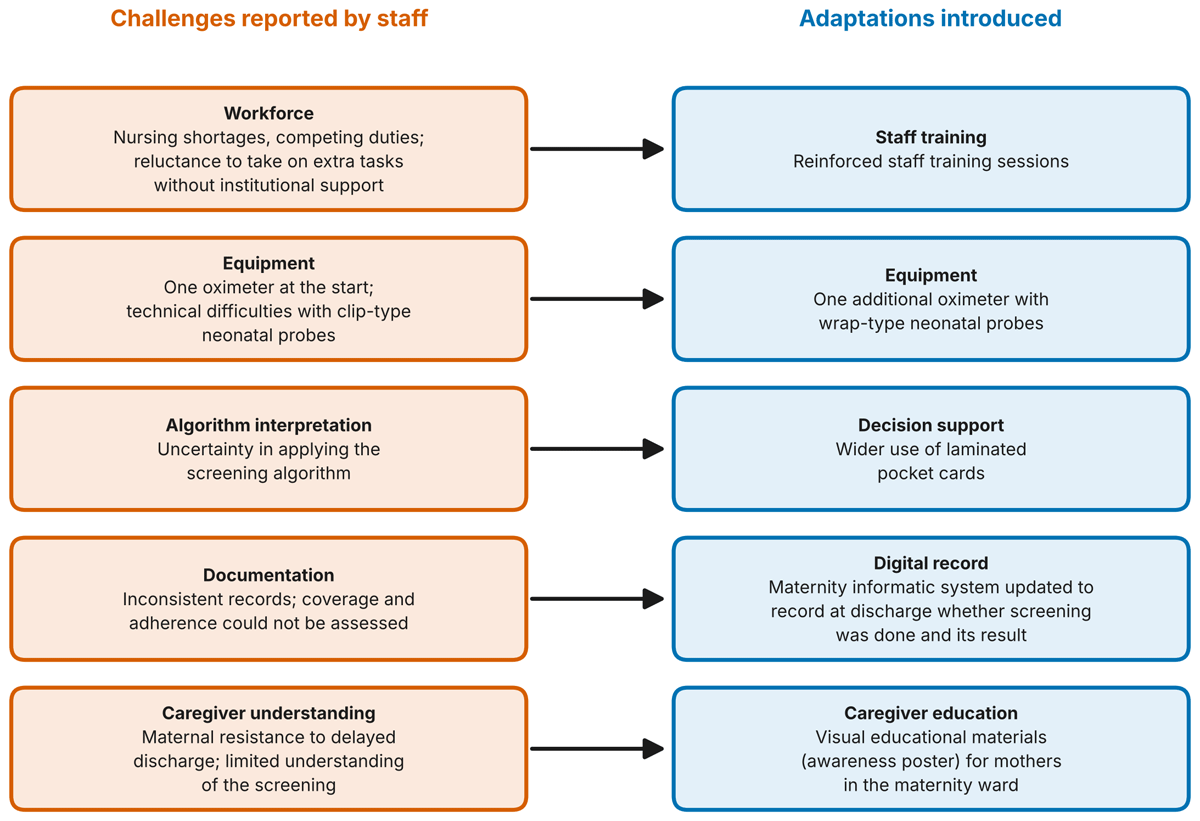
Figure 2
Implementation challenges reported by maternity staff in semi-structured interviews and adaptations introduced during the initial implementation of routine pulse oximetry screening at Hospital Ayres de Menezes, São Tomé and Príncipe, 2023.
Source: Figure prepared by the authors.