
Table 1
Baseline demographic characteristics, clinical, and echocardiographic characteristics (N = 1406).
| PARAMETERS | ISOLATED MITRAL REGURGITATION DEGENERATIVE (N = 1130) | ISOLATED MITRAL REGURGITATION RHD (N = 276) | P |
|---|---|---|---|
| Sex | |||
| Male | 744 (65.8%) | 64 (23.2%) | P < 0.0001 |
| Female | 386 (34.2%) | 212 (76.8%) | |
| Age | 53 ± 13 | 37 ± 14 | P < 0.0001 |
| EKG | |||
| SR | 732 (64.8%) | 104 (37.7%) | P < 0.0001 |
| AF | 307 (27.2%) | 145 (52.5%) | |
| Other | 14 (1.2%) | 4 (1.4%) | |
| LVEF | |||
| (mean ± SD) | 65.74 ± 11.43 | 61.51 ± 11.62 | P < 0.0001 |
| <60% | 245 (21.7%) | 88 (31.9%) | P < 0.0001 |
| EDD | 56.63 ± 8.57 | 57.7 ± 10.0 | P = 0.154 |
| ESD | 35.60 ± 8.09 | 38.6 ± 8.4 | P < 0.0001 |
| LAVi | |||
| (mean ± SD) | 87.36 ± 70.37 | 193 ± 307 | P < 0.0001 |
| TAPSE | |||
| (mean ± SD) | 22.4 ± 5.5 | 20.5 ± 5.9 | P < 0.0001 |
| <17 mm | 160 (14.2%) | 68 (24.6%) | P < 0.0001 |
| TR Vmax | |||
| >3.4 m/s | 262 (23.2%) | 97 (35.1%) | P < 0.0001 |
| Presence of at least moderate tricuspid regurgitation | 254 (22.47%) | 144 (52.2%) | P < 0.0001 |
[i] Data are presented as n (%), mean ± SD, or median [IQR], as appropriate.
AF = atrial fibrillation, EDD = end-diastolic diameter, ESD = end-systolic diameter, LAVi = left atrium volume index, LVEF = left ventricle ejection fraction, SR = sinus rhythm, TAPSE = tricuspid annular plane systolic excursion, TR Vmax = tricuspid regurgitation maximum velocity.
Table 2
Univariable and multivariable analysis parameters associated with reduced LV ejection fraction (<60%).
| UNIVARIABLE ANALYSIS | MULTIVARIABLE ANALYSIS | ||||
|---|---|---|---|---|---|
| P VALUE | Or | P VALUE | 95% CONFIDENCE INTERVAL | ||
| LOWER | UPPER | ||||
| Gender | |||||
| Female | Reference | 0.31 | 0.000 | 0.177 | 0.560 |
| Male | 0.201 | ||||
| Atrial fibrillation | |||||
| No | Reference | 1.15 | 0.883 | 0.176 | 7.556 |
| Yes | 0.134 | ||||
| Etiology | |||||
| Degenerative | Reference | 2.54 | 0.012 | 1.223 | 5.265 |
| Rheumatic | 0.101 | ||||
| TR Vmax | |||||
| ≤3.4 m/s | Reference | 0.37 | 0.370 | 0.824 | 1.682 |
| >3.4 m/s | 0.157 | ||||
| TAPSE | |||||
| >17 mm | Reference | 0.97 | 0.937 | 0.415 | 2.25 |
| ≤17 mm | <0.000 | ||||
| Age (years) | 0.056 | 0.96 | 0.000 | 0.943 | 0.983 |
| ESD (mm) | <0.0001 | 0.76 | 0.000 | 0.726 | 0.802 |
| LAVi (ml/m2) | 0.651 | – | – | – | – |
[i] ESD = end-systolic diameter, LAVi = left atrium volume index, LVEF = left ventricle ejection fraction, TAPSE = tricuspid annular plane systolic excursion, TR Vmax = tricuspid regurgitation maximum velocity.
Table 3
Univariable and multivariable analysis parameters associated with impaired TAPSE (<17 mm).
| UNIVARIABLE ANALYSIS | MULTIVARIABLE ANALYSIS | ||||
|---|---|---|---|---|---|
| P VALUE | OR | P VALUE | 95% CONFIDENCE INTERVAL | ||
| LOWER | UPPER | ||||
| Gender | |||||
| Female | Reference | 0.90 | 0.688 | 0.547 | 1.488 |
| Male | 0.105 | ||||
| Atrial fibrillation | |||||
| No | Reference | 1.88 | 0.441 | 0.378 | 9.347 |
| Yes | 0.000 | ||||
| Etiology | |||||
| Degenerative | Reference | 1.19 | 0.622 | 0.594 | 2.390 |
| Rheumatic | 0.000 | ||||
| TR Vmax | |||||
| ≤3.4 m/s | Reference | 0.60 | 0.001 | 0.441 | 0.805 |
| >3.4 m/s | 0.000 | ||||
| LVEF | |||||
| ≥60% | Reference | 3.81 | 0.002 | 1.622 | 8.960 |
| <60% | <0.000 | ||||
| Age (years) | 0.587 | – | – | – | – |
| ESD (mm) | 0.05 | 1.031 | 0.090 | 0.995 | 1.067 |
| LAVi (ml/m2) | 0.000 | 0.998 | 0.056 | 0.996 | 1.000 |
[i] ESD = end-systolic diameter, LAVi = left atrium volume index, LVEF = left ventricle ejection fraction, TAPSE = tricuspid annular plane systolic excursion, TR Vmax = tricuspid regurgitation maximum velocity.
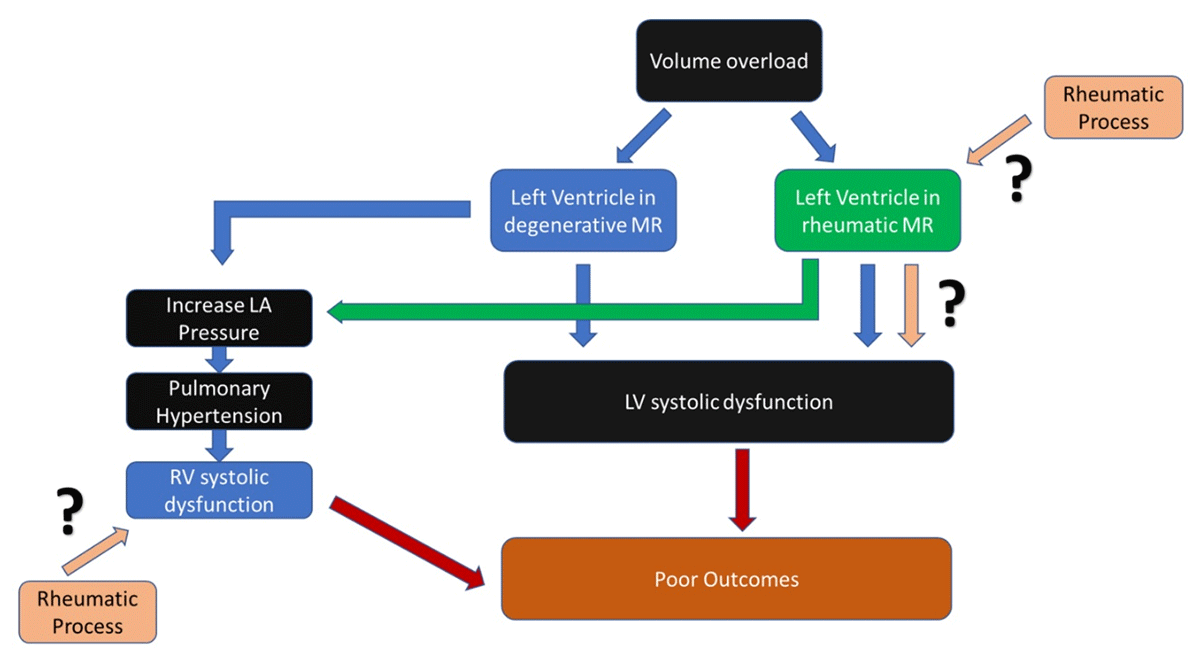
Figure 1
Central illustration. Proposed mechanism of left and right ventricular dysfunction in degenerative and rheumatic mitral regurgitation.
Ventricular volume overload and pulmonary hypertension responsible for the development of left and right ventricular dysfunction, respectively, in chronic mitral regurgitation. However, the rheumatic process independently associated with the reduced ventricular function is not well established.