
Table 1
Comparison of the five HEALTHWISE infrastructures across the common dimensions used to structure the case studies, and the cross-cutting themes each case study most directly informs.
| NOTTINGHAM (UK) | QUEENSLAND (AUSTRALIA) | CAPE TOWN (SOUTH AFRICA) | A*STAR (SINGAPORE) | SWANSEA (UK) | |
|---|---|---|---|---|---|
| Context and drivers | National investment through HDR UK and DARE UK; NHS England requires re-use of patient data without specific consent to take place within a SDE | Statewide single electronic medical record (iEMR) providing a unified source of routinely collected health data | Fragmented regulation across multiple jurisdictions; historical data extraction without local benefit; DS-I Africa initiative funded by the US National Institutes of Health | City-state of approximately 6.2 million people with three health clusters; regional hub for cross-border biomedical research | Over a decade providing secure access to anonymised health and administrative data, predominantly from Wales |
| Governance model | Federation defined as independent organisations retaining control of their own data, services and platforms; national SDE policy | SMART Team hierarchical oversight with eHealth Queensland; conjoint appointments; Five Safes Framework implemented in UQTRE | GA4GH Passports for federated authentication and authorisation | TRUST hosted by A*STAR in partnership with the National Research Foundation and Ministry of Health | Five Safes Framework underpins SeRP and SAIL Databank governance; governance defined by data and operational context; governed output checking |
| Data standards | OMOP CDM; open-source tools for concept mapping and rule generation | OMOP CDM applied across thousands of iEMR source tables | GA4GH standards: Data Repository Service, Data Connect, Workflow Execution Service, and Passports | OMOP CDM through the National OMOP Working Group | GA4GH Task Execution Service standard, implemented in Five Safes TES |
| Technical architecture | OMOP mapping tooling available to the national SDE Network | UQTRE with segregated project workspaces, audit logging and governed output release | Cloud-agnostic federated open data science platform | TRUST platform; Biomedical Data Hub; PET Zoo microservices | SeRP platform with multi-modality support, output checking and high-performance computing; deployed in Canada and Australia |
| Approach to federation | Federation of TREs and SDEs through agreed standards and protocols | NINA: federated analytics and machine learning across seven sites; Australian Health Data Evidence Network (OHDSI-style) | GA4GH Starter Kit proof of concept across four African nodes | PETs: federated learning, secure multi-party computation, trusted execution environments, and homomorphic encryption | DARE UK blueprint components: TELEPORT and Five Safes TES |
| Principal challenges | Data transformation burden on custodians; researcher unfamiliarity with OMOP; ensuring SDEs are useful to researchers | Governance, access, and standardisation of highly complex clinical data | Learning curve for GA4GH standards; uneven research and technical capacity | Legal and regulatory fragmentation; interoperability gaps; accountability for federated analysis | Serving diverse technical and governance requirements at scale |
| Most relevant themes in Section 3 | 3.1 Tripartite tension 3.2 Standards as infrastructure | 3.2 Standards as infrastructure 3.3 Governance as an enabler | 3.2 Standards as infrastructure 3.4 Equity | 3.2 Standards as infrastructure 3.3 Governance as an enabler | 3.2 Standards as infrastructure 3.3 Governance as an enabler |
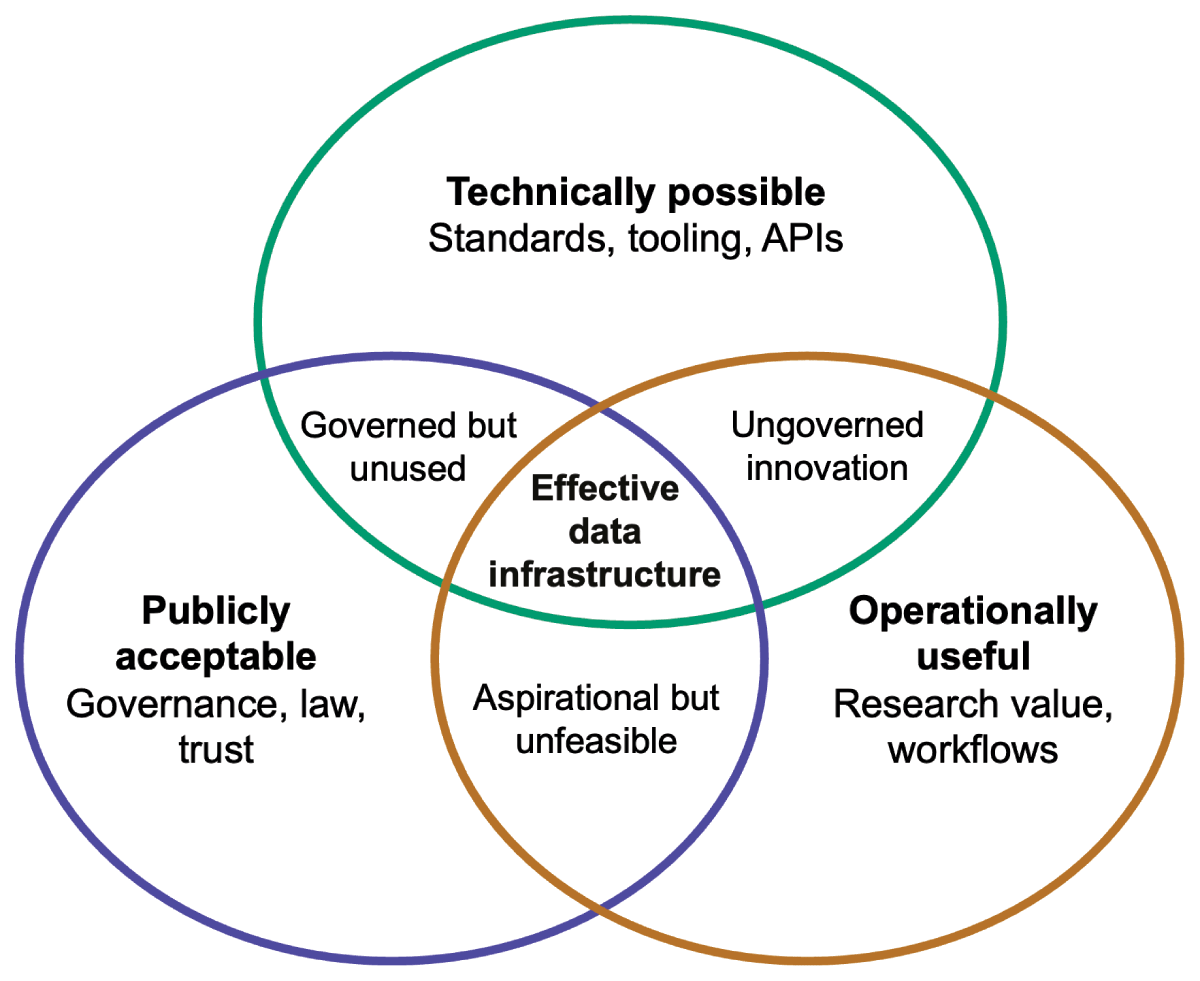
Figure 1
The tripartite tension in health data infrastructure. Effective infrastructure requires alignment across all three domains.