
Table 1
Positioning of the proposed framework in relation to established certification and trust frameworks.
| FRAMEWORK | SCOPE AND ROLE | ASSESSMENT MODE | PRIMARY OUTPUT | COVERAGE MAPPING | RELATION TO THIS STUDY |
|---|---|---|---|---|---|
| OAIS Reference Model | Conceptual reference model for long-term digital preservation | Conceptual model (non-audit) | Preservation framework | Governance, preservation processes | Provides conceptual foundation for repository trust but does not specify operational evaluation elements |
| ISO 16363 | Standard for audit and certification of trustworthy digital repositories | Formal audit-based certification | Certification decision | Organizational infrastructure, digital object management, technical infrastructure | Certification-focused; does not prioritize operational criteria for routine assessment |
| TRAC | Checklist-based audit framework for digital repositories | Audit checklist | Trust evaluation report | Organizational, technical, preservation controls | Precursor to ISO 16363; audit-oriented rather than element consolidation |
| CoreTrustSeal | Community-based repository certification mechanism | Certification against defined requirements (R0–R16) | Certification seal | Organizational, digital object management, technical infrastructure | Focuses on compliance verification rather than cross-source operational integration |
| TRUST Principles | High-level governance principles for digital repositories | Principle-based guidance | Governance principles | Transparency, responsibility, sustainability, user focus, technology | Conceptual guidance without prioritized operational breakdown |
| PREMIS | Preservation metadata specification | Metadata standard | Semantic units for preservation metadata | Preservation metadata, provenance | Supports preservation documentation but not holistic repository evaluation |
| This Study | Integrated operational evaluation framework | Expert-validated prioritization | Structured criteria library (Mandatory/Optional) | Governance, system support, workflows, QA/QC mechanisms, access and identifiers | Consolidates functional elements across sources and introduces prioritization for routine and comparative assessment |
Table 2
Main requirements of RDA Data Repository Criteria.
| CATEGORY | REQUIREMENT |
|---|---|
| Metadata | Support for various metadata schemas, including domain-specificity and interoperability, enabling data annotation by owners, authorized individuals, or automatic tools, and evaluating metadata quality. |
| Persistent Identifiers (PID) | Assignment of PID/DOI and integration of PIDs into data management. |
| Authentication | Enable fine-grained authentication and authorization, allow integration or import from external systems, and provide single sign-on with support for various authentication methods. |
| Data Access | Allow data providers to choose the access level (e.g., Open Access), offer state-of-the-art interfaces and clients for the repository’s lifetime, provide authorized users access to data versions, enable embargo date selection, offer sophisticated search capabilities, and allow local downloads of selected information. |
| Policy Support | Enable the automated use of data policies with enforcement points and require all data to be attributed with handling requirements. |
| Publication | Provide data access statistics through external analytics services or internal monitoring, display bibliographic citations for data with export options for citation software, and maintain citations linked to the data. |
| Submission/Ingest/Management | Provide application programming interfaces (APIs) for automated task execution, record audit trails, offer a user-friendly ingest process, ensure integrity and quality control for data and metadata, support micro-services, enable fast data transfer and remote access management, facilitate data and metadata collection with mobile devices, offer definable workflows and both single and batch ingest paths, allow product updates and content deletion by authorized users, provide a vocabulary service, and support staged content. |
| Data Organization | Resource naming through collection virtualization/logical naming |
| Location | Tight integration with (near) data processing. |
| Integration | Support federation, including storage drivers. |
| Preservation and Sustainability | Maintain a permanent history of all data versions, convert files to accessible formats while allowing proprietary and legacy types case-by-case, ensure repository scalability, and support workflows. |
| User Experience/User Interface | Ensure seamless integration of data and research outputs into a coherent discovery and access solution and allow the creation of exceptional collection views or digital exhibitions. |
| Data and Product Quality | Capture ‘degree of confidence’ on each data item. |
Table 3
Main requirements of COAR Community Framework.
| OBJECTIVE | ESSENTIAL CHARACTERISTICS |
|---|---|
| Discoverability | The repository supports basic and advanced Dublin Core metadata, Open Archives Initiative Protocol for Metadata Harvesting (OAI-PMH) harvesting, tombstone pages for withdrawn resources, PIDs, search functionality, indexing by external services, inclusion in repository registries, and provides metadata in both human-readable and machine-readable formats. |
| Access | The repository offers free access to resources including resource links on landing pages, supports accessibility for persons with disabilities, and provides mechanisms to restrict access to sensitive data for authorized users only. |
| Reuse | The repository includes licensing information in the metadata record, stipulating reuse conditions for the resource. |
| Integrity and Authenticity | The repository employs security practices to prevent unauthorized manipulation, supports metadata revision and resource versioning, and regularly performs integrity checks to detect unauthorized changes or accidental damage. |
| Quality Assurance | The repository conducts lightweight reviews and enhancements of basic metadata upon submission and provides documentation or policies detailing the applied curation processes for resources and metadata. |
| Preservation | The repository has a digital preservation plan detailing management duration, roles, and procedures, records checksums upon submission or modification, collects preservation metadata, ensures that depositor agreements cover necessary preservation actions, allows metadata and resources to be copied or migrated, stores copies in different locations, and maintains a business continuity plan for natural disasters or cyber-attacks. |
| Sustainability and Governance | The repository identifies its managing organization and governance, provides user assistance and dedicated management staff, responds to queries promptly, has a policy for resource management if operations cease, and maintains a long-term management and funding plan. |
| Other | The repository provides public documentation that outlines the scope of the resources accepted in the repository. |
Table 4
Main requirements of Science Europe data repository criteria.
| CATEGORY | REQUIREMENT |
|---|---|
| Provision of PIDs | Allow data discovery and identification, enable searching, citing, and retrieval, and provide support for data versioning. |
| Metadata | Enable finding, referencing, and providing publicly available data, including protected or retracted data, using broadly accepted metadata standards that are machine-retrievable. |
| Data Access and Usage Licenses | Enable access to data under well-specified conditions, ensure data authenticity and integrity, enable data retrieval, provide licensing and permissions information (ideally in machine-readable form), and ensure confidentiality and rights of data subjects and creators. |
| Preservation | Ensure persistence of metadata and data and be transparent about mission, scope, preservation policies, and plans, including governance, financial sustainability, retention period, and continuity plan. |
Table 5
Main requirements of FAIRsharing Initiative.
| CRITERIA | DEFINITION |
|---|---|
| Certification and Community Badges | Does the repository have certification schemes or community badges assessing its fitness, trustworthiness, and adoption? |
| Data Access Conditions | What is the process for requesting and granting access to the repository or dataset, and are the data freely available or subject to a request and approval process? |
| Data and Metadata Standards | What community-defined standards does the repository implement to ensure consistent, machine-readable representation of data and/or metadata, facilitating their discovery and interpretation? |
| Data Curation | Are there minimum curation steps that the repository performs on submitted data, and is there a webpage or document describing the type of curation done? |
| Funding | What type of funding (e.g., grants, donations, memberships) does the repository receive, and which organizations fund it? |
| PIDs for Data | Does the repository assign globally unique and persistent identifiers to the deposited data, and what identifier schema is used? |
| Repository Coverage | What higher-level subject areas, disciplines, and cross-disciplinary domains does the repository cover, including data types, technology, and study? |
| Repository Status | What is the life cycle status of the repository: Is it still being developed, or is it in production and accepting data submissions while possibly undergoing (re)development, enhancement, or maintenance? |
| Resource Sustainability | Does the repository have a webpage or document that describes its sustainability plans? |
| User Support | Does the repository provide a contact point, such as a helpdesk email or contact form, to assist data depositors and users during or after submission? |
| FAIRsharing Record Maintainer | Has the owner or maintainer of the repository claimed the record in FAIRsharing and vetted its descriptions, ensuring verified information and tracking the resource’s evolution, alongside FAIRsharing’s in-house curation? |
Table 6
Main requirements of DSpace-based repository evaluation.
| REQUIREMENT | DESCRIPTION |
|---|---|
| Guidelines for Data Upload and Storage | Supporting various file types and metadata schemas and providing upload mechanisms with instructions. |
| De-identification Practices Before Upload | Providing links to de-identification tools and requirements and implementing de-identification tools. |
| Control of Data Quality | Supporting quality control in its workflow. |
| Formal Contract for Upload and Storage | Incorporating a data transfer agreement in the system workflow. |
| Application of a Metadata Schema | Using a consistent metadata schema, allowing customization, providing tools for metadata completion, and making metadata publicly available. |
| Application of an Identifier | Applying a primary PID system and using other PIDs as appropriate. |
| Flexibility of Access | Allowing open access with optional embargo, web-based self-attestation, managed access through group membership or case-by-case basis, and supporting granular access to different dataset parts. |
| Long-Term Preservation | Supporting long-term data and metadata preservation using sustainable software systems. |
Table 7
Distribution of evaluation criteria elements across five cases.
| CATEGORY | REQUIREMENT | NUMBER OF ELEMENTS | ||||||
|---|---|---|---|---|---|---|---|---|
| RDA | COAR | SCIENCE EUROPE | FAIRSHARING | DSPACE | TOTAL | |||
| A Data Access and Retrieval | A-1 | Metadata | 3 | 3 | 5 | 1 | 4 | 16 |
| A-2 | Access and Retrieval | 6 | 20 | 3 | 1 | 5 | 35 | |
| B Permanent Identifier | B-1 | Permanent Identifier | 2 | 2 | 3 | 1 | 1 | 9 |
| C Sustainability and Governance | C-1 | Rights, License and Copyright | 1 | 2 | 2 | 5 | ||
| C-2 | Preservation and Sustainability | 4 | 13 | 2 | 1 | 1 | 21 | |
| C-3 | Policy Support and Repository Coverage | 3 | 3 | 4 | 1 | 11 | ||
| C-4 | Repository Certification | 1 | 1 | |||||
| C-5 | Funding | 1 | 1 | 2 | ||||
| D Data Curation and Citation | D-1 | Curation of Data | 15 | 1 | 16 | |||
| D-2 | Data Citation | 3 | 1 | 4 | ||||
| E User Interface and System Support | E-1 | User Interface | 4 | 2 | 6 | |||
| E-2 | System Support | 3 | 4 | 2 | 6 | 15 | ||
| F Quality Control | F-1 | Data Authenticity and Integrity | 2 | 5 | 1 | 1 | 9 | |
Table 8
Cronbach’s alpha coefficients for categories.
| CATEGORY | ALPHA COEFFICIENT |
|---|---|
| A Data Access and Retrieval | 0.82 |
| B Permanent Identifier | 0.76 |
| C Sustainability and Governance | 0.94 |
| D Data Curation and Citation | 0.90 |
| E User Interface and System Support | 0.93 |
| F Quality Control | 0.76 |
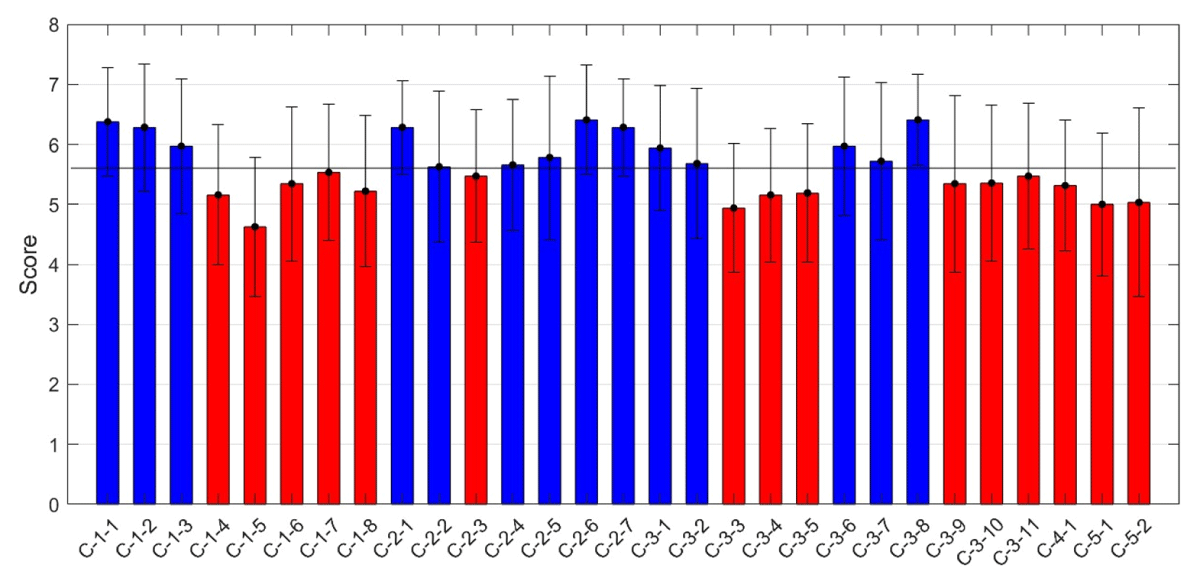
Figure 1
Response score for elements of ‘C Sustainability and Governance’ category.
Table 9
Response average and priority for elements of ‘C Sustainability and Governance’ category.
| REQUIREMENT | ELEMENT | AVERAGE SCORE | OBLIGATION | |
|---|---|---|---|---|
| C-1 Rights, License and Copyright | 1 | Provide information about licensing and permissions ideally in machine-readable form. | 6.38 | Mandatory |
| 2 | Ensure confidentiality and rights of data subjects and creators. | 6.28 | Mandatory | |
| 3 | Allow open access to material, with an optional embargo period. | 5.97 | Mandatory | |
| 4 | Offer managed access through group membership. | 5.16 | Optional | |
| 5 | Support granular access to different parts of dataset collections. | 4.63 | Optional | |
| 6 | The resources in the repository are available at no cost to the user. | 5.34 | Optional | |
| 7 | Provide different access rights for groups and individuals (roles) on collections and allow the import of such concepts (e.g., from identity management systems). In the case of confidential or proprietary data, authenticate every access and authorize every operation. | 5.53 | Optional | |
| 8 | Provide single sign-on and/or support for different authentication methods. | 5.22 | Optional | |
| C-2 Preservation and Sustainability | 1 | Support long-term preservation of data and metadata. | 6.28 | Mandatory |
| 2 | The repository collects basic preservation metadata including provenance, date of upload, and file format. | 5.63 | Mandatory | |
| 3 | The metadata and the resources in the repository can be copied or migrated to other systems. | 5.47 | Optional | |
| 4 | At least one copy of the repository contents is stored in a different location than the original repository. | 5.66 | Mandatory | |
| 5 | The agreement between depositor and repository provides for all actions necessary to meet preservation responsibilities—for example, rights to copy, transform, and store the items. | 5.78 | Mandatory | |
| 6 | Ensure persistence of metadata and data. | 6.41 | Mandatory | |
| 7 | Files need to be converted to the most accessible formats. | 6.28 | Mandatory | |
| C-3 Policy Support and Repository Coverage | 1 | Data policies are used to define what happens when to which dataset. For example, for processing and quality control, regularly enforced policies are helpful. | 5.94 | Mandatory |
| 2 | Policy enforcement points: Control all operations with administrator-defined rules. | 5.68 | Mandatory | |
| 3 | The higher-level subject areas/disciplines that the repository covers, as well as cross-disciplinary domains, such as the types of data, technology, and study. | 4.94 | Optional | |
| 4 | The repository provides public documentation that outlines the scope of the resources accepted in the repository. | 5.16 | Optional | |
| 5 | The life cycle status of the repository: Is it still being developed or is it in production and accepting data submissions? The latter does not exclude that some (re)development, enhancement, or maintenance may be ongoing, as happens in any repository. | 5.19 | Optional | |
| 6 | Be transparent about mission, scope, preservation policies, and plans (including governance, financial sustainability, retention period, and continuity plan). | 5.97 | Mandatory | |
| 7 | The repository has a digital preservation plan that states the duration of time that the resources will be managed for, identifies roles, and documents procedures for the preservation of different resource formats. | 5.72 | Mandatory | |
| 8 | The repository has a business continuity plan that details the response and procedures in case of natural disasters or cyber-attacks. | 6.41 | Mandatory | |
| 9 | Plan that gives information about sustainability plans for the repository: Does the repository have a webpage or document that describes these? | 5.34 | Optional | |
| 10 | The repository provides documentation or has a policy outlining what curation processes are applied to the resources and the metadata. | 5.35 | Optional | |
| 11 | The repository is included in one or more disciplinary or general registry of repositories. | 5.48 | Optional | |
| C-4 Repository Certification | 1 | Certification schemes and/or community badges that assess certain aspects of the repository (e.g., its fitness, trustworthiness, adoption): Does the repository have any? | 5.31 | Optional |
| C-5 Funding | 1 | The type of funding (e.g., grants, donations, memberships) and the organization(s) that fund the repository. | 5.00 | Optional |
| 2 | The repository (or organization that manages the repository) has a long-term plan for managing and funding the repository. | 5.03 | Optional | |
Table 10
Comprehensive evaluation criteria for data repositories.
| CATEGORY | REQUIREMENTS | ELEMENTS | SOURCE | OBLIGATION | |
|---|---|---|---|---|---|
| A Data Access and Retrieval | A-1 Metadata | 1 | Support various types of metadata. | RDA | Mandatory |
| 2 | Ensure that metadata are machine-retrievable. | Science Europe | |||
| 3 | Provide information that is publicly available and maintained, even for non-published, protected, retracted, or deleted data. | Science Europe | Optional | ||
| A-2 Access and Retrieval | 1 | Include a link to each resource on its respective landing page in the repository. | COAR | Mandatory | |
| 2 | Enable linking between related contents in the metadata record, such as preprints, published articles, data, and software. | COAR | |||
| 3 | Allow data providers to choose the access level for data (e.g., Open Access). | RDA | |||
| 4 | Enable data or at least metadata retrieval using an open and standardized protocol. | Science Europe | |||
| 5 | Permit local download of selected information. | RDA | |||
| 6 | Support the use of controlled vocabularies in metadata records. | COAR | Optional | ||
| 7 | Facilitate indirect access to restricted resources (e.g., by contacting the author). | COAR | |||
| 8 | Allow data-depositing users to select an embargo date. | RDA | |||
| 9 | Provide a tombstone page for withdrawn resources, ensuring the metadata record remains publicly available. | COAR | |||
| 10 | Offer support to users during or after submission with a contact point (e.g., helpdesk email or contact form) to assist data depositors and users. | FAIR sharing | |||
| B Permanent Identifier | B-1 Permanent Identifier | 1 | Assign a PID/DOI to data and collections during data ingestion or ‘project publication’ time or earlier (e.g., when a paper is submitted but the data are not final yet). Ensure that the PID resolves the research data’s ‘landing page,’ displaying the required descriptive metadata during the embargo period, and establish a clear transition from PID collections to a DOI. | RDA | Mandatory |
| 2 | Integrate all data management activities with PID management. Ensure that PID metadata is always synchronized with the data/metadata holdings. | RDA | |||
| 3 | Ensure that PIDs are included in the corresponding metadata. | Science Europe | |||
| 4 | Consistently assign PIDs (e.g., DOI, URN, ARK) to the data, allowing the corresponding data and metadata to be found, referred to, and retrieved, even if the storage location changes. | Science Europe | |||
| 5 | Support PIDs for authors, funders, institutions, funding programs, and other relevant entities. | COAR | Optional | ||
| 6 | Ensure that metadata information can declare links to other relevant or associated information by providing the PID and a description of the scientific relation, including details of the associated researcher, with permanent research IDs (e.g., ORCID, ISNI, DAI). | Science Europe | |||
| C Sustainability and Governance | C-1 Rights, License and Copyright | 1 | Provide information about licensing and permissions, ideally in machine-readable form. | Science Europe | Mandatory |
| 2 | Ensure confidentiality and rights of data subjects and creators. | Science Europe | |||
| 3 | Allow open access to material, with an optional embargo period. | DSpace | |||
| 4 | Offer managed access through group membership. | DSpace | Optional | ||
| 5 | Support granular access to different parts of dataset collections. | DSpace | |||
| 6 | Ensure that resources in the repository are available at no cost to the user. | COAR | |||
| 7 | Provide different access rights for groups and individuals (roles) on collections, allowing the import of such concepts (e.g., from identity management systems). Authenticate every access and authorize every operation for confidential or proprietary data. | RDA | |||
| 8 | Provide single sign-on and/or support for different authentication methods. | RDA | |||
| C-2 Preservation and Sustainability | 1 | Support long-term preservation of data and metadata. | DSpace | Mandatory | |
| 2 | Collect basic preservation metadata, including provenance, date of upload, and file format. | COAR | |||
| 3 | Store at least one copy of the repository contents in a different location than the original repository. | COAR | |||
| 4 | Ensure that the agreement between depositor and repository provides for all actions necessary to meet preservation responsibilities (e.g., rights to copy, transform, and store the items). | COAR | |||
| 5 | Ensure persistence of metadata and data. | Science Europe | |||
| 6 | Convert files to the most accessible formats. | RDA | |||
| 7 | Ensure that metadata and resources in the repository can be copied or migrated to other systems. | COAR | Optional | ||
| C-3 Policy Support and Repository Coverage | 1 | Use data policies to define what happens to which dataset, enforcing policies regularly for processing and quality control. | RDA | Mandatory | |
| 2 | Implement policy enforcement points to control all operations with administrator-defined rules. | RDA | |||
| 3 | Be transparent about mission, scope, preservation policies, and plans (including governance, financial sustainability, retention period, and continuity plan). | Science Europe | |||
| 4 | Have a digital preservation plan that states the duration of time that the resources will be managed for, identifies roles, and documents procedures for the preservation of different resource formats. | COAR | |||
| 5 | Maintain a business continuity plan detailing the response for various scenarios. | COAR | |||
| 6 | Specify the higher-level subject areas/disciplines that the repository covers, including cross-disciplinary domains, types of data, technology, and study. | FAIR sharing | Optional | ||
| 7 | Provide public documentation outlining the scope of the resources accepted in the repository. | COAR | |||
| 8 | Indicate the life cycle status of the repository: whether it is still being developed or is in production and accepting data submissions. | FAIR sharing | |||
| 9 | Provide information about sustainability plans for the repository, such as a webpage or document describing these. | FAIR sharing | |||
| 10 | Document or have a policy outlining the curation processes applied to resources and metadata. | COAR | |||
| 11 | Ensure that the repository is included in one or more disciplinary or general registry of repositories. | COAR | |||
| C-4 Repository Certification | 1 | Obtain certification schemes and/or community badges that assess certain aspects of the repository (e.g., fitness, trustworthiness, adoption). | FAIR sharing | Optional | |
| C-5 Funding | 1 | Specify the type of funding (e.g., grants, donations, memberships) and the organization(s) that fund the repository. | FAIR sharing | Optional | |
| 2 | Ensure that the repository (or managing organization) has a long-term plan for managing and funding the repository. | FAIR sharing | |||
| D Data Curation and Citation | D-1 Curation of Data | 1 | Maintain a permanent history of versions for all data. | RDA | Mandatory |
| 2 | Ensure that the version of the data stored in the repository is clearly specified and documented via a permanent audit trail for provenance tracing. | Science Europe | |||
| 3 | Support the revision of metadata and versioning of resources. | COAR | |||
| 4 | Incorporate a formal contract regarding upload and storage, including a data transfer agreement in the system workflow. | DSpace | |||
| 5 | Handle staged content, including submission states that are raw, processed, curated, and published. | RDA | Optional | ||
| 6 | Provide an easy-to-use ingest process with minimal barriers to participation. | RDA | |||
| 7 | Define a submission/ingest workflow. | RDA | |||
| 8 | Perform review and annotation of data, ensuring that a set of minimum curation steps are applied to the submitted data. | FAIR sharing | |||
| 9 | Provide a webpage or document describing the type of curation done. | FAIR sharing | |||
| 10 | Register workflows as executable objects and track the provenance of each workflow execution. | RDA | |||
| 11 | Define data access mechanisms and terms at the repository and/or dataset level, outlining the process for requesting and granting access. | FAIR sharing | |||
| 12 | Provide different versions of a dataset. | RDA | |||
| D-2 Data Citation | 1 | Display bibliographic citations for data and allow exporting bibliographic data to citation software (e.g., EndNote, Citavi, Zotero). | RDA | Mandatory | |
| 2 | Ensure that citations provide recognition and updates from others utilizing the data for experiments or other purposes. | RDA | |||
| 3 | Make metadata in the repository available for download in a standard bibliographic format at no cost to the user. | COAR | Optional | ||
| E User Interface and System Support | E-1 User Interface | 1 | Support a responsive, mobile-friendly user interface. | COAR | Mandatory |
| 2 | Provide interfaces (APIs) for automated task execution, such as data ingestion or integration with data analysis tools and other external applications. | RDA | |||
| 3 | Ensure that scientific terms are consistent for future reuse via a vocabulary service. | RDA | |||
| 4 | Provide data access statistics using external analytics services or internal monitoring of user activity. | RDA | |||
| 5 | Offer sophisticated search capabilities for metadata and data, including full-text search and schema-specific search for both humans and computers. | RDA | |||
| 6 | Ensure access to documentation and metadata for individuals. | COAR | |||
| 7 | Allow the creation of special collection views or digital exhibitions. | RDA | Optional | ||
| 8 | Enable fast data transfer, ingestion, and export. | RDA | |||
| 9 | Support data and metadata collection with mobile devices. | RDA | |||
| 10 | Allow authorized users to mark content for deletion. | RDA | |||
| 11 | Collect and share usage information using a standard methodology (e.g., number of views, downloads). | COAR | |||
| 12 | Apply a metadata schema to describe contents and provide tools to help data generators complete metadata fields. | DSpace | |||
| 13 | Allow data annotation by the data owner, authorized individuals, or automatic metadata extraction tools. | RDA | |||
| E-2 System Support | 1 | Support metadata harvesting using OAI-PMH. | COAR | Mandatory | |
| 2 | Implement de-identification practices before data upload. | DSpace | |||
| 3 | Ensure that mechanisms are in place to limit access to authorized users only for sensitive research data. | COAR | |||
| 4 | Recommend tools to anonymize sensitive data to enable data sharing. | COAR | |||
| 5 | Provide mechanisms to make very large files available to users outside the normal user interface when file size becomes unwieldy. | COAR | |||
| 6 | Adhere to the most recent version of the W3C Web Content Accessibility Guidelines. | COAR | |||
| 7 | Ensure that the repository is scalable regarding the amount of data. | RDA | |||
| 8 | Use sustainable software systems. | DSpace | |||
| 9 | Record audit trails to track changes to resource metadata and information relationships. | RDA | |||
| 10 | Integrate data and other research outputs into a coherent and consistent discovery and access solution. | RDA | |||
| 11 | Support both individual and bulk uploads in the repository’s submission system. | COAR | |||
| 12 | Apply a primary PID system. | DSpace | |||
| 13 | Require all data to be attributed with handling requirements, including licenses and security parameters. | RDA | |||
| 14 | Support a range of file types and metadata schema for data upload and storage. | DSpace | |||
| 15 | Provide state-of-the-art user interfaces and clients throughout the repository platform’s lifetime, updating features and functionality to meet current researchers’ requirements and expectations. | RDA | Optional | ||
| 16 | Allow open access after web-based self-attestation of the user. | DSpace | |||
| 17 | Offer managed access through application on a case-by-case basis. | DSpace | |||
| 18 | Encapsulate operations in micro-services that can be chained into a workflow. | RDA | |||
| 19 | Provide both single and batch ingest paths to efficiently submit a range of data types and scales. | RDA | |||
| 20 | Allow product developers to update product information within the repository. | RDA | |||
| 21 | Manage data collections and their properties independently of the storage system and resource naming through collection virtualization/logical naming. | RDA | |||
| 22 | Integrate with near-data processing facilities like High Performance Computing to handle large data volumes efficiently, maintaining provenance information. | RDA | |||
| 23 | Build the repository on well-supported, open-source software. | COAR | |||
| 24 | Map access protocol to storage protocol using storage drivers. | RDA | |||
| 25 | Allow authorized individuals to curate materials from distributed locations through remote access management. | RDA | |||
| F Quality Control | F-1 Data Authenticity and Integrity | 1 | Enforce metadata quality evaluation using metrics. | RDA | Mandatory |
| 2 | Perform regular integrity checks of resources to detect unauthorized changes or accidental damage. | COAR | |||
| 3 | Ensure data authenticity and integrity by including detailed provenance information in the metadata. | Science Europe | |||
| 4 | Support quality control in its workflow. | DSpace | |||
| 5 | Undertake lightweight review and enhancement of basic metadata upon submission of resources. | COAR | Optional | ||
| 6 | Record the checksum when a resource is submitted or modified. | COAR | |||
| 7 | Apply security practices to prevent unauthorized manipulation of resources. | COAR | |||
| 8 | Capture a structured stewardship confidence indicator derived from curation status, validation stage, provenance completeness, and workflow review history, rather than a direct scientific quality score. | RDA | |||
| 9 | Maintain a contact person or organization as the FAIRsharing record maintainer for the repository’s description in FAIRsharing, ensuring that the record is claimed and vetted. | FAIR sharing | |||