
Table 1
Overview of the Finna service and metadata coverage.
| ASPECT | COVERAGE |
|---|---|
| Participating organizations | More than 500 Finnish libraries, archives, museums, and other cultural heritage organizations.a |
| Material types | Books, journals, manuscripts, sheet music, sound recordings, audiovisual materials, images, archival descriptions, maps, museum objects, and electronic publications. |
| Access methods | Finna web interface, REST API, and OAI-PMH services. |
| Searchable metadata fields | More than 18 searchable metadata fields are available through the Advanced Search interface, including title, author, subject, description, classification, identifier, publisher, publication year, and media type.b |
| Metadata richness | OAI-PMH harvesting supports multiple metadata schemas (e.g., MARC21, Dublin Core, LIDO, and EAD), ranging from relatively compact schemas with fewer than 20 core elements (e.g., Dublin Core) to highly detailed schemas containing hundreds of metadata fields and subfields (e.g., MARC21). |
| Limitations | Coverage varies across institutions and collections; some records and digital objects are restricted by copyright, licensing, or institutional policies. |
[i] a Complete list of participating organizations: https://www.finna.fi/Content/organisations.
b Complete list of searchable metadata fields: https://www.finna.fi/Search/Advanced.
Table 2
Major collections accessible through the National Library’s Finna service.
| COLLECTION | DESCRIPTION | RECORDS |
|---|---|---|
| Vaari | National Repository Library holdings, including monographs, serials, dissertations, and Braille materials. | 10,480,618 |
| Arto | Bibliographic database of Finnish journal and monograph articles. | 2,328,020 |
| Fennica | Finnish National Bibliography covering books, serials, maps, audiovisual materials, and electronic publications relating to Finland. | 1,323,790 |
| Helka | Research library collections from the University of Helsinki and partner institutions. | 1,232,098 |
| Viola | Finnish national discography and national bibliography of sheet music. | 1,162,875 |
| Humaniora | Humanities and social sciences research literature and reference collections. | 766,898 |
| Slavica | Slavonic Library collections supporting research on Russia and Eastern Europe. | 255,026 |
| Journal.fi | Finnish scholarly journals and annual publications. | 103,362 |
[i] Collection descriptions and record counts were obtained from the National Library of Finland collection description and collection search services (National Library of Finland, 2026a, b).

Figure 1
Schematic diagram for finna package and Finna-API interaction. The package retrieves metadata records from the Finna-API and supports downstream processing in the R statistical environment. The package enables structured, reproducible access to Finnish cultural heritage metadata.
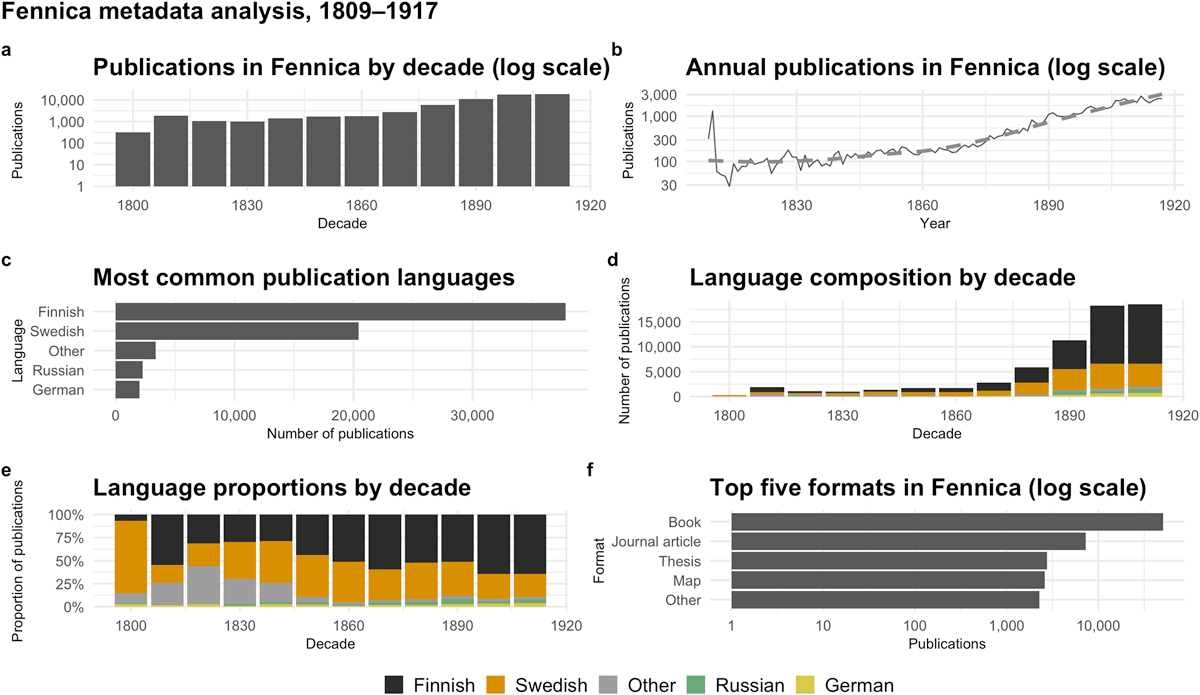
Figure 2
Fennica metadata analysis (1809–1917). Top row: Publication volume trends by decade and annually. Middle row: Language distribution (total counts, temporal shifts, proportional changes). Bottom row: Top publication formats.
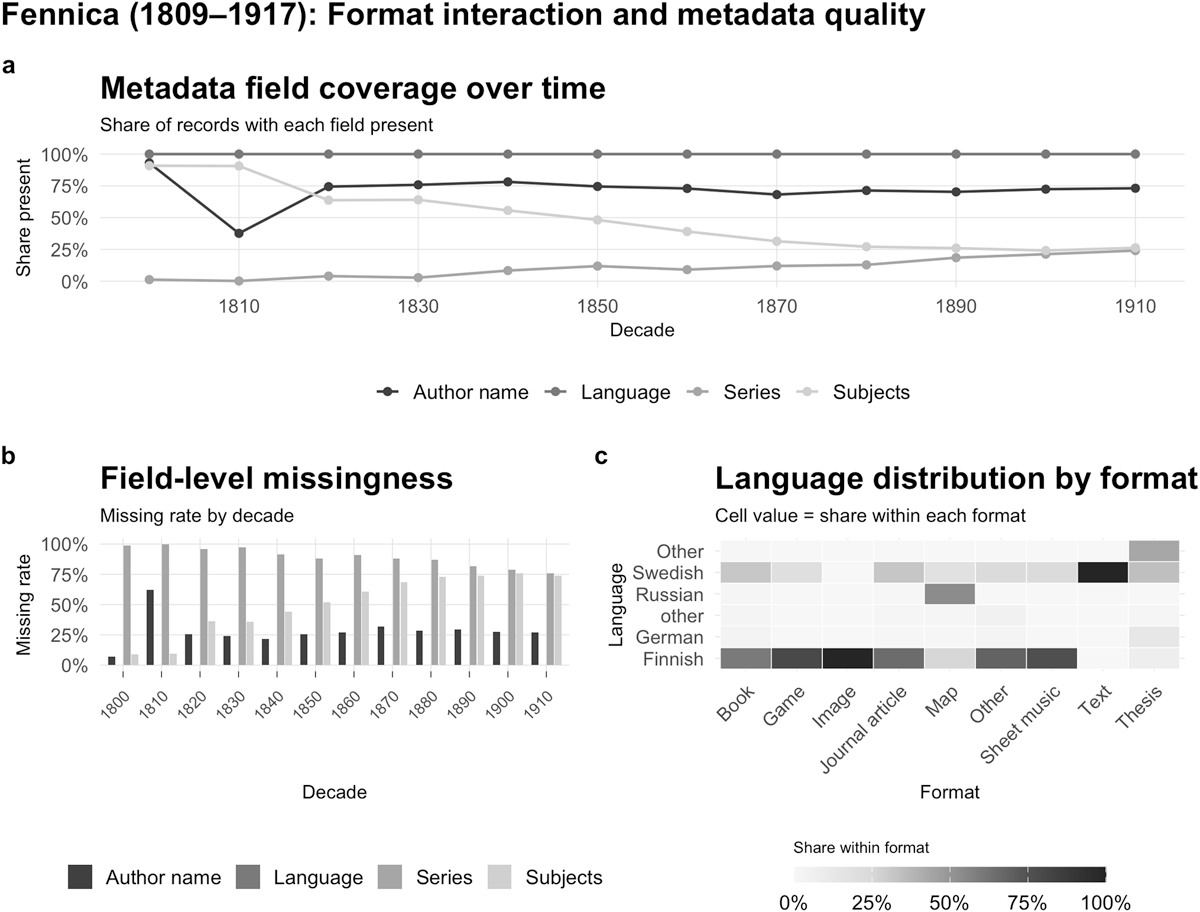
Figure 3
Fennica (1809–1917): Format interaction and metadata quality. (a) Share of records per decade with Language, Author, Subjects, and Series fields present; dashed lines indicate LOESS trends. Language information is consistently near-complete, while subject coverage declines markedly over the century and series coverage gradually increases. (b) Field-level missingness by decade, showing complementary patterns to panel A, with high and persistent absence of series information and increasing subject gaps in later decades. (c) Distribution of publication languages across major formats (lumped categories); cell values represent the share within each format. Finnish dominates most textual formats, while language composition varies across material types such as maps and sheet music.
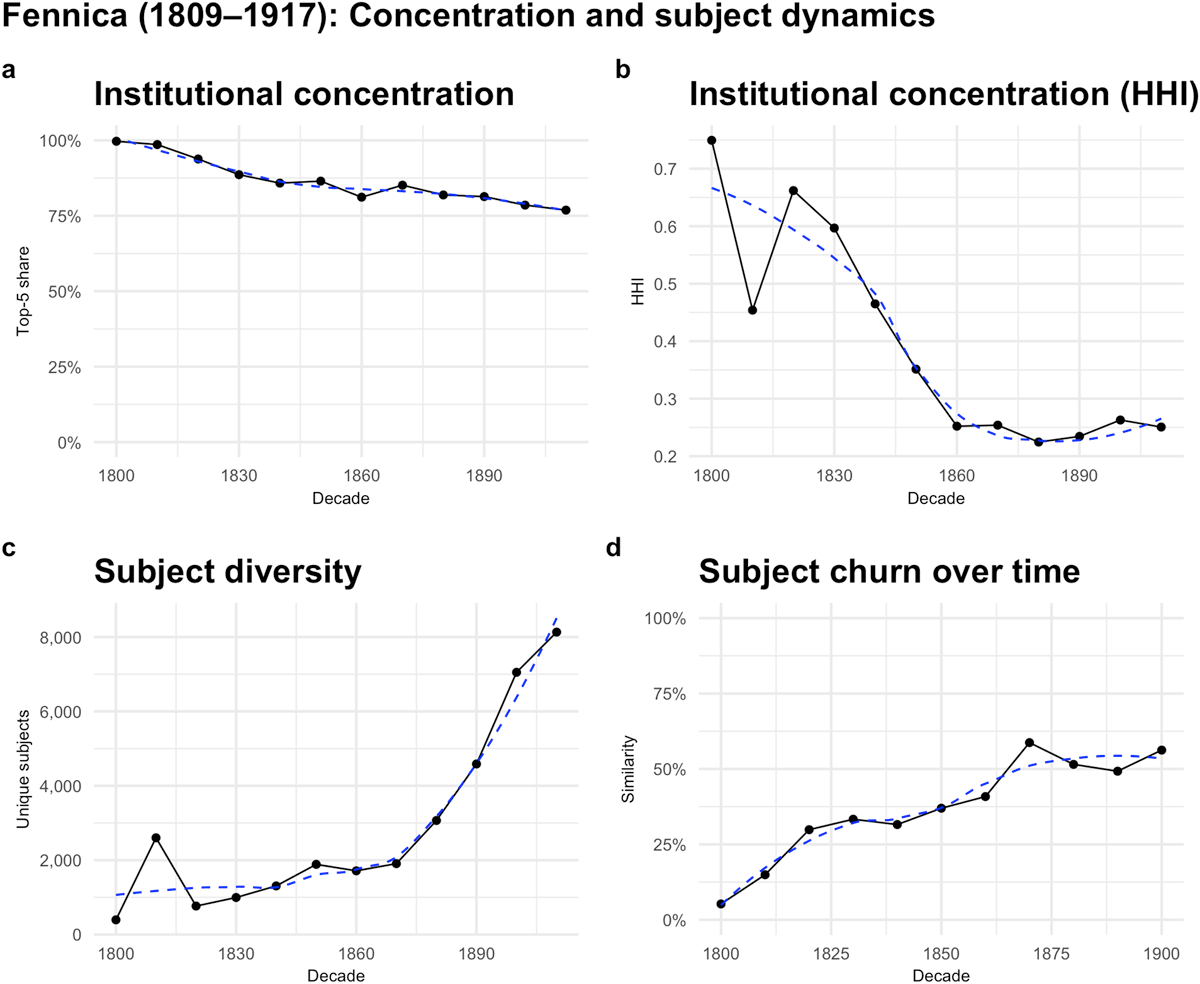
Figure 4
Fennica (1809–1917): Concentration and subject dynamics. (a) Share of records contributed by the five largest libraries per decade, showing a gradual decline in institutional concentration over time. (b) Herfindahl–Hirschman Index (HHI) of library shares, confirming decreasing concentration and subsequent stabilization at lower levels. (c) Number of unique subject labels per decade, indicating strong growth in thematic diversity toward the late nineteenth century. (d) Jaccard similarity between top-50 subject sets in consecutive decades, showing increasing stability of dominant subject categories. Black points and solid lines show observed values; blue dashed lines indicate LOESS smoothing.
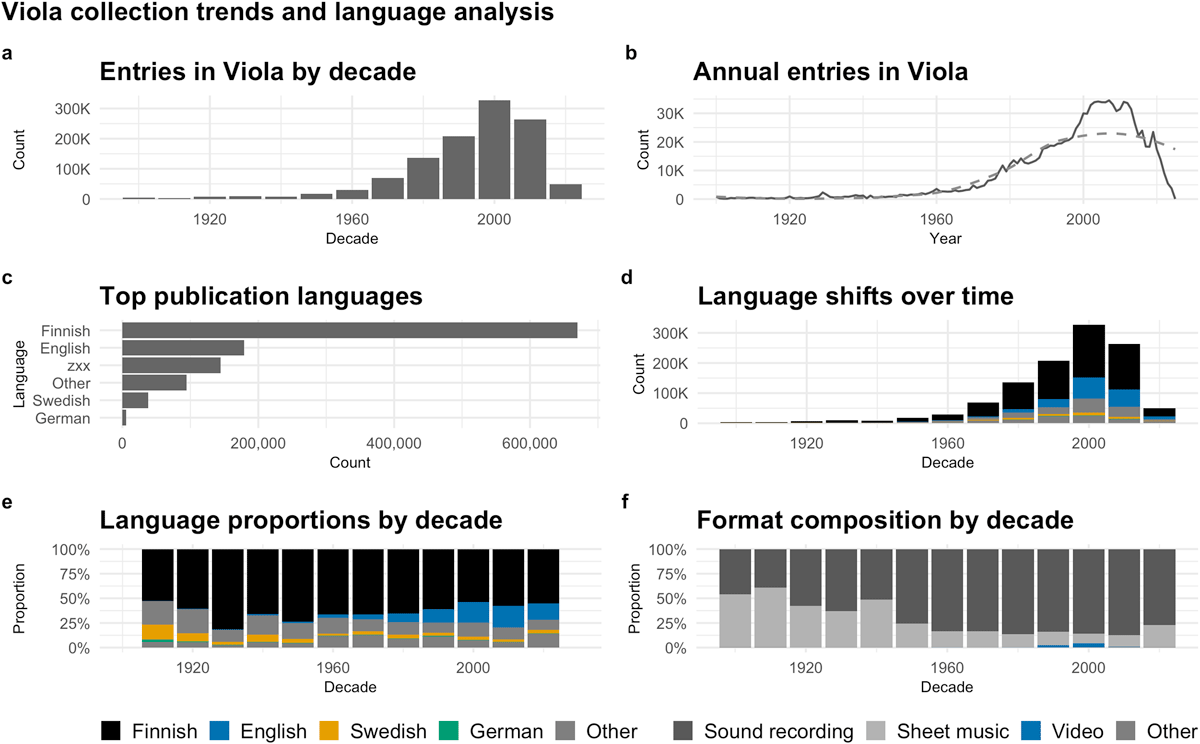
Figure 5
Trends and language composition in the Viola collection. (a) Number of records by decade (1900–2025). (b) Annual record counts with a smoothed trend line. (c) Most common publication languages. (d) Changes in publication language counts across decades. (e) Relative language composition by decade across the full temporal coverage of the collection. (f) Proportional distribution of sound recordings and sheet music by decade.
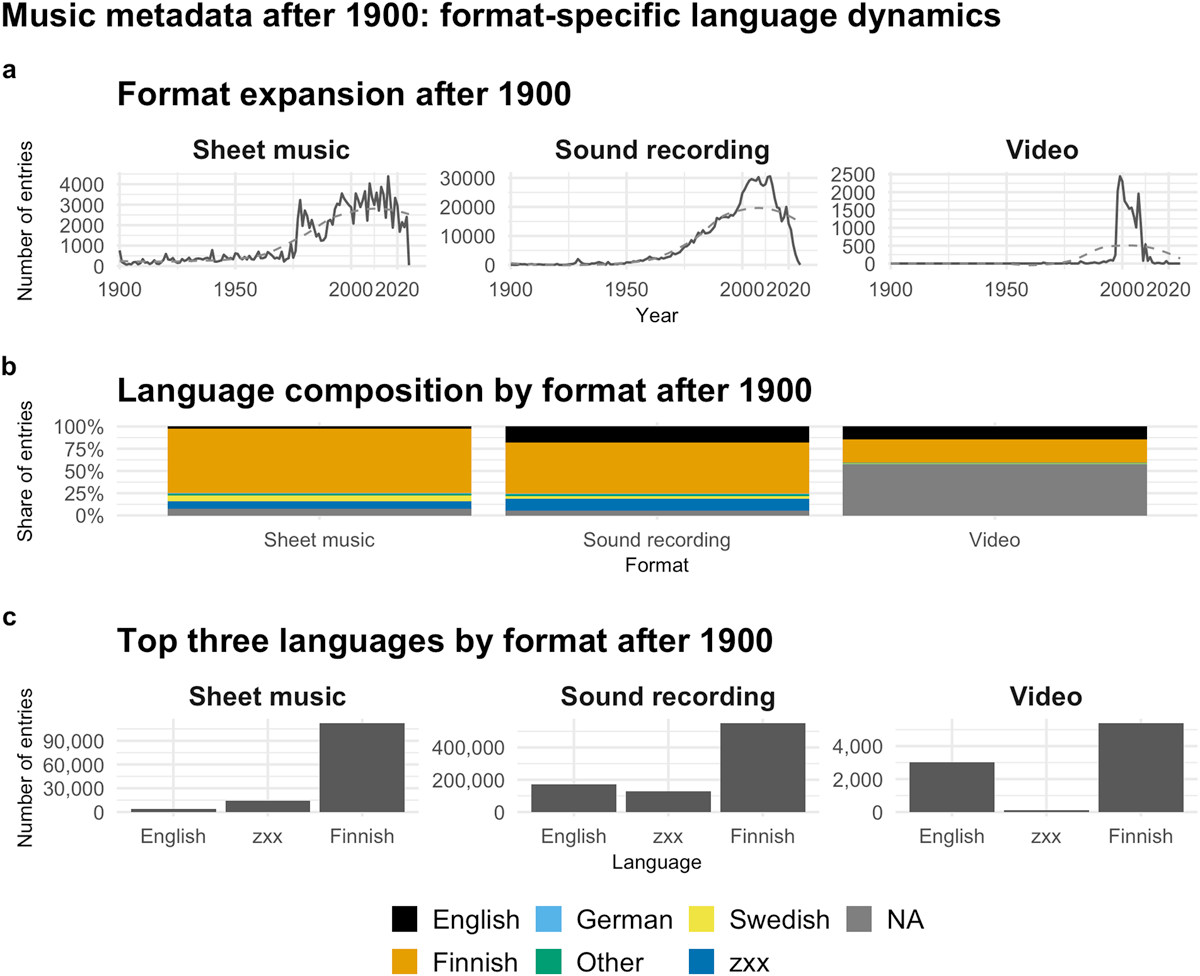
Figure 6
Music metadata after 1900: format-specific language dynamics in the Viola collection. (a) Annual growth of sheet music, sound recordings, and video. (b) Overall language composition within each format. (c) Absolute counts of the three most frequent languages per format.