
1. Introduction
Open science practices are fostered by institutions and research funders as a way of making research more collaborative, transparent and accessible to the public. Among these practices we find the effort to make research data useful for reuse. To achieve this goal, the FAIR principles were developed (Wilkinson et al., 2016) and consolidated (Jacobsen et al., 2020). These principles emphasise that data should be Findable, Accessible, Interoperable, and Reusable. Implementing these principles with research data promotes accessibility and ensures metadata can be retrieved when data cannot be shared publicly. When managing personal data from research activities, we have encountered the following situation: data cannot be openly shared.
A decade ago, researchers at Harvard proposed the idea of tagging personal data to provide researchers with a tool for determining how to share this kind of data (Bar-Sinai et al., 2016; Sweeney et al., 2015). The project, known as DataTags, was created following relevant US laws, and it would require adaptations to be implemented in other legal frameworks. A year later, Data Archiving and Networked Services (DANS), the Dutch national centre of expertise and repository for research data, began adapting the model (Baxter et al., n.d.; von Stein, 2017) within the European General Data Protection Regulation (GDPR) framework (European Union, 2016). Although this project was never completed, there are certain projects that came out of this idea (Alter et al., 2020; Sansone et al., 2017). It was also the predecessor of ours.
The library at the University of Barcelona, known as CRAI (Centre de Recursos per l’Aprenentatge i la Investigació), currently provides support to manage research data, especially in developing data management plans and in publishing data in the consortium repository, CORA.RDR (Catalan Open Research Area, Repositori de Dades de Recerca). Until now, this repository has not allowed the deposit of personal data, and researchers often ask how to manage and store personal data safely. These were the two main reasons for developing the current work and continuing what DANS started, inspired by the American DataTags. Initially we used the GDPR as the legal foundation to build our tools, but when we invited the Data Protection Office to be part of our project, we focused on the application of the GDPR in Spain specifically because the national law of each EU Member State may apply GDPR differently. The GDPR allows EU Member states to supplement its provisions, as Spain did through Organic Law 3/2018 of 5 December, on Personal Data Protection and the Guarantee of Digital Rights (LOPDGDD) (Spain, 2018).
This work can be divided into two key phases. The first phase involved designing a decision tree (see Figure 1) and defining the data tags, providing researchers with a practical tool to assess the nature of the data they handle. This phase also demonstrated that the FAIR principles could still be upheld even when certain data must remain restricted due to security and privacy concerns. The decision tree serves to uphold the principle of ‘as open as possible, but as closed as necessary,’ challenging the misconception that non-open data cannot adhere to the FAIR principles. We try to show that open science must be done responsibly and when sensitive data should be restricted if necessary. The second phase focused on the implementation of the necessary security and precautionary measures in research data repositories. Our next step is to work on integrating these data tags into CORA.RDR, ensuring that the appropriate safeguards are in place to protect sensitive data while maintaining its accessibility for research purposes.
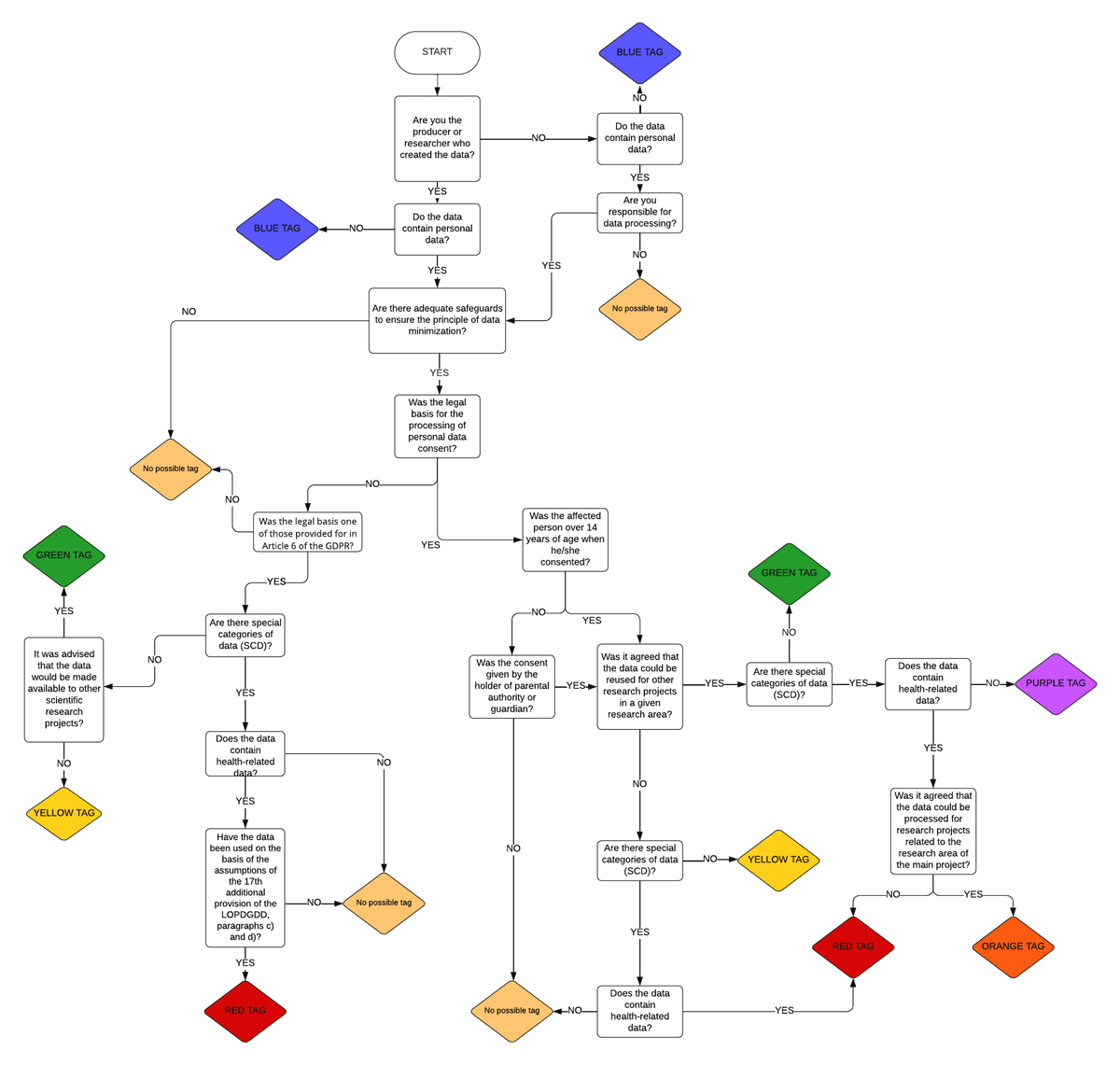
Figure 1
Decision tree for the classification of personal data. This diagram guides researchers and depositors in assigning tags to datasets containing personal data based on their conditions for reuse and compliance with the GDPR and Spanish law. The colour-coded tags (blue, green, yellow, orange, purple and red) indicate different legal bases and limitations for the secure storage, access and reuse of the data in research contexts.
2. Legal Framework
The main legal framework for the protection of personal data, including in research, is the GDPR. Though it sets a very high standard for data protection, it also contains important provisions that accommodate the unique needs of scientific research and balance the protection of personal data with the advancement of knowledge.
One of the important features of the GDPR, in research, is its flexibility. Article 9 explicitly recognises the importance of scientific research and allows the processing of special categories of personal data, under certain conditions, without explicit consent. For instance, personal data may be processed when research is in the public interest, provided that appropriate safeguards, such as pseudonymisation or anonymisation, are implemented to reduce risks for individuals. The GDPR also allows personal data collected for one purpose to be reused for compatible research purposes, provided that such use respects the principles of data minimisation and purpose limitation, as outlined in Article 5.
The GDPR specifically addresses special categories of data in Article 9. These include data revealing racial or ethnic origin, political opinions, religious or philosophical beliefs, or trade union membership, as well as the processing of genetic data, biometric data for the purpose of uniquely identifying a natural person, data concerning health, or data concerning a natural person’s sex life or sexual orientation. The processing of such data is generally prohibited unless specific conditions are met, such as obtaining explicit consent from the data subject or if the processing is necessary for scientific research purposes based on Union or Member State law, subject to appropriate safeguards to protect the rights and freedoms of the data subjects.
In Spain, the GDPR is complemented by LOPDGDD, which fills critical gaps and introduces more flexible measures in certain areas. The LOPDGDD tailors the GDPR to the Spanish context, providing detailed regulations for processing health data in scientific research.
The LOPDGDD aligns with the GDPR by allowing the processing of health data for research without explicit consent under specific conditions, such as when the research is carried out in the public interest. However, it imposes additional safeguards, including stricter requirements for pseudonymisation, encryption and access control. Moreover, the LOPDGDD mandates that data protection impact assessments (DPIAs) be conducted for research projects involving sensitive data in the cases laid down by Article 35 of Regulation (EU) 2016/679 or in those established by the supervisory authority.
One area where the LOPDGDD introduces further specificity is in the retention and reuse of data for research purposes. While the GDPR allows data to be reused for compatible purposes, the LOPDGDD explicitly requires that researchers establish clear protocols for ensuring compliance with data minimisation and proportionality principles. It also defines additional restrictions for certain types of research data, requiring explicit legal or ethical justifications to override the rights of individuals.
Recent European regulatory developments such as the Data Governance Act (European Union, 2022) are highly relevant to the broader debate on data reuse and governance. However, their direct applicability to the framework proposed in this study requires careful examination. Chapter II of the DGA regulates the reuse of certain categories of protected data held by public sector bodies. Nevertheless, Article 3(2)(c) explicitly excludes from its scope ‘data held by cultural establishments and educational establishments.’ Given that universities fall within the category of educational establishments, the provisions of Chapter II are not applicable to the context addressed in this work.
Chapter III of the DGA establishes requirements for data intermediation services, which could, at first glance, appear relevant to non-commercial research data repositories. Article 2(11)(d) includes within this concept data sharing services offered by bodies that do not aim to establish commercial relationships. However, Recital 29 of the DGA clarifies that repositories whose purpose is to enable the reuse of scientific research data in accordance with open access principles should not be considered data intermediation services within the meaning of the Regulation. Consequently, the framework presented in this study does not fall under the scope of Chapter III of the DGA.
With regard to the European Health Data Space (EHDS) Regulation, it should be noted that its application has been deferred until 26 March 2027, with several provisions becoming applicable at a later stage. Furthermore, key aspects related to the secondary use of health data require further development at the national level by EU Member States. In the absence of implementing national legislation and authoritative guidance from competent bodies, it is not yet possible to adequately assess the concrete impact of the EHDS Regulation on the framework proposed in this study. For this reason, the EHDS has not been incorporated into the present analysis.
3. Methods and Procedures
The reason for developing this work was first the need for a standardised procedure that facilitates the reuse of research data in contributing to responsible open science, in which the guarantee of privacy rights would go hand in hand with compliance with the FAIR principles. We therefore set out to investigate works that had been previously discussed in Harvard and DANS, and to implement their projects based specifically on the Spanish legal framework. The development of the labels went hand in hand with the development of the decision tree (see Figure 1). This was a process of optimisation of both parts (tags and tree), which has resulted in a tree with a total of seven possible outcomes. This study seeks to answer two key research questions: what criteria are used in the labelling system to classify data based on its sensitivity, and what specific consequences and precautions must be taken according to the assigned tag? To address these issues, a decision tree (see Figure 1) based on GDPR and LOPDGDD, and an outline (see Table 1) of the consequences and precautions associated with each type of tag were created during the development of the project. The procedure for the user of the tool consists of reviewing the decision tree to analyse how tags are assigned based on issues related to the nature of the data and their legal use, as well as examining a table of consequences to identify recommended actions and precautions for each type of data tag.
Table 1
The blue to red model for tags categorises datasets based on their risk levels. Datasets with no associated risks fall under the blue tag, while increasing risk levels demand stricter data protection measures and more complex safeguards, with the red tag assigned to datasets of the highest sensitivity and risk.
| TAG TYPE | IDENTIFICATION AND AUTHENTICATION | READ AND DOWNLOAD PERMISSIONS |
|---|---|---|
| Blue | Not necessary | Public access without authentication |
| Green | Registration to the repository is required Implementation of access controls (username and password, certificate, second-factor authentication) Assigned roles with privilege differentiation | Access by registered users In the case of downloading documentation, encrypted with a password |
| Yellow | Registration to the repository and approval by the data depositor is required Implementation of access controls (username and password, certificate, second-factor authentication) Assigned roles with privilege differentiation | Registered users can access the data after authorisation of the depositor In the case of downloading documentation, encryption with a password |
| Orange | Registration to the repository and approval by the data depositor is required Implementation of access controls (username and password, certificate, second-factor authentication) Assigned roles with privilege differentiation Validation according to source IP | Registered users can access the data after authorisation of the depositor In the case of downloading documentation, encryption with a password |
| Purple | Registration to the repository and approval by the data depositor is required Implementation of access controls (username and password, certificate, second-factor authentication) Assigned roles with privilege differentiation Validation according to source IP | Registered users can access the data after authorisation of the depositor In the case of downloading documentation, encryption with a password |
| Red | Registration to the repository and approval by the data depositor is required Implementation of access controls (username and password, certificate, second-factor authentication) Assigned roles with privilege differentiation Validation according to source IP | Access to protected data without permission to download |
| TAG TYPE | STORAGE AND TRANSMISSION | KEY STORAGE |
| Blue | Unencrypted | N.A. |
| Green | Storage: simple encryption Transmission: simple encryption Use secure encryption algorithms | Encryption key stored separately from repository data |
| Yellow | Storage: simple encryption Transmission: simple encryption Use secure encryption algorithms | Encryption key stored separately from repository and depositor data |
| Orange | Storage: double encryption Use secure encryption algorithms | One key is stored separately from the data by the repository, and the other key is stored by a trusted third party |
| Purple | Storage: double encryption Use secure encryption algorithms | One key is stored separately from the data by the repository, and the other key is stored by a trusted third party |
| Red | Storage: double encryption Use secure encryption algorithms | One key is stored separately from the data by the repository, and the other key is stored by a trusted third party |
In order to develop the decision tree in a coherent manner, we knew that we first had to separate the data into three large blocks and then examine whether it was necessary to make further distinctions within those blocks. Within each of the three main categories of data, a fine-grained labelling logic was developed to reflect the range of legal obligations and technical safeguards required by both the GDPR and the Spanish LOPDGDD:
Block of non-personal data: This group is made up of datasets that do not contain any identifiable or re-identifiable information. As no person can be linked to the content, no additional restrictions will apply to the processing. Consequently, a single label – blue – was assigned to represent full openness and unrestricted reuse of data that did not require authentication or encryption measures.
Block of personal data but not sensitive: For the data classed as ‘personal’ under Article 4 of the GDPR, but not belonging to special categories, multiple ranges were needed to reflect different conditions of reuse. The green label corresponds to cases where informed consent explicitly allows reuse for compatible research purposes; therefore, access to authenticated users can be granted under standard security measures. The yellow label represents sets of personal data that lack explicit consent for their reuse, but for which the data controller may still authorise secondary use under the principle of compatibility (Art. 5(1)(b) and Recital 50 GDPR). This distinction was introduced to operationalise the legal difference between reuse based on prior consent and reuse based on compatibility assessment, a key element of compliance when managing research data repositories.
Special categories of the personal data block: The data in Article 9 of the GDPR and the LOPDGDD required the most detailed differentiation. Two subgroups were created according to the nature of the data and the conditions of consent. For data related to health or genetics, the orange label is applied when reuse is allowed only within a defined medical or research speciality, in accordance with Additional Provision 17(2)(a) of the LOPDGDD. The red label, on the other hand, denotes datasets of the same nature, but without consent for their reuse, requiring dependence on an alternative legal basis such as public interest in scientific research (Section 2a of Additional Provision 17a of the LOPDGDD (c–d), according to Art. 9(2)(j) GDPR). For other special categories of data (e.g., ideology, religion, sexual orientation), the purple label reflects the logic of the orange label, applying when reuse is allowed only for specific research areas under conditional consent according to Recital 33 GDPR.
This hierarchical labelling structure allows the model to capture the legal reasoning behind each level of data sensitivity and translate it into the corresponding technical safeguards – authentication, encryption and access control – later detailed in Table 1. The decision to maintain six different labels ensures a balance between legal accuracy and practical usability, avoiding both the sub- and excessive classification of research datasets.
4. Classification Data by Tags
As we aimed to create a useful and efficient tool for research and technical staff involved in data management, we tried to find the optimal point between not having too many questions in the decision tree but just enough to be able to correctly classify the data. Likewise, we used the same idea for the creation of each tag, trying not to generate too large a number of tags with specific characteristics for each, which could become unmanageable or impractical, but to generate a sufficient number to be able to correctly separate different sets of data that would otherwise have to be closed in a more restrictive way. Here is our proposal that guarantees this optimisation:
- Blue tag: Non-personal data.
- Green tag: Personal data. The publication of the dataset needs to indicate (a) whether the participants were informed that the data would be made available to other researchers or (b) whether consent was obtained that the data could be reused for other research projects in a particular research area by indicating this area.
- Yellow tag: Personal data requiring the intervention of the data depositor (we understand data depositor as the person responsible for the processing of the data). The intervention of the data depositor is required to assess whether the reuse complies with Article 5.1b of the GDPR and Recital 50 of the GDPR.
- Orange tag: Personal data relating to health or genetics where consent for reuse is available under certain conditions. Intervention by the data depositor is required to assess whether the reuse complies with Section 2a of Additional Provision 17a of the LOPDGDD, considering the consent given by the subject that the data may be reused for other research projects in a general area linked to a medical or research speciality.
- Purple tag: Special categories of personal data other than those related to health or genetics, where consent for reuse is available under certain conditions. Intervention of the data depositor is required to assess whether the reuse of the data complies with Recital 33 of the GDPR and Article 9.2a of the GDPR, considering the consent given by the subject that the data may be reused for other research projects in a particular area of research.
- Red tag: Personal data relating to health or genetics where consent for reuse is not available. Intervention by the data depositor is required to assess whether the reuse complies with Section 2c or 2d of Additional Provision 17a of the LOPDGDD.
- No tag possible: This is the end of a decision tree that indicates that the nature of the data is so complex that a prior review of the specific case by the Data Protection Officer of each institution is necessary.
The difference between the orange and the purple tag lies in the scope of the consent for reuse given by the participants in the original project. The orange tag refers to medical or research specialities, the purple to other research areas.
The reason for differentiating these two tags was to avoid a message being displayed at the end of the decision tree explaining the two criteria according to the type of data being deposited.
5. Implementation for Research Data Repositories
One of the goals of our work was to implement the model in actual repositories that could provide open metadata while securing access and storage for research personal data according to Article 32 of the GDPR. To ensure that research data repositories comply with data protection regulations and adequately safeguard research data, we have classified the requirements into four key areas. These areas help determine the necessary safeguards and actions based on the sensitivity of the data:
- Identification and authentication: Refers to the process of validating the identity of users accessing the data repository. Depending on the sensitivity of the dataset, authentication may not be required (public access), or more complex systems may be implemented, such as repository registration, passwords, two-factor authentication and even validation by IP address to ensure that only authorised users have access.
- Read and download permissions: Establishes who has the right to view or download data from the repository. This ranges from unrestricted public access to permissions granted exclusively to registered users, who in some cases need explicit approval from the data depositor. For more sensitive data, downloading may be encrypted with passwords or even disabled completely.
- Storage and transmission: Refers to measures to protect data during storage in the repository and during transmission between systems. This ranges from unencrypted data (for low-risk tags) to the use of advanced encryption algorithms and double encryption for sensitive data. Transmission should always be through secure channels, such as encrypted connections, to prevent unauthorised access.
- Encryption key storage: Describes strategies for protecting the keys used to encrypt data. For more sensitive data, the keys must be stored separately from the data in the repository. In highly sensitive cases, a distributed model is implemented, where one key is managed by the repository and another by a trusted third party, ensuring maximum security even in the event of a breach.
While it seems that all measures are the same for the orange and the purple label, the difference is in the organisational measures regarding approval, as the depositor will have to consider different criteria.
As part of the implementation effort, we developed an interactive tool (see Figure 2) that puts the decision tree described in Section 4 into practice and translates it into a classification interface useful for researchers and data managers. The tool is a web-based application that guides users through each question in the decision model, dynamically displaying contextual explanations, legal definitions (e.g., ‘personal data,’ ‘special categories of data’ or the requirements of Article 6 of the GDPR) and references to the relevant provisions of the GDPR and the LOPDGDD. The system processes the user’s responses and automatically assigns one of seven possible labels, displaying the corresponding technical and organisational measures required for that classification. By structuring the decision process into a sequence of conditional nodes, the framework is understandable to non-experts. This practical application demonstrates that the model can be integrated into a repository workflow: the tool can be incorporated into the deposit interface, so that depositors must complete the decision path before uploading a dataset, ensuring that a label is assigned consistently and that the repository records the legal basis and consent conditions necessary for reuse. Although integration into CORA.RDR is still ongoing, the development of this tool offers a concrete demonstration of the framework’s viability and clarifies how it can be applied in real data management work.
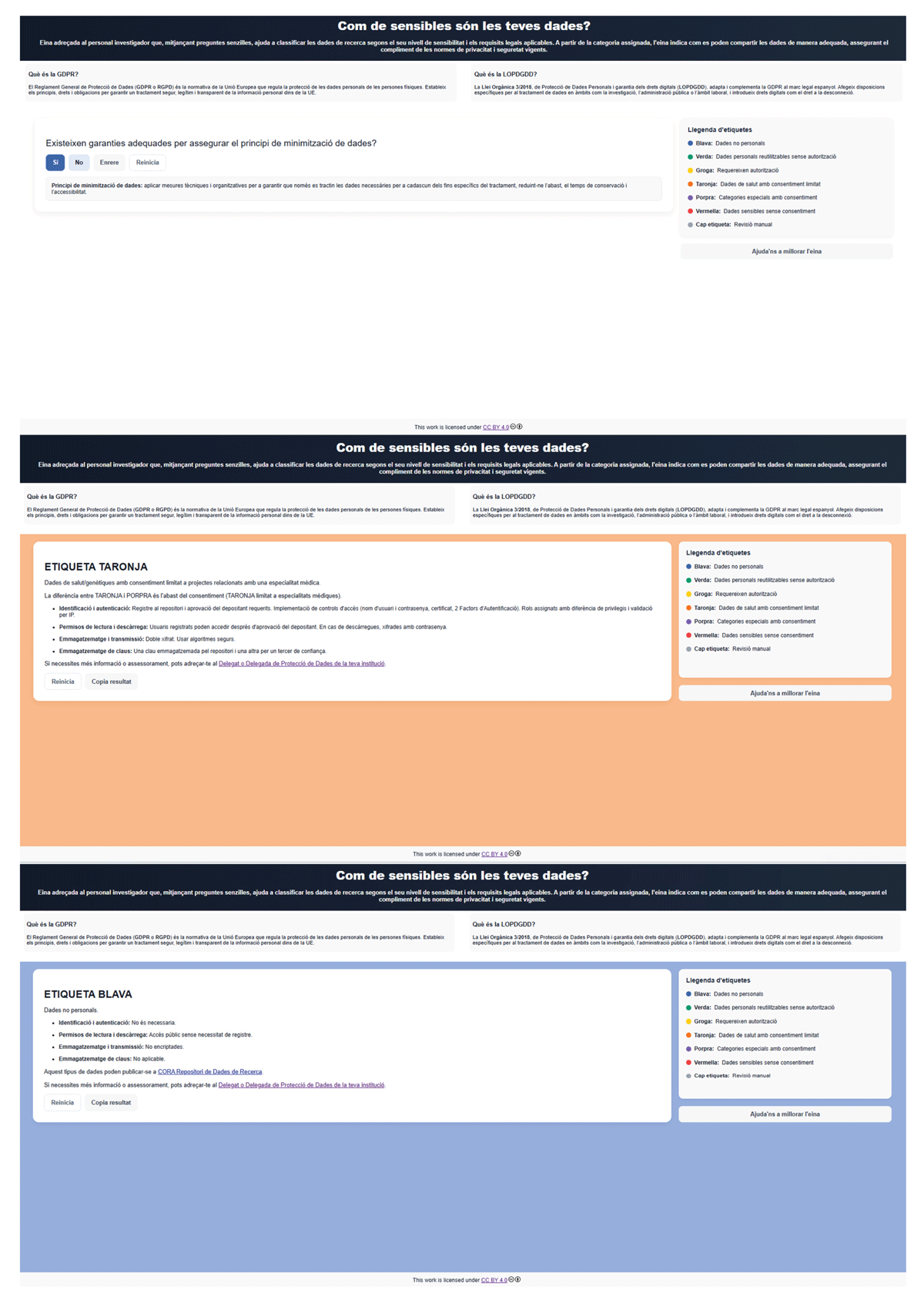
Figure 2
Screenshots of the interactive classification tool developed to operationalise the decision tree. The tool is currently deployed in Catalan for the local research community at the University of Barcelona.
6. Discussion
The classification of research data using data labels offers a practical and compliant solution for managing sensitive data (i.e., special categories of data according to the GDPR). Each tag provides a specific framework to help researchers and data controllers comply with legal and ethical obligations. The implementation of data labels is essential to properly manage the risks associated with the processing of research data. It also provides a standardised methodology that could facilitate future audits and compliance reviews.
The original DataTags project was created with the idea of being implemented in a Dataverse environment. Our consortium repository uses such an environment, and the project has already been presented for its deployment there. We hope in a short period of time it will be available for researchers along with the decision tree. Our aim is to improve the reuse of research data while keeping personal data safe when needed, following the principle of as open as possible and as closed as necessary.
FAIR data and responsible open science are fully compatible with robust security measures, ensuring the protection of sensitive data while enabling data sharing and reuse. The goal of this work is to provide a standardised tool to facilitate the identification, classification and subsequent management of research data. Future work includes integrating this tagging system into CORA.RDR, the University of Barcelona’s research data repository.