
Table 1
Acronyms and Key Terms Used in This Study.
| ACRONYM/TERM | FULL NAME | BRIEF DESCRIPTION |
|---|---|---|
| FAIR | Findable, Accessible, Interoperable, Reusable | Guiding principles for improving the reuse of digital research objects |
| FIP | FAIR Implementation Profile | A structured description of how a community implements FAIR Principles |
| FER | FAIR Enabling Resource | Technical solutions that support FAIR Implementation |
| FIP Wizard | N/A | Web-based tool that supports the collaborative creation and publication of FAIR Implementation Profiles (FIPs) |
Table 2
Definitions of FAIR Rating Levels.
| FAIR RATING | DESCRIPTION |
|---|---|
| Beginning FAIR | FAIR Principles have not yet been adopted in any significant way. There is little to no use of FAIR-related services. This level represents a starting point with substantial room for improvement. |
| Basic FAIR | Some initial FAIR-aligned steps have been taken, but adoption is limited and inconsistent. Only a few practices are in place. |
| Core FAIR | A solid foundation of FAIR implementation exists. Many important elements are implemented, though several areas still need attention. Indicates a clear commitment to FAIR. |
| Advanced FAIR | FAIR Principles are applied consistently and effectively. Most practices are well established, with only minor gaps remaining. |
| Exemplary FAIR | Outstanding implementation of FAIR. Practices are comprehensive, effective, and can serve as models for others in the community. |
Table 3
Interpretive Scale for Assessing F2. Metadata Schema. The highest entry in each Assessment Aspect is the most FAIR; the lowest entry is the least FAIR. Each row has five interpretive answers ordered from most to least FAIR.
| ASSESSMENT ASPECT | QUESTION | INTERPRETIVE SCALE |
|---|---|---|
| Field Names | Does the metadata schema define structured representations of metadata attributes? | Semantic Standard Standardized Transparent Opaque Absent |
| Field Values | Does the schema support globally unique, persistent, and resolvable identifiers (GUPRIs) for referenced entities? | Formally Profiled Semantic Standard Standardized Described Undefined |
| Versioning Support | Does the schema support identification and relation of multiple versions of an entity? | Spec + Instance (Internal) Spec (Internal) Spec + Instance (External) Spec (External) None |
| Community Adoption | Is the schema widely adopted or compatible with community standards? | Standard or International Domain or Nation Multi-Project Project Individual |
| Findability Attributes | Does the metadata schema include at least 20 attributes to support findability? | 20 or more 15 to 19 10 to 14 5 to 9 0 to 4 |
| Schema Representation | Is the schema itself a computable and structured specification that is described with core metadata? | Formally Profiled Semantic Standard Computable Descriptive Absent |
| Schema Flexibility | Can the metadata schema support optional attributes and multiple-valued attributes? | Optional + Ranged Multiple Optional + Multiple Optional Attribute Repeated Attributes Neither Supported |
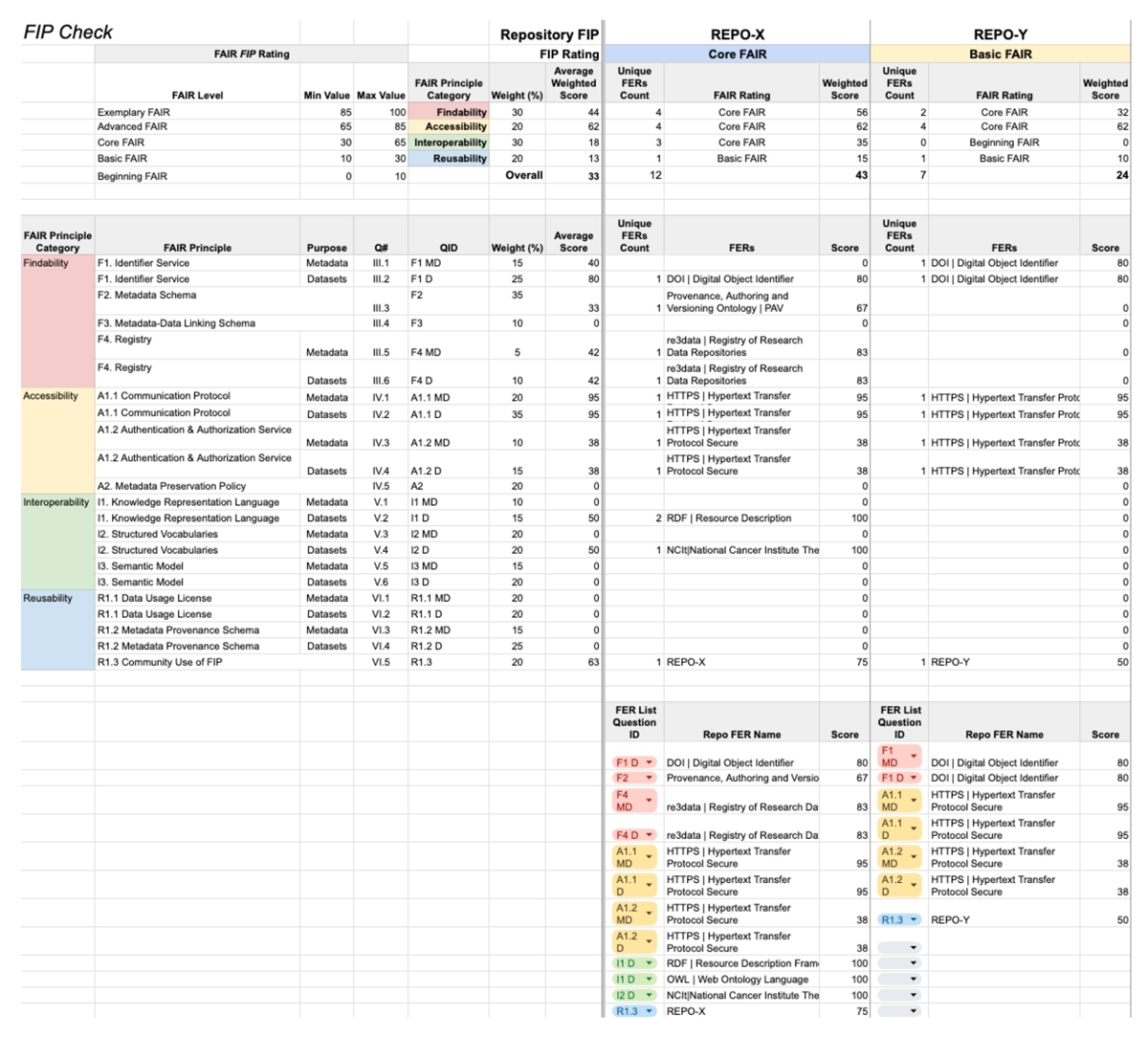
Figure 1
FIP Check Interface - Primary Assessment Tab “FIP Assessment”.
This view shows the aggregation of individual FER scores by FAIR Principle and FAIR Principle Category. FIP-level scores (e.g., REPO-X, REPO-Y) are calculated using weighted averages across FAIR domains.
Table 4
FIP Check Assessment Schemes – Standard (left) and Simplified (right).‘Standard Assessment Scheme’ uses an ordinal 5-point scale to capture varying degrees of FAIRness. Responses are mapped to scale from 0 (No Support) to 100 (Full Support), with intermediate levels (25, 50, 75) indicating partial alignment. ‘Simplified Assessment Scheme’ applies a binary approach: full or strong support scores 1, while any partial or weak support scores 0.
| STANDARD ASSESSMENT | |
|---|---|
| SUPPORT LEVEL | SCORE CONTRIBUTION |
| Yes/Full Support | 100 |
| Mostly/Strong Support | 75 |
| Partially/Moderate Support | 50 |
| Minimally/Weak Support | 25 |
| No/No Support | 0 |
| SIMPLIFIED ASSESSMENT | |
| Yes/Full Support | 100 |
| Mostly/Strong Support | 100 |
| Partially/Moderate Support | 0 |
| Minimally/Weak Support | 0 |
| No/No Support | 0 |
Table 5
FAIR Rating Levels and Score Thresholds.
| FAIR RATINGS | SCORE RANGE (UPPER INCLUSIVE) |
|---|---|
| Exemplary FAIR | 85–100 |
| Advanced FAIR | 65–85 |
| Core FAIR | 30–65 |
| Basic FAIR | 10–30 |
| Beginning FAIR | 0–10 |
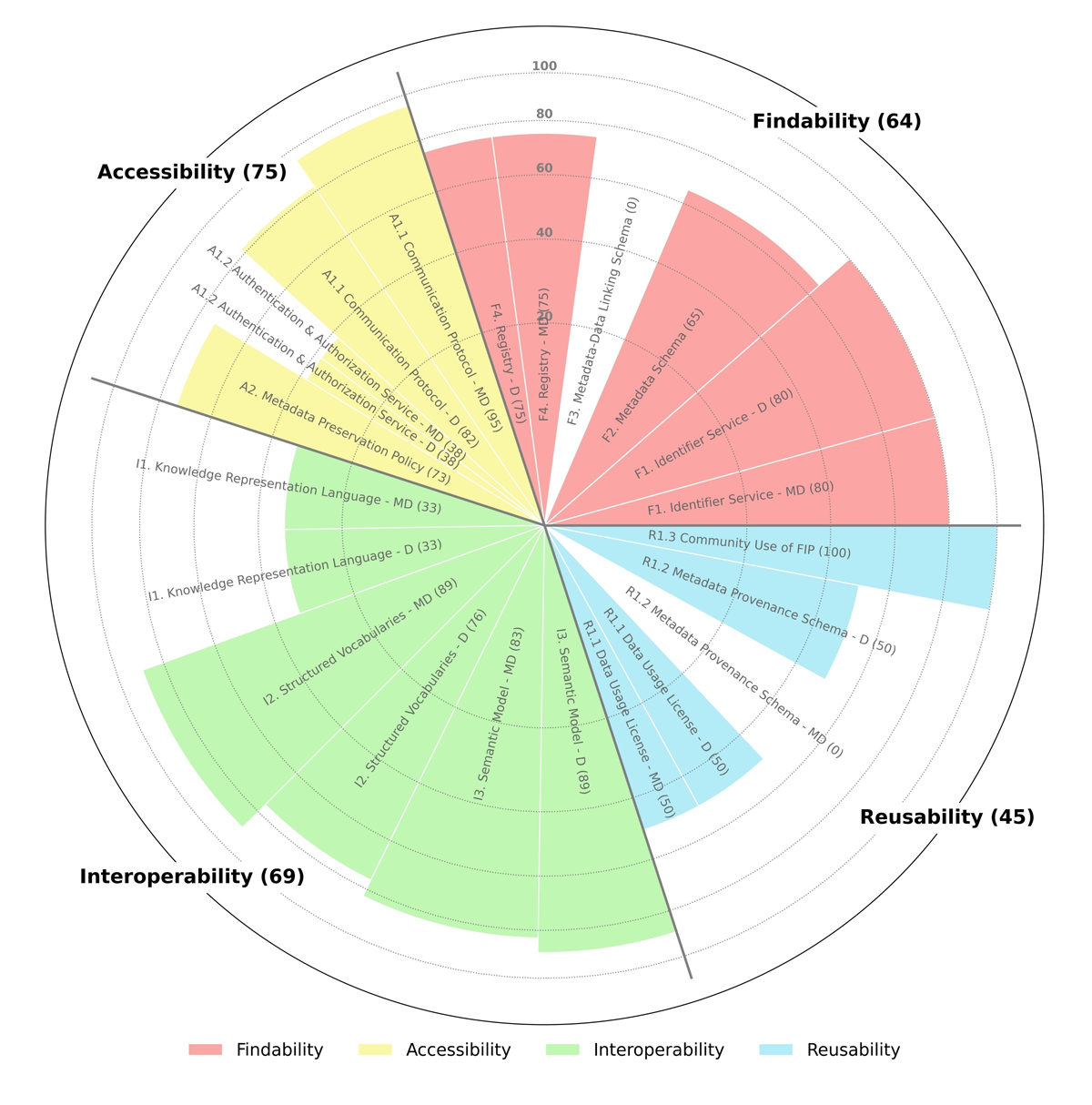
Figure 2
FIP Check Radial Visualization of REPO-D’s FAIR Alignment.