
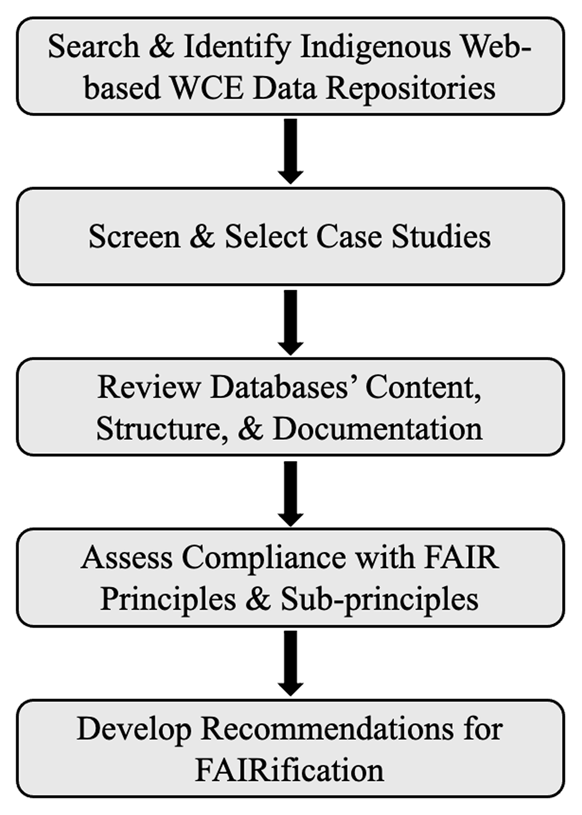
Figure 1
Overview of the key stages of this study.
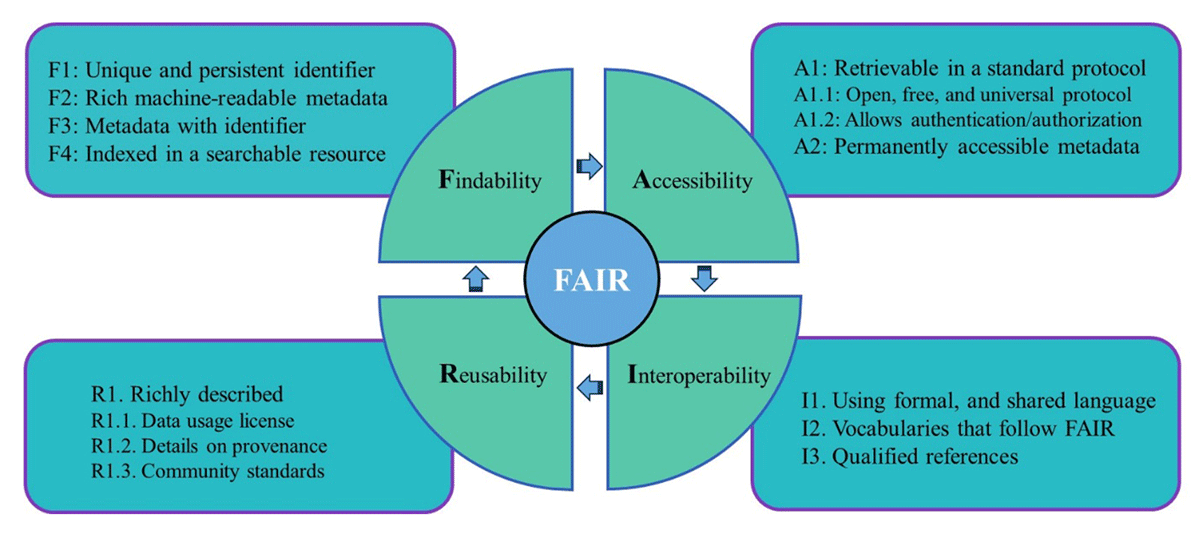
Figure 2
Overview of the FAIR principles and their corresponding sub-principles.
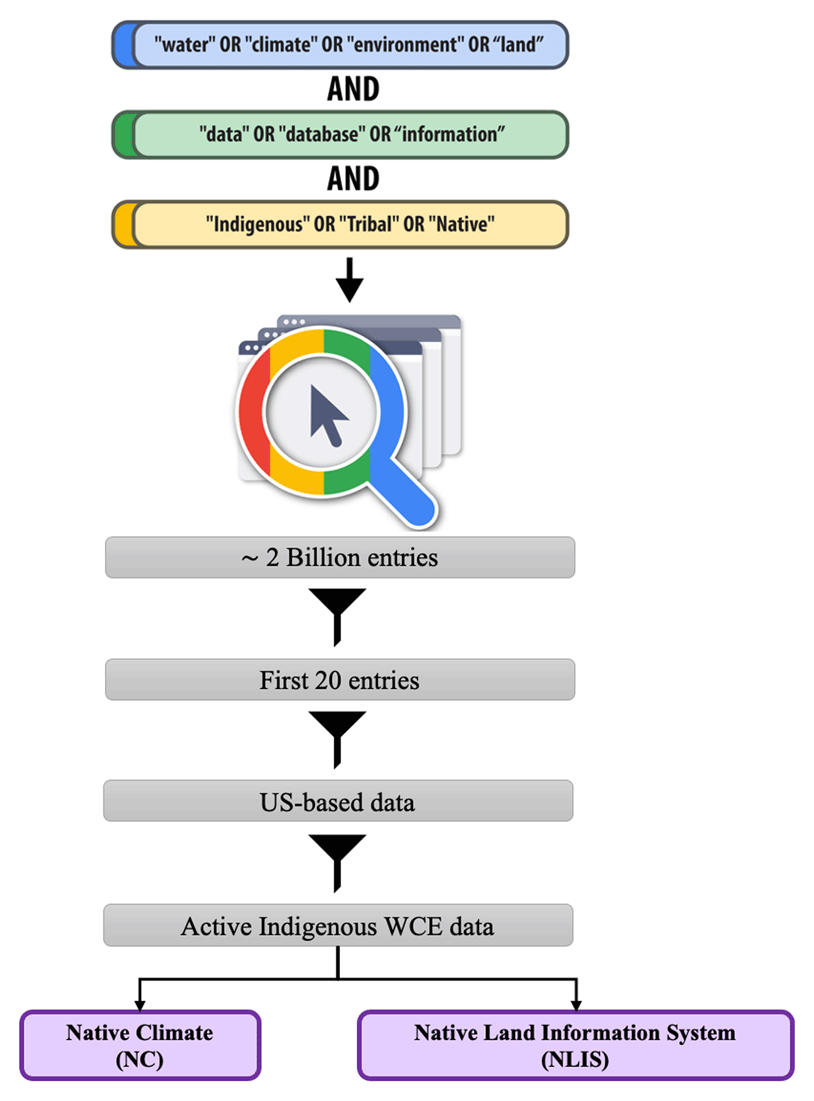
Figure 3
Systematic search flowchart for the active Indigenous Water-Climate-Environment (WCE) data repositories using the Google Search Engine on Google Chrome.
Table 1
Summary of the NC and NLIS data repositories’ features.
| DATA REPOSITORY | DATA TYPES | VARIABLES | DEVELOPERS | SPONSORS | WEBSITE |
|---|---|---|---|---|---|
| Native Climate(NC) | Agricultural climate variables | Annual precipitation, spring precipitation, summer precipitation, fall precipitation, winter precipitation, average precipitation on wet days, average precipitation on wet days (trace), maximum 3-day precipitation, number of wet days, number of wet days (trace), number of dry days, number of dry days (trace), day of first snow, average temperature, number of days ≥ 100 F, number of days with heat index hazard, growing degree days, frost free days, first day of growing season, last day of growing season, length of growing season, average surface wind speed, number of days with average wind speed ≥ 20 mph | Desert Research Institute, University of Nevada-Reno Tribal Extension, Montana Climate Office, University of Arizona Tribal Extension, and USDA Climate Hub | US Department of Agriculture-National Institute of Food and Agriculture, Native Waters on Arid Lands | native-climate.com |
| Native Land Information System(NLIS) | Surface water, groundwater, hydroclimatic variables, environmental risks and land cover variables | Mean monthly and annual surface flow, lake average storage and capacity, aquifer characteristics, wells characteristics and water table, Palmer Drought Severity Index (PDSI), Extreme Heat Days (EHD), precipitation, Wildfire Hazard Potential (WHP), land cover types and acres, projected mean annual precipitation, change of snow-to-precipitation ratio | Native Land Advocacy Project | Indian Land Tenure Foundation, Native American Agriculture Fund, Village Earth | nativeland.info |
Table 2
Summary of FAIR-F evaluation; italic text displays FAIR non-compliance.
| DATA REPOSITORY | FINDABILITY |
|---|---|
| NC | F1. No unique and persistent identifiers have been explicitly assigned for each dataset. F2. Rich metadata, no ideal machine-readable metadata format has been provided. F3. Metadata does not include the identifier. F4. Indexed in the Google search engine’s database. |
| NLIS | F1. No unique and persistent identifiers have been explicitly assigned. F2. Rich metadata, no consistent machine-readable metadata format has been provided. F3. Metadata does not include the identifier. F4. Indexed in the Google search engine’s database. |
Table 3
Summary of FAIR-A evaluation; italic text displays FAIR non-compliance.
| DATA REPOSITORY | ACCESSIBILITY |
|---|---|
| NC | A1. Retrievable in an open, free access protocol, and no authentication/authorization is currently required. A2. No guarantee for metadata preservation. |
| NLIS | A1. Retrievable in an open, free access protocol, and no authentication/authorization is currently required. A2. No guarantee for metadata preservation. |
Table 4
Summary of FAIR-I evaluation; italic text displays FAIR non-compliance.
| DATA REPOSITORY | INTEROPERABILITY |
|---|---|
| NC | I1. (Meta)data are provided in a partially formal, accessible, shared, and broadly applicable language formats. I2. (Meta)data partially use FAIR vocabularies. I3. The metadata provides the key references. |
| NLIS | I1. (Meta)data are provided in a partially formal, accessible, shared, and broadly applicable language formats. I2. (Meta)data partially use FAIR vocabularies. I3. The metadata provides the key references. |
Table 5
Summary of FAIR-R evaluation; italic text displays FAIR non-compliance.
| DATA REPOSITORY | REUSABILITY |
|---|---|
| NC | R1. No clear data usage license is provided, details on data provenance is provided, and partially follows the community standards. |
| NLIS | R1. No clear data usage license is provided, details on data provenance is provided, and partially follows the community standards. |