
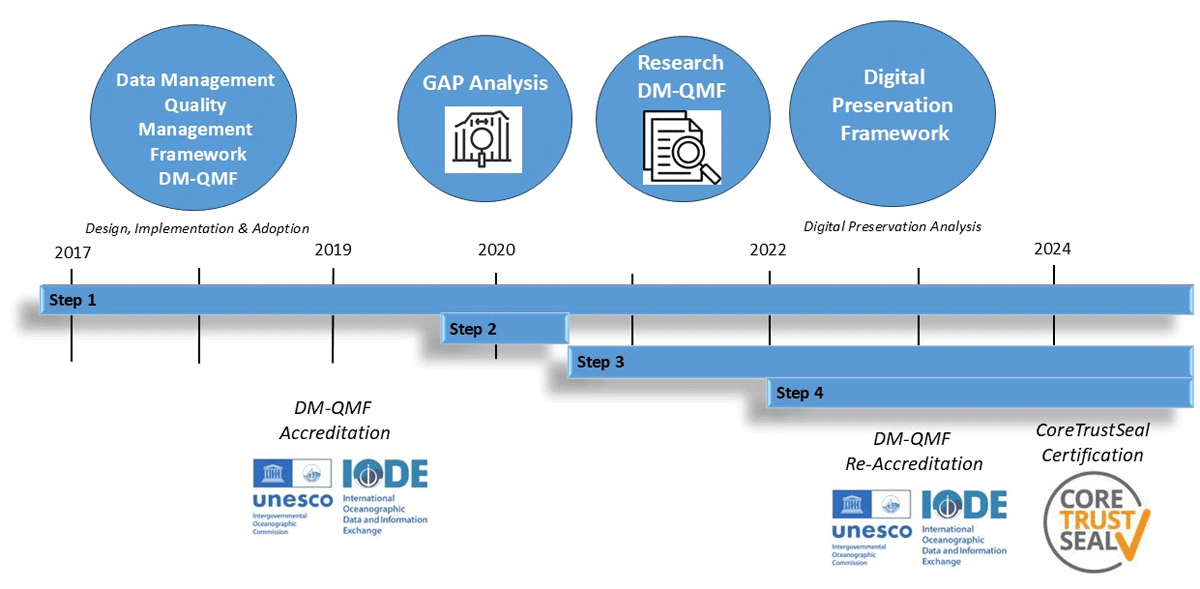
Figure 1
Methods and timelines of frameworks.
Table 1
ISO requirement statements.
| CHAPTERS OF ISO 9001:2015 | ‘SHALL’ (LINE STATEMENTS) | COMPLIANCE | EFFECTIVENESS | RISK-BASED THINKING |
|---|---|---|---|---|
| Total | 131 (368) | 368 | 736 | 1,104 |
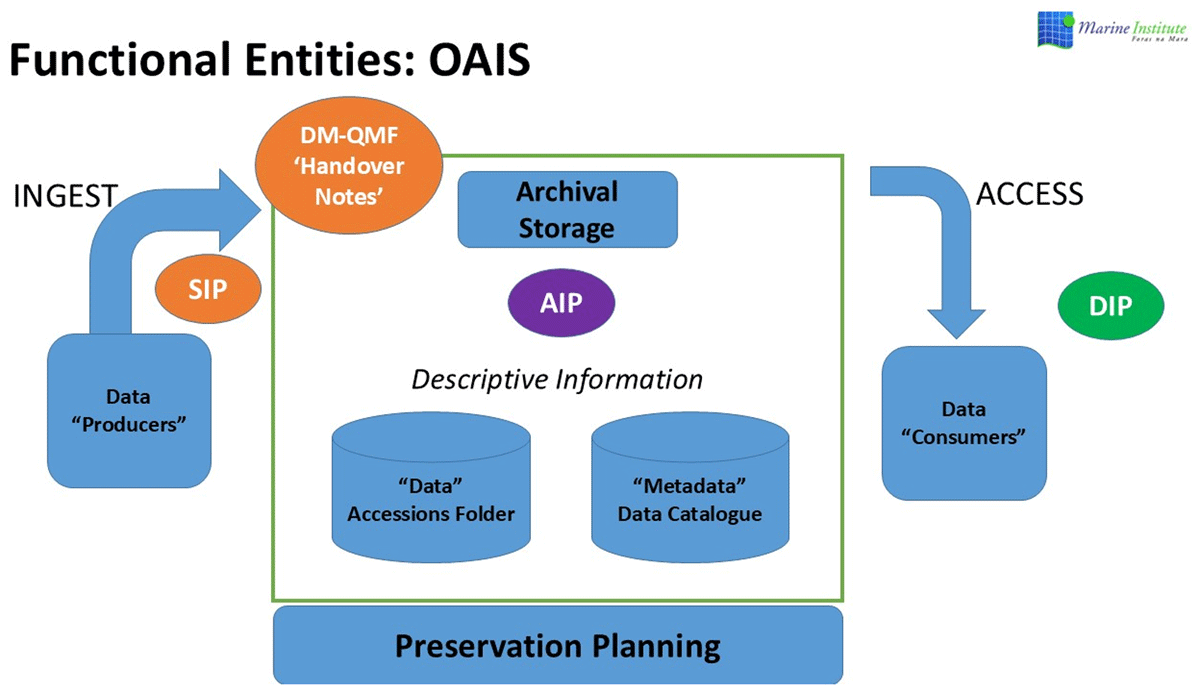
Figure 2
Open Archive Information System (OAIS) model depicting how DM-QMF can become ingestion suite.
Table 2
Benefits of the DM-QMF.
| COMMUNICATION CHANNEL | BENEFIT |
|---|---|
| Formal* | Improves customer satisfaction: Delivering a more consistent service/product using well documented processes and procedures. |
| Increases staff Engagement. | |
| Improves risk management. | |
| Aids reduction of waste. | |
| Provides direction for defining, improving, and controlling processes. | |
| Facilitates and helps identify training opportunities. | |
| Aids with setting organisation-wide direction. | |
| Communicates an ability and commitment to produce consistent high-quality results. | |
| Informal^ | Greater consistency in data products and services produced by the MI. |
| Increased efficiency by improving time and resources, improved customer satisfaction. | |
| Consistency with all processes across the service areas. | |
| Continuous assessment and opportunities for improvement. | |
| Training materials for all staff – particular benefit to new starters. | |
| Reduced risk of undocumented processes and procedures. | |
| The identification of any sensitives associated with General Data Protection Regulations (GDPR) as well as the more recent Artificial Intelligence Act. | |
| Ensuring the quality of the management of data for use in Marine Spatial Planning, Marine Strategy Framework Directive, European Maritime Fisheries Fund, and other data-demanding legislative drivers into the future. | |
| The use of data visualisation dashboards is gaining traction which offers further insights into the underlying data; from a Quality Control perspective but also added value opportunities. |
[i] *Formal benefits were captured as part of an OceanTeacher Global Academy Training Course that was developed and delivered by originators of the DM-QMF at the Marine Institute October 2020 (UNESCO, 2002).
^Informal communications with Data Stewards and Data Coordinators within the Marine Institute (pers. comms).
Table 3
Benefits of a Digital Preservation Framework (CTS).
| COMMUNICATION CHANNEL | BENEFIT |
|---|---|
| Formal* | Validates the quality and transparency of internal processes |
| Increases awareness of and compliance with established standards | |
| Builds stakeholder confidence | |
| Enhances the reputation of the NODC | |
| Demonstrates that the NODC is following best practices | |
| Is a benchmark for comparison and helps to determine the strengths and weaknesses of the NODC | |
| Informal^ | Provides a framework for the policies and practices related to scientific data curation and preservation |
| Provides assurance that data are preserved and can be reused in the future | |
| Helps plan data preservation sustainably | |
| The IODE has confirmed reaccreditation of the MI’s existing Data Management Quality Management framework (Reed, 2023, p. 10)^^ |
[i] *Formal benefits as depicted by CTS themselves.
^Informal communications (pers, comms).
^^ ‘Any NODC or ADU that has been certified by CoreTrustSeal will be awarded the status of Accredited IODE National Oceanographic Data Centre or Accredited IODE Associate Data Unit provided they can show evidence of (i) providing national reports to the IODE Committee, and (ii) adherence to IODE Standards and Best Practice.’
Table 4
Mapping between FAIR, CTS requirements and how the MI has met these requirements.
| FAIR PRINCIPLES | NODC ‘APPROACH’ | CHECKS IN PLACE |
|---|---|---|
| FINDABLE |
| The DM-QMF (aligned to ISO 9001) requires the population of a Data Catalogue record as part of the implementation pack. The NODC follows the best practice guidance as described in the Draft Data Preservation Policy. This includes the ISO 14721 (OAIS Model) for storage as well as the other preservation functions. |
| ACCESSIBLE |
| A Data Catalogue has been developed to export metadata for datasets and services in ISO 19115/19139 based XML format in compliance with the INSPIRE implementing rules for metadata (Leadbetter et al., 2020b). |
| INTEROPERABLE |
| OGC CSW (Catalog Service for the Web) which aligns with ISO 19128: supports metadata retrieval using ISO 19115/ISO 19139 standards, ensuring compatibility with standardised metadata schemas |
| REUSABLE |
| A Data Catalogue has been developed to export metadata for datasets and services in ISO 19115/19139 based XML format in compliance with the INSPIRE implementing rules for metadata (Leadbetter et al., 2020b). The Digital Preservation Framework, Certified under CoreTrustSeal, is aligned to ISO 16363 which is a standard for Trust Digital Repositories. |
