
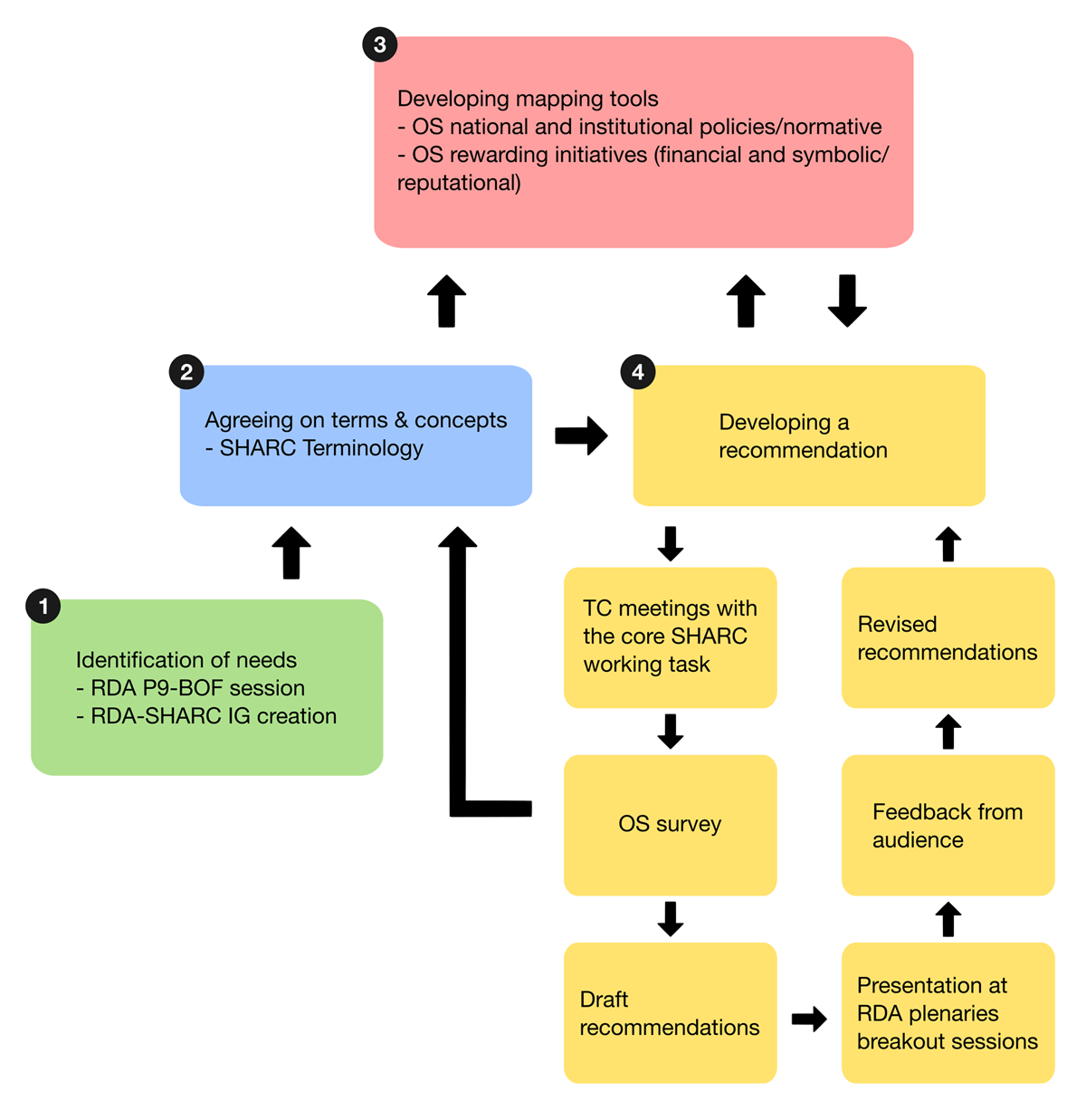
Figure 1
Flowchart of developing the RDA-SHARC IG Recommendations on Open Science rewards and incentives to various stakeholders. The process included 4 steps, namely: 1) identifying the needs and research focus areas, 2) agreeing on terms and concepts (developing rewards-related terminology), 3) mapping existing policies and rewarding initiatives, 4) developing a set of recommendations out of SHARC IG meetings, a global survey and feedback from RDA sessions.
Table 1
Recommendations to Research performing organisations.
| RECOMMENDATION SCOPE | RECOMMENDED ACTION | EXAMPLES*/DETAILS |
|---|---|---|
| Promoting RRA | Participate in building & promoting relevant frameworks and initiatives related to responsible research assessment (e.g., join forums such as the CoARA: Coalition for Advancing Research Assessment) | Sign DORA Declaration Sign CoARA Agreement |
| Engaging with OS communities | Be part of the OS conversation by joining relevant communities, such as the Research Data Alliance | List of examples of OS communities of practice |
| Adopting formal OS policies | Establish institutional prerequisites to enable the practice of OS | |
| * Post institutional OS policies in a visible and easy to find place (website), including all facets of OS (publications, data, software, citizen science) * Mandate deposit of ALL research outputs (e.g., publications, datasets, code) in the institutional or other compliant repository to be publicly available under an open licence (no later than the time of an associated publication, as much as possible)
* Mandate for a DMP/software management plan for all research projects, which the staff/postgraduate students are involved in * Require to manage research data in line with the FAIR principles * Ensure that all publications (co)-authored by the staff/postgraduate students contain data availability statements | OS at Finnish Meteorological Institute | |
| * Encourage that the staff/postgraduate students retain sufficient IP rights to comply with the OA requirements * Minimise the administrative burden generated by some OS activities and provide support to facilitate these steps while promoting trust and transparency | Harvard University’s Rights Retention policy; UK Institutional Rights Retention policies | |
| Include criteria for open research activities in recruitment, evaluation and rewarding policies | ||
| * Consider the Hong Kong principles to reinforce open science and research integrity | WCRI Hong Kong principles | |
| * Consider/create indicators (qualitative and/or quantitative) in general as well as disciplinary data-level metrics for crediting data sharing in the evaluation schemes | CoARA agreement on RRA; DORA RRA documents; EC’s OS Career Assessment Matrix (OS-CAM); | |
| * Boost appreciation of the researchers who excel in Research Data Management & OS practices, including well-documented, FAIR and open digital outputs, during their annual reviews by integrating these activities into the institutional research evaluation scheme | NOR-CAM Assessment Framework; TU Delft strategic-plan-2025; BIH QUEST programme; Researcher assessment at FMI | |
| * Promote that non-OA (closed, i.e., only accessible over paywall) outputs should not be reported for performance evaluation procedures | CNRS policy (p. 11) | |
| OS capacity building | Provide OS capacity building support | |
| * Provide OS courses (ideally as part of the annual mandatory training for research staff and mandatory subjects for postgraduate students) * Organise institutional working groups, workshops * Provide digital training materials, newsletters * Ensure that the various facets of OS are coherently developed and do not work in silos | FAIR & OS training initiatives; UNESCOs index; Mandatory OS course for PhD candidates at Maastricht University; Mandatory OS course for PhD candidates at Erasmus University Rotterdam; UU Digital Competence Centers; NFDI, DE | |
| * Establish dedicated human resources/units, such as OS regulatory adviser, data stewards & managers, appoint professionalised Data Stewards, and engage libraries * Facilitate collaboration with related OS groups and people | TU Delft Data Stewardship project and Data Champions initiative; CNRS DDOR | |
| OS infrastructure | Provide infrastructure and material resources for OS | |
| * Provide or work with a trusted repository (certification based on CoreTrustSeal, Nestor Seal DIN31644 or ISO16363) | ECs expectations for trusted repositories (pp. 155–156) | |
| * Provide digital services & operational tools (e.g., DMP tool, FAIR data management, anonymisation and analysis tools, entry points for OS help) | ||
| * Develop/refine systems which track/monitor research outputs, including OS outputs | Korean NTIS platform | |
| OS funding | Provide financial support for OS * Cover costs associated with registering PIDs (e.g., DOIs) for all research outputs, including datasets | |
| * Determine reasonable OA costs to support while transitioning to the Diamond OA model | New Gates Foundation’s OA policy | |
| * Cover costs associated with research data/software management | RADS Initiative: estimates of institutional expenses for public access to research data | |
| * Provide templates for cost calculation of OS activities in order to facilitate their inclusion in funding applications | ||
| * Financially support sustainable tools, initiatives and infrastructure development for OS locally, nationally and internationally | SCOSS; Liverpool University Press’s Opening the Future programme for Diamond OA books; 2024 Report on the Sustainability of Diamond OA in Europe | |
| OS rewards | Implement various types of rewards | |
| * Awards, gifts to researchers that contribute very actively to OS | Open Research Awards: a Primer from UKRN | |
| * Organise free time (sabbatical time) * Salary bonus to researchers being actively engaged with OS | ||
| * Create data champions schemes | TU Delft Data Champions initiative | |
| * Create OS stamp/badge/label (e.g., in a PhD Degree Certificate) | Examples of OS Badges/Certificates/Tokens |
[i] *The list of examples referred to in the table point to initiatives/policies active in 2024.
Table 2
Recommendations to Funders.
| RECOMMENDATION SCOPE | RECOMMENDED ACTION | EXAMPLES*/DETAILS |
|---|---|---|
| Engaging with OS communities | Be part of the OS conversation by joining relevant communities, such as the Research Data Alliance | List of examples of OS communities of practice;RDA ‘s Research Funders and Stakeholders on Open Research IG;RDA’s National PID Strategies WG |
| Adopting formal OS policies | Adopt and publish formal policies requiring/strongly encouraging OS activities * Be specific whether it is a requirement or a recommendation (e.g., require vs encourage preprints) | |
| OS evaluation | Align OS outputs with traditional ones | |
| * Recognise well-documented, FAIR and open digital outputs as first-class contributions during the project lifecycle and in the research assessment framework | NOR-CAM Assessment Framework;EC’s OS Career Assessment Matrix (OS-CAM) | |
| Monitoring OS outputs | Monitor compliance in OS implementation and make it transparent to relevant stakeholders | |
| * Share funded OS activities with open scholarly infrastructure, academic databases and search engines | Transition of Open Funder Registry into Research Organisation Registry; OpenAlex: open bibliographic database;Funders’ support of the Barcelona Declaration on Open Research Information | |
| * Share/credit the array of research outcomes from funded projects and explore project identifiers like the RAiD as an opportunity to link the project outcomes | RAiD;Korean NTIS platform (linkage of outputs based on national R&D project number) | |
| OS Funding | Create calls financing OS-driven activities | |
| * Calls financing data sharing and re-use and support for software that is critical to research | DataWorks! Prize;Essential Open Source Software for Science | |
| * Short-term funding for early career researchers to improve OS sharing | ||
| For all research projects, systematically allocate a portion of the proposal budget to OS activities, such as data management and sharing | A Pilot incentive programme from the Uruguayan ANII research funding agency | |
| Ensure that enough funding is dedicated to appropriate resources for staff and OS infrastructure devoted to the development of shared data platforms (i.e., with standardisation, quality control and analysis tools services that will enable real-time use of data within a project collaboration and future reuse by all) | Life watch services |
[i] *The list of examples referred to in the table point to initiatives/policies active in 2024.
Table 3
Recommendations to Publishers.
| RECOMMENDATION SCOPE | RECOMMENDED ACTION | EXAMPLES*/DETAILS |
|---|---|---|
| Unambiguous identification | Make use of ORCID mandatory in all research outputs (as it is the only universal and free identifier) * Make the ORCID search easier in the manuscript submission system | Getting started with your ORCID record |
| Findable data & software citation | Require that authors cite data & software they produce and/or reuse in the method/reference section or in a data/software availability statement | AGU’s Data & Software Availability Statement |
| Pre-printing | Provide support for preprints to facilitate Open Access and open peer-review | eLife’s New Model Peer Community in |
| Open peer-review | Foster discussion on the implementation of open peer-review models and the recognition of expert efforts in open peer-review | Open Research Europe: Open Peer-Review Publishing Model |
| Recognising contributorship | Adopt the CRediT taxonomy to enable the mention of OS activities as part of the contributors’ research outputs | Implementing CRediT; ESIP Research Artefact Citation (see Activities/Large Spreadsheet of Research Artefacts) |
| Encouraging OS activities | Adopt the OS badges initiative to award badges based on pre-registration/open data/open materials | CoS Badges initiative |
| Encourage OA publishing in all LMICs by revising the criteria for publishing fees and adjusting them based on meaningful indicators (for instance, to the national Gross domestic expenditure on R&D/GERD and not only to the country GDP) | Research and Development Expenditure (% of GDP); Research4 Life | |
| Assessing openness | Assess journals for transparency and openness | |
| * Start with assessing OA and use the TOP factor for more advanced assessment | TOP factor | |
| Establish data and software review mechanisms where relevant | ||
| * Establish data editors that work with the publication stakeholders to assess quality and FAIRness of data/software | Role of data editors in astronomy |
[i] *The list of examples referred to in the table point to initiatives/policies active in 2024.
Table 4
Recommendations to Government policymakers.
| RECOMMENDATION SCOPE | RECOMMENDED ACTION | EXAMPLES*/DETAILS |
|---|---|---|
| Promoting national overarching policies on OS | Develop overarching policies requiring/strongly encouraging OS activities at all levels, including an increase in OS awareness among decision-makers Ensure that the national policies will allow to: * Harmonise practices * Provide a budget * Monitor implementation across disciplines and institutions * Include rewarding mechanisms as key elements of OS policies (positive aspects rather than a ‘burden’ and requirements only)
| RDA-SHARC list of examples of national/institutional OS policies |
[i] *The list of examples referred to in the table point to initiatives/policies active in 2024.
Table 5
Recommendations to Researchers.
| RECOMMENDATION SCOPE | RECOMMENDED ACTION | EXAMPLES*/DETAILS |
|---|---|---|
| Raising awareness of OS policies | Be aware of the existing and relevant institutional, countrywide, regional, and community research policies, including laws, regulations and agreements | RDA-SHARC list of examples of national/institutional OS policies |
| Raising awareness of OS training | Be aware of OS training sessions and resources provided by institutions or communities | UNESCO OS Capacity Building Index;OS Loterre Thesaurus |
| OS Capacity building | Maximise as much as possible digital presence using PID for individuals and for all outputs (ex: ORCID, DOI or other identifier for Open Access publications/Open Access datasets/open source software) | Parsec Digital Presence checklist;PLOS Handbook/Guide |
* Include citation elements for research data/software created in the References section of a paper. To support indexing and reuse:
* Include a data/software availability statement in any paper that describes where and how data are available, and how to cite them if possible. | AGU’s Data and Software Availability and Citation Checklist & Templates | |
| Update CV & reporting information within OS activities | ||
| Recognising contributorship | Acknowledge OS contributorship | |
| * Specify all kind of contributorship early in the projects | The Turing Way project’s Acknowledging Contributors | |
* Use the CRediT taxonomy:
| Implementing the CRediT Taxonomy | |
| Cite or acknowledge researchers’ OS outputs while leveraging PIDs * Cite data and research outputs in Data Availability Statement and References sections of papers * Acknowledge and cite OS tools used, e.g., with an identifier or ‘How to cite’ statement (if any) | F1000 Open Data, Software and Code Guidelines | |
| Raising awareness of OS costs | Be aware of how to include OS costs in all funding applications | Curation and Data Management Services |
| Raising awareness of OS financial rewarding | Solicit dedicated financial reward or support* Apply to specific funds for OS activities wherever relevant * Apply to OS prize/awards if any | RDA-SHARC list of examples of existing financial rewarding tools |
| Raising awareness of OS symbolic rewarding | Get symbolic reward * Apply for OS certificates/OS ambassador/OS badge schemes * Apply for training badges * Join OS acknowledging opportunities to gain visibility/reputation | RDA-SHARC list of examples of existing symbolic rewarding tools |
[i] *The list of examples referred to in the table point to initiatives/policies active in 2024.