
Introduction
What is a commons?
The term ‘commons’ derives from the English idea of land held in common and was popularised in the modern sense as a way of referring to shared resources by the ecologist Garrett Hardin in his influential 1968 article, ‘The Tragedy of the Commons’ (Hardin, 1968). The Nobel laureate, Elinor Ostrom, revisited this idea and demonstrated instead that there do exist practical algorithms for the collective use of a limited common resource (Ostrom, 1990). The idea of the commons has since been taken up and applied to a wide range of domains, including fisheries (Berkes et al., 1989), urban planning (Colding et al., 2013) and genomic data (Grossman, 2019). Grossman (2023) lists a number of reasons as to why research projects might find commons a useful approach.
What is a research commons?
A research commons can be defined as a research-focused version of a digital commons, where ‘informational resources are created and shared within voluntary communities of varying size and interests’, are held as communal, and management is ‘oriented towards use within the community, rather than exchange in the market’” (Stalder, 2010). Commons are emerging as an important tool for enabling the reuse of different types of data at the national and global levels. As more commons are developed, the need for coordination of these infrastructures on various levels (country, continent, discipline, sector) and focus (for all or some of the research artefacts) is increasing. Examples include the European Open Science Cloud (EOSC, 2018), the Australian Research Data Commons (ARDC, 2024), the International Virtual Observatory Alliance (IVOA, n.d.) and the African Open Science Platform (Participants of African Open Science Platform Stakeholder Workshop September 2018 et al., 2018; AOSP n.d.).
Typology of Commons Elements
GORC Interest Group
The GORC Interest Group (GORC-IG) grew out of a Birds of a Feather meeting held as part of the 11th Research Data Alliance plenary in Berlin in March 2018 (Bicarregui, 2018). The goal of the IG was to provide a neutral place where people could coordinate the development of a typology to describe what are referred to as ‘Open Science Commons’ or ‘Data commons’ within the research commons umbrella (Treloar et al., 2019).
As a first step, the GORC-IG examined a range of existing research commons architectures to review current practice. As a subsequent step, the GORC-IG generated a definition of a commons: a global trusted ecosystem that provides seamless access to high-quality interoperable research outputs and services. Lastly, it developed a typology of the essential elements in a commons (Figure 1) and a set of definitions for each of the essential elements.
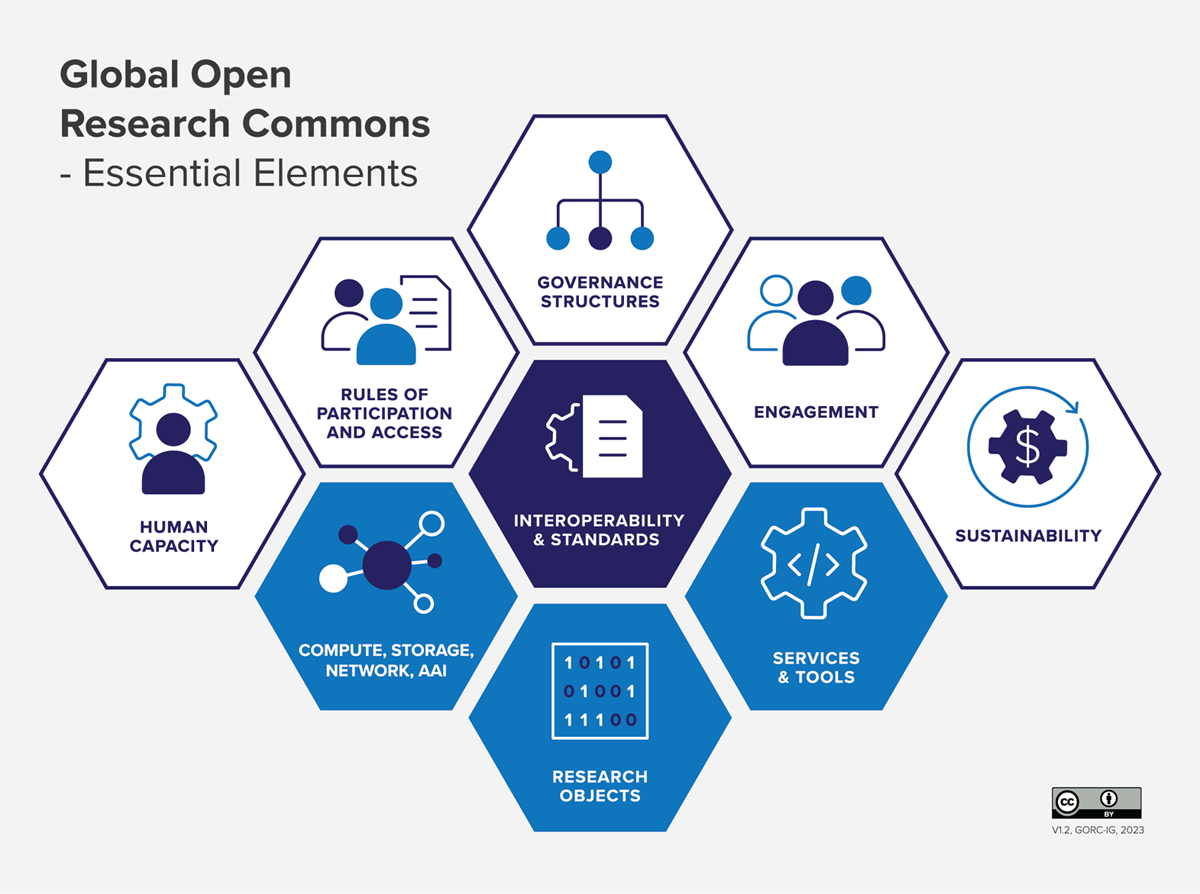
Figure 1
Essential elements of a research commons.
The three elements in blue are the underpinning elements that constitute the parts of the commons with which people interact: ICT Infrastructure, Services & Tools and Research Objects. The five elements in white are the social or human elements that are needed to make the commons succeed: Governance, Rules of Participation & Access, Sustainability, Engagement and Human Capacity. The central element in dark blue represents the central importance of Standards and Interoperability at the core of any commons.
This typology was presented to the RDA community as a draft supporting output in early 2023, revised in July 2023 to respond to community comments, and accepted as a supporting output in August 2023 (Jones et al., 2023). The typology and definitions were designed to support the goal of fostering discussion amongst stakeholders. In addition to the typology and providing a forum for conversations about commons, the GORC-IG is now working towards a roadmap for global alignment and integration of research commons.
International Model
International Model WG
The GORC International Model Working Group (GORC-WG) worked under the auspices of the GORC-IG in support of the development of an interoperability roadmap. Specifically, the mission of the GORC-WG was to ‘generate a set of pertinent attributes to identify common features across commons’ and ‘review and identify attributes or features currently implemented by a target set of GORC organisations and, when possible, identify how they measure their user engagement with these features’ (Payne, Leggott and Treloar, 2021). This model, the realisation of that mission, can be thought of as an organisational structure or framework that captures observations of commons elements, attributes and key performance indicators (KPIs) from real-world implementations currently in use or expected in research commons.
Methods
The model is based on the GORC-IG typology outlining the essential elements of a commons (Jones et al., 2023), shown in Figure 1. Essential elements are high-level concepts that are essential to the composition of an Open Research Commons. The model further refines these essential elements by defining categories and subcategories of the essential elements as well as attributes and features of these entities. The items in the model were identified from a range of sources, including a speaker series and related documentation, a literature review, and a community consultation process.
Speaker Series
Authors of the first WG case statement (Payne, Leggott and Treloar, 2021) developed a list of 46 potential commons that were considered for review to produce the model typology. Successive iterations of the WG case statement narrowed the scope of those potential commons to 13, of which 12 were featured as speakers during WG meetings. A speaker series was used as a main instrument for information gathering as the GORC-WG wanted to develop a model based on current research infrastructures, what they found was working and what they identified as challenges and successes. Live presentations allowed the speaker series participants to include information about their organisation they felt was relevant and the broader membership of the WG to participate.
In consultation with the RDA community during the 18th RDA Plenary in November 2021, the GORC-WG chairs generated a list of questions that were given to members of the speaker series prior to their presentations as editable Google Docs or Microsoft Word files on request. All speakers were asked to respond in writing to these questions before their presentation date, which included an open-ended section to capture any relevant concerns for commons that were not covered in the questionnaire. Each speaker was asked to present on their organisation in a 45–50-minute presentation using the questionnaire as a guide that would be followed by synchronous questions from the WG. This questionnaire was designed to solicit information about a range of topics, such as their perception of whether or not their organisation was a commons, their mission, roadmap and social and organisational constructs and the types of services they provide. This last question was further delineated by asking speakers to mark items from a checklist to identify which, if any, of a set of services they currently, or intended, to provide via their commons.
The speaker series was hosted from November 2021 through July 2023. We hosted 12 presentations with question-and-answer periods and received seven complete questionnaires and three partially complete questionnaires. The questionnaire template, instructions sent to all speakers and list of speakers can be found in Appendix 1. These existing initiatives were foundational to the model developed by the WG. The presentations were recorded and used to identify aspects of each organization that were then coded and iteratively added or used to modify the growing list of items in the model. The questionnaire was developed and used before the GORC IG Typology (Jones et al., 2023) was finalized or endorsed, and so a mapping between the questionnaire and the essential elements was created to assist in coding the latter half of the speaker series and organizing the model, as seen in Appendix 2.
Literature Analysis
One of the authors (Woodford), assigned to the WG by the World Data System (WDS), reviewed the information from the speaker series and relevant reports and publications in two phases: August 2022–October 2022 and January 2023–September 2023. Sources included white and grey literature, and a full list of all sources analyzed can be found in Appendix 3. There were no exclusion criteria. The inclusion criteria were if the source mentioned or referred to digital research infrastructure, research commons or research infrastructure more generally in any context. A systematic search was not performed. Rather, the literature included was suggested by members of the GORC-WG and GORC-IG. Sources were ordered by priority dynamically, with the highest priority being any and all documentation concerning or developed by the speaker series participants. Sources from high-relevance partners such as RDA, CODATA and FAIRsFAIR were also considered high priority among others. These sources were used to create a running list of potential commons attributes and success indicators, which was updated by WG members with information that emerged from the speakers series, their own work and exploration of commons’-related literature. The resulting set of potential items was then reviewed by a series of task groups described below. Completed outputs from all relevant RDA groups were analyzed.
Community Consultation
The running list of potential attributes was the starting point for community consultation. Consultations were conducted via task groups (TGs), RDA meetings, a workshop dedicated to model development and general requests for comments through the RDA and the wider digital research infrastructure community.
The purpose of the TGs was to refine the initial list of items identified during the first phase review. Items were allocated to balance work across the TGs, and so some TGs evaluated items in multiple essential elements, while other TGs evaluated items for single essential elements. The TG members came from a mix of self-nomination and invitation, and a full list can be found in Payne et al. (2023) Appendix C. The five TGs were international and met through online video calls; each TG was charged with creating their own internal communication strategy. Out of the 69 GORC-WG members at the time, 14 members participated in the TGs from October 2022 to March 2023. Results of this first phase review were showcased during RDA20 in Gothenburg, Sweden (Payne, 2023; Payne and Woodford, 2023). With the support of RDA-TIGER (RDA, n.d.), the TGs then took part in a full-day in-person workshop co-located with RDA20. The workshop allowed WG members and stakeholders to review each other’s work and address working group-wide concerns. There were 17 in-person participants and three online participants at the workshop, in addition to two RDA-TIGER facilitators. Ten participants were TG members; four were speaker series participants; two were WG members not a part of the TGs; and four were stakeholders external to the WG. The result was version 0.5 of the model.
An updated V0.6 was shared with the RDA community and interested parties on 20 July 2023 after a second review by 15 WG members in six TGs. A last round of revisions was conducted by the six TGs, WG and interested external parties, such as representatives from other RDA IGs and WGs, before 13 September 2023, including 9 synchronous meetings in the first week of September 2023, during which categories and subcategories were introduced into the model structure. The result of these consultations was version 0.9 of the GORC International Model (GORC IM), which was sent to RDA to begin the official community request for comment process in mid-September 2023. Version 1 of the model (Woodford et al., 2023) and the accompanying report (Payne et al., 2023) were endorsed by RDA in October 2023.
Purpose
The purpose of the resulting GORC IM is to provide a framework and common language to be used by stakeholders around the world who are committed to developing interoperable research services for the public good. The target audience for the model is anyone that is involved in the planning, development, operation, funding or use of a research commons. It is not intended to be prescriptive but rather to define and establish a common basis that users of the model can consider in the context of their own commons as it evolves and to enable interoperability between research commons.
Structure
The model breaks down each essential element into a set of categories that provide scope for the broad concepts that each element represents. Categories may be broken down into subcategories that provide a more granular scoping and definition for the concept being described. Each entity (essential element, category, subcategory) has associated with it one or more attributes. An attribute is a standard, characteristic, functionality or point of reference from which information can be documented, or measurements or comparisons may be made. Attributes may be further subdivided into features. Characteristics (attributes, features) are inherited from parent to child entities in all cases.
For each item (entity, characteristic) in the model, there is an associated extended description, examples, consideration level and the primary sources that were used to define it.
The model also provides a set of KPIs and metrics, providing a starting point for commons to consider and create their own set of relevant success indicators and measures.
The FAIR (Wilkinson et al., 2016), CARE (Carroll et al., 2020) and TRUST principles (Lin et al., 2020) are community-developed, widely implemented principles for data reuse resources. As such, they inform and are represented in all essential elements directly and indirectly. More detail can be found in the model itself, represented as a spreadsheet (Woodford et al., 2023) and the accompanying narrative report (Payne et al., 2023).
Applications of the International Model
Since the release of the Typology of Essential Elements and the International Model in 2023, they have been taken up in three different contexts: describing an existing open research commons (SURF), considering how to interact within an existing open research commons (ELIXIR) and as a way of planning a new open research commons (REASON). All three case studies were presented as adoption stories during the GORC-IG & IM WG combined session at the RDA22 on 22 May 2024 (Woodford, Treloar and Lopez Albacete, 2024).
SURF Case Study
SURF is a cooperative for research institutions in the Netherlands and the major provider of research data infrastructure (SURF, n.d.). Since 2023 they have used GORC to promote a commons approach to enhance coordination of existing infrastructures, provide a point of connection to European and international initiatives, and shape alternatives to commercial providers. SURF was considering how best to connect national initiatives to EOSC and saw the IM as a way of taking an inventory of current activities using a common language. They derived topics and questions from the model to be used in semi-structured dialogs. They found the IM was helpful as a way to identify common activities and challenges among different national initiatives and nodes. The model helped to unveil attributes that had not yet been considered. They also found that the model exposed ways in which all elements of the activities were related.
Their deep engagement with the IM also exposed areas of desirable improvement. There are occasional mismatches between how the 10 essential elements are described in the Typology and in the IM. They found there to be a steep learning curve when applying the model. In particular, they recommended that we provide guidance on how to use the model for complex initiatives. They also suggested the need to provide greater guidance on how to use the model for less formal initiatives that they want to connect to.
ELIXIR Case Study
ELIXIR is a distributed European infrastructure for life science information resources. It brings together software and data resources to enable research in the biomolecular and cellular sciences through national, European and global collaborations (StR-ESFRI2, 2021). The national aspect of Life Science data provision is provided by the network of ELIXIR Nodes. Each member state provides a Node as a national organisation, which provides a direct connection to funders and end users to respond to local research & training priorities and funding opportunities (Tedds et al., 2022). It currently consists of 23 National Nodes, plus the ELIXIR Hub, connecting more than 250 research institutes across Europe in a federated model (ELIXIR, n.d.a). ELIXIR hosts five platforms: data, tools, compute, training and interoperability.
Through individual RDA members across its Nodes, ELIXIR has a long-standing exchange with the global cross-disciplinary RDA community, supported by the ELIXIR RDA Activities Focus Group (ELIXIR, n.d.b). In this context, individual members have engaged with the GORC IM work and proposed activities to explore how ELIXIR and its members can approach aligning with and leveraging the model. ELIXIR’s EOSC strategy (Tedds et al., 2022) is an example of how ELIXIR has approached a similar alignment activity in the past. In June 2024, the ELIXIR All Hands meeting will have a workshop that looks at strengthening ELIXIR Nodes, Platforms and Communities, and the IM is one approach that will be presented (ELIXIR, 2024).
Due to ELIXIR’s existing success and node-based model, there has been difficulty in stakeholders seeing the benefit of using the IM for international interoperability and alignment. The development of an adoption starter package, complete with specific value propositions for the IM, as well as profiles of discipline-specific research commons to aid adoption, would assist with this.
REASON Case Study
The ResEArch CommonS fOr Norway (REASON) is a funding proposal submitted to the Research Council of Norway in November 2023 (Conzett and Macneil, 2023). REASON is a proposed generalist research infrastructure for Norway that complements and supplements existing domain-specific/specialized infrastructures. It involves five Norwegian and nine international partner organisations across Europe, US and Canada.
This proposal is explicitly structured around the 10 essential elements of the IM (Conzett and Macneil, 2024), which provides for the first time a globally accepted template for research commons. Aligning with GORC demonstrates alignment with a larger international agenda. The IM was stated by the proposers to be an essential reference model to use in structuring the proposal. REASON proposes to make comprehensive use of the GORC elements and to build out a range of services and tools within these elements. The proposers also see an essential role for REASON in a future national EOSC node in Norway.
The proposers noted variations in how well described the different elements are and suggested this needs to be improved. They also noted the need to clarify the interaction between the three technical elements in an updated version.
Future Work
In the dynamic world of digital research infrastructure, there cannot be a static or definite model of all possible considerations for research commons. Further landscape and literature analyses are needed, as well as supporting outputs to assist in the use of the model.
At minimum, the GORC-WG will restart in 2024 within RDA to begin tackling new avenues of work and support existing and new adopters of the model. Clear initial needs are revisions to the IM, such as consistent wording and descriptions, adoption support, mapping to relevant frameworks and moving the IM into a more visual, interactive container. Developing the analysis from the GORC-WG that was not included in the model or report is another priority, including work on identifying types of commons and how the speaker series participants were represented in the IM. This will lead into creating discipline- and commons-type-specific profiles of the model, which in turn will lead into creating implementation maps (i.e., how did research commons implement items in the IM). Setting a maturity level on the adoption of considerations or implementations within the model is also of interest. As we develop these various supporting outputs, we will consistently reevaluate the model and will aim to release future versions as well, in particular a version 2.0 including research hardware (Miljković et al., 2024) and physical instruments.
As we develop profiles and new versions of the model, special attention will be paid to addressing emerging topics in digital research infrastructure, including the use and misuse of artificial intelligence, data security, big data, and equity, diversity, inclusion and accessibility (Pérez-Jvostov, Sahrakorpi and Zhang, 2023).
Conclusion
The GORC IM provides a list of commons components (entities) and characteristics to be considered when undertaking the development or assessment of a commons of any kind, at any stage. The model does not mandate what should be implemented or in what way; the decisions on what is relevant and where resources should be invested will vary depending on the environment and priorities of the implementer. Our hope is that a large global survey of the current state of the art in commons initiatives, thoughtfully organised, vetted by international experts and well presented, will provide actionable information for organisations as they make their decisions about what and how to focus and develop their infrastructure.
While the work supports the development of individual commons, it also supports the work necessary to make the commons interoperable. The GORC-WG outputs provide an agreed language and model to describe commons components and a firm foundation for the GORC-IG as it seeks to create a roadmap for commons integration.
In order to address current and future challenges, especially at the accelerated pace necessitated by the multiple global crises facing humanity, our researchers will need to have access to the next generation of scientific platforms. This work envisions an interoperable set of platforms that build on both the advances of the internet and the consensus and strengths of the research community. The GORC IM will continue to be evaluated through RDA working groups, case studies and community consultation, as well as supporting outputs such as model profiles and implementation examples.
Additional Files
The additional files for this article can be found as follows:
Appendix 1
Speaker Series Instructions, Questionnaire and Participants. DOI: https://doi.org/10.5334/dsj-2024-056.s1
Appendix 2
Speaker Series Questionnaire Mapped to Essential Elements. DOI: https://doi.org/10.5334/dsj-2024-056.s2
Acknowledgements
The authors gratefully acknowledge the contributions of all members of the GORC-IG and GORC-WG and, in particular, the speakers who participated in the WG speaker series and members who engaged in TGs. The consideration of the case study participants on their representation in this work was invaluable, especially from Rory Macneil and Philipp Conzett on behalf of REASON, Maarten Hoogerwerf on behalf of SURF and Wolmar Nyberg Åkerström on behalf of ELIXIR. This paper is a significant revision of and addition to the GORC IM full report (Payne et al., 2023), written by the GORC IM writing group: Dr. Karen Payne, Dr. Brian Corrie, Francis Crawley, Dr. Natalie Harrower, Rory Macneil, Dr. Lauren Maxwell, Dr. Susanna-Assunta Sansone, Dr Andrew Treloar, Dr Charles Woodford and Wolmar Nyberg Åkerström.
Competing Interests
The authors have no competing interests to declare.
Author Contributions
Both authors were highly involved in the work described here. Treloar and Woodford were involved in the writing of the original report that this publication is based on and spearheaded the creation of the current publication text.