
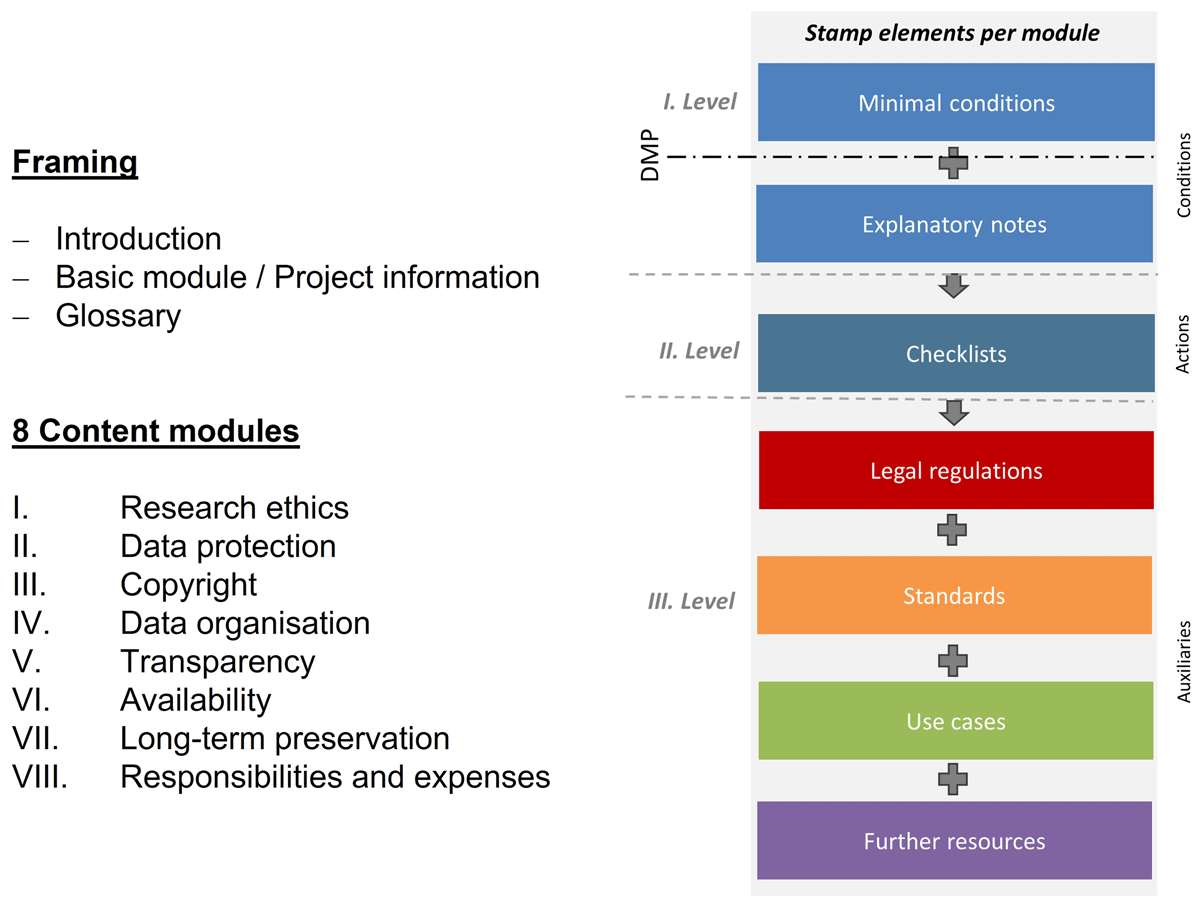
Figure 1
Overview of the Stamp.
Table 1
Minimal Conditions of the Stamp.
| I. Research Ethics Data and related materials are processed in accordance with the rules of good scientific practice. The project members respect (personal) rights of everyone involved in the project throughout its duration and beyond. II. Data Protection Personal data will be processed in accordance with the legal requirements of data protection. This applies to (1) the secure processing of personal data during the project, (2) the availability of data for re-use by others beyond the project, and (3) the long-term preservation of relevant materials. III. Copyright Processing of data and related materials generated in the project as well as the materials of third parties re-used are carried out in accordance with the provisions of intellectual property rights. In the duration of the project, this applies to (1) the legally compliant use of materials in accordance with the project, (2) the transfer of copyrights to re-use the data in the context of data sharing with others, and (3) the long-term preservation of relevant materials beyond the project. IV. Data Organisation Data and related materials are systematically stored and secured in a protected back-up system to ensure its usability during the project (and, if necessary, beyond). V. Transparency Data and related materials are processed and documented in the project in such a way that project members as well as third parties can 1) recap the entire data genesis, and 2) (re-)use the data and related materials in the current project as well as beyond. VI. Availability As far as possible, all data and related materials generated in the project will be made available for re-use by others via a repository or research data centre. Shared data and related materials should be as comprehensive as possible in terms of content, as open as possible in terms of legal and research ethics and made available as early as possible in the duration of the project. VII. Long-Term Preservation Data and related materials that cannot be shared for re-use with others will be preserved for at least 10 years beyond the end of the project in accordance with the rules of good scientific practice. VIII. Responsibilities and Expenses Responsibilities and expenses are defined for processing data and related materials. It concerns both responsibilities for the implementation of the present Stamp and the expenses necessary to do so (1) over the entire duration of the project, (2) for the availability of data for re-use by others, and (3) for the long-term preservation of data and related materials beyond the project. |
Table 2
Checklist II.Ba.5 consent management (II. data protection).
| NOT APPLICABLE | CONSIDERED | ||
|---|---|---|---|
| ⚬ | II.Ba.5 | project members implement a consent management system, considering | |
| ⚬ | II.Ba.5.1 | the purposes of processing consented | |
| ⚬ | II.Ba.5.2 | further (categories) of recipients of data | |
| ⚬ | II.Ba.5.3 | the duration of data storage as well as the criteria for data destruction | |
| ⚬ | II.Ba.5.4 | the claiming of rights of the persons concerned, documenting | |
| ⚬ | II.Ba.5.4.1 | who has claimed which rights, when, and how | |
| ⚬ | II.Ba.5.4.2 | the timely communication with persons claimed their rights | |
| ⚬ | II.Ba.5.4.3 | consequences of right claiming for further data processing see use case on Objection Data Processing and Revocation of Consent (II.Ba.5.4.3.F) | |
| ⚬ | II.Ba.5.4.4 | restriction of rights of data subjects and its conditions see use case on Restricting Participant’s Right (II.Ba.5.4.4.F) | |
| ⚬ | II.Ba.5.5 | possible deadlines, e.g., for destructing contact data, according to the consent form |
Table 3
Checklist V.Al.11 Documentation of the measuring instrument and Checklist V.As.6 Documentation of the measuring instrument and the method of data analysis (V. Transparency).
| NOT APPLICABLE | CONSIDERED | |||||
|---|---|---|---|---|---|---|
| V.Al.11 Documentation of the Measuring Instrument | ||||||
| ⚬ | ⚬ | V.Al.11 | The documentation contains information on the measurement instrument at the study level | |||
| ⚬ | ⚬ | V.Al.11.1 | (documentation of the) original (digitalized) measurement instrument, including all questions, items, tasks, and answer options (as well as options for refusing to answer) | |||
| ⚬ | ⚬ | V.Al.11.2 | (documentation of) digitalized interviewer instructions | |||
| ⚬ | ⚬ | V.Al.11.3 | (documentation of) digitalized skip pattern structure in the measurement instrument | |||
| V.As.6 Documentation of the Measuring Instrument and the Method of Data Analysis | ||||||
| ⚬ | V.As.6 | The documentation contains information on the survey instrument and the evaluation method on the study level | ||||
| ⚬ | ⚬ | V.As.6.1 | (documentation of the) original (digitalized) measurement instrument | |||
| ⚬ | ⚬ | V.As.6.2 | (documentation of) digitalized documentation forms, socio-demographic questionnaire, interview guide, etc. | |||
| ⚬ | ⚬ | V.As.6.3 | description of document collection or protocolling of interviews see recommendations on Observation Protocols (V.As.6.3.E) | |||
| ⚬ | V.As.6.4 | description of specifications regarding data storage, transport and preservation of recording and observations | ||||
| ⚬ | V.As.6.5 | description of data collection and measures to ensure data quality | ||||
| ⚬ | ⚬ | V.As.6.6 | citation (source, persistent identifier, and mode of citation, if applicable) and licence conditions of all materials (re-)used in the project, such as | |||
| ⚬ | ⚬ | V.As.6.6.1 | data, artefacts, and documents | |||
| ⚬ | ⚬ | V.As.6.6.2 | further measurement instruments, like interview guides | |||
| ⚬ | ⚬ | V.As.6.6.3 | supporting materials for interviewing, stimuli etc. | |||
| ⚬ | V.As.6.7 | (documentation of) method of data analysis | ||||