
Table 1
Sources of data for the case study (see also supplementary files for survey and interview questionnaires).
| DATA SOURCE | INDIVIDUALS PER DATA SOURCE | DESCRIPTION |
|---|---|---|
| Field notes | 49 | Field notes from program coordinators and external evaluators that include observations about fellows and their interactions with the fellowship and RDA. |
| Fellow CV | 49 | Resumes and curriculum vitae of accepted applicants. |
| Fellow application statement | 49 | Statements submitted by fellows during the application process. Statements included brief descriptions of the applicant’s research interests and relevance of RDA to their career. |
| Orientation survey | 32 | Follow-up surveys that were sent to each cohort after the orientation with questions about fellows’ perceptions of the event, the RDA and the fellowship. |
| Plenary survey | 51 | Follow-up surveys that were sent to fellow attendees after each plenary with questions about fellows’ perceptions of the event and their participation in it and the RDA. |
| Fellow interview | 35 | Structured interviews with the fellows, containing questions about fellows’ perceptions of the program, the organizers, and the benefits to their career. The cohort of 2014 was not included in the evaluation process and therefore was not interviewed. |
| Program coordinators interview | 4 | Structured interviews with program coordinators, containing questions about the coordinators’ role in the program and their perception of its activities and impact. |
| Mentor interview | 6 | Structured interviews with mentors, containing questions about the mentors’ role in the program and their perception of the fellows’ performance. The formal mentorship program was in place only in 2015. |
| Fellow final report | 17 | Reports that were submitted by the fellows at the completion of their fellowship. |
| Fellow poster | 60 | Fellows’ posters presented at the plenaries as part of their program (some fellows presented more than one poster). |
Table 2
Gender representation across cohorts.
| 2014 INTERN/FELLOW | 2015 FELLOW | 2016 FELLOW | 2017 FELLOW | TOTAL | |
|---|---|---|---|---|---|
| Female | 6 | 3 | 7 | 9 | 25 |
| Male | 8 | 5 | 7 | 4 | 24 |
| Total | 14 | 8 | 14 | 13 | 49 |
Table 3
Fellows’ position title categories.
| TITLE CATEGORY | FREQUENCY | PERCENT |
|---|---|---|
| Academic (e.g., assistant professor, lecturer, other faculty) | 8 | 16% |
| Professional (e.g., data manager, librarian, software developer) | 8 | 16% |
| Graduate student (doctoral or master’s) | 25 | 51% |
| Postdoctoral fellow | 8 | 16% |
Table 4
Fellows’ degree areas.
| DEGREE AREA | FREQUENCY | PERCENT |
|---|---|---|
| Computer science/Engineering | 8 | 16% |
| Life sciences | 5 | 10% |
| Library and information science | 23 | 47% |
| Physical sciences | 2 | 4% |
| Social sciences | 4 | 8% |
| Other (e.g., statistics, public health, IT) | 7 | 14% |
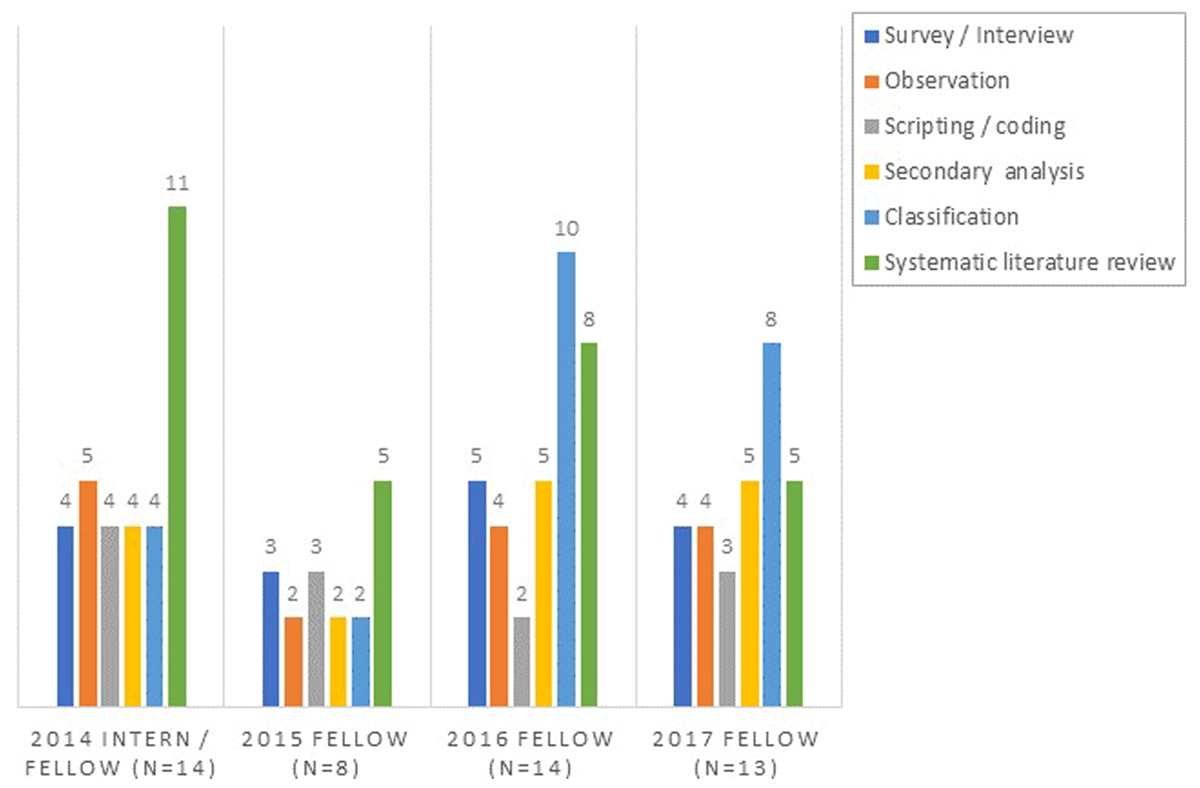
Figure 1
Use of methods in fellows’ projects (each fellow could use more than one method).
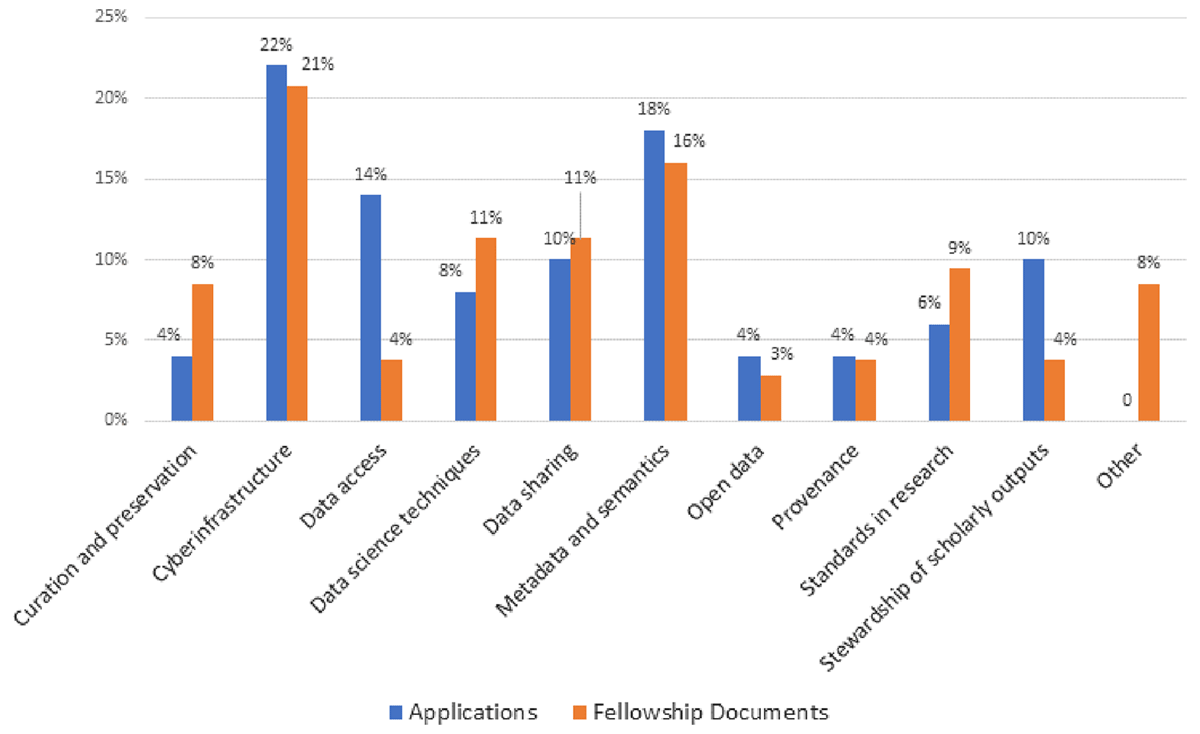
Figure 2
Themes in ECs applications (N = 49) and documents during the fellowship (N = 112).
Table 5
Recommendations and outcomes that promote interdisciplinary and open data cultures.
| RECOMMENDATION | POSSIBLE OUTCOMES |
|---|---|
| Reach out to multiple disciplinary and cross-disciplinary areas to ensure a diverse representation of applicants and participants | Increased opportunities for participation in the program along multiple criteria of diversity (demographic, educational, social, and so on) Changes in one’s own attitudes and behavior |
| Use mutual sharing among participants, guided discussions, and collaborative projects to help ECs learn about data practices in other research fields and in other geographical regions | Respect for diverse methodologies and epistemological standpoints Improved communication across diverse groups Broader professional networks |
| Incorporate both formal and informal training that covers a broad range of competencies in professional conduct | Skills that are applicable to all stages of the research and data lifecycle (European Commission Working Group on Education and Skills, 2017) Awareness of multiple stakeholders that are involved in and contributed to data cultures Ability to continue learning and participate in diverse communities |
| Engage speakers and mentors from both academic and professional fields to bridge gaps between practice and research | Interpretations of openness and interdisciplinarity as concepts that are changing and can sometimes be contested, expanded or transformed (Barry et al, 2008; Fecher and Friesike, 2014) Problem-oriented mindsets Broader professional networks |
| Provide interdisciplinary mentorship and discuss alternative career paths | An expanded repertoire of possible careers Diversification of norms, expectations and decisions in academic careers (Laudel et al, 2019) |
| Incorporate themes and activities that focus on action, leadership and change, e.g., include an explicit open science pledge for ECs (Farnham et al, 2017) | Understanding of the gaps between norms and behaviors in science and research (Anderson et al, 2007; Bray and von Storch, 2017; Nosek et al, 2015) Changes in one’s own attitudes and behavior |