
Table 1
RDA outputs applied to the management of the DiSSCo data lifecycle.
| RDA output | RDA IG/WG | DiSSCo Element | Purpose | Workflow/Data phase |
|---|---|---|---|---|
| 1. Adoption of Digital Object Architecture | Data Foundation and Terminology WG Data Fabric and Terminology IG | DiSSCo Digital Specimen Architecture | Define the FAIR Digital Object Architecture of DiSSCo, including the Digital Specimen Object Model | Creation and management of digital objects/All phases of the data life cycle |
| 2. Persistent Identifiers and Kernel Information | PID Kernel WG | Meta-information about a digital object and DiSSCo (data) type registry | Allowing smart programmatic decisions and inspection of the object’s PID record | Data acquisition, curation, publishing, use |
| 3. Aggregation of digital objects | Research Data Collection WG | DiSSCo data repository/portal/API | Provide meaningful entities and serving the data | Data publishing and use (share, download) |
| 4. Metadata attribution and use of PROV entities | RDA/TDWG Metadata attribution working group | Digital Specimen and collection objects | Correctly attribute sources of data and work carried out | Digitization, curation and maintenance of digital object (for example collection objects or specimens) |
| 5. FAIR data maturity model | RDA FAIR data maturity model working group | DiSSCo Digital Specimen Architecture | Develop guidelines and specifications to assess FAIR implementation plan. | DiSSCo data lifecycle |
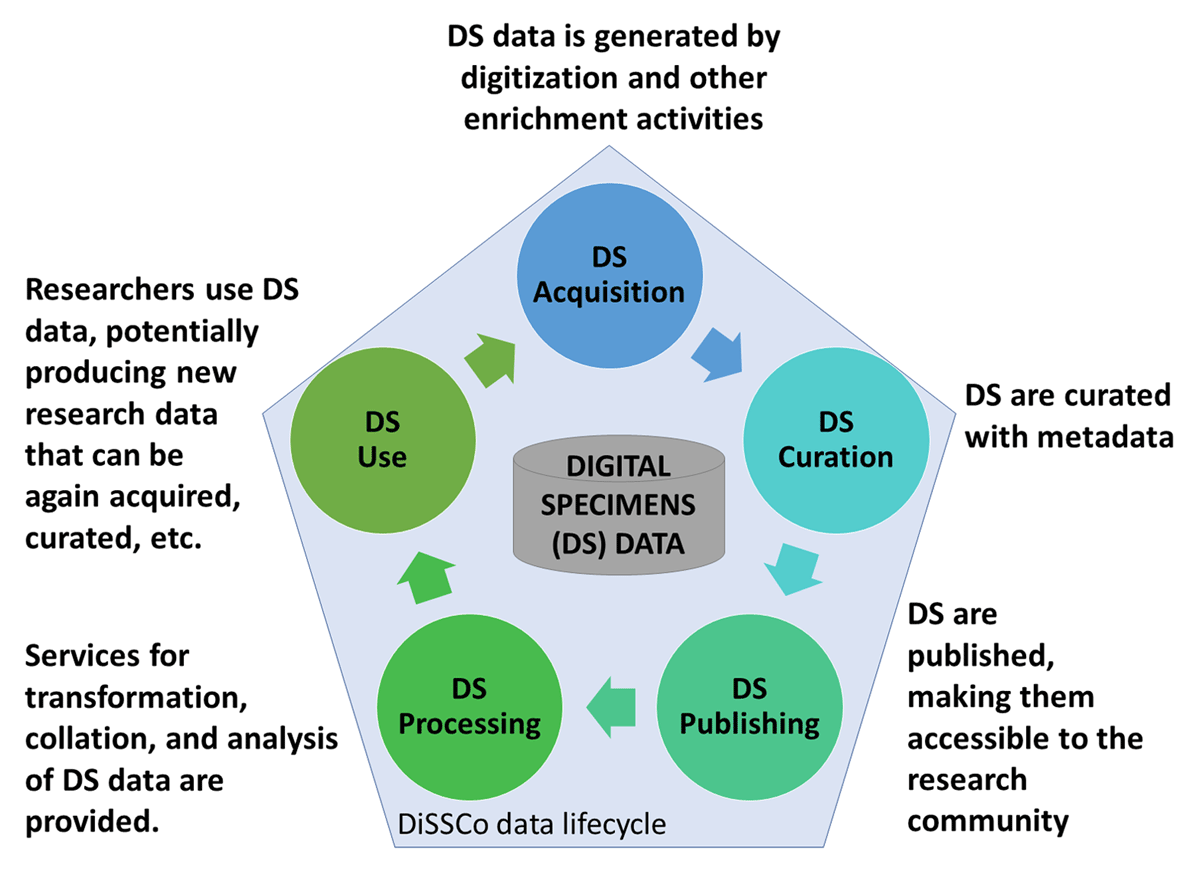
Figure 1
Lifecycle of Digital Specimen research data in the DiSSCo data infrastructure, from acquisition through curation, publishing, processing and use, which can create new data that can be iteratively acquired, curated, etc.
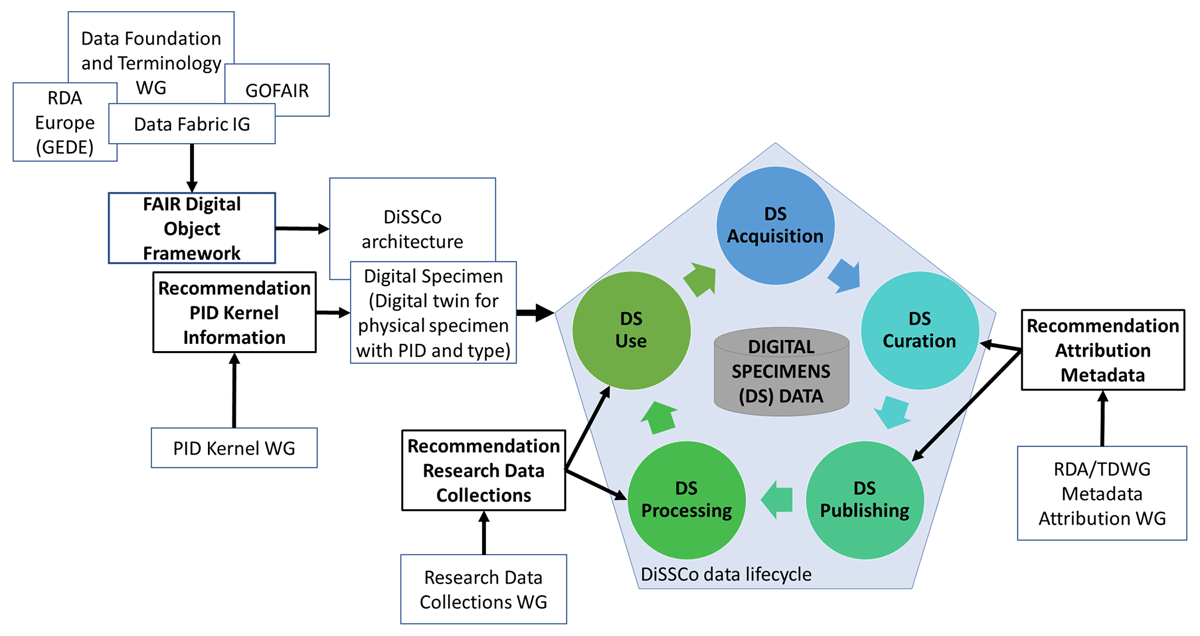
Figure 2
Contributions of RDA outputs to the design of data management in the DiSSCo Digital Specimen data infrastructure. The FAIR Digital Object Framework and the Recommendation on PID Kernel Information contribute to the architecture as a whole while the Recommendation on Research Data Collections and Attribution Metadata contribute more explicitly into specific phases of the data lifecycle.
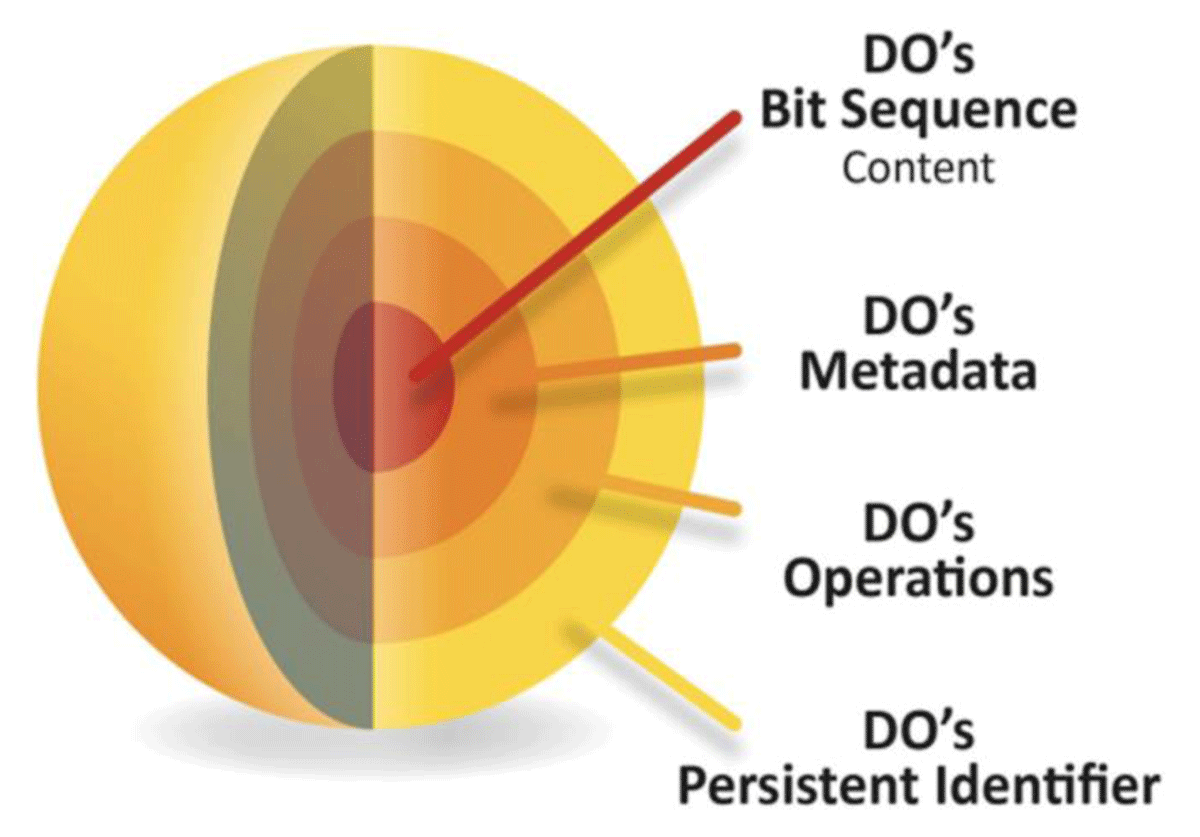
Figure 3a
Main components of a digital object – The core of the DO is a bit sequence that is encoding content (data, metadata, software, etc.). This is described by metadata to enable access and for correct interpretation. A persistent identifier uniquely identifies the DO and operations permit the content and metadata to be manipulated. Reproduced with permission (Wittenburg et al. 2019).
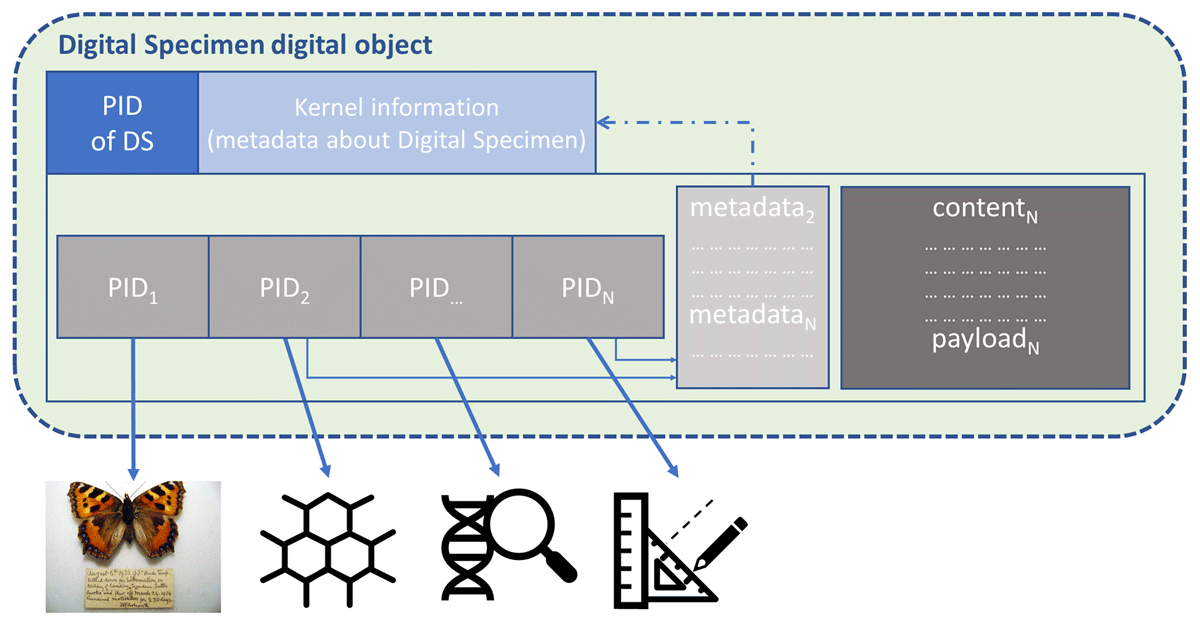
Figure 3b
Basic structure of a Digital Specimen (DS). A DS acts as a container for pointers, metadata and embedded content, i.e., information about and derived from the corresponding physical specimen including but not limited to, for example, necessary information about the specimen, image(s), molecular data, genetic sequence data, and morphological measurements.
Table 2
Simple example of PID Kernel Information for a Digital Specimen. Example PID: 123prefix/uuid-27a9edf63.
| Attribute | Value Type | Example Value |
|---|---|---|
| Location | url | http://example-dissco-repo/uuid-27a9edf63 |
| Created | date and time | 2019-04-24T11:07:11.771Z |
| Type | type definition | typedef123/DigitalSpecimen |
| PhysicalSpecimenId | string | BMNH:1905.5.30.352 |
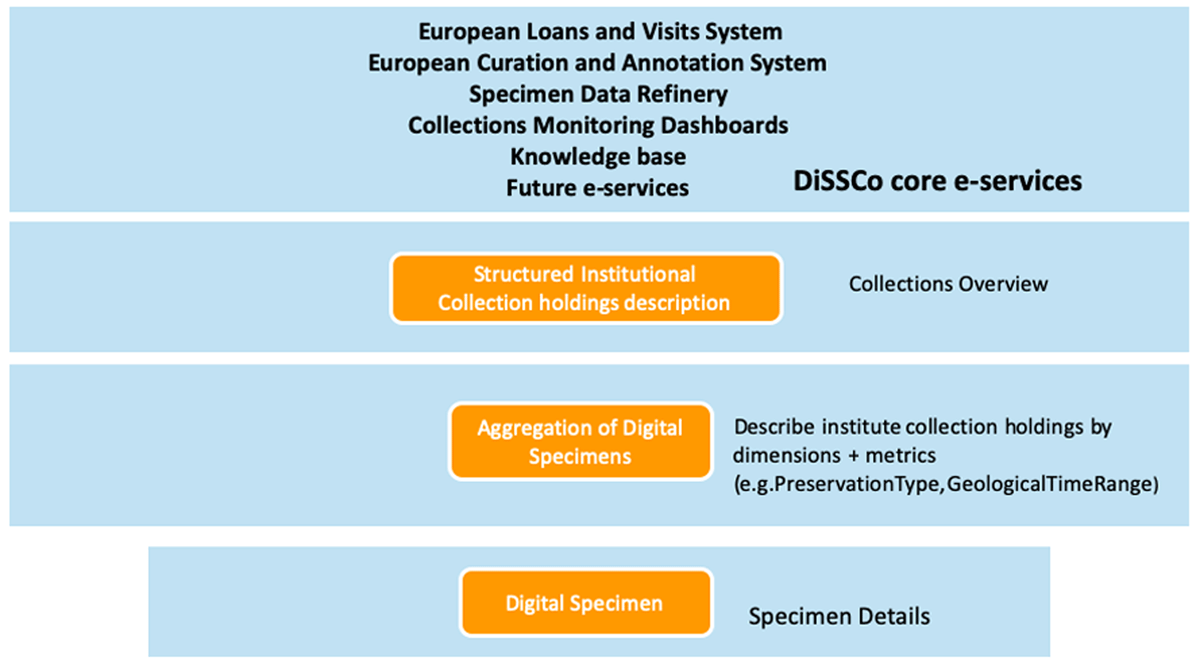
Figure 4
Building blocks of DiSSCo e-services start with individual objects (represented digitally through Digital Specimens), collections and collections overview.