
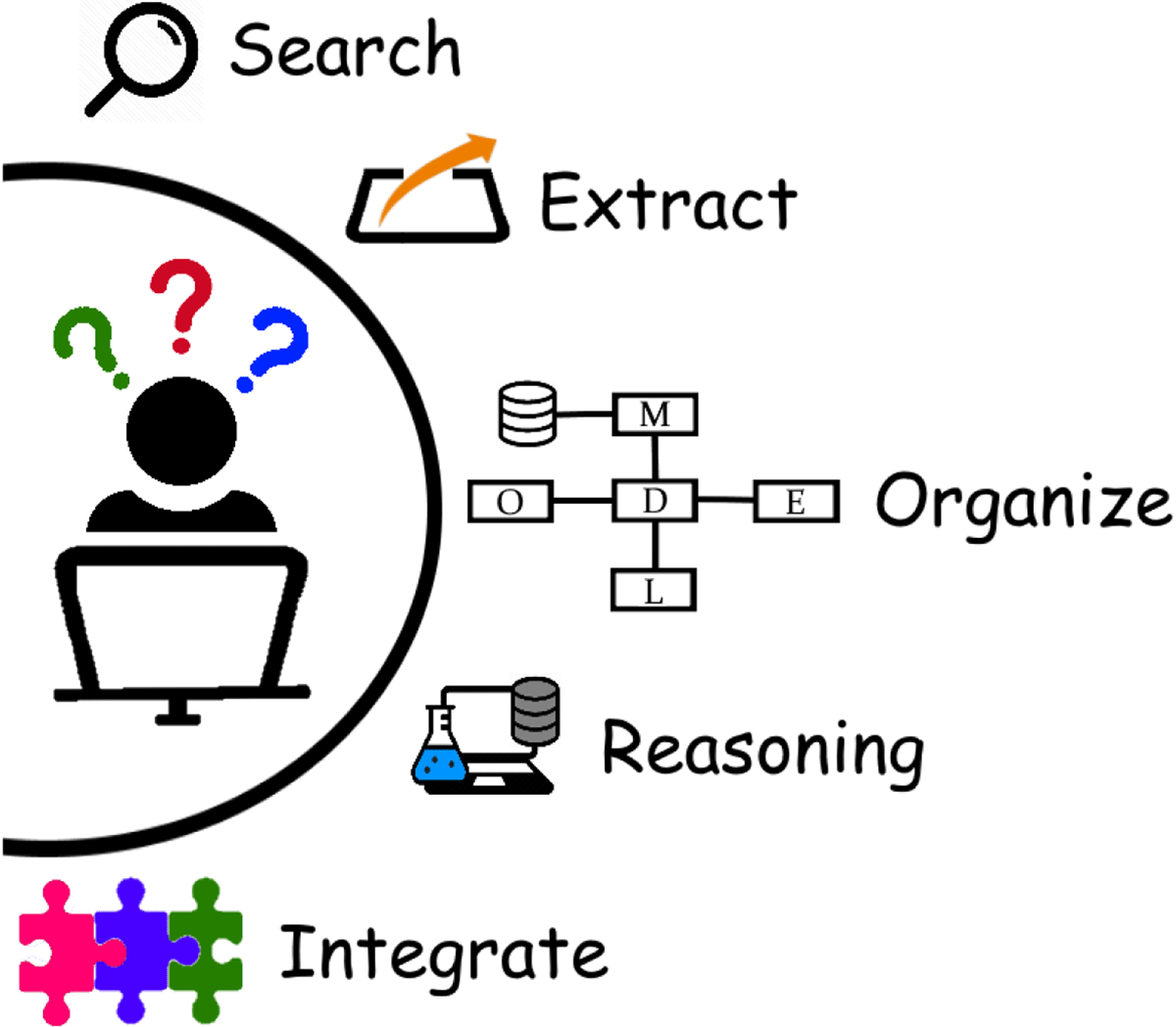
Figure 1
The five main tasks identified by the Agrisemantics WG as involving semantics.
Table 1
Summary view of the recommendations (third column), organized by the user profile they are most relevant to (first column), and the topic they are concerned with (second column). In the third column, a reference to the corresponding recommendations if given in parenthesis.
| User profile | Topic | Recommendations |
|---|---|---|
| Semantic web developers | Integration | Consider integration and interoperability from the beginning to facilitate connections to other SRs (R10) and integration into suites (R1). Using open source licenses (R2), adding metadata (R6), and automatically notifying of new releases (R11) will make integration easier |
| Best practices and quality | Following best practices (R3) and ensuring some quality level (R9) are always a good idea when developing software | |
| Alignment/matching/mapping support | With that many vocabularies, it is useful to support alignment, matching, and/or mapping approaches (R12, R13). Also allow for customization of those editing and alignment tools supported by your platform (R8) | |
| End User | Always consider end-users, prepare to provide documentation (R4) and support for both semantic and non-semantic experts (R5). Also, include some guidance on how to choose the right semantic data structure (R7) | |
| Semantic professionals | FAIR principles | Implement the FAIR principles (R14), deposit versions in repositories (R15) from alpha to production releases (R16), reuse SRs (R18, R20) |
| Best practices and quality | Use best practices (R17) and metrics to assess usage (R22) | |
| Community | Promote communities of practice (R19) and use of standards (R21) together with recommendation and training (R23) and use cases, lessons learnt, etc. (R24) | |
| Developers of data platforms consuming semantic resources | Technologies | Keep up to date concerning technologies (R25), support multiple formats (R29) |
| Best practices and quality | Support multiple functionalities (R26), use metadata to describe data (R27) and semantics to characterize it (R28) | |
| Data managers and producers | Best practices and quality | Get familiar with Research Data Management (RDM) (R30) plans and use them (R31), carefully characterize your data (R32), prefer SRs whenever possible (R33), and document cross-references (R34) |
| Policy makers and funders | Best practices and quality | Encourage the use of SRs (R35), |
| Maintenance | Provide support for maintenance (R36, R38) | |
| Community | Promote discoverability (R37) and dissemination via training (R39) |
Table 2
How the Agrisemantics WG’s recommendations align with the FAIR principles.
| FAIR | Agrisemantics | Comment |
|---|---|---|
| Findable | R6, R10, R14, R16 | Our recommendations insist on the importance of rich standardized metadata for SR (F2) and to register or index SR in searchable catalogs and repositories (F4). Also, we do recommend SR are assigned a globally unique and persistent identifier (F1). |
| Accessible | R10, R14 | Several of our recommendations enforce the use of Semantic Web technologies to facilitate data access (A1). We also encourage sharing both SR and their metadata in various repositories and catalogs so they become accessible, even when the SRs are no longer directly available (A2). |
| Interoperable | R1, R7, R12, R13, R18, R21, R26, R28, R29, R31 | A handful of our recommendations are related to interoperability. Recommendations related to format and technologies encourage the use of appropriate, formal, accessible, shared, and broadly applicable languages for knowledge representation, alignment, and metadata (I1). We also strongly support the (re)use of other SRs and/or standard vocabularies when building a SR (I2). Then, the recommendations about alignment intersect with the notion of qualified references between SR (I3). |
| Reusable | R2, R4, R26, R32, R33, R36 | We do recommend tools and SRs are released with a clear and accessible data usage license (R1.1) and work with domain-relevant community standards for both SR content and metadata (R1.3) as well as with semantically enabled data types. We also encourage important documentation and description of the SRs and provenance processes (R1.2). |