
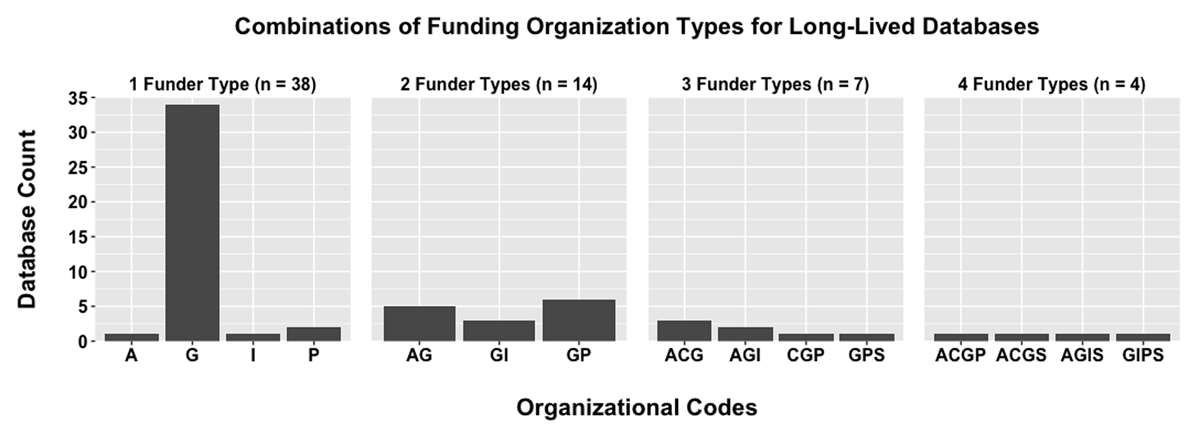
Figure 1
The distribution of funding organizations for the 63 reporting databases shows none attributed more than four distinct types of funders, with the majority of databases attributing support to only government organizations. Organizational codes are A (academic), C (consortium/collective), G (government), I (industry), P (philanthropic), and S (society/association).
Table 1
Top 10% of organizations most frequently reported as funding the 63 long-lived molecular biology databases within this study which reported funding support.
| Rank | Funder | Org Code | Database Count |
|---|---|---|---|
| 1 | US National Institutes of Health | G | 29 |
| 2 | European Commission | G | 13 |
| 3 | UK Biotechnology and Biological Sciences Research Council | G | 7 |
| US Department of Energy | G | 7 | |
| 4 | Ministry of Education Culture Sports Science and Technology of Japan | G | 6 |
| US National Science Foundation | G | 6 | |
| 5 | Japan Science and Technology Agency | G | 5 |
| European Molecular Biology Laboratory | G | 5 | |
| Danish Ministry of Higher Education and Science | G | 5 |
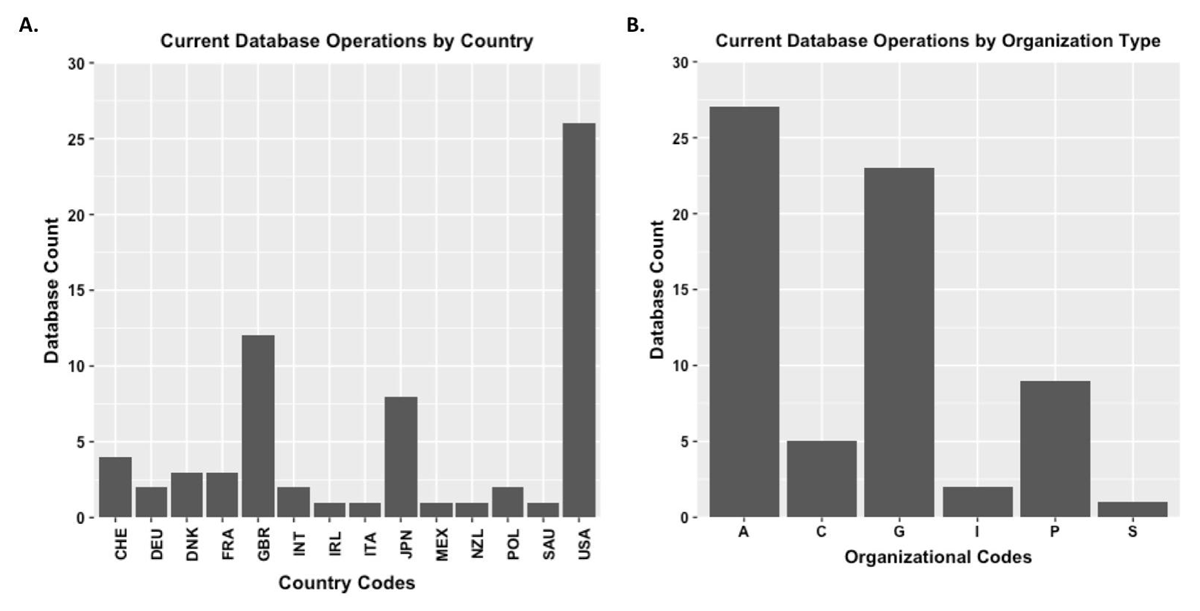
Figure 2
Panel A: Operational responsibilities for 67 long-lived databases are spread across 13 distinct countries. Country codes provided follow the ISO standard, with the exception of “INT” for “international” when operational responsibilities were determined to be split across multiple countries. Panel B: Operational responsibilities for 67 long-lived databases were found to be most likely to fall to academic and government organizations. Organizational codes are A (academic), C (consortium/collective), G (government), I (industry), P (philanthropic), and S (society/association).
Table 2
Top 10% of organizations most frequently operating the 67 long-lived molecular biology databases within this study.
| Rank | Operator | Org Code | Database Count |
|---|---|---|---|
| 1 | European Molecular Biology Laboratory | G | 8 |
| 2 | Swiss Institute of Bioinformatics | G | 4 |
| US National Institutes of Health | G | 4 | |
| 3 | Kazusa DNA Research Institute | P | 3 |
| Jackson Laboratory | P | 3 |