
Table 1
Policy feature definitions.
| Feature | What | Why |
|---|---|---|
| Definition of research data | Define which research data the policy applies to, and the types of research data covered by the policy. | This enables the policy to define its scope and, where appropriate, provide general or discipline specific information on research data and file and format types (Hodson & Molloy, 2015). Specifying non-numeric data types (images, video, text etc) helps ensure relevance and applicability across research disciplines. |
| Definition of exceptions | Define what data do not need to be, or should not be made publicly available, under the policy and the alternative options for describing the availability of these data. | Ensures data policy is applicable to all research publications, but acknowledges legitimate exceptions and makes clear the policy does not create new legal or ethical precedents. |
| Embargoes | Define if and what embargoes on data release are permitted. | Researchers’ reasonable right of first use of data generated during their research is a widely accepted principle of data sharing (Anon, 2016b), but reasonable lengths of embargo may vary by discipline, data type and study. |
| Supplementary materials | Define the journal/publisher’s position on data sharing via supplementary materials, and if and when sharing data as supplementary materials is permitted under the policy. | While many policies preference sharing data in repositories (McCarthy, 2009; Santos, Blake & States, 2005; Evangelou, Trikalinos & Ioannidis, 2005), sharing data as supplementary materials remains very common. Some journals have strong data sharing policies and specify supplementary materials as the mechanism for data sharing. Supplementary materials are often a solution for researchers without discipline specific repositories and the definitions of supplementary material and research data often overlap. |
| Data repositories | State position on the use of data repositories. Data repositories are the preferred mechanism for sharing data with community/discipline specific repositories preferred to general repositories, where they are available. | Lack of an appropriate repository or lack of awareness of repositories are common reasons reported by researchers for not sharing data (Stuart, Baynes, Hrynaszkiewicz, et al., 2018). Journal and publisher information for authors is an important way of raising awareness of the availability of repositories for the majority of research data (Schmidt, Gemeinholzer & Treloar, 2016). |
| Data citation | Statement on the journal/publisher’s support for the provision of persistent identifiers for research data that support publications, and statement of support for data persistent identifiers to be included in the reference list as formal citations. Includes whether data citation is encouraged or required. | Citing and linking to data increases visibility of research, increases academic credit and has been correlated with published articles receiving more citations (Piwowar & Vision, 2013; Piwowar, Day & Fridsma, 2007; Anon, n.d.; Henneken & Accomazzi, 2011; Dorch, Drachen & Ellegaard, 2015). This benefits researchers, journals, publishers, and society. Data citation in reference lists occurs in a fraction of published literature but is steadily increasing (Anon, n.d.). To ensure data citation happens consistently in published articles requires additional effort from authors and editors, and therefore operational costs, but enhances reader and use experience by consistently linking important research outputs (Cousijn, Kenall, Ganley, et al., 2018). |
| Data licensing | Define position on licensing and copyright for research data. | Lack of understanding of copyright and
licensing of research data is a common reason why researchers
don’t share data (Stuart, Baynes,
Hrynaszkiewicz, et al., 2018).
Journal/publisher policy can help increase awareness and prevalence of
explicit, and ideally open, licenses for research data. However, many
established repositories do not have open data-conformant licenses and
this is unlikely to change in the foreseeable future (Anon, 2017). Publishers are frequently asked whether the journal/publisher requires copyright transfer for datasets. Publishers issued a joint statement in 2006 declaring they would not take copyright in research data (STM & ALPSP, 2006). |
| Researcher/author support | Information on who authors should contact at the journal or publisher for more information on complying with the policy. | Research data sharing remains a new concept for some journals and disciplines and common questions can be answered by journal and publishing staff, such as writing data availability statements, finding repositories and on exceptions to the policy (Astell, Hrynaszkiewicz, Grant, et al., n.d.). |
| Data availability statements (DASs) | Define position on provision of data availability statements. | Data availability statements are a simple,
consistent, human and, increasingly, machine-readable way of expressing
data availability and policy compliance. They are already encouraged, expected or required by many journals and publishers and some funding agencies (Anon, 2016a; Murphy & Samors, 2018). |
| Data formats and standards | State position on the use of community/discipline-specific data standards – whether encouraged, required in some cases, or required in all cases. Also state whether certain file formats, such as open formats, are preferred or required. | Data prepared according to community standards
are more interoperable and reusable, and data available in open formats
are more accessible (Sansone, McQuilton,
Rocca-Serra, et al., 2019). Data standards are distinct from reporting standards, which are not within the scope of a research data policy. (e.g. MIAME as a reporting standard for papers describing for microarray experiments). |
| Mandatory data sharing (specific papers) | Statement on whether data sharing is mandatory for specific types of research data, such as where there is a community or journal-specific mandate, and the mechanism(s) by which these types of data must be shared. Examples include DNA and RNA sequence data, and macromolecular structure data. | Where there are established community mandates for data sharing, journals and publishers have an obligation to support editors and researchers in upholding community standards as part of their service to the research communities they serve (Anon, n.d.). |
| Mandatory data sharing (all papers) | Sharing of research data via an external mechanism (repositories or supplementary information) is a condition of submission or publication for all articles published. | Mandatory data sharing policies that are enforced during the peer-review and publishing process, and supported with suitable data repositories, are the most effective policies (Vines, Andrew, Bock, et al., 2013). These policies can also be more costly (time consuming) to implement and have the greatest impact on editors and authors (Grant & Hrynaszkiewicz, 2018). They could however have the most benefits in terms of increasing citations and visibility of papers. |
| Peer review of data | Statement on whether peer review of data is
expected or required, and if so what the expectations of peer reviewers
are in their assessment of data files. Reviewers can also or alternatively be asked to assess compliance with research data policy. | Where data are made available with research articles they are accessible to peer reviewers, but for journals with a strong focus on data, such as data journals, consistent review of the data and the description of those data can be required. Peer review traditionally focuses on manuscripts rather than data, but more consistent availability of data for validation and reuse can improve the reproducibility – and quality – of published research (Anon, 2016c). |
| Data Management Plans (DMPs) | State position on sharing of DMPs. | This is currently uncommon in journal and publisher policy although encouraging their provision is analogous to the number of medical journals which encourage or require sharing or publication of study protocols. Furthermore, they are increasingly required by funding agencies. Some journals, such as RIO journal, publish them as articles. |
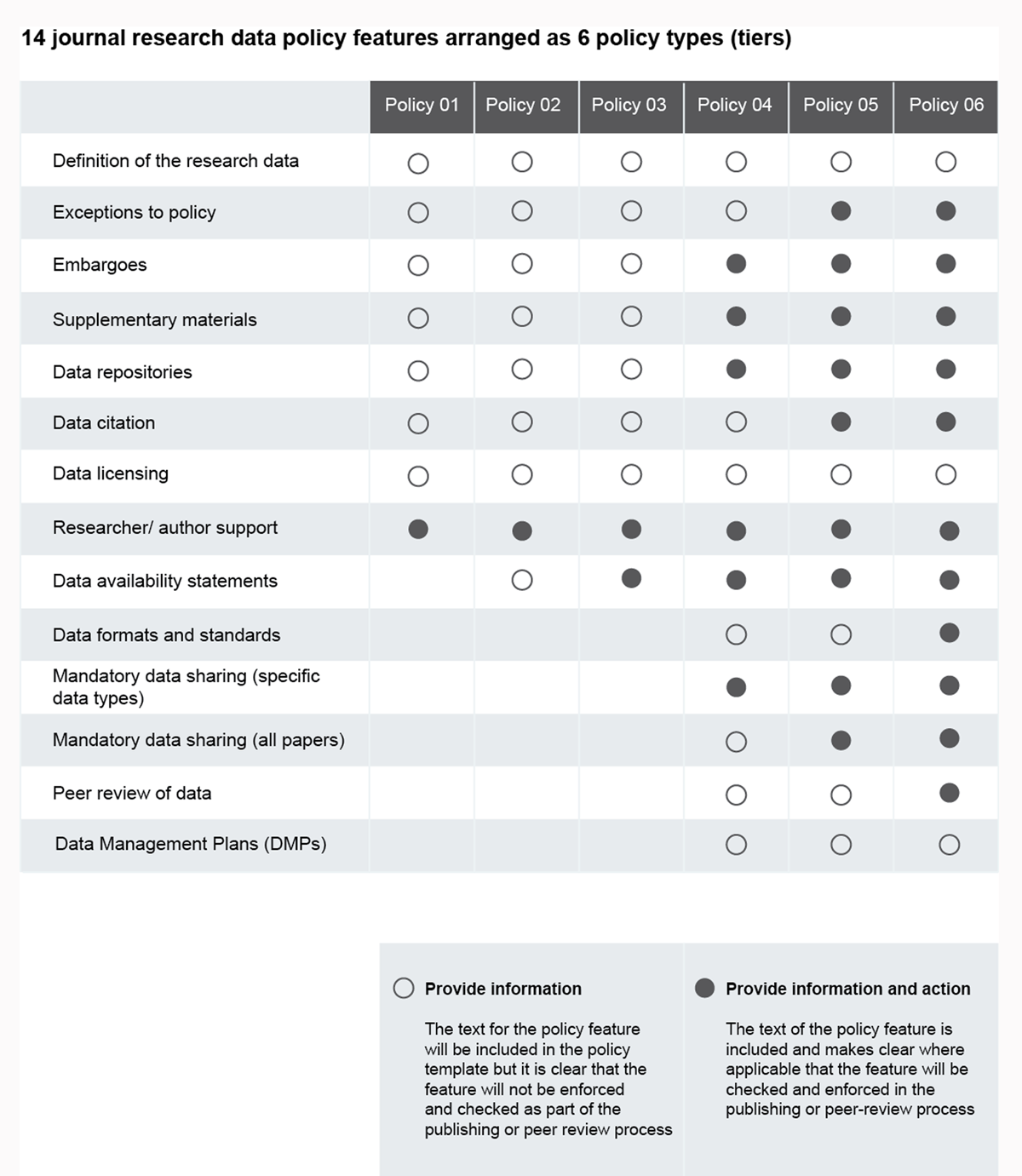
Figure 1
Fourteen journal research data policy features arranged as six policy types (tiers).