
| Result for (a): | Nigeria, Tertiary, Institution, Management |
| Result for (b): | Knowledge, Grid, “knowledge sharing” |
| Result for (c): | library, blood, HIV, AIDS, Autism, Breast, Cancer, Aquaculture, Hospital, Water, Solar, Manufacturing, Vegetable, Human, Resource, Audit, Drug, Law, Bird, Property |
| Result for (d): | Nigeria Tertiary institution management Knowledge OR Grid OR “knowledge sharing” -library -blood -HIV -AIDS -Autism -Breast -Cancer -aquaculture -hospital -water -Solar -Manufacturing -Vegetable -Human -Resource -Audit -drug -law -bird -property |
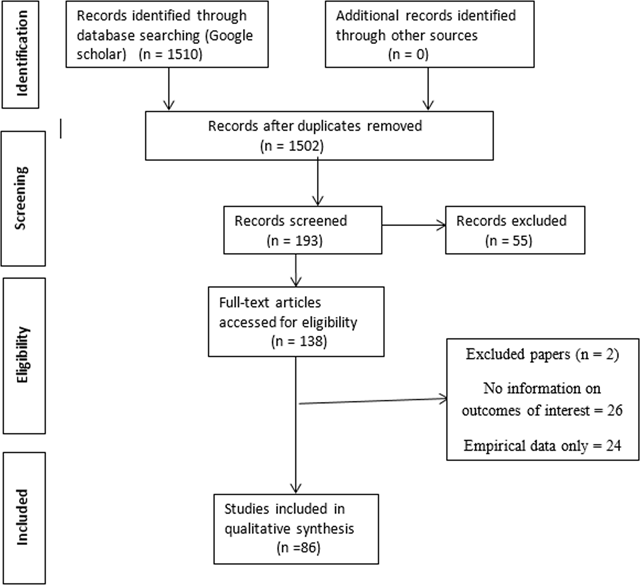
Figure 1
Preferred Reporting Items for Systematic Reviews and Meta-Analyses (PRISMA) Flow Diagram of Included Studies.
Table 1
Summary of Grid Technologies implemented outside Nigeria.
| Author(S) | Research Title | Research Description | Applied Area | Technology Used | Continent (Country) |
|---|---|---|---|---|---|
| Cannataro, Talia, and Trunfio (2001) | Knowledge Grid: High Performance Knowledge Discovery Service On The Grid | The aim of this paper was the design and implementation of a parallel and distributed knowledge discovery (PDKD) architecture that integrate data mining techniques and computational grid resources. The Knowledge Grid allowed the cooperation of scientists that must mine data that are stored in different research centres | General | Knowledge Grid | Europe (Italy) |
| Zhuge (2002) | A knowledge grid model and platform for global knowledge sharing | This paper developed a knowledge grid model for sharing and managing globally distributed knowledge resources. The model arranges knowledge in a three dimensional knowledge space (category, level and location) and provides a knowledge grid operational language (KGOL). | General | Knowledge Grid | Asia (China) |
| Wang and Liqun Ji (2005) | An Effective Knowledge Management Environment Based on Knowledge Grid in Business Organizations | This paper developed a theoretical and pragmatic architecture of knowledge management system based on Knowledge Grid for better implementation of knowledge management (KM) in business organizations to facilitate their growth and development. This paper objectively analysed the environmental problems that most of those enterprises that are knowledge-based encounter in such a distributed, increasingly changing environment. | Business | Knowledge Grid | Asia (China) |
| Arenas, Comito, Talia et. al. (2008) | Knowledge and Data Management in Grids: Notes on the State of the Art | A review on the use of grids for management of data was carried out. The authors established the significance of knowledge in supporting high-level applications where Grids are used as supporting platforms, engines and tools for complex information systems. | General | Grid computing | Europe |
| Mach and Owoc (2010) | Knowledge Granularity and Representation of Knowledge: Towards Knowledge Grid | In this paper, relationships between knowledge granularity as a result of different ways of knowledge representation were considered. The paper addressed problem of developing knowledge grid in the context of encapsulation of knowledge including different dimensions and measures. | General | Knowledge Grid | Europe (Poland) |
| Lecca et al. (2011) | Grid computing technology for hydrological applications. | The paper illustrated the results of six different surface and subsurface hydrology applications that have been deployed on the Grid. This paradigm handles several topics including data management, algorithm optimization, security, performance, and collaboration issues. | Hydrology | Grid computing | Europe (Italy/France) |
| Owoc and Weichbroth (2015) | Toward knowledge-grid model for Academic purposes | This paper developed a multi-dimensional knowledge space model, designed to efficiently distribute and manage knowledge resources. This hybrid technique combined web log analysis and context-aware knowledge. Final presentation is a useful and valuable tool for students and scholars. | Academic | Knowledge Grid | Europe (Poland) |
| Caballé, Miguel, Xhafa, Capuano and Conesa (2017) | Using trustworthy web services for secure e-assessment in collaborative learning grids | This paper presented a framework that integrate flexible and interoperable Web based secure e-learning services based on trustworthiness model into e-assessment activities in on-line collaborative learning courses. This service-oriented secure assessment model combined both technological security solutions and functional trustworthiness services | Academic | Grid computing | Europe (Spain, Italy) |
| McCloughlin and Matthews (2017) | Personal Constructions of Biological Concepts – The Repertory Grid Approach | A review of repertory grid analysis as a tool for investigating the structures of students’ representations of biological concepts was carried out. The biological concepts examined are ‘natural kinds’: a technical class of concepts which ‘appear’ to have invisible ‘essences’ meaning carrying more perceptual weight than being perceptually similar. | Academic | Grid computing | Europe (Dublin, Ireland) |
| Raja, Pandian, Pamina (2017) | Certificate Revocation Mechanism in Mobile ADHOC Grid Architecture | In this paper, the grid architecture was designed by using trace based approach to trace the mobile nodes and thus removed the malicious nodes using the revocation mechanism. The mobility of the nodes which is the major problem in the Mobile Ad-Hoc Network (MANET) was fixed by carefully determining the position and stability time parameters of the mobile nodes. | Communication | Grid computing | Asia (India) |
| Murumba and Micheni (2017) | Grid Computing For Collaborative Research Systems in Kenyan Universities | This paper identified opportunities, benefits and challenges in using grid technologies to support collaborative research in universities especially Kenyan and encourages developing countries to adopt it because of its benefits | Academics | Grid computing | Africa (Kenya) |
| Nhien-An Le-Khac, Kechadi and Carthy (2017) | Admire Framework: Distributed Data Mining (DDM) On Data Grid Platforms | This paper presented the ADMIRE architecture; a new framework based on Grid infrastructure for implementing DDM techniques. It is more dynamic and autonomous in the mining, integrating and processing phases. | commercial and academic applications | Grid and peer to peer system | Europe (Dublin, Ireland) |
| Aouad, Nhien-An Le-Khac, and Tahar Kechadi (2017) | Variance-based Distributed Clustering | In this paper, the need for efficient distributed and grid-based clustering algorithms was presented. Therefore, distributed algorithm based on a variance constraint was proposed. This algorithm improves the quality of clustering while compared with classical local centralized and finds real global data nature. | General | Grid system | Europe (Dublin, Ireland) |
Table 2
Application of Grid Technology implemented in Nigerian.
| Author(S) | Research Title | Research Description | Applied Area | Technology Used | Operational Status |
|---|---|---|---|---|---|
| (Akinyemi, 2003; Akinyemi, Daramola, & Adebiyi, 2007) | Grid-Enabled e-Learning Framework for Nigerian Educational Institutions | An e-learning framework was design for Nigerian Education institutions using Grid technology | Academics | Grid computing | Theoretical framework and not practically in use |
| (Onyeka, Olawande, & Charles, 2010) | A Grid-Based E-Learning Model For Open Universities | A Grid-based e-learning model for Open Universities was proposed. Universities can set up multiple remotely located campuses within a country e.g. National Open University (NOUN) | Academics | Grid computing | Theoretical framework and not practically in use |
| (Uzoka, Akinnuwesi, Olabiyisi, & Demilade, 2011) | A case Analysis of factors affecting the adoption of Grid Technology by universities | With the increase in numbers of universities in Africa, lack of basic information technology resources, the adoption of grid computing will increase collaboration, enhanced research, course management and other development. This study identified key challenges of adopting grid computing in tertiary institutions. | Academics | Grid computing | Empirical study only |
| (Uzoka, Akinnuwesi, Olabiyisi, & Alabi, 2012) | An empirical study of potentials of adoption of grid computing as a vehicle for tertiary institutions collaboration | A practical study on the adoption of grid computing as a vehicle for collaboration among tertiary institutions in Nigeria was carried out. A new framework for adoption of this technology was proposed. The key challenges that suggestively affect the adoption of grid computing in tertiary institutions were discussed | Academics | Grid computing | Empirical study only |
| (Alowolodu, Alese, Adetunmbi, Adewale, & Ogundele, 2013) | Elliptic Curve Cryptography for Securing Cloud Computing Applications | Cloud computing requires that organizations trust that a service provider’s platforms are secured and provide a sufficient level of integrity for the client’s data. In this paper, Elliptic Curve Cryptography scheme was used as a secure tool to model a secured platform for the Cloud Application. | General | Cloud computing | Theoretical framework and not practically in use |
| (Ohiorenoya & Eboreime, 2014) | Knowledge Management Practices And Performance In Nigerian Universities | This paper investigated the relationship between knowledge management and performance and their variation in knowledge management effectiveness among Nigerian universities. Six accredited universities were selected, which were classified into two federal, two state and two private universities. Random sampling was used to select the various universities. | Academic | Knowledge Management | Empirical study |
| (Abdulraheem, Aremu, Adewole, & Muhamme, 2014) | Fingerprint Biometric-Based Cryptographic System as A Security Approach in Grid Environment | This paper examined Grid Architecture where various components of a grid play major role in resource sharing and securing of grid. Biometric-based model was used that provides security for grid users using fingerprint for authentication and authorization | general | Grid computing | Theoretical framework and not practically in use |