
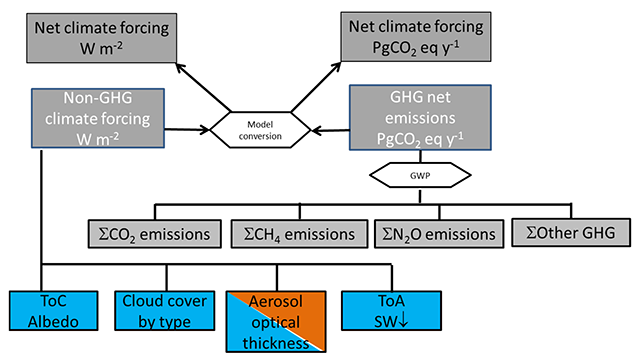
Figure 1
The top-level components of a climate forcing observation system for Africa. The global warming potential (GWP) is measured in units of CO2 equivalent (CO2 eq) and is derived from the net flux of the different GHG observation components. Non-GHG climate forcing components include top-of-canopy (ToC) albedo, cloud cover, aerosols and top-of-atmosphere (ToA) downward short-wave (SW) irradiance. Grey boxes illustrate observationally-constrained model products. Blue is for space-based observations, orange is for land-based observations.
Table 1
Set of 58 essential variables as identified by SEACRIFOG and respective data requirements. Underlined variables can largely be observed from space with complementary land-based/in situ observations. Conversely, variables in bold font were found to have particularly high design needs in terms of systematic in situ data generation across Africa. Note that uncertainties correspond to ±1 standard deviation from the actual value in percent, i.e. the percentual margins of a 68% confidence interval. The column ‘Defined By’ indicates the initiative from which the respective requirement specifications originate. A – Atmospheric; O – Oceanic; T – Terrestrial.
| Variable | Domain | Temporal Resolution (Target) | Spatial Resolution (Target) | Max. Uncertainty (Target) | Defined By |
|---|---|---|---|---|---|
| Aerosol properties | A | 4 h | 5 km | 10% | GCOS |
| Boundary layer height | A | 1 h | 20 km | 20% | SEACRIFOG |
| Cloud Cover Fraction | A | 1 h | 25 km | 10% | SEACRIFOG |
| Halocarbons | A | 1 week (flask) | 1 site | 5% | SEACRIFOG |
| Nitrogen Oxides (NOx) | A | 4 h | 5 km | 20% | GCOS |
| Non-methane hydrocarbons | A | 1 h | 1 site | 10% | WMO GAW |
| Sulfur Dioxide (SO2) | A | 4 h | 5 km | 30% | GCOS |
| Tropospheric Carbon Monoxide (CO) | A | 1 h | 1 site | 1% (1 ppb) | WMO GAW |
| Tropospheric CH4 mixing ratio | A | 1 h | 1 site | 0.05% (1 ppb) | WMO GAW |
| Tropospheric CO2 mixing ratio | A | 1 h | 1 site | 0.25% (0.1 ppm) | WMO GAW |
| Tropospheric N2O mixing ratio | A | 1 h | 1 site | 0.05% (0.1 ppb) | WMO GAW |
| Economic Development | O | 1 year | 1 country | 5% | SEACRIFOG |
| Inorganic Carbon (Ocean) | O | 1 month | 250 km | 10% | GOOS |
| Marine Nutrients | O | 3 months (seasonal) | 100 km (marine biochemical province) | 20% | GOOS |
| Marine Oxygen | O | 1 month | 100 km (marine biochemical province) | 10% | GOOS |
| Nitrous Oxide (Ocean) | O | 1 day | 1 km | 1% | GOOS |
| Ocean Colour | O | 8 days | 1 km | 5% | SEACRIFOG |
| Oceanic Dimethyl Sulfide (DMS) | O | 1 month | 10 degrees | 10% | SEACRIFOG |
| Sea Surface Salinity | O | 8 days | 1 km | 1% | SEACRIFOG |
| Sea Surface Temperature | O | 1 day | 1 km | 0.03% (0.1 K) | SEACRIFOG |
| Stable Carbon Isotopes | O | 3 months (seasonal) | 100 km | 10% | GOOS |
| Above ground biomass | T | 1 year | 500 m | 20% | GCOS |
| Active Fire | T | 1 h | 250 m | 5% | GCOS |
| Albedo | T | 1 month | 300 m | 5% | GCOS/SEACRIFOG |
| Area of ploughed land | T | 5 years (resolve seasons) | 1 ha | 20% | SEACRIFOG |
| Below-Ground Biomass | T | 5 years | 1 km | 10% | SEACRIFOG |
| Biosphere-Atmosphere CH4 flux | T | 1 h | 1 site (every major ecoregions) | 5% | SEACRIFOG |
| Biosphere-Atmosphere CO2 flux (NEE) | T | 1 h | 1 site (every major ecoregions) | 5% | SEACRIFOG |
| Biosphere-Atmosphere N2O flux | T | 1 h | 1 site (every major ecoregions) | 5% | SEACRIFOG |
| Burnt Area | T | 1 day | 30 m | 15% | GCOS |
| CO2, CH4, N2O emissions by country and IPCC sector | T | 1 year | 1 country | 10% | SEACRIFOG |
| Crop Yield by Type | T | 1 year | 1 country | 10% | SEACRIFOG |
| Evapotranspiration | T | 1 day | 1 km | 10% | SEACRIFOG |
| Extent of inland waters | T | 3 months | 20 m | 1% | SEACRIFOG |
| Fertilizer application | T | 1 year | 1 country | 20% | SEACRIFOG |
| Fire Fuel Load | T | 1 year | 1 km | 15% | SEACRIFOG |
| Fraction of Absorbed Photosynthetically Active Radiation (FAPAR) | T | 8 days | 300 m | 5% | SEACRIFOG |
| Human Population | T | 5 years | 20 km | 5% | SEACRIFOG |
| Infiltration and Runoff | T | 1 month | 1 km | 10% | SEACRIFOG |
| Irrigation | T | 1 day | 100 m | 10% | SEACRIFOG |
| Land Cover | T | 1 year | 250 m | 15% | GCOS |
| Land Use/Land Use Change | T | 1 year | 1 km | 20% | SEACRIFOG |
| Litter | T | 5 years (resolve seasons) | 1 km | 10% | SEACRIFOG |
| Livestock Distribution | T | 5 years | 20 km | 15% | SEACRIFOG |
| Manure Management | T | 5 years | 1 livestock system | 20% | SEACRIFOG |
| Net Primary Productivity | T | 1 month | 1 km | 10% | SEACRIFOG |
| Net Radiation at surface (SW/LW) | T | 1 month | 100 km | 0.25% (1 W/m2) | GCOS |
| Plant Species Traits | T | Once off for all common species | All major biomes | 10% (determine for 90% of cover) | SEACRIFOG |
| Precipitation (surface) | T | 1 day | 1 km | 10% | SEACRIFOG |
| Pressure (surface) | T | 1 h | 1 Site | 0.01% (0.1 hPa) | GCOS |
| River Discharge | T | 1 day | 1 river basin | 10% | GCOS |
| Soil Moisture | T | 1 day | 1 km | 4% (0.04 m3/m3) | GCOS |
| Soil Organic Carbon | T | 10 years | 1 km | 5% | SEACRIFOG |
| Surface Roughness | T | 5 years | 1 km | 20% | SEACRIFOG |
| Surface Wind Speed and direction | T | 3 h | 10 km | 10% (5 m/s) | GCOS |
| Temperature (surface) | T | 1 h | 1 site | 0.03% (0.1K) | GCOS |
| Water Vapour (surface) | T | 1 h | 1 site | 1% | GCOS |
| Wild Herbivore Distribution | T | 5 years | 20 km | 15% | SEACRIFOG |
Table 2
Existing and planned data records from space agency sponsored activities for the ECVs which were identified by SEACRIFOG to be essential for observation across the African continent and surrounding oceans. The ECVs listed below are congruent with or directly related to 20 of the SEACRIFOG essential variables. Source: ECV inventory by the CEOS/CGMS Working Group on Climate.
| Domain ECV | Existing | Planned |
|---|---|---|
| Atmosphere | ||
| Aerosol Properties | 34 | 13 |
| Carbon Dioxide; Methane and other Greenhouse Gases | 32 | 28 |
| Cloud Properties | 100 | 82 |
| Earth Radiation Budget | 74 | 53 |
| Precipitation | 11 | 4 |
| Precursors supporting the Ozone and Aerosol ECVs | 10 | 12 |
| Surface Wind Speed and Direction | 16 | 8 |
| Water Vapour | 59 | 35 |
| Land | ||
| Albedo | 21 | 13 |
| Fraction of Absorbed Photosynthetically Active Radiation (FAPAR) | 2 | 3 |
| Fire Disturbance | 3 | 9 |
| Leaf Area Index | 2 | 3 |
| Lakes | 3 | |
| Land Cover | 1 | 1 |
| Land-Surface Temperature | 10 | 18 |
| Soil Moisture | 4 | 24 |
| Ocean | ||
| Ocean Colour | 8 | 8 |
| Sea Surface Temperature | 16 | 17 |
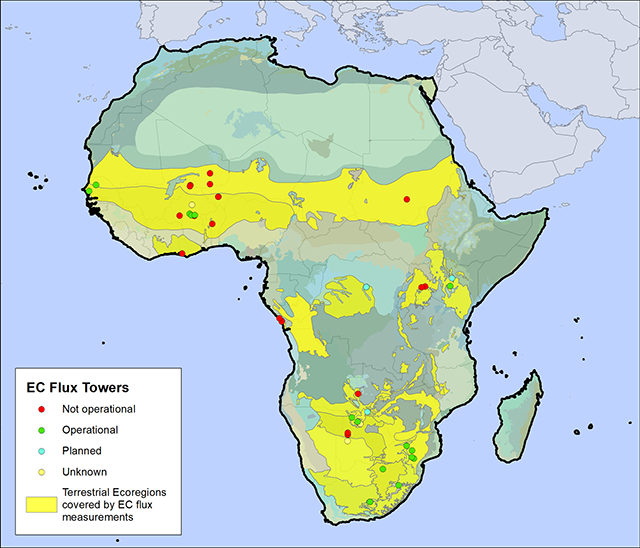
Figure 2
Past, current and planned EC flux observations on the African continent as compiled by SEACRIFOG and the African terrestrial ecoregions (Olson, et al., 2001) partially covered by these observations. Full figure legends and tabular data are provided in the supplementary materials.