

Figure 1
Screen capture of the human-oriented landing page for a given query. The “Data source”, “Data source version”, “XSAMS version”, “Query” fields indicate respectively which data-node produced the result, the version of the data-node, the version of the standards when the query was processed, and the content of the query. The “Query identifier” is the UUID assigned by the Query-Store service to this query. The “Query Result downloaded on” list recall when this query was submitted (or re-submitted) and the “References” list contains the bibliographic references used for compiling the output file. For these, it is possible to switch between a tabular or a BibTex view (cf. figure 2). Finally a link gives access to the output file produced by the data-node while answering the query.
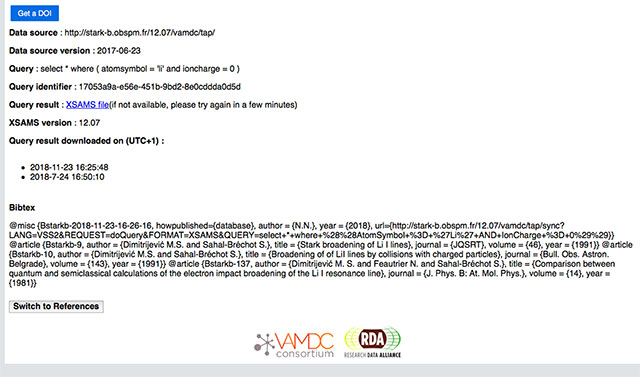
Figure 2
Screen capture of the human-oriented landing page for a given query where a BibTex view is chosen for displaying the references. By clicking on the “Switch to References” button, one goes back to the display of figure 1.
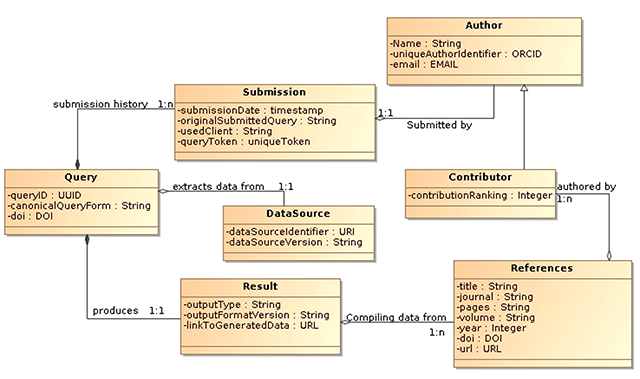
Figure 3
UML graphical representation of the data model used for organizing the metadata available in the Query-Store service.
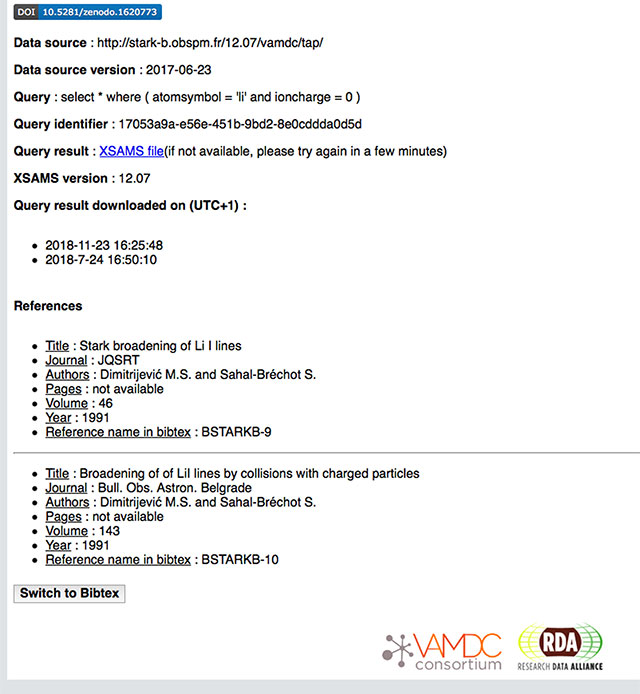
Figure 4
When a DOI is assigned, the “Get a DOI” button (cf. figures 1 or 2) is replaced by the DOI badge.

Figure 5
Partial screen-shot of the Zenodo-record landing page: The mentioned query token is the one generated by the node serving the query (cf. section 3.1). The set of references are those provided by the Query-Store service during the submission phase. One can also see on the right side the reverse link (Related Identifiers) pointing to the original query record on the VAMDC side.
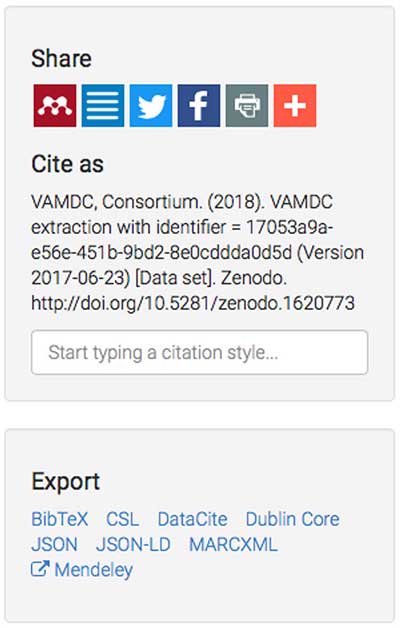
Figure 6
Partial screen-shot of the Zenodo-record landing page: this part of the screen displays the instruction for citing the current query-record.

Figure 7
Bibtex format to be used for citing the query-record of this example.

Figure 8
Graphical representation of the meta data associated with a query cluster: Each cluster is created and/or modified by specific contributors (a first author, a second author, etc.). Each author may add to the clusters the Queries he/she performed (provided the query related data are still present and not deleted from the system, cf. remark 2). Each Query produces a result by extracting data from a specific data source. Each result has a list of references, i.e. the list of all the publication used for compiling the result. The unique identifier of each Cluster is resolvable and the associated landing page will contain all the cluster-associated metadata, together with access to the underlying data (i.e. all the data coming from the extraction performed by the queries composing the cluster).