
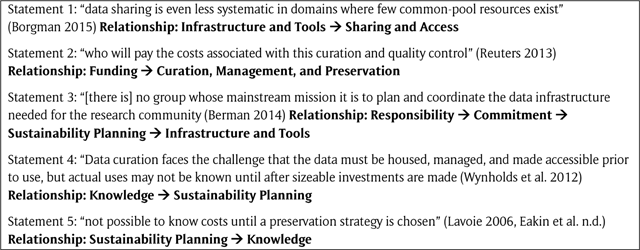
Figure 1
Statements about gap areas and the relationships between them.
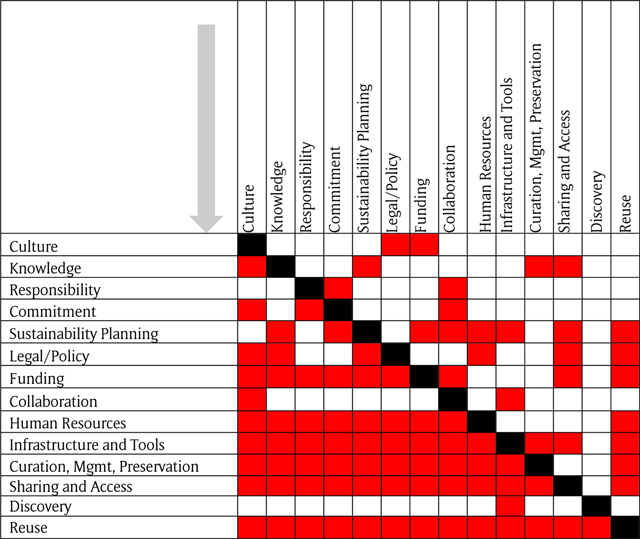
Figure 2
Gap areas and relationships between them. The figure is arranged to show that gap areas in each column impact the gap areas in the rows below them. For instance, Culture (in the first column) impacts Knowledge, Commitment, Legal and Policy Issues, etc. (the gap areas in the rows of that column).
Table 1
Stewardship gap areas, descriptions.
| Gap Area | Description |
|---|---|
| Culture | Gap arising from differences in attitudes, goals, practices, and priorities among disciplines and communities that have an impact on data stewardship and reuse |
| Legal/Policy | Gap between current regulations and policies that govern data stewardship and reuse and those that would maximally facilitate stewardship and reuse |
| Knowledge | Gap between what is known and what needs to be known to effectively plan for and ensure effective data stewardship |
| Responsibility | Gap between who currently has responsibility for stewardship and who is best placed to steward data over time |
| Commitment | Gap between the stewardship commitments that exist on valuable data and the commitments necessary to ensure long-term preservation and access |
| Human Resources | Gap between the human effort and skills needed to steward and make data accessible, and the effort and skilled workers that are available |
| Infrastructure and Tools | Gap between the infrastructure available to steward and reuse data and infrastructure needed to maximize stewardship and reuse capabilities |
| Funding | Gap between the funding needed for effective stewardship and the funding available |
| Curation, Management, and Preservation | Gap between the ways data is managed and prepared for preservation and reuse and ways that would maximize its potential for preservation and reuse |
| Sustainability Planning | Gap between planning that is done to ensure adequate resources for stewardship and the planning that is needed |
| Collaboration | Gap between the collaboration needed for effective stewardship and the collaboration that takes place |
| Sharing and Access | Gaps between the amount of data that are shared or made accessible and the amount of data that is not |
| Discovery | Gap between the amount of accessible data that is discoverable and the amount that is not |
| Reuse | Gap between the data that is available for reuse and the data that is used |
Table 2
Three levels of coding of gap areas and sub-areas and how many studies for each we identified in the literature. We identified some works as both measurement and metrics studies and some fell into multiple gap areas and sub-areas. The rows with totals include the distinct number of studies (out of 142) in each Level 1 gap area.
| Level of coding aggregation | Measurement Studies | Metrics Studies | ||
|---|---|---|---|---|
| Level 1 | Level 2 | Level 3 | ||
| Culture | Culture | |||
| Sharing attitudes and practices | 45 | 2 | ||
| Standards | 8 | 0 | ||
| Research and development culture | 6 | 0 | ||
| Evaluation of quality | 5 | 10 | ||
| Stewardship priority | 2 | 0 | ||
| Demand for data | 1 | 0 | ||
| Data definition | 1 | 0 | ||
| Intellectual property | 1 | 0 | ||
| Archive mandates and objectives | 0 | 0 | ||
| Identifying what is valuable | 11 | 5 | ||
| Legal and Policy | ||||
| Lack of consistency and alignment | 11 | 3 | ||
| Deficiencies that inhibit stewardship, access, and use | 10 | 0 | ||
| Institutional structures and pressures | 6 | 1 | ||
| Incentives that support stewardship, access, and use | 5 | 1 | ||
| Culture Measurement and Metrics Study Total | 77 | |||
| Knowledge | Knowledge | |||
| Amount of data | 27 | 5 | ||
| Costs of stewardship | 14 | 10 | ||
| Infrastructure for stewardship | 2 | 0 | ||
| Where to deposit data | 2 | 0 | ||
| Challenges of enabling data reuse | 1 | 0 | ||
| How to preserve | 1 | 0 | ||
| Provenance and authenticity | 0 | 3 | ||
| Reuse possibilities | 0 | 0 | ||
| Knowledge Measurement and Metrics Study Total | 47 | |||
| Responsibility | Responsibility | |||
| Conduct stewardship activities | 9 | 8 | ||
| Coordinate stewardship activities | 1 | 1 | ||
| Support stewardship activities | 1 | 7 | ||
| Responsibility Measurement and Metrics Study Total | 18 | |||
| Commitment | Commitment | |||
| Lack of commitment | 1 | 1 | ||
| Extent of commitment | 1 | 1 | ||
| Duration of commitment | 0 | 1 | ||
| Commitment Measurement and Metrics Study Total | 2 | |||
| Resources | Human Resources | |||
| Lack of skills | 19 | 4 | ||
| Lack of support for data management | 10 | |||
| Lack of people | 5 | 0 | ||
| Uneven distribution of skills | 2 | 0 | ||
| Unequal access to resources and expertise | 0 | 0 | ||
| Infrastructure and Tools | ||||
| Lack of infrastructure | 19 | 2 | ||
| Lack of tools | 16 | 1 | ||
| Difficulty meeting generalized and special needs | 2 | 0 | ||
| Different timescales of infrastructure development and maturity | 0 | 0 | ||
| Funding | ||||
| Lack of funding | 12 | 0 | ||
| Imbalance in funding | 0 | 0 | ||
| Resources Measurement and Metrics Study Total | 37 | |||
| Actions | Curation, Management, and Preservation | |||
| Fragmented data management | 21 | 0 | ||
| Insufficient data curation or management | 18 | 7 | ||
| Difficulty managing data for reuse | 14 | 2 | ||
| Difficulty establishing the trustworthiness of curated data | 1 | 2 | ||
| Difficulty maintaining the integrity of data over time | 1 | 9 | ||
| Tradeoffs between data management for short or long term | 0 | 0 | ||
| Sustainability Planning | ||||
| Business and economic models | 5 | 8 | ||
| Dynamic and adaptable infrastructure | 4 | 0 | ||
| Lack of strategy and planning | 4 | 0 | ||
| Design and staffing of organizations | 3 | 2 | ||
| Collaboration | ||||
| Lack of collaboration | 3 | 0 | ||
| Challenges forming partnerships | 2 | 0 | ||
| Support structures | 0 | 0 | ||
| Lack of critical mass | 0 | 0 | ||
| Sharing and Access | Sharing and Access | 36 | 7 | |
| Discovery | Discovery | 7 | 0 | |
| Reuse | Reuse | 26 | 2 | |
| Actions Measurement and Metrics Study Total | 87 | |||
Table 3
Gap sub-area measurement studies with a larger proportion of “wider” studies than “targeted”.
| Gap Sub-area | Measurement | ||
|---|---|---|---|
| Targeted | Wider | Total | |
| Fragmented data management | 7 | 14 | 21 |
| Lack of infrastructure | 4 | 16 | 19 |
| Lack of skills | 4 | 15 | 19 |
| Difficulty managing data for reuse | 3 | 11 | 14 |
| Insufficient data curation or management | 4 | 14 | 18 |
| Lack of funding | 2 | 10 | 12 |
| Lack of tools | 4 | 12 | 16 |
| Identifying what is valuable | 4 | 7 | 11 |
| Lack of support for data management | 0 | 10 | 10 |
| Conduct stewardship activities | 0 | 9 | 9 |
| Deficiencies that inhibit stewardship, access, and use [in legal and policy areas] | 0 | 10 | 10 |
| Standards | 1 | 7 | 8 |
| Incentives that support stewardship, access, and use | 0 | 5 | 5 |
| Evaluation of quality | 1 | 4 | 5 |
| Lack of people | 1 | 4 | 5 |
| Lack of strategy and planning | 1 | 3 | 4 |