
Table 1
Breakdown of the Program’s time by session type in 2016 and 2015 (in parentheses).
| Session type | Proportion of allocated time (%) |
|---|---|
| Experts’ lectures | 25 (37) |
| Hands-on exercises (individual work) | 33 (21) |
| Excursions | 15 (15) |
| Teamwork: discussion and problem solving | 12 (12) |
| Teamwork: presentation of proposed solutions | 5 (5) |
| Social events | 10 (10) |
Table 2
The Program’s schedule in 2016.
| Day | Location | Activity |
|---|---|---|
| Day 1 Mon | UTokyo, Tokyo | Program Introduction Lecture: Integrated Water Resources Management Lecture: Case Problem Setting Group work: First Group Discussion and Presentation |
| Day 2 Tue | UTokyo, Tokyo | Lecture: Global Water Circulation Lecture: Current Issues on Water Lecture: Big Data and New World Lecture: DIAS Introduction and Demonstration |
| Day 3 Wed | UTokyo, Tokyo | Lecture and Exercise: DIAS CMIP5 Tool and its Use (Climate Model Output Selection), Individual Assignment Lecture and Exercise: DIAS CMIP5 Tool and its Use (Climate Model Output Bias Correction), Individual Assignment |
| Day 4 Thu | Shimokubo Dam, Gunma | Excursion to the site of the dam: lecture and structure visit BBQ and a short walk along the river |
| Day 5 Fri | UTokyo, Tokyo | Lecture: Introduction to GIS: ArcGIS software Exercise: ArcGIS software |
| Day 6 Sat | UTokyo, Tokyo | Optional program: Additional hands-on: GIS and the DIAS CMIP5, consulting with lecturers |
| Day 7 Sun | Tsukuba | Optional program: Climbing Mt. Tsukuba, Ibaraki Prefecture |
| Day 8 Mon | Tsukuba Kasukabe Saitama | Lecture: JAXA’s GSMaP precipitation product Excursion: JAXA Space Center Exhibition Hall Excursion: Metropolitan Area Outer Underground Discharge Channel |
| Day 9 Tue | ICHARM, Tsukuba | Lecture: Introduction to ICHARM Lecture: Social Science Approach to Water-related Disasters Lecture: Hydrological Modeling and Integrated Flood Analysis System (IFAS) |
| Day 10 Wed | ICHARM, Tsukuba | Lecture: Water Disaster Management Lecture: Economic Evaluation of Natural Disaster and Mitigation Policy Exercise: IFAS |
| Day 11 Thu | ICHARM, Tsukuba | Exercise and Teamwork: IFAS Teamwork: Work on the Case Problems, Presentation Preparation |
| Day 12 Fri | ICHARM, Tsukuba | Teamwork: Work on the Case Problems, Presentation Preparation Final Presentation; Certificate Ceremony and Closing; Reception |
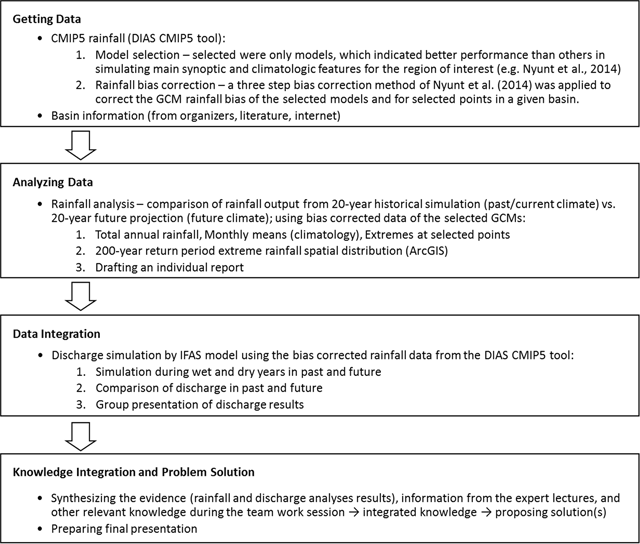
Figure 1
Framework of the workflow used to solve case-study problems.
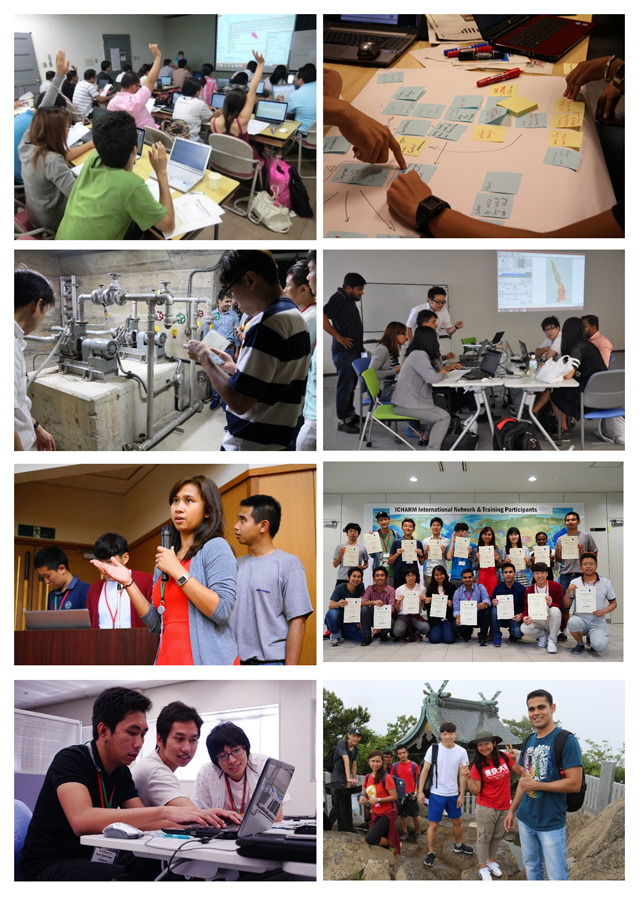
Figure 2
Photos from the Program: (a) 2015: a lecture session; (b) 2016: the initial teamwork session; (c) 2016: the excursion to the Shimokubo dam; (d) 2015: the IFAS training session; (e) 2016: the final presentation; (f) 2016: the final presentation preparation; (g) 2016: the hiking trip to Mt. Tsukuba; (h) 2016: the final group photo with Certificates.
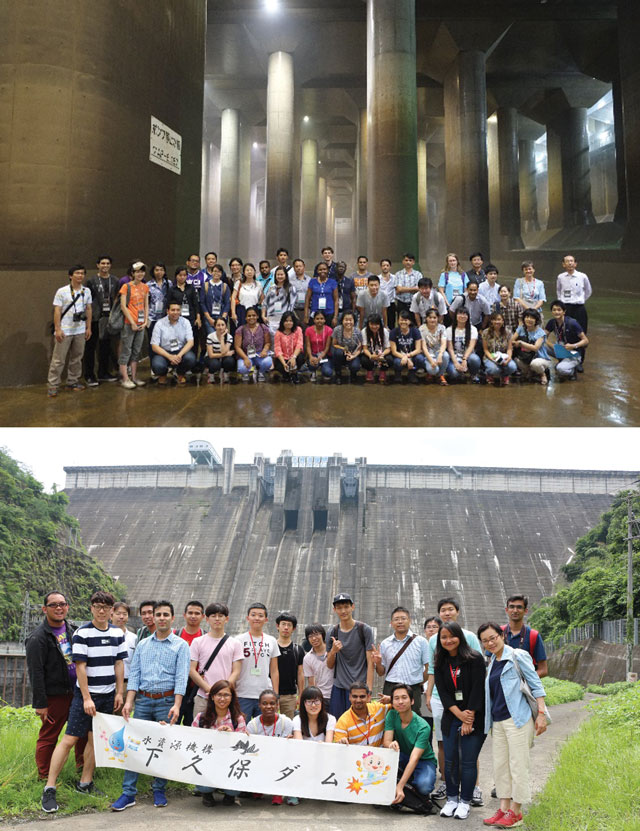
Figure 3
Group photos of the Program participants in 2015 – the Metropolitan Area Underground Channel excursion (above) and in 2016 – the Shimokubo dam (below).
Table 3
Responses to the Summer Program’s evaluation surveys given by the participants of the two events in 2015 and 2016. The first row of numbers shows totals for both events; the second-row and third-row numbers are the results from 2016 and 2015, respectively. *Question 11 was included only in 2016, when a participation fee was charged.
| Question | Strongly agree (%) Total 2016 2015 | Agree (%) Total 2016 2015 | Neutral (%) Total 2016 2015 | Disagree (%) Total 2016 2015 | Strongly disagree (%) Total 2016 2015 | No. (%) responding (Total only) |
|---|---|---|---|---|---|---|
| 1. The Program content was academically challenging. | 38 47 32 | 56 47 62 | 4 6 3 | 2 0 3 | 0 0 0 | 48 (100%) |
| 2. The Program provided a valuable addition to my university education or research/professional focus. | 47 53 43 | 49 47 50 | 4 0 7 | 0 0 0 | 0 0 0 | 47 (98%) |
| 3. I have gained useful knowledge for my future study/work. | 61 65 58 | 35 29 39 | 4 6 3 | 0 0 0 | 0 0 0 | 48 (100%) |
| 4. The set of provided lectures was appropriately combined and provided good basis for acquiring the targeted skills and completing the given assignments. | 31 35 29 | 63 65 61 | 6 0 10 | 0 0 0 | 0 0 0 | 48 (100%) |
| 5. I have improved my understanding of water-resource management problematics and their relevance and linkages to other disciplines. | 54 65 48 | 44 35 49 | 2 0 3 | 0 0 0 | 0 0 0 | 48 (100%) |
| 6. The interdisciplinary approach was clearly visible and well incorporated into the case problems. | 23 19 26 | 64 75 58 | 13 6 16 | 0 0 0 | 0 0 0 | 47 (98%) |
| 7. I have gained a better notion of Big Data and their value and usage for water-resource management. | 55 63 52 | 41 31 45 | 4 6 3 | 0 0 0 | 0 0 0 | 47 (98%) |
| 8. The case problems were designed well to exercise problem-solving skills – I feel I improved this capability. | 23 31 19 | 66 63 68 | 11 6 13 | 0 0 0 | 0 0 0 | 47 (98%) |
| 9. The international format provided an opportunity to gain a cross-cultural experience. | 50 56 47 | 48 44 50 | 0 0 0 | 2 0 3 | 0 0 0 | 46 (96%) |
| 10. Diversity of participants in terms of profession provided a unique experience of working in interdisciplinary and multi-profession teams. I feel I improved my ability to incorporate new values and ideas into my own thought and decision-making process. | 45 38 48 | 49 50 49 | 4 12 0 | 2 0 3 | 0 0 0 | 47 (98%) |
| 11.* I feel my expectations from the course were met, and the course was worthy of my invested funds and time. I would recommend the course to my friends. | 63 | 37 | 0 | 0 | 0 | 16 (33%) |
| General evaluation | Excellent (%) | Very Good (%) | Good (%) | Satisfactory (%) | Unsatisfactory (%) | No. (%) responding |
| 12. Please evaluate the Program as a whole by a single grade. | 53 82 37 | 41 18 53 | 6 0 10 | 0 0 0 | 0 0 0 | 47 (98%) |