
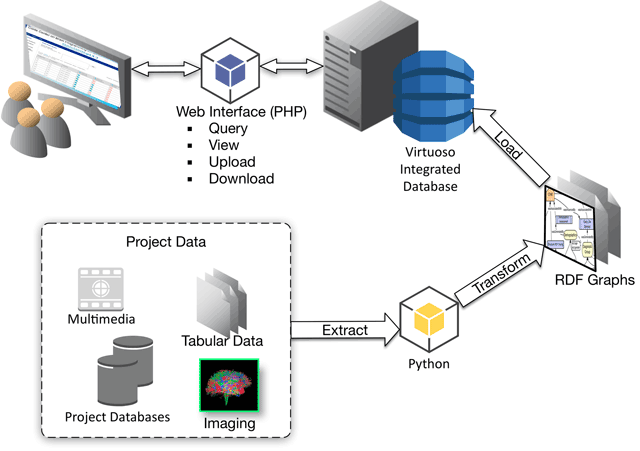
Figure 1
High-level Informatics Architecture. Project data in their native form are extracted and transformed to RDF graphs with Python. The graphs are loaded directly into the Virtuoso integrated database. A PHP web application is used to interact with the data.
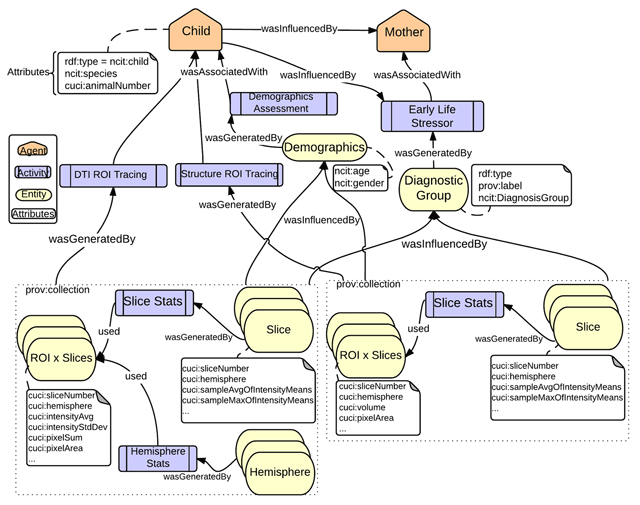
Figure 2
Object Model. Simplified rodent neuroimaging object model showing the relationships among the animal “Agents”, the experimental condition (Early Life Stressor), simple demographics, and the region of interest (ROI) tracing statistics for both DTI and structural MRIs by slice (ROIxSlice) and combined by Slice and Hemisphere. For brevity, only a subset of attributes is shown.
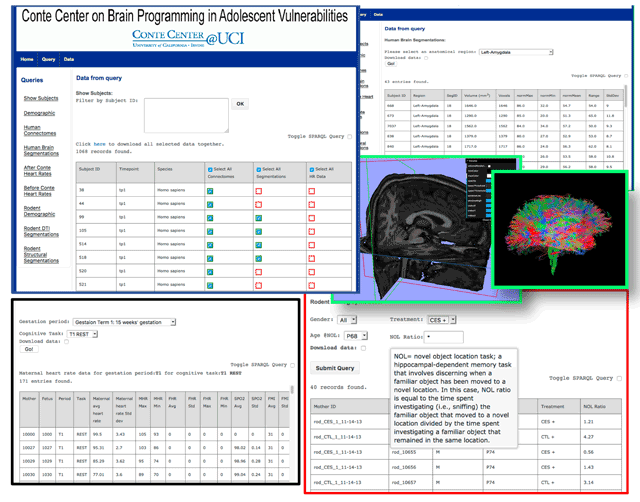
Figure 3
User Interface. Montage of selected user interface components of the system. Top left panel displays the union of all data in the database across species, and provides a simple selection system for downloading selected data types. The bottom left panel shows the interface for heart rate recording data, where summary statistics are computed on the fly during query time. The top right panel shows the structural segmentation results with the XTK-enabled UI for viewing data. The bottom right panel shows information about rodents and experimental conditions.
Table 1
SPARQL query to find human children of comparable age to rodents using a linear age mapping.
| Line | SPARQL Query |
|---|---|
| 1 | ?rod_agent rdf:type prov:Agent ; |
| 2 | ncit:species “Sprague-Dawley” ; |
| 3 | cuci:animalNumber ?rodent_id . |
| 4 | ?demo_entity prov:wasGeneratedBy/prov:wasAssociatedWith ?rod_agent ; |
| 5 | ncit:age ?rodent_age . |
| 6 | BIND(IF(?rodent_age >= 7,(-3.5 + 0.5*?rodent_age),0) as ?equiv_human_age) |
| 8 | ?agent_uri rdf:type prov:Agent ; |
| 9 | ncit:species “Homo sapiens” ; |
| 10 | ncit:subjectID ?child_id . |
| 11 | ?activity_uri prov:wasAssociatedWith ?agent_uri . |
| 12 | ?entity prov:wasGeneratedBy ?activity_uri ; |
| 13 | ncit:age ?child_age . |
| 14 | filter((?child_age = ?equiv_human_age) |
Table 2
Mean (+/– SD) query times in milliseconds (ms) of ten repeated queries across differing graph complexities and return sizes.
| Query | Type | Graph Size (triples) | Return Set (triples) | MeanTime (ms) | SD Time (ms) |
|---|---|---|---|---|---|
| 1 | Rodent Demographics | 1564 | 40 | 422.6 | 7.4 |
| 2 | Human Heart Rate, 1 time point | 13299 | 390 | 1364.6 | 24.7 |
| 3 | Human Connectome | 20253 | 2451 | 645.2 | 11.2 |
| 4 | Human Heart Rate, 4 time points | 54499 | 863 | 7539.8 | 160.4 |
| 5 | Rodent Structural Segmentation | 96210 | 3674 | 2739.5 | 96.2 |
| 6 | Human Structural Segmentation | 1577291 | 4943 | 5535.8 | 57.1 |