
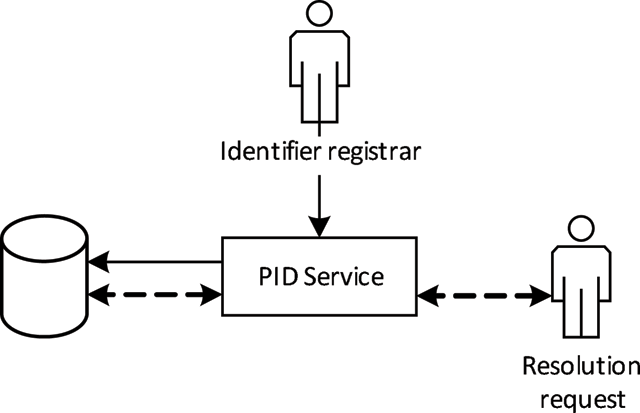
Figure 1
Close coupling between the PID Service registration and resolution service and its internal storage database. PID Service acts as a single interface between users and the database.
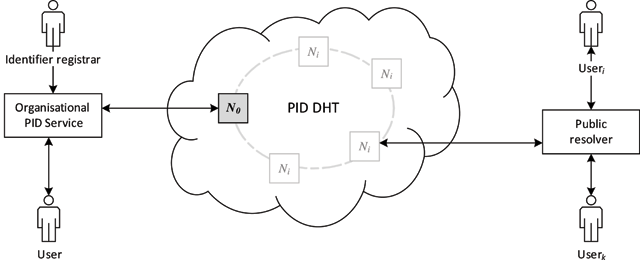
Figure 2
Registration and resolution of persistent identifiers and associated metadata via a Persistent Identifiers Network DHT that avoids maintaining a single database at the organisational level, where persistent identifiers are issued.

Figure 3
An XML serialised instance of a PID Service’s mapping rule. Shown are the default actions (redirection to an HTML page) as well as pattern-based conditional redirects to certain Internet media types.
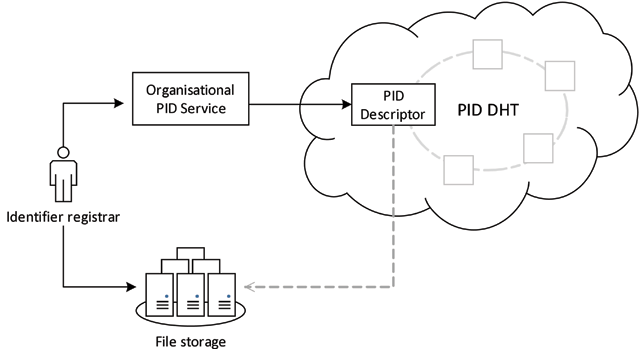
Figure 4
Persistent identifier registration for a file-based information object delivered from a single authoritative source. A single data delivery node puts additional strain on organisational network and essentially is a single point of failure.
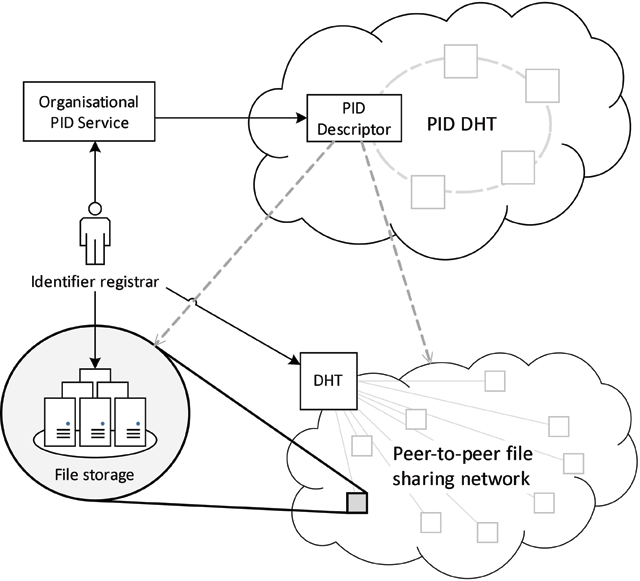
Figure 5
Persistent identifier registration for a file-based information object in a PID Distributed Hash Table and parallel registration of the file torrent in a traditional P2P file sharing network, which registrar’s organisation is a participating node of.
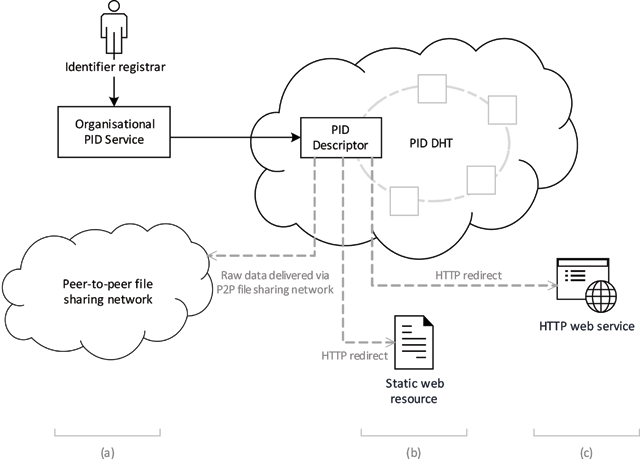
Figure 6
Persistent identifier registration for a multi-faceted information object with different types of views – (a) file distributed via P2P file sharing network, (b) a reference to a static web resource (e.g., HTML page, report, etc.), and (c) a delegated web request to a web service.