
Table 1
Size of the companies surveyed.
| Company ID code | Size | Staff | Annual turnover (€) |
|---|---|---|---|
| Company a | Micro | 1 | 0 |
| Company b | Medium | 103 | 12 Millions |
| Company c | Large | 50,000 | 25 Billions |
| Company d | Small | 25 | 2.5 Millions |
| Company e | Micro | 5 | Not disclosed |
| Company f | Medium | 68 | 30 Millions |
| Company g | Large | 70,000 | 40 Billions |
| Company h | Large | 1,500 | 500 Millions |
| Company i | Micro | 5 | 500,000 |
| Company j | Small | 10 | 200,000 |
| Company k | Medium | 200 | 25 Millions |
| Company l | Small | 10 | 250,000 |
| Company m | Large | 88,000 | 60 Billions |
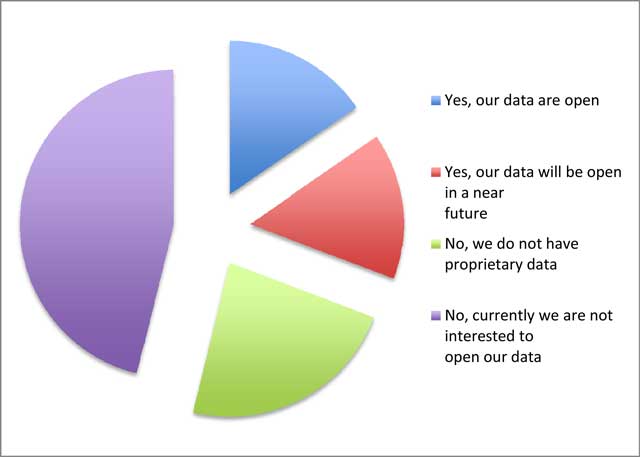
Figure 1
Openness of proprietary data. Yes, our data are open (15.5%); yes, our data will be open in a near future (15.5%); no, we do not have proprietary data (23%); no, currently we are not interested to open our data (46%).
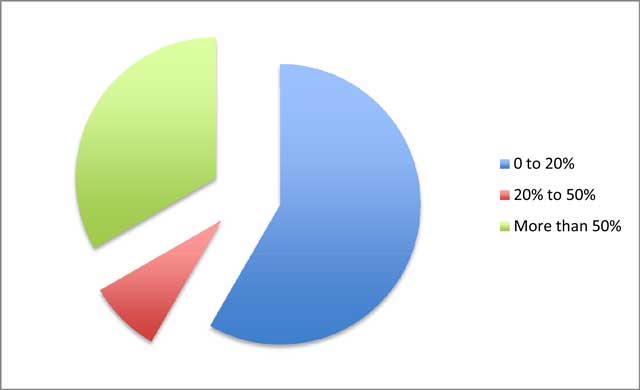
Figure 2
Use of open research data vs other sources of data. The percentages indicated correspond to the open research data. 59% of the respondents use open data in a limited way (blue); 33% of the respondents use more open data than other types of data (green); 8% of the respondents use equally different types of data (red).
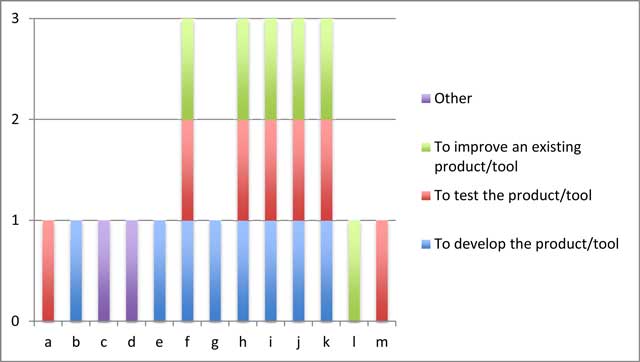
Figure 3
Use of open research data and Technology Readiness Level of the product. a, b, c, d, e, f, g, h, i, j, k, l and m are the identifiers of the companies interviewed (see Table 1).
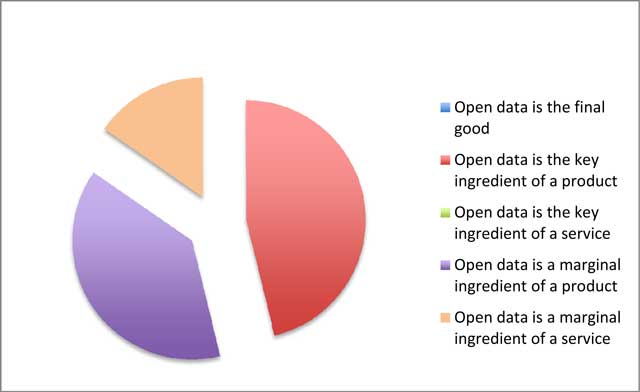
Figure 4
Value of the open data for the marketed product or service. Open data is a marginal ingredient of a service (15.5%), open data is a marginal ingredient of a product (38.5%), open data is the key ingredient of a product (46%).