
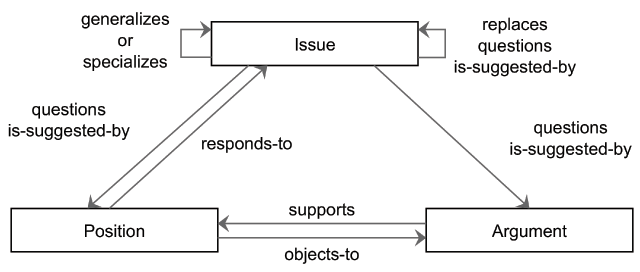
Figure 1
Relationships between IBIS elements (Conklin and Begeman 1988).
Table 1
Properties of IBIS elements.
| Element | Properties |
|---|---|
| Issues | Issues are the organisational “atoms” of IBIS-type systems:
|
| Positions | A Position is a statement or assertion which resolves the Issue. A logically closed set of possible Positions or an open list of possible Positions may be assigned to each issue. |
| Arguments | Arguments are constructed in defence of or against the different Positions until the Issue is settled by convincing the opponents or decided by a formal decision procedure. |
| Relationships | There are several kinds of Relationships between Issues, forming networks between the Issues which can be used to aid the search for similar Issues, the history of an Issue, the consequences of previous decisions, etc.:
|
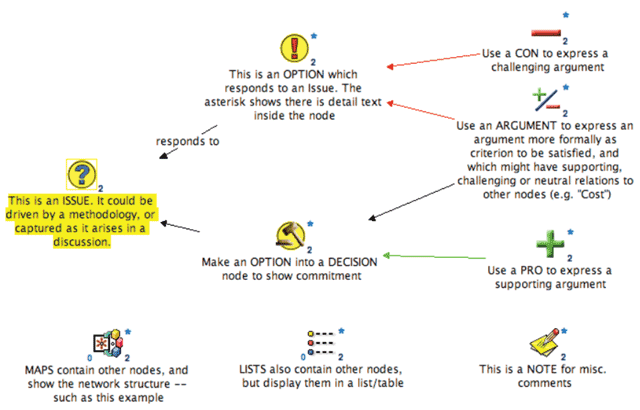
Figure 2
IBIS nodes in Compendium (Shum, Selvin, Sierhuis, Conklin, Rowley, et al. 2006).
Table 2
Definition of Argumentation Language requirements.
| Requirement | Sub-requirement | Description |
|---|---|---|
| Functionality | R1: Added value | Explicit visual and formal representation for the underlying questions for attributes and categories of differentiation. |
| R2: Interoperability | Transformation from and to IBIS | |
| Usability | R3: Objective usability | Reduce complexity in terms of space required |
| R4: Subjective usability | Reduce visual and representational complexity of the argumentation diagrams |
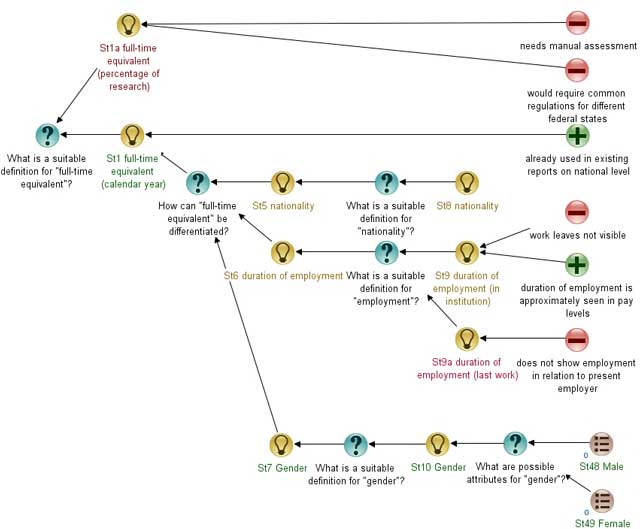
Figure 3
Excerpt defining “full-time equivalent” in Compendium using the IBIS notation.
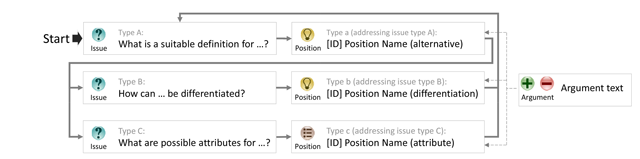
Figure 4
Modelling research information definitions with IBIS.
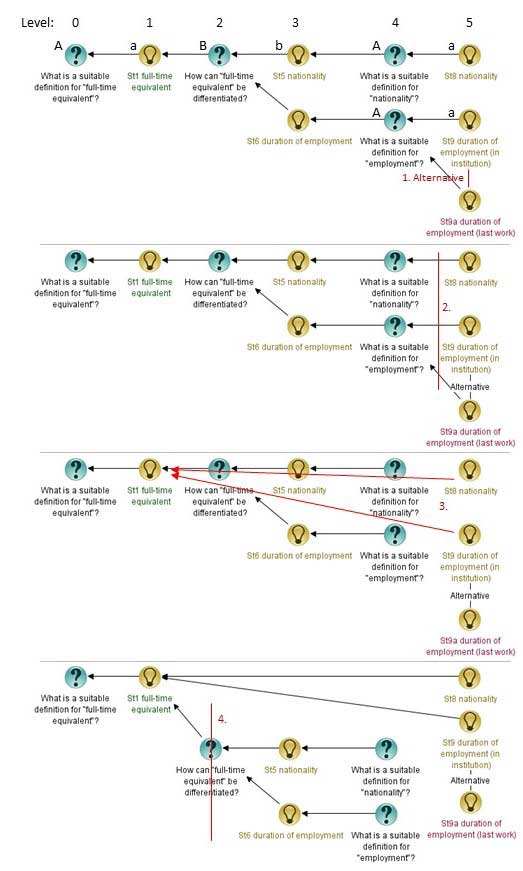
Figure 5
Main steps of transforming rule-based IBIS to RIDAL.
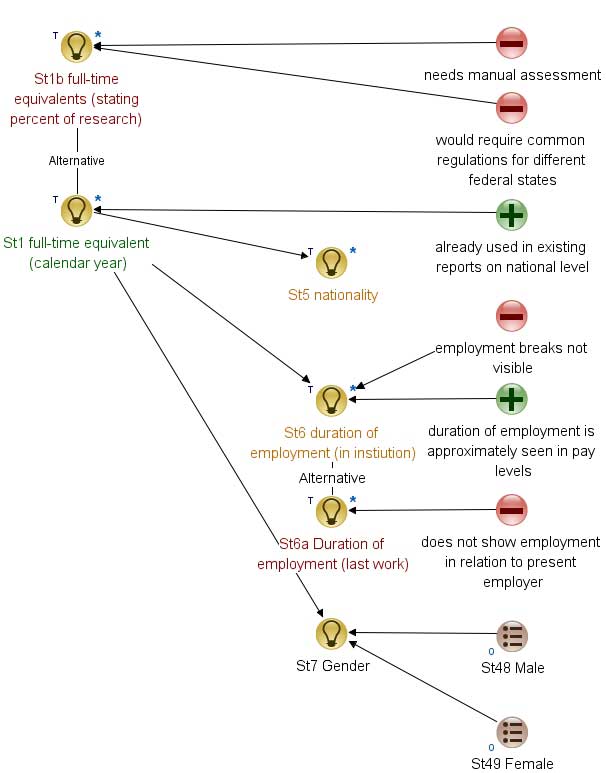
Figure 6
Excerpt defining “full-time equivalent” in Compendium using RIDAL.
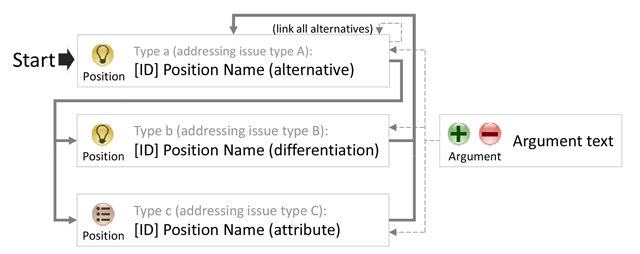
Figure 7
Modelling research information definitions with RIDAL.