
Table 1
User Stories.
| ID | User Story | In Scope? |
|---|---|---|
| 1 | I want to use the HTML normalized visualizations to read a text and be able to capture the identifier of the specific text and visualization I used so that I can cite it in a publication. | Yes |
| 2 | I want to use the HTML normalized visualizations or analytic visualizations to read and cite a text and also refer be able to capture the location of the diplomatic visualization so that I can check something in the text. | Yes |
| 3 | I want to be able to cite a word search conducted in normalized layer in a word study of a particular corpus or author’s work. | No |
| 4 | I want to search for all forms of a dictionary headword (example, the word for “destroy”) in order to study how it gets used in different forms in a particular text, and then be able to cite all documents in a particular group with this word in it, including the original and normalized layers. | Yes |
| 5 | I want to search for a particular part of speech tag or tags and download and cite all phrases (i.e. several tokens surrounding the tagged word) containing that part of speech. | Partially |
| 6 | I want to search for loan words using the language annotation and download and cite the data in original and normalized form, including the language and part of speech annotations. | Partially |
| 7 | I want to be able to search for N-grams with a specific tag in order to analyze style and then cite the corpora in which they are found. | Yes |
| 8 | I want to be able to cite biblical verses quoted by a specific author or author group so that I can cross-reference them in my other corpora. | Yes |
| 9 | I want to be able to cite search results for certain markers for scriptural citation so that I can isolate and compare uses of certain rhetorical phrasing in a specific text. | Partially |
| 10 | I would like to be able to use the static HTML visualizations for a handout for a conference paper. | Yes |
| 11 | I want to cite specific passages in the texts. | Partially |
| 12 | I want to cite specific passages with an equivalent specificity to page and /line numbers. | Partially |
Table 2
Coptic SCRIPTORIUM Resources.
| Resource Type | Description |
|---|---|
| Conceptual works | Letters, treatises, sermons, contracts, monastic rules and other texts, as distinguished from the individual instantiations, editions, or versions of these “conceptual works” that survive in specific manuscript witnesses and publications. |
| Original physical manuscripts representing instantiations of the works | Fragmented papyri and parchment codices, housed in different museum, library, and private repositories. |
| Digital versions of the physical manuscripts | Digital facsimiles such as photographs and/or existing digital transcriptions of texts. |
| Logical groupings of works | Author groups (e.g., texts by monastic authors Shenoute or Besa) or groupings in which anonymous or multi-authored works have circulated or been grouped historically (e.g., the “New Testament” or collections of sayings known as the Apophthegmata Patrum). |
| Physical collections housing the manuscripts | Museum, library, and private repositories with unique (and sometimes changing) cataloguing systems. |
| Physical codices, each containing one or more manuscripts | Books (fragmentary or whole) that may contain multiple works; the works may have been bound into a codex in the original, ancient repository (such as a monastery), or works (fragmentary or whole) may have been bound into a codex at a modern repository, having been collected from different original sources but now all residing in a modern collection. |
| Authors of works | Original author, named or anonymous. |
| Scribes or hands | Persons who transcribed the text on the existing witness; may or may not be the author (in literary texts rarely if ever the author). |
| Paleogeographic symbols | Notations including punctuation, supralinear strokes. |
| Digital images of manuscripts | Digital photographs of manuscript pages and papyri, of varying quality and accessibility depending on the repository; majority of documents not photographed or photographs unavailable to the general public. |
| Linguistic Annotations5 | Annotations made by modern editors for linguistic properties, such as part of speech (nouns, verbs, articles, etc.) or syntax. |
| Morphemes6 | Linguistic units smaller than words that are linguistically or lexically meaningful and therefore annotated. |
| Word tokens | Coptic words. |
| Bound groups | Coptic is an agglutinative language with words and morphemes joining together in groupings (e.g., subject pronoun + verb + direct object pronoun). |
| Editors and Annotators of the Coptic Scriptorium project | Names of individuals who have transcribed and annotated documents. |
Table 3
Citable Visualizations.
| Visualization/Representation | Description |
|---|---|
| Normalized HTML | An HTML visualization of text annotations in which the Coptic text has been normalized for spelling, punctuation, word segmentation for ease of reading. |
| Analytic HTML | An HTML visualization that expresses multiple annotations, particularly by aligning a normalized Coptic annotation, an English translation annotation, and the part of speech annotation. |
| Diplomatic HTML | An HTML visualization of a transcription that most closely resembles a manuscript transcription. Coptic text annotations include original spellings, punctuation, orthography; visualization also may also express annotations for the manuscript’s line, column, and page breaks, ink color, gaps or lacunae, and other paleogeographic information (Krause and Zeldes, 2013). |
| TEI XML | Coptic text and annotations encoded in XML according to the EpiDoc subset of the Text Encoding Initiative standards9. (Does not contain the full set of linguistic and syntactic annotations.) |
| PAULA XML | Coptic text and annotations encoded in standoff markup XML according to PAULA standards10. Contains full set of annotations. |
| relANNIS | Relational database files including all text and annotations for search and visualizations in the ANNIS11 database infrastructure. |
| ANNIS Visualization | Live search and visualizations of the texts and annotations in the ANNIS infrastructure installed on a web server. |
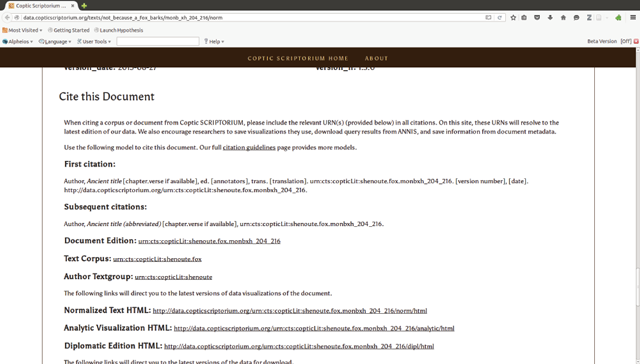
Figure 1
Cite This Document.