
Table 1
Definitions of terms used in this paper.
| Term | Description |
|---|---|
| Dataname | a name for a concept with which one or more values can be associated |
| Data item | a single item of information, consisting of a dataname and one or more associated data values |
| Ontology | A collection of datanames and associated meanings, including relationships. Once ‘ologs’ have been defined (section 2.1), ‘ontology’ usually refers to an ontology expressed using an olog. |
| Data format | The structures in which the data are encapsulated for transfer, for example XML or HDF5. Informal discussions often use the word ‘format’ to encompass both the file format and the ontology used to interpret the dataitems found in it. To avoid confusion, the word ‘format’ is here used to refer only to the file structure. |
| Data bundle | A collection of data items |
| Dataname list | The subset of datanames from an ontology that are included in a given data bundle |
| Format adapter | A description of how the values associated with datanames are encoded in a particular data format |
| Transfer specification | The combination of a format adapter with a dataname list |
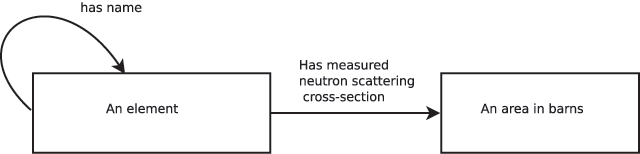
Figure 1
A simple ontology using the olog formalism.
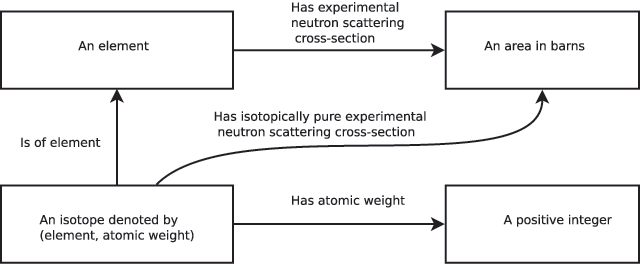
Figure 2
Adding a new dependency to an ontology. Adding a dependency on isotope requires definition of a new dataname denoted here by “isotopically pure experimental neutron scattering cross-section”.
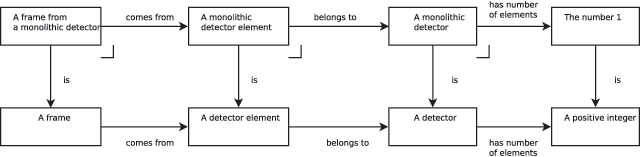
Figure 3
Using pullbacks to relate restrictive definitions to broader definitions. The types on the top left of each square are pullbacks from the types beneath and to the right. Values for datanames corresponding to identifiers and functions in the top row can be automatically derived from data described using the bottom row, and vice versa.
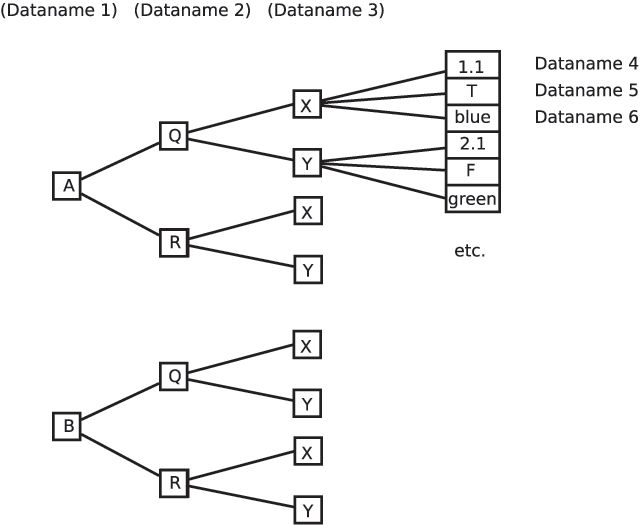
Figure 4
Table 3 as a hierarchy. Six repetitions of dataname 1 values and 4 repetitions of dataname 2 values are removed, saving space.
Table 2
Datanames used in the NXmx-imgCIF translation example. The canonical names are those datanames used by the API. Intermediate datanames used during dictionary-based translation are not included. The imgCIF and NeXus columns identify equivalent locations in the respective formats, where they exist.
| Canonical name | imgCIF | NXmx | Depends on | Comments |
|---|---|---|---|---|
| incident wavelength | diffrn_radiation_wave-length.wavelength | NXinstrument.NXmono-chromator.wavelength | incident wavelength ID | |
| wavelength ID | diffrn_radiation_wave-length.id | From order of appearance in NXbeam.wavelength | ||
| scan ID | diffrn.id | NXentry | ||
| frame axis location axis ID | diffrn_scan_frame-_axis.axis_id | NXtransformations | ||
| frame axis location frame ID | diffrn_scan_frame-_axis.frame_id | from order of appearance in NXtransform-ations.position | ||
| frame axis location angular position | diffrn_scan_frame-_axis.angle | NXtransformations.position | frame axis location frame ID, frame axis location axis ID | NXmx actually uses an array attached to the group node. Due to limitations in the third-party NeXus access software, we have created a “position” field. |
| axis ID | axis.id | |||
| axis type | axis.type | |||
| axis vector | axis.vector | |||
| axis offset | axis.offset | |||
| {goniometer, simple detector} axis ID | NX{sample,detector}.NX-transformations | “Simple” denotes uncoupled axes | ||
| {goniometer, simple detector} axis vector mcstas | NX{sample,detector}.NX-transformations@vector | axis ID | ||
| {goniometer, simple detector} axis offset mcstas | NX{sample,detector}.NX-transformations@offset | axis ID | ||
| 2D data identifier | array_data.binary_id | |||
| 2D data | 2D data identifier | Not the same as simple scan data as imgCIF data may have a variety of layouts or come from submodules | ||
| simple scan data | NXinstrument.NXdetector.NXdata.data | simple scan frame frame ID | ||
| simple scan frame frame ID | from order of appearance in NXdata.data | |||
| data axis ID | NXdetector.NXdata.axes | Must unpack to get values | ||
| data axis precedence | From ordering in NXdetector.NXdata.axes | data axis ID |
Table 3
A hypothetical data table where datanames 4, 5 and 6 are each functions of the combined values of datanames 1, 2 and 3.
| Dataname 1 | Dataname 2 | Dataname 3 | Dataname 4 | Dataname 5 | Dataname 6 |
|---|---|---|---|---|---|
| A | Q | X | 1.1 | T | ‘blue’ |
| A | Q | Y | 2.1 | F | ‘green’ |
| A | R | X | 1.5 | F | ‘yellow’ |
| A | R | Y | 11.2 | T | ‘green’ |
| B | Q | X | 2.1 | F | ‘yellow’ |
| B | Q | Y | 3.1 | T | ‘pink’ |
| B | R | X | 4.5 | F | ‘yellow’ |
| B | R | Y | –1.2 | T | ‘brown’ |