
Table 1
Response Rates and Timing of NSF EarthCube Disciplinary Domain Workshops (n=824 of 1,828).
| Version 1 of the survey instrument: | ||
| 1. Early Career | 24.7% (n =3 7 of 150) | Oct. 17–18, 2012 |
| 2. Structure and Tectonics | 70.5% (n = 24 of 34) | Nov. 19–20, 2012 |
| 3. EarthScope | 31.9% (n = 22 of 69) | Nov. 29–30, 2012 |
| 4. Experimental Stratigraphy | 42.9% (n = 21 of 49) | Dec. 11–12, 2012 |
| 5. Atmospheric Modeling / Data Assimilation and Ensemble Prediction | 31.2% (n = 29 of 74) | Dec. 19, 2012 |
| Version 2 of the survey instrument: | ||
| 6. OGC | 28.0% (n = 14 of 50) | Jan. 13, 2013 |
| 7. Critical Zone | 28.3% (n = 39 of 138) | Jan. 21–23, 2013 |
| 8. Hydrology / Envisioning a Digital Crust | 48.9% (n = 23 of 47) | Jan. 29–31, 2013 |
| 9. Paleogeoscience | 50.6% (n = 40 of 79) | Feb. 3–5, 2013 |
| 10. Education & Workforce Training | 57.9% (n = 33 of 57) | Mar. 3–5, 2013 |
| 11. Petrology & Geochemistry | 71.1% (n = 59 of 83) | Mar. 6–7, 2013 |
| 12. Sedimentary Geology | 55.6% (n = 50 of 90) | Mar. 25–27, 2013 |
| 13. Community Geodynamic Modeling | 46.4% (n = 45 of 97) | Apr. 22–24, 2013 |
| 14. Integrating Inland Waters, Geochemistry, Biogeochem and Fluvial Sedimentology Communities | 39.0% (n = 46 of 118) | Apr. 24–26, 2013 |
| 15. Deep Sea Floor Processes and Dynamics | 49.2% (n = 29 of 59) | June 5–6, 2013 |
| 16. Real-Time Data | 23.4% (n = 25 of 107) | June 17–18, 2013 |
| 17. Ocean ‘Omics | 71.2% (n = 42 of 59) | Aug. 21–23, 2013 |
| 18. Coral Reef Systems (two workshops) | 91.7% (n = 44 of 48) | Sept. 18–19/Oct. 23–24, 2013 |
| 19. Geochronology | 44.6% (n = 66 of 148) | Oct. 1–3, 2013 |
| 20. Ocean Ecosystem Dynamics | 45.0% (n = 36 of 80) | Oct. 7–8, 2013 |
| 21. Clouds and Aerosols | 63.9% (n = 39 of 61) | Oct. 21–22, 2013 |
| 22. Rock Deformation and Mineral Physics | 44.3% (n = 37 of 79) | Nov. 12–14, 2013 |
| 23. Marine Seismic | 46.2% (n = 24 of 52) | Dec. 11–12, 2014 |
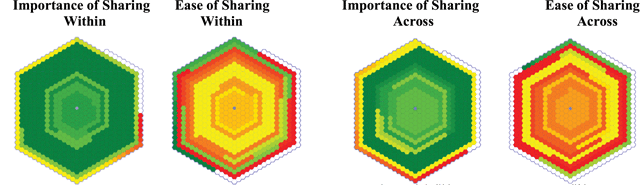
Figure 1
Visual Representation of Importance and Ease of Sharing Data Within and Across Fields.
Note: The contrast between importance and ease can be seen within and across fields. There are few cases where it is not important and a few cases where it is seen as easy (the outliers on the outside edges of each z-flower), but these are small compared to the central tendencies. Each small hexagon represents a respondent. Shades of green signal positive views; shades of yellow, neutral views; shades of red, negative views. Responses are tiled from the middle, which is the mean, in a spiral outward above and below the mean, so the middle is the central tendency and outliers are on the outside. Missing responses are white.
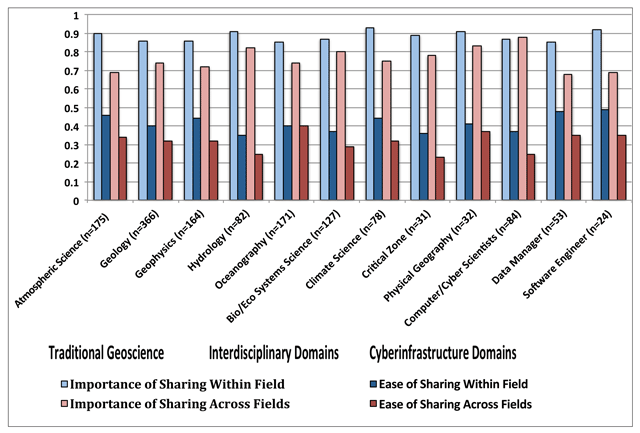
Figure 2
Ease and Importance of Sharing Data, Tools, and Models: Within and Across Fields.
Note: The gaps between importance and ease within and across fields are remarkably similar in these diverse fields. Bar charts are used rather than z-flowers to compare means across multiple fields (in addition to illustrating the full diversity of responses.
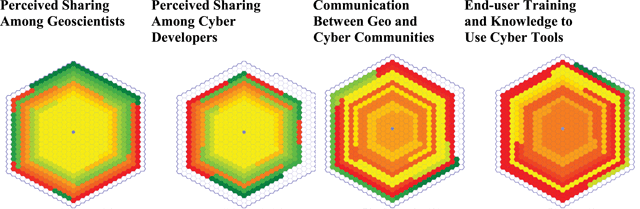
Figure 3
Visual Representation of Cooperation Between Geo and Cyber and End-User Knowledge and Training in the Cyberinfrastructure.
Note: While there are some very positive and very negative outliers in perceptions of sharing among geoscientists and among cyber developers (the first and second z-flowers), the dominant view is at the midpoint on the scale. Note that many respondents indicate no response when asked about cooperation among cyber developers. The communication between geo and cyber is seen negatively and the responses are even more negative when asked about end-user training and knowledge on the use of cyber tools. Each small hexagon represents a respondent. (see note on figure 1 for additional explanation on reading these figures.)
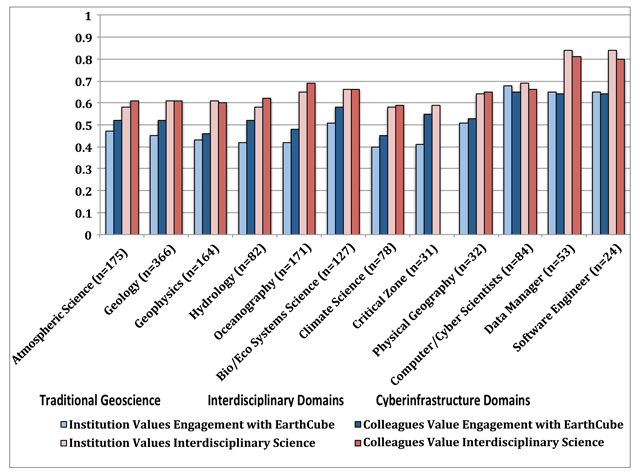
Figure 4
Support from Employer/Institution and from Colleagues for Engagement with EarthCube and for Interdisciplinary Science.
Note: The general support for interdisciplinary science is greater than the specific support for engagement with EarthCube. The levels of support are higher among the cyber domains. The number of respondents for the second set of interdisciplinary questions is about half the total listed number of respondents since that question was added part way through data collection.
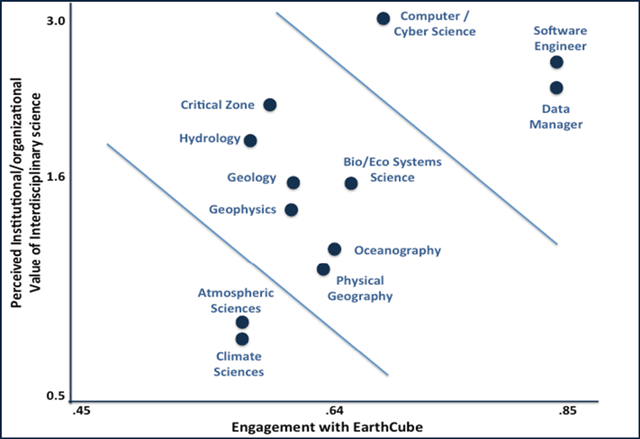
Figure 5
Support from Employer/Institution for Interdisciplinary Science and Engagement with EarthCube (N = 785 for the second version of the survey).
Note: Engagement with EarthCube by organizations and institutions that individuals are part of is correlated with support for interdisciplinary science. Cyber professionals, builders of infrastructure, populate the upper right zone above the contour line and are most positive.
Table 2
Predicting Engagement with EarthCube.
| Independent Variables | Dependent Variable: Engagement with EarthCube1 (B / Standard Error) | |||||||
|---|---|---|---|---|---|---|---|---|
| Model 1 N = 1,508 | Model 2 N = 1,508 | Model 3 N = 1,508 | Model 4 N = 1,248 | |||||
| Constant | 0.120 | 0.158 | 0.070 | 0.185 | 1.394 | 0.206*** | 0.467 | 0.277 |
| Years of Experience | 0.230 | 0.036*** | 0.230 | 0.036*** | 0.231 | 0.036*** | 0.266 | 0.041*** |
| Female/Male (0,1) | –0.071 | 0.076 | –0.071 | 0.076 | –0.065 | 0.076 | –0.028 | 0.085 |
| International/Domestic Org (0,1) | 1.045 | 0.103*** | 1.044 | 0.103*** | 1.050 | 0.103*** | 1.070 | 0.124*** |
| Atmospheric Science (0,1) | –0.597 | 0.123*** | –0.547 | 0.157*** | –1.883 | 0.176*** | –1.621 | 0.198*** |
| Geology (0,1) | 0.051 | 0.138 | –1.285 | 0.160*** | –1.479 | 0.195*** | ||
| Geophysics (0,1) | –0.235 | 0.126 | –0.185 | 0.159 | –1.521 | 0.178*** | –1.057 | 0.175*** |
| Hydrology (0,1) | 0.215 | 0.166 | 0.266 | 0.192 | –1.071 | 0.208*** | –1.255 | 0.196*** |
| Oceanography (0,1) | –0.470 | 0.124*** | –0.420 | 0.156** | –1.756 | 0.176*** | –0.873 | 0.225*** |
| Bio/Eco Systems Science (0,1) | –0.050 | 0.139 | –1.336 | 0.187*** | –0.646 | 0.305* | ||
| Climate Science (0,1) | –0.938 | 0.167*** | –0.887 | 0.192*** | –2.224 | 0.209*** | –1.964 | 0.232*** |
| Critical Zone (0,1) | 0.455 | 0.256 | 0.506 | 0.274 | –0.830 | 0.286** | –1.170 | 0.205*** |
| Physical Geography (0,1) | –0.263 | 0.253 | –0.212 | 0.270 | –1.548 | 0.282*** | –1.409 | 0.319*** |
| Other Scientists/Others (0,1) | –0.162 | 0.145 | –0.112 | 0.174 | –1.448 | 0.192*** | –1.254 | 0.213*** |
| Computer/Cyber Scientists (0,1) | 1.336 | 0.162*** | 1.387 | 0.188*** | ||||
| Data Manager (0,1) | 0.420 | 0.199* | 0.470 | 0.22* | –0.865 | 0.235*** | –0.698 | 0.262** |
| Software Engineer (0,1) | 0.610 | 0.315 | 0.610 | 0.315 | 0.608 | 0.316 | 0.585 | 0.355 |
| Other Experts (0,1) | 0.167 | 0.174 | 0.218 | 0.199 | –1.119 | 0.215*** | –0.931 | 0.235*** |
| Importance/Ease Within Fields2 | –0.101 | 0.174 | ||||||
| Importance/Ease Across Fields2 | 0.560 | 0.164*** | ||||||
| EC Engagement Support Scale3 | 0.893 | 0.149*** | ||||||
| F | 23.268*** | 23.268*** | 23.040*** | 17.955*** | ||||
| Adjusted R Square | .19 | .19 | .19 | .21 | ||||
[i] Note: The engagement in EarthCube of cyber domains is significantly higher than the geo fields. Among geo and interdisciplinary domains, atmospheric science, climate science, and oceanography are less likely to be engaged. The interdisciplinary gap between importance and ease and support for engagement in EarthCube are positive predictors of actual engagement.
*p < 0.05; **p < 0.01; ***p < 0.001.
1Six item ordinal scale for increasing degrees of engagement with EarthCube.
2Calculated gap between perceived “importance” and “ease”.
3Two-item scale – Cronbach’s alpha = .79.