
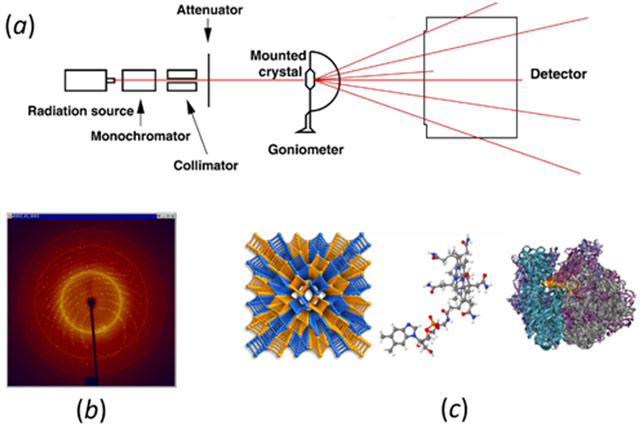
Figure 1
Determining molecular structure from crystallographic X-ray diffraction. (a) Schematic of a diffraction experiment. The apparatus may fit on a laboratory bench; or it may involve an intense X-ray beam from a synchrotron, a particle accelerator hundreds of metres in diameter. X-rays diffracted from regular planes of atoms in the crystal scatter into a number of beams, recorded as diffraction spots on an image detector (b). From the positions and intensities of the diffracted beams, atomic positions may be inferred and molecular structures deduced (c). The technique can be applied to inorganic materials, small organic molecules, large protein and nucleic acid molecules, or even viruses.
Table 1
Timeline for CIF implementation by IUCr journals.
| 1987 | IUCr Working Party on Crystallographic Information (WPCI) |
| 1988 | WPCI recommends STAR File as data format |
| 1989 | CIF syntax derived from STAR File approach |
| 1990 | Acta Crystallographica Section C recommends CIF use |
| 1991 | First CIF data and text submission |
| 1992 | checkCIF validation facility introduced |
| 1994 | CIF web upload and auto-validation |
| 1996 | Acta C also publishes papers authored solely in CIF format |
| 1996 | Acta C mandates CIF-format submissions only |
| 2001 | Acta Crystallographica Section E online: short structure reports in CIF format |
| 2005 | Acta Crystallographica Section F online (short reports of macromolecular structures); International Tables for Crystallography Vol. G published |
Table 2
The ontologies currently constructed with STAR DDLs.
| Crystallographic Core | Shared with all crystallographic ontologies |
| Crystallographic Diffraction Image |  |
| Crystallographic Macromolecular Structure | |
| Crystallographic Modulated Structure | |
| Crystallographic Powder | |
| Crystallographic Multipole Density | |
| Crystallographic Restraints | |
| Crystallographic Symmetry | |
| Crystallographic Twinning | |
| Data Definition Language 1 | Used in crystallographic core, modulated structure, powder, multipole density, restraints, twinning |
| Data Definition Language 2 | Used in crystallographic macromolecular structure, diffraction image, symmetry |
| Data Definition Language 3 | CIF version of DDLm being applied to crystallographic dictionaries |
| Data Definition Language m | ‘Methods’ language with STAR2 specifications published in J. Chem. Inf. Model. (2012) [19] |
| Nuclear Magnetic Resonance | |
| Molecular Information File | |
| QCHEM: Quantum Chemistry |
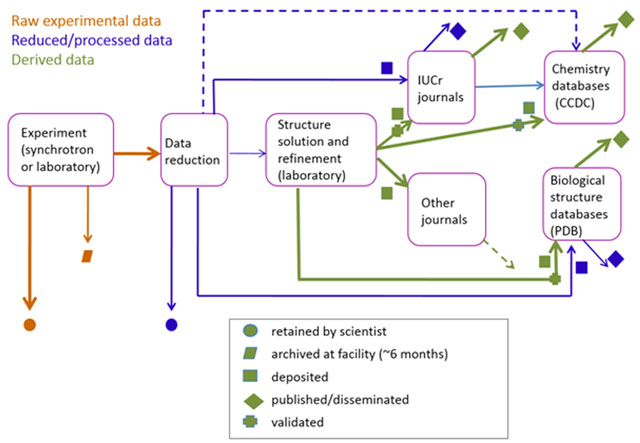
Figure 2
A coherent information flow in crystallography. CIF ontologies characterize data at every stage of the information processing life cycle, from experimental apparatus to published paper and curated database deposit.