Table 1
Authors’ affiliations and commitments to citizen science, in alphabetical order by last name.
| Author Name | Affiliation/Country | Commitment to Citizen science |
|---|---|---|
| Anne Bowser | Woodrow Wilson International Center for Scholars, USA | Supports the resources hosted on Citizenscience.gov; helps lead an international project on citizen science data and metadata interoperability and standardization; member of the board of the Citizen Science Association (CSA) |
| Jessica L. Cappadonna | Queensland University of Technology, Australia | Ecologist/PhD student who is studying how to engage citizen scientists with bioacoustics to find an elusive bird species; member of the Australian Citizen Science Association Management Committee |
| Luigi Ceccaroni | 1000001 Labs, Spain | Coordinator of the Citclops project (http://www.citclops.eu), a 5 M€ European project about a citizens’ observatory for coastal and ocean monitoring; member of the European Citizen Science Association (ECSA) Board of Directors; editor of the book “Analyzing the Role of Citizen Science in Modern Research” (2017); chair of working group to “Improve data standardization and interoperability” of COST Action CA15212 “Citizen Science to promote creativity, scientific literacy, and innovation throughout Europe” |
| Caren Cooper | North Carolina State University and North Carolina Museum of Natural Sciences, USA | Co-authored ornithology/ecology papers with citizen science data (e.g., NestWatch, Christmas Bird Count, Project Feederwatch, Breeding Bird Survey); helped develop NestWatch, YardMap, and Celebrate Urban Birds; developed and manages the Sparrow Swap project; director of Research Partnerships with SciStarter; blogger of citizen science; founder and moderator of #CitSciChat; associate editor of CSA’s journal, Citizen Science: Theory & Practice |
| Brittany Davis | Allegheny College, USA | Environmental studies professor studying marine citizen science projects in Central America and the Caribbean |
| Daniel Dörler | Citizen Science Working Group at the University of Natural Resources and Life Sciences, Vienna, Austria | Zoologist currently completing a PhD on the ecology of an invasive slug in Austria using a citizen science approach; coordinator and founder of the citizen science networking platform “Österreich forscht” (http://www.citizen-science.at); organizer of the annual Austrian Citizen Science Conference |
| Ruth Duerr | Ronin Institute for Independent Scholarship, USA | Member of the Exchange for Local Observations and Knowledge of the Arctic (ELOKA) (http://www.eloka-arctic.org/), which facilitates the collection, preservation, exchange, and use of local observations and knowledge of the Arctic |
| MV Eitzel | University of California Santa Cruz, USA | Works on theories of epistemic justice at the Science and Justice Research Center; hands-on application to citizen science at the Statewide and Diablo California Naturalist Programs to develop stewardship of California’s ecosystems; and decolonial citizen science with The Muonde Trust’s community-based research team in rural Zimbabwe |
| Muki Haklay | University College London, UK | Researching participatory/co-created/co-production of citizen science, particularly in the context of local environmental issues, and indigenous and traditional ecological knowledge |
| Ed Harris | Scleroderma Education Project, USA | Medical educator and lead researcher on a new disease pathogenesis model for the rare autoimmune disease systemic scleroderma |
| Florian Heigl | Citizen Science Working Group at the University of Natural Resources and Life Sciences, Vienna, Austria | Agrobiologist and leader of “Project Roadkill” (http://www.roadkill.at/en), a citizen science project on road-killed animals in Austria, currently doing a PhD thesis on this project; coordinator and founder of the citizen science networking platform “Österreich forscht” (www.citizen-science.at); organizer of the annual Austrian Citizen Science Conference |
| Qijun Jiang | Wageningen University & Research, The Netherlands | Engaged in citizen science projects such as Amsterdam Smart Citizens Lab and Urban AirQ, which use bottom up and co-creation approaches that involve citizens in all steps of the process; member of the European Citizen Science Association (ECSA). |
| Tim Kiessling | Faculty of Ocean Sciences, Catholic University of the North, Chile | Marine biologist investigating the extent and impact of ocean litter pollution within the citizen science program “Científicos de la Basura” in Chile and Germany |
| Christopher Kyba | GFZ German Research Centre for Geosciences, Germany | Responsible for the “Loss of the Night” citizen science app and the “http://www.myskyatnight.com” webapp that allows users to view and analyze light pollution data |
| Chris Santos-Lang | Citizen Science Belleville, USA | Leads citizen science of a bible study that tests replicability of experiments to improve health, relationships, and well being for future generations (http://www.osf.io/fqn7v/wiki/home) |
| Anya Metcalfe | United States Geological Survey, Arizona, USA | Stream ecologist and entomologist who manages and utilizes a citizen science project across western U.S. examining aquatic insect distribution and emergence in a dam-regulated riverscape (http://www.gcmrc.gov) |
| Lesandro Ponciano | Federal University of Campina Grande and Pontifical Catholic University of Minas Gerais, Brazil | Computer science professor studying participation of volunteers in citizen science projects conducted through crowdsourcing and human computation systems, such as Zooniverse, Crowdcrafting, and Socientize platforms |
| Joseph Roche | Trinity College Dublin, Ireland | Astrophysicist and Assistant Professor in Science Education who lectures on citizen science for the M.Ed program in Science Education; on the science team for Sunspotter.org (Zooniverse project) |
| Andrea Sforzi | Maremma Natural History Museum, Italy | Director of the museum and responsible for the citizen science project (naturaesocialmapping.it) that includes a recording website and courses for citizen scientists and bioblitzes; member of the ECSA Board of Directors |
| Fraser Shilling | University of California, Davis, USA | Ecologist who co-directs the Road Ecology Center; trained water quality monitors for California’s longest running watershed-monitoring program (Yuba); co-developed the largest volunteer-contribution, roadkill-observing system in world; develops standard approaches and web-tools for public science; and tries not to use the term ‘citizen science’ |
| Martin Thiel | Faculty of Ocean Sciences, Catholic University of the North; Millennium Nucleus Ecology and Sustainable Management of Oceanic Island (ESMOI); Center of Advanced Studies in Arid Zones (CEAZA), Coquimbo, Chile | Professor of Marine Biology, Director of the citizen science program “Científicos de la Basura” (http://www.cientificosdelabasura.cl), which has been investigating marine litter along the coast of Chile for the past 10 years, involving the participation of K-12 students and their teachers; associate editor of CSA’s journal, Citizen Science: Theory & Practice |
| Arika Virapongse | Ronin Institute for Independent Scholarship, USA | Social ecologist with expertise in conservation and development, including participatory approaches, and studying the role of citizen scientists in social-ecological observing and community development |
| Sarah West | Stockholm Environment Institute, University of York, UK | Designs, runs, evaluates, and conducts research about environmental citizen science projects in the UK and Kenya; projects include the OPAL project and Moors for the Future Community Science Project |
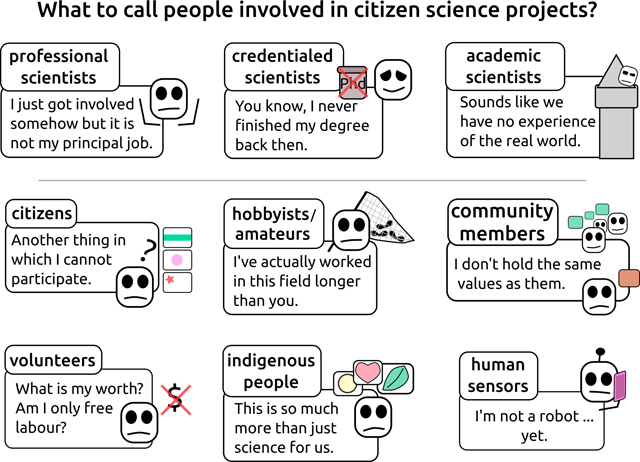
Figure 1
Illustrated examples of negative interpretations of commonly used names to describe people participating in citizen science, selected from our list of terms. Every term is used and interpreted in many different ways in different situations; this graphic highlights interpretations commonly encountered by the authors (also see Tables 3 and 4, particularly ‘caveat’ column).
Table 2
Geopolitical contexts, in alphabetical order.
| Country | Citizen science terminology and context |
|---|---|
|
Arctic regions
Traditional Ecological Knowledge (TEK) | As noted in a Community White Paper (Noor Johnson et al. 2013), “Arctic Indigenous peoples have been systematically observing the environment for millennia” where such monitoring “plays a significant role in daily life, providing information that is critical to safe travel and successful hunting and harvesting activities.” The term ‘Citizen Science’ is rarely if ever used for research in these regions, perhaps due to the existence of the Arctic Council which has “promoted cooperation, coordination and interaction among the Arctic States, Arctic indigenous communities and other Arctic inhabitants on common Arctic issues, in particular on issues of sustainable development and environmental protection in the Arctic” for the last 20 years. |
|
Australia
Citizen science | While members of the public have contributed to scientific research in Australia for decades, the term ‘citizen science’ and the ubiquity of such activities was relatively unknown until recently. Citizen science leaders recognized the need to connect this community, which led to the formation of the Australian Citizen Science Association (ACSA; http://www.citizenscience.org.au) in May 2014 and the first Australian citizen science conference in July 2015. To date, citizen science activities have been identified at community, regional, state, and national levels. For most projects, citizen scientists contribute observations of fauna, flora, and habitat, though a few projects exist in astronomy, meteorology, and seismology. Citizen science in Australia is also rapidly diversifying into new domains (e.g., online) and disciplines (e.g., biomedical sciences). |
|
Austria
Bürgerwissenschaft | Citizen science has developed rapidly over the last 3–4 years in Austria, although the approach has been known for more than100 years. In 2014, the first Austrian online platform for citizen science projects (Österreich forscht, http://www.citizen-science.at) began to connect citizen science projects and actors to foster this method and to ensure quality. The platform is borne by citizen science project leaders, so it is independent from institutions. In parallel, a second platform (Centre for Citizen Science, http://www.zentrumfuercitizenscience.at) was developed at Österreichischer Austauschdienst. |
|
Brazil
Ciência cidadã | The Citizen Science Movement (“Movimento Ciência Cidadã,” http://www.movimentocienciacidada.org) is an effort focused on democratizing access to Brazilian scientific production on topics of social interest. Some examples of citizen science projects are Farmer-Experimenter Groups, the ForestWatchers Project (http://www.forestwatchers.net), and Contribua (http://www.contribua.org). Participants are usually called volunteer (‘voluntário’) or participant (‘participante’). |
|
Chile
Ciencia ciudadana | Chile has a long-standing tradition of Participatory Action Research (Investigación-Acción Participativa), which became widespread during social movements of the 1960s and early 1970s. There is also a legacy of close collaboration with artisanal fishermen and small-scale farmers, using Traditional Ecological Knowledge (TEK), which has only recently been considered ‘citizen science.’ |
| China 公民科学 or 公众科学 (Simplified Chinese), 公民科學or公眾科學 (Traditional Chinese) | The term ‘citizen science’ is translated to “公众科学” or “公眾科學” in simplified Chinese or traditional Chinese respectively. This translation is close to ‘public science’ in English. A more direct translation is ‘公民科学’ or ‘公民科學’ in simplified Chinese or traditional Chinese respectively. |
|
Estonia
Kodanikuteadus | The collaboration of citizens and scientists has a long tradition in Estonia, with roots beginning with the Estonian Naturalists’ Society, which was founded in 1853. However, the awareness and understanding of citizen science is still expanding in Estonian society. There are many parallel translations of the term citizen science: Kodanikuteadus translates to ‘citizen science’ and can be misunderstood as “science about being citizen,” which is rather formal; harrastusteadus translates to “hobby or amateur science,” rahvateadus translates to ‘people science,’ and huviteadus translates to ‘hobby or lay science.’ There are no existing associations for Estonian citizen science practitioners and there is no common website. |
|
Europe
Citizen science | Citizen science in Europe is mainly represented by the activities of the European Citizen Science Association (ECSA), which is a non-profit association organized to encourage the growth of citizen science in Europe. It draws on 200 individual and organizational members from more than 28 countries across the European Union and beyond. Launched in 2013, ECSA has grown from an informal network of civic educators interested in citizen science into the reference network of citizen-science initiatives for Europe. |
|
Germany
Bürgerwissenschaften | Citizen science in Germany has long been visible among prestigious local groups, but has rapidly increased in the past decade. The project GEWISS (BürGEr schaffen WISSen, literally translated as “citizens create knowledge,” is an initiative of different university and non-universitary organizations, funded by the German Ministry of Education and Research. GEWISS reflects, promotes, and supports citizen science in Germany. As of August 2016, the online platform buergerschaffenwissen.de lists 73 current German citizen science projects. |
|
Ireland
Citizen science | Citizen science in Ireland has grown in the last decade, but it is still a relatively unknown concept. Most of the citizen science projects that have taken place are localized, with few having the support needed to become national endeavors. The projects that do gain traction tend to be contributory, and are often led by environmental or biodiversity-focused organizations such as the Environmental Protection Agency, the National Biodiversity Data Centre, the Irish Wildlife Trust, and Science Gallery Dublin. |
|
Italy
Citizen science | Although citizen science in Italy has become more common in the last few years, it is not a widespread concept. Defining citizen science in Italy relies on first discovering the existing citizen science projects, and this is hindered from a lack of clear terminology for this field. However, the international citizen science movement has recently activated some citizen science projects at the local, regional, and national scales of Italy. In 2015, an informal group called Citizen Science Italy was formed with the purpose of sharing experiences and developing the concept of citizen science. Most members, however, are observers or simply interested in supporting the development of citizen science in Italy. Nevertheless, Italy is among the most represented countries (i.e., number of members) in ECSA, demonstrating great interest and potential growth for this field in the future. |
| The
Netherlands Burgerwetenschap | Dutch people are involved in a variety of citizen science projects, for example, air quality monitoring (Jiang et al. 2016) and noise monitoring and gas extraction-induced earthquakes (Carton and Ache 2017). These projects are often bottom-up in origin. The term ‘citizen science’ is ‘Burgerwetenschap’ in Dutch, but the English term is also widely used. |
|
Spain
Citizen science | The context of citizen science in Spain is similar to other countries in Europe, except for the language used by contributors, which is mainly Spanish and Catalan, and to a lesser extent Euskera and Galician. |
|
UK
Citizen science | In the late 2000s, the term citizen science gained popularity as projects, such as OPAL, began to use the term. Many biological recording schemes rebranded themselves as citizen science (Roy et al 2012), as use of the term caught on in the media. Most citizen science projects in the UK are contributory, but there are some examples of co-created projects, for example, the ExCites group at UCL, which emerged from participatory action research. |
|
U.S.
Citizen science | Citizen science is widespread in the U.S., which has the highest percentage of members of the Citizen Science Association. However, citizen science activities are not particularly coordinated among host groups. One important and growing network is within U.S. government agencies, which are coordinated through the Federal Community of Practice for Crowdsourcing and Citizen Science (CCS) and the formal Agency Coordinators. In an effort to expand and accelerate the role of crowdsourcing and citizen science in the U.S. government, a collaborative group of agencies released the Federal Crowdsourcing and Citizen Science Toolkit (http://www.citizenscience.gov/) as a venue for finding, planning, and maintaining federal citizen science projects. |
|
Zimbabwe
N/A | Most scientific work done by citizens in Zimbabwe is currently undocumented and occurring at a grassroots level, though there is little evidence of its existence. This work is conducted on such topics as traditional medicine for people and livestock, wild fruit and plant processing and preservation, civic construction, art, and climatology. Because communities do not recognize that they are doing ‘citizen science’ there is no word in Shona for the activity (and likely not in the other national languages of Zimbabwe). Zimbabwe’s low GDP is the main hindrance to formal scientific inquiry, so citizen science has potential to grow in the country as a way to generate information and solve problems. |
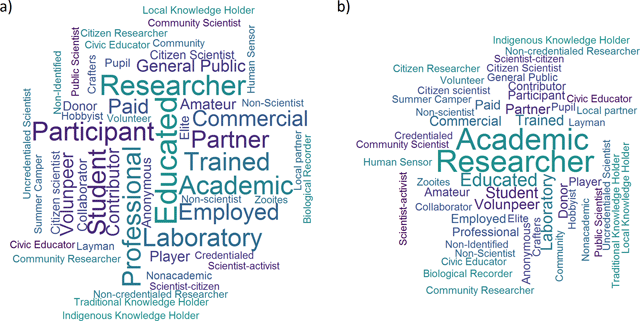
Figure 2
Word clouds for various citizen science participant terms in a) Google Scholar and b) Google News searches from December 2016. Terms corresponding to ‘citizens’ are colored in shades of purple, and terms corresponding to ‘scientists’ are colored in shades of blue-green (note that ‘citizen scientist’ appears twice, once for ‘citizens’ and once for ‘scientists’). Words with higher frequency are larger. All terms were searched along with the phrase ‘citizen science,’ and Appendix A provides the frequencies for each search term along with the exact search phrases.
Table 3
Terms describing scientists who work with citizens in ‘citizen science.’
| ‘Scientist’ term | Definition | Example | Caveat |
|---|---|---|---|
| Citizen scientist, Scientist-citizen, public scientist, community scientist | Individual with formal science training who is actively engaged in the civic sphere and wants their work to both serve the greater good and do so transparently (Stilgoe 2009) | Citizen scientists investigated anecdotal evidence to construct hypotheses regarding developmental disorders that members of the public claimed were triggered by a MMR vaccine (Stilgoe 2009). Members of Union of Concerned Scientists’ Science Network (http://www.ucsusa.org/science-network) | ‘Citizen Scientist’ is easily confused with more common meaning of public involvement in science |
| Civic educators | Individual who provides information and/or creates educational opportunities for others with the purpose of building a path for greater civic engagement | Researchers, teachers, scientists, issue advocates, journalists, reporters and political campaigners (Ceccaroni et al. 2016) | Closely associated with democratic values, inherently politically laden |
| Commercial | Individual trained in science with the goal of creating products for profit | Commercial fisher, Commercial scientist | Incentivized by financial profit, rather than ‘knowledge for the sake of knowledge’ |
| Credentialed, Trained, Educated | Individual with formal scientific degrees and training | Faculty member at a university | Reinforces the value of formal scientific education |
| Elite | Individual with experience and/or privilege not shared by the general public | Only elite scientists may serve in some peer-review processes or are considered for tenure or funding | Typically excludes the general public, early-career scientists, and minorities; many scientists strive not to be elitist |
| Institutional, Academic, Laboratory | Individual employed by or affiliated with an academic institution, agency, company, or non-governmental organization | Tenured professor, Government scientist, Laboratory technician, Student | Scientists may not be affiliated with an institution or may not work in a laboratory |
| Professional, Paid, Employed | Individual working in a scientific occupation, profession, or holding a position for which they are paid | White collar professional, Professor, Employee | Some scientists may conduct participatory projects outside paid time |
| Researcher | Individual investigating a specific and identified scientific question | Research scientist, Research ecologist | Researchers are often interpreted strictly as academics |
| Scientist-activist | Individual with formal science training who applies their expertise to political agendas | Internationally, thousands of scientists participated in a “March for Science” on April 22, 2017 to show support for evidence-based policies in government | Can be perceived as having shed the ‘objectivity’ of science |
| Volunteer Scientist | An individual who is not paid for their participation in scientific pursuits | Graduate students | Implies that scientist is inexperienced or not worth formally hiring |
Table 4
Terms describing the ‘citizens’ in ‘citizen science.’
| ‘Citizens’ term | Definition | Example | Caveat |
|---|---|---|---|
| Amateur, Hobbyist | Individual participating in science for non-fiscal personal gain | Amateur Astronomer, Amateur Naturalist | Implies that an individual is not a professional or expert |
| Anonymous, Non-identified | An individual participating in citizen science that is not identified by name | An anonymous contributor to http://www.myskyatnight.com | Does not credit participants |
| Citizen | An inhabitant of a particular town or city; a member of the general public in a defined geographic locale | American Citizen, Citizen Soldier | Can also be defined as “a legally recognized subject or national of a state, either native or naturalized,” which is misleading and potentially exclusive in the context of citizen science |
| Citizen Researcher, Individual Citizen Scientist | An individual leading an activity or performing independent or collaborative research as the lead investigator | Citizen researcher Edward Harris (a co-author of this paper) initiated the Scleroderma Education Project | Inherently separates projects from being considered traditional scientific research |
| Collaborator | An individual working together with a project leader | Participants on www.zooniverse.org are referred to as collaborators | Does not specify the level of collaboration (i.e., what part of the scientific enterprise) |
| Community, Community Researcher | Individuals who have joined a community, online or in person, to work toward a common research objective; members of a pre-existing community | Friends of Spy Pond monitoring program (Castleden et al 2008) | Implies parochial interest; implies familiarity among participants that may or may not exist; ‘community’ may be difficult to define |
| Contributor, Donor | A benefactor or contributor of money, goods, or other intellectual or physical products with value | Financial donor, Organ/tissue/blood donor, Intellectual property donor | Most often refers to individuals who donate money or materials, and not information; connotes a contributory model of citizen science with limited involvement of participants |
| Human Sensor | Individual who is part of a network by sending data and observations that are often taken and transmitted via modern communication tools, like smartphones, to a central database | The US Geological Survey has developed a smartphone app to record individual observations of Earthquakes (“Did you feel it?” https://earthquake.usgs.gov/data/dyfi/) | Has a historic stigma of scientists utilizing data on people (e.g., health, behavior, web history) without explicit consent |
| Indigenous/traditional/local knowledge expert or holder | An individual with place-based knowledge gained through lived experience or oral tradition | The indigenous Chukchi communities of Turvaurgin and Nutendli are documenting contemporary observations of climate change and comparing them to historic conditions on traditional hunting grounds (http://eloka-arctic.org) | The exact term used may be project specific and based on the expertise of the people involved, however, ‘traditional’ is less favored because the knowledge is dynamic; indigenous knowledge is viewed as different from science by both the holders of this knowledge and formally trained scientists |
| Lay Knowledge Holder, General Public | An individual who is not affiliated with a scientific establishment, but may possess specialized knowledge | People applying their knowledge of local geography to identify cities at night (http://www.citiesatnight.org) | ‘Lay knowledge’ is broad and suggests that everyone has this |
| Layman | A person without specialized knowledge or training of a specific subject | A farmer providing novel pest specimens to agricultural research | Outdated term; was more commonly used during 19th century than in past 100 years |
| Participant | An individual involved in research | The Audubon Christmas Bird Count enlists thousands of participants to observe and quantify migratory birds | This term is used by those running a project; the term comes from participatory research and ‘volunteer’ may be preferred instead |
| Partner | An individual or organization working with a scientist; term is often used in community-based participatory research | Community partner | Power dynamics are rarely equal; term ‘ally’ may be favorable |
| Student, Pupil | An individual who is engaged because their classroom/school is participating in a citizen science project | Entire classrooms or schools are sometimes assigned participation in projects | These individuals are a captive audience and not truly volunteers in the democratizing sense of citizen science |
| Uncredentialed/non-credentialed Researcher, Nonacademic, Non-scientist | An individual participating in a citizen science project who lacks scientific credentials (Nielsen 2011) | Most online citizen science projects receive data and input from non-credentialed users | Definition based on what people are not or don’t have and relies on credential, affiliation, or scientist as a defining characteristic |
| VolunPeer | A volunteer, organization, or institution representing knowledge-building activities and collaborative enterprises | Twitter hashtag #volunpeers quickly connects individuals for asynchronous collaborative activities (http://www.meghaninmotion.com) | Not currently considered a word in any official dictionary |
| Volunteer | An individual who contributes unpaid labor or service to an enterprise, e.g., a science activity | Volunteer Monitor, Volunteer Recorder | A general term without being explicitly linked to science; some participants may be paid |
| Project-specific terms | Specific terms may be appropriate or preferred for specific projects or by specific participants | ‘Biological Recorder’ (Biological Recording Centre), ‘Crafters’ (CrowdCrafting), ‘eBirder’ (eBird), ‘Local partner’ (MassBays), ‘NestWatcher’ (NestWatch), ‘Player’ (Foldit), ‘Zooites’ (Zooniverse) | Limited generalizability (but generalizability may not be desired) |