
Introduction
Gamification is commonly defined as the application of game elements, such as levels, leaderboards, or badges, in contexts other than games (Deterding et al. 2011), and has been applied to areas such as education, marketing, and health. In citizen science (CS), gamification may be used to motivate volunteer participation, as many CS projects require a group of volunteers to contribute with little to no monetary or tangible compensation in return (Morschheuser et al. 2017a).
There is some evidence to support the effectiveness of gamification for CS platforms in promoting cooperation, making experiences more enjoyable and ultimately leading to an improved intention to contribute (Morschheuser et al. 2017b); however, gamification research is still underdeveloped in CS (Baer et al. 2019; Hantke et al. 2019) compared with disciplines such as education and healthcare, which are more mature and systematic (Bassanelli et al. 2022). Gamification literature in CS generally features project-specific papers and design guidelines (Kim et al. 2024), which hinders a comprehensive understanding of what works within the field. This necessitates a rigorous evaluation of gamification, synthesising insights from different project types and CS expertise; here, we focus on its potential to support behaviour change as an outcome of a CS project.
Gaps in gamification literature
Gamification involves the use of game elements such as point systems to reward users for completing a particular task, badges to provide feedback to users for performing activities, leaderboards that instill a sense of competition, and levels that “unlock” to indicate user progress (Basten 2017). Within CS, initial evidence shows that gamified systems make the experience feel more enjoyable for the participants and improve intention to contribute, and hence can be beneficial for promoting cooperation on CS platforms (Morschheuser et al. 2017b). Additionally, game elements such as points and badges have been successfully used to quantify effort, facilitate social comparison, and increase the quantity of submissions by engaged CS volunteers (Simperl et al. 2018). However, Helmefalk (2019) points out how this consistent use of certain game elements has not led to an improved understanding of their impact, as gamification studies often lack a control condition, are case studies, or do not use validated psychometric measurements in evaluating outcomes.
Additionally, there is a lack of a unified theoretical foundation that directs gamification design or evaluation (Hamari et al. 2014). When theory is used to direct the use of gamification, it tends to focus on Self-Determination Theory (SDT) (Krath et al. 2021; Hammady and Arnab 2022). SDT discusses three basic needs—autonomy, competence, and relatedness—that are essential for fostering intrinsic motivation (Ryan and Deci 2000b), and gamified systems are designed to fulfil these needs (Hammady and Arnab 2022). Other theories focus on specific disciplines or research contexts. For example, flow theory (Csikszentmihalyi 2014) is used commonly in motivation-based gamification research; reinforcement theory (Skinner 1953) is used to describe behaviour-focused gamification research; social learning theory (Bandura 1997) is often seen in learning-focused gamification research; and affordance theory is used in human-computer interaction research (Krath et al. 2021). This inconsistency in the application of theory; the use of such theories as SDT and flow, which do not predict behaviour directly; and a lack of understanding of how and under which circumstances gamification elements work, means we lack an understanding of how gamification impacts socio-cognitive processes and elicits behavioural responses. Therefore, the understanding of gamified CS’s impact on volunteer behaviour remains limited (Hantke et al. 2019) but continues to receive interest from projects seeking to improve volunteer contributions (Simperl et al. 2018) and to address the crucial issue of continued volunteer engagement and retention (Robinson et al. 2021).
Outcomes of citizen science participation
CS is the involvement of non-expert citizen volunteers in the production of science to generate new knowledge, either as leaders, contributors, collaborators, or other forms of meaningful participation (Haklay et al. 2021). Engagement with a CS project can stimulate change in the volunteer, both in terms of attitude and behaviour, with impacts that go beyond the project (Hart et al. 2022). In an environmental context, participation has been linked to increased scientific literacy in the volunteers, support for environmental conservation, and an improved interest in local ecosystems (Chao et al. 2021). However, behavioural outcomes of participation in CS projects are an underexplored area. While multiple studies point towards the potential for CS to affect science engagement, as well as provide benefits to both society and the participant, many authors point out the simplistic nature of measurement tools used or the lack of measurement of outcomes completely, which limits understanding of the impact on volunteers’ behaviour (Hoedoafia et al. 2024; Somerwill and Wehn 2022).
To improve understanding of the potential of gamified CS to impact volunteer behaviour and behavioural outcomes, this study uses the Behaviour Change Wheel framework. At the core of this are three key factors—capability, opportunity, and motivation—which are theorised to interact to drive behaviour (the COM-B model). Going beyond motivation alone, as in SDT, the COM-B model integrates both external and internal drivers of behaviour. Capability refers to the skills and abilities of an individual, both psychological and physical, which are needed to perform a behaviour; opportunity refers to physical and social factors that make a behaviour possible; and motivation refers to the internal mechanisms that drive choices and actions (Michie et al. 2014). The COM-B model is a comprehensive model developed as a behaviour-change intervention framework, used to understand the barriers and enablers that affect the targeted behaviour (Michie et al. 2014). The COM-B model has been used to understand barriers to participation in CS (Kam et al. 2021); here, we use it to understand how a gamified CS project can advocate for and lead to behaviour change in volunteers (e.g., environmental behaviour change could be about engagement with sustainable behavioural practices or further engagement with the project). Specifically, we consider whether participation may enhance the capability of volunteers, highlight opportunities that enable them to engage in changed behaviour, or increase motivation to participate or change other behaviour, and, specifically, how these have, or may be, achieved. This can be useful for projects aiming to affect attitudes and behaviours of their volunteers in a broad range of domains.
This study
By interviewing CS experts, this study aims to gather in-depth, cross-disciplinary insights about the use of gamification features and whether these features can support CS volunteer behaviour change, by promoting the key factors of capability, opportunity, and motivation. We consider gamification as an overarching strategy that includes various features, tools, and game elements within. To the best of our knowledge, this is the first study that applies the COM-B model to CS experts’ perspective on the potential impact of gamified CS on volunteer behaviour. This helps clarify the impact that gamified CS could have on volunteer behaviour, either in the form of further engagement with the project or behaviour change beyond the project. The COM-B model can further clarify which behavioural factors can be influenced by different gamification elements.
We aim to understand how gamification can be a useful tool for CS by interviewing CS experts from various disciplines. Our semi-structured in-depth interview study goes beyond single-system analysis. It attempts to synthesise insights from across different disciplines and project types, offering new insights that have a broader application. CS experts often face multiple challenges within a CS project and have a wealth of knowledge regarding the implementation of gamification, and its successes and failures, including how it affects project volunteers. They often interact with these volunteers directly and have goals to improve the impact of the project. Hence, they offer unique perspectives in design and impact of gamified CS projects, and by interviewing these experts, we could grasp the CS volunteer experience of gamification, including its potential impact on volunteer behaviour.
Research Questions
Can Gamification be a useful strategy for CS projects?
From a CS expert perspective, can gamification in CS projects influence volunteer behaviour by encouraging further engagement with the project or influencing behaviour beyond the project?
Methods
Participants
Seventeen CS experts participated in the study, an appropriate sample size based on the concept of information power (Malterud et al. 2016). Participants were recruited using a purposive sampling strategy to ensure relevant expertise. An expression of interest form detailing the study’s aims was distributed through CS newsletters, emails, and the authors’ personal contacts, asking those with experience and interest in gamified CS to sign up. Participants had expertise in various domains and came from countries across Europe and the US. This was probably due to most CS projects being based in these regions, though we did not attempt to restrict recruitment in this way. A full summary of participant demographics is provided in Supplemental File 1: Appendix A, Table A1, with each participant assigned a number, P1–P17.
Data collection
Participants provided informed consent via an online consent form. Data was collected using semi-structured interviews recorded via Microsoft Teams. Interviews ranged from 27 to 49 minutes. The interview guide (Supplemental File 2: Appendix B) was developed based on previous literature and the COM-B model, and was piloted with 2 participants prior to the study. To ensure participants and researchers had a unified terminology to address the research questions, participants were shown slides to differentiate gamification from other similar concepts such as serious games. Serious games are games intended for education, training, or for purposes other than entertainment, usually with a traditional game structure but with goals other than play. Conversely, gamification adds game elements to other activities (e.g., physical activity or classroom quizzes) rather than building a separate game structure (Hammady and Arnab 2022). Participants were first asked about their experience of using gamification in CS projects, before examining whether CS participation can lead to lasting behaviour change in volunteers. The interviews concluded with asking participants how they think gamification could support this behaviour change as outcomes of a CS project.
Data analysis
Microsoft Teams transcriptions were checked and edited for accuracy and used for analysis. A reflexive thematic analysis approach was chosen as this allowed for flexibility, crucial due to the exploratory nature of this research. It also allowed us to take an active role in meaning-making and draw on the experiences of the researchers involved. Primary analysis was undertaken by one researcher; secondary analysis involved two other researchers reviewing two of the anonymised transcripts (one transcript was the same for both researchers and one was different, so three transcripts were second coded altogether). Codes were discussed between all three researchers before themes were jointly finalised. This discussion was enriched by the environmental psychology and behaviour-change expertise of one of the researchers and the cyberpsychology and CS expertise of the other researcher. A reflexivity statement outlining the researchers’ positionality and potential influence is provided in Supplemental File 3: Appendix C.
Results and Discussion
The analysis revealed 3 overarching themes: (i) gamification for wider accessibility but not for super-users; (ii) behaviour change through enhancing capability and highlighting opportunity; and (iii) barriers to gamified behaviour change. These are summarised in Supplemental File 4: Appendix D and discussed in more detail in the following sections. Figure 1 illustrates the relationship between these themes.
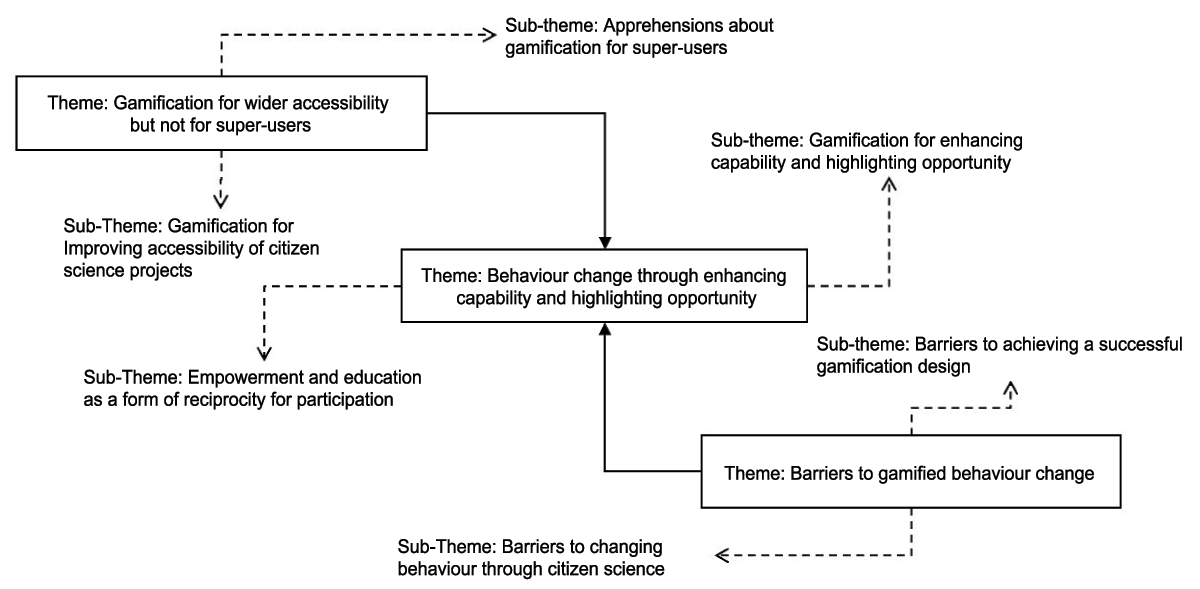
Figure 1
Conceptual framework of the identified themes.
Gamification for wider accessibility but not for super-users
The theme “gamification for wider accessibility but not for super-users” captures the contradiction that participants expressed while talking about the use of gamification in CS. The two sub-theme sections discuss how gamification is seen as useful for reaching out to a wider audience, but as counter-productive for a particular CS volunteer type.
Gamification for improving the accessibility of citizen science projects
One of the key insights that emerged from interviews was the idea that gamification can be a way to improve the accessibility of CS projects. Super-users, or volunteer contributors who keep coming back to submit data or engage continuously with a project, are often quite few in number (Boakes et al. 2016), meaning the reach of the project remains limited. Overrepresentation of certain groups leads to a reduction in the diversity of voices in project data and the people it impacts (Spiers et al. 2018).
Our CS experts expressed difficulty in engaging volunteers who might not care about the science or the subject matter of the project as much. Those who end up participating could be people who already care about or are engaged with the subject matter, thus limiting the impact the project can have (Pateman and West 2023). One expert expresses this specifically in the context of an environmental CS project: “There’s all these kind of cliches about the groups that are easy to reach because if you try and recruit through the existing volunteer groups that are doing things around environmental topics, which is a very effective way to recruit people. Yeah, it’s really unrepresentative. And it’s a kind of a very small subset of the population. So, I think games and gamification has like a big potential there, making it interesting to people, I guess in that sense as well” (P12).
To tackle this issue, interviewees felt that gamification could be a tool to democratise science, making it easier to reach people who tend not to engage with science. Gamification could help direct a project towards an audience who might hesitate to participate otherwise, improving the diversity of voices within the project. Evidence suggests that for CS projects that require more ecologically valid data, for example, in an applied linguistics project, gamification can improve data quality and data collection by getting individuals from different walks of life to take part (Kim et al. 2024). Additionally, CS projects tackling issues that receive little public attention can use gamification to direct attention towards the issue, benefitting the project and gaining crucial data for it (Speelman et al. 2023).
CS volunteers are generally classified as super-users or casual users (those who are more sporadic contributors to the project). While super-users are deeply engaged with the project, maintaining the engagement of casual users is often a challenge (Lotfian et al. 2020). Our CS experts referred to the potential of gamification to help with this, getting the casual users to care about the science and potentially converting them to super-users by encouraging them to take up long-lasting roles within the community, and to engage with tasks outside their comfort zones. As another expert points out, this is not about rewarding the volunteer but presenting the task differently: “When it was about data analysis, people, said to me, I’m not good at that, I’m not good enough. So I’m not coming because first of all I [don’t] want to expose my ignorance in front of other people. And based on the same discussion that we were having before right, on gamification making things easier for people to understand and to be part of. I think it [gamification] could play a role here in terms of increasing engagement” (P15).
Gamification is generally utilised to reward volunteers with points or virtual badges (Kapenekakis and Chorianopoulos 2017). However, during the interviews, participants raised the idea of using gamification as an alternative mode of presentation, using it to ease the understanding of the complex scientific ideas, reduce fears of doing something wrong, and hence further encourage participation with the project. In one expert’s words: “sometimes you can, using games, you can have metaphors for better explaining real things, and those will be so it’s explaining the reality using things that will stay in the memory of the people, right?” (P13). Evidence also suggests that using gamification elements such as narratives, wherein stories are used to depict how events occur over time, are better at helping individuals grasp information, remember it, and recall it better as compared with straightforward factual information (Armstrong and Landers 2017).
Our CS experts felt that this gamified presentation could encourage volunteers to explore alternative environmental scenarios and experiment with different actions to understand their outcomes. Gamification could further help visualise the impact of individual contribution, see the positive change, and recognise volunteers for their impact. For example, virtual badges have been shown to indicate mastery or completion of a task (Goh et al. 2017), which can make the impact of specific contributions on the overall outcomes of the project clearer. Understanding can be further aided by the familiarity of gamification concepts that already exist around us. Our interviewees drew upon their experiences with gamification in aspects of their lives such as the gym, exercise apps, or language learning apps: “Maybe if it’s too science-y and too…, then it maybe they feel alienated from it and feel difficult and not familiar with it. And if it’s gamification, maybe they think, hey this is easy to understand. I feel familiar with it” (P4). Familiarity with gamification could be helpful as volunteers do not feel the need to re-learn the rules of the system and can therefore feel more at ease with grasping scientific ideas.
Apprehensions about gamification for super-users
Super-users are responsible for most contributions in a project, and are motivated by science and being able to contribute to science (Robinson et al. 2021). Our CS experts expressed apprehension while talking about the super-users and their experience of gamified CS projects. Experts were concerned that gamification could be counterproductive for super-users, as super-users are participating for scientific reasons and would continue to do so regardless of how complex the data gets or how complicated the science gets.
“Are they going to dislike, you know, some of the mechanics and some of the interactions that are used, you know, more specifically towards Gamification goals as opposed to, you know, just the pure science goals that people are after?” (P8).
Gamification was seen by experts as shallow, as rewarding volunteers for the quantity of their contributions rather than the quality, leading volunteers to focus more on getting the gamified reward, badge, or point, rather than being rigorous with their contribution.
Motivation to contribute is a complex phenomenon, and theory suggests that extrinsically rewarding individuals can undermine their intrinsic motivation to do something (Ryan and Deci 2000a). For super-users, gamification was thought to not only undermine the intrinsic motivation to contribute, but also to appear condescending or patronising by framing science as a game. As one expert described, “I almost found it condescending in some ways. Like, well, our researchers willing to do this, but you’re obviously not because you’re just a member of the public. So you need it to be a game, like you’re only going to be engaged in this research if we make it shiny and we make it a game and you get points and you get badges” (P9).
Changing behaviour by enhancing capability and highlighting opportunity
This theme addresses the second research question about the effect of gamified CS on volunteer behaviour. The first sub-theme within it emerged out of a general discussion about the behaviour-change potential of CS, whilst the second sub-theme elicits the expert perspective on how gamification specifically could support this behaviour-change potential. Taken together, these two sub-themes argue that gamification can be useful for supporting a variety of CS outcomes, especially empowerment and education, which may relate to the capability factor of the COM-B model.
Empowerment and education as a form of reciprocity for participation
Our experts felt that it is a moral obligation of a project to give something back to the CS volunteers for their time spent on the project. CS is a collaboration between the scientist and the volunteers, where both parties should benefit from this collaboration. P7 strongly expressed the scientist’s responsibility towards the CS volunteers: “… in a paper that talks about hey, we started a CS project to get people to collect lots of data that will process lots of data for us, we save so much money because, we reduce the cost, this is such an efficient and economical way to achieve my scientific aims. My review comment for a paper like this is, hey, you keep talking about how much effort and money this saved YOU as this academic scientist, right? But how are you treating these participants? You didn’t say anything about that?”
Projects that adopt an extractive approach, focusing primarily on getting data, lead to decreased motivation and data quality, while acknowledgement of the volunteer’s input, giving meaningful feedback, and keeping volunteers updated about their progress could improve data quality (Hall et al. 2024). Thus, our experts thought that CS should focus on being relational, emphasising building relationships between scientists and volunteers. Behaviour change is one of the things that a CS project can give back to its volunteers: “So for me, I think some form of giving back, whether that’s in a behaviour change, in an increase of learning, an increase of agency, an increase of access to science like or education, I think is important” (P9).
The interviewees discussed how changes in volunteer behaviour post participation in a project can take different forms, from growing the citizen community itself to using data collected to inform policy, affecting millions of individuals who might not be connected to the project at all. In terms of the COM-B model, our CS experts connected volunteer participation to behaviour change primarily through the capability factor, which refers to both the possession of necessary knowledge to perform the change in behaviour and the possession of reasoning, thought processes, understanding, and comprehension to perform the changed behaviour (Willmott et al. 2021). Both education and awareness, as well as the mental process of feeling empowered, were referenced by the CS experts.
Participation in a CS project was seen as a way to educate people and raise awareness about a topic, which could eventually lead to behaviour change. For most, it was seen as necessary that CS projects educate people. “Whether that leads to behaviour change or not is another question, so I think we do have an imperative to educate through citizen science” (P3). Our CS experts felt that participation could be a window to another world for volunteers. They talked about how participation often elicited a sense of curiosity in volunteers, leading them to explore the subject matter outside of project participation. Some felt that CS could also be a unique opportunity for volunteers to engage in experiential learning, potentially leading them to think extensively about the project topic. It might have a bigger impact on people’s memory of the topic and trust in the related science, compared with reading a scientific report. This could be especially true for projects that involve an in-person component of participation, wherein volunteers can physically engage with the subject matter. “Citizen Science, I think, is the perfect crossroad in getting science out of this ivory tower and getting the people to experience in an active way… All of the outreach that you preach for” (P16).
In the context of enhancing capability, CS experts also mentioned the potential of a project to empower the volunteer, which has been connected in previous literature to enhancing capability through affecting various mental processes such as increasing self-efficacy, heightening awareness, enabling problem-solving, equipping individuals with essential skills, and exerting control over situations, among others (Alismail 2024; Mosanya and Kassie 2024). This empowerment was also seen as a crucial part of the CS project by our experts. “When you’re involving communities in your research, you really should be involving them in the results and empowering them and capacitating them to use it in whichever form” (P6).
CS experts believed that participation in a CS project helps break down barriers between scientists and volunteers and opens doors for non-scientists to engage with science. Our experts saw CS as more than just obtaining data (or analytic assistance); they understood it to be about collaborating with the public, with a two-way flow of knowledge, where the volunteer also benefits from the expertise of scientists access to scientific resources and data that can benefit the community. Our interviewees considered this access empowering for volunteers: “When, when involving citizens in these kind of projects, you’re giving them a little bit of superpower, right, because they’re not scientist. But in this way they can become one so they can have this empowerment of being engaged in something they are usually not” (P2). This empowerment is often overlooked by CS projects (Hall et al. 2024).
Experts also highlighted how collecting data may itself be empowering for citizens, helping volunteers to communicate with friends or with relevant authorities if necessary; this could also inspire people to change their behaviour, and direct behaviour change. “There’s the old adage you can’t manage what you don’t measure. We should improve the state of the river. Well, what state is it in? And until you know that you have some sort of a benchmark, you don’t know what your trajectory of change is…” (P6).
The role of a CS community in empowering volunteers also came up during interviews. While participation in a community has previously been shown to affect how empowered individuals feel (Christens et al. 2011), it has not been studied extensively in CS. However, experts intuitively understood the power of a CS community, pointing towards the potential of a community to inspire volunteers, generate interesting ideas, achieve large collective goals, teach other community members, spread awareness, instil a sense of belongingness, and also potentially support behaviour change. “The other is more social is to, you get a bunch of strangers together talking about the same problem and they didn’t know they have that in common before, but they do” (P5).
Gamification for enhancing capability and highlighting opportunity
As highlighted in the previous sub-theme, our CS experts identified education and empowerment as key mechanisms by which involvement in CS may lead to behavioural change. When asked specifically about the link between gamification and behaviour change, our experts felt that gamification could further support this empowerment, or in COM-B terms, enhance capability. They also talked about the potential of gamification to highlight areas for behaviour change, which relates to the opportunity factor of the COM-B model.
CS experts alluded to how gamification can indicate how volunteers have enhanced their capability within the project domain. Indeed, game elements such as points and badges, often referred to as virtual rewards, could be beneficial in providing immediate feedback to volunteers by translating volunteer effort into quantifiable and comparable virtual items that can facilitate an understanding of volunteer progression and performance on the project (Goh et al. 2017; Simperl et al. 2018). These virtual rewards have also been shown to allow recognition for variable competencies of different volunteers on a crowdsourcing platform (Maddalena et al. 2023). Hence, badges can be awarded to CS volunteers for meaningful purposes, such as for skills they have gained, or to indicate “levelling up” of their understanding, which can also create a sense of competition with oneself.
Designing behaviour-change interventions by incorporating the opportunity factor often involves enabling or highlighting opportunities for individuals to engage in changed behaviour. For example, in the environmental behaviour context, the individual needs to feel that they have the opportunity to alter their consumption habits, buying habits, or lifestyle (Benz et al. 2022; Kureshi et al. 2023). While talking about highlighting opportunities, CS experts mentioned game character identification or fictional personas to indicate possible actions that could be undertaken. Game character identification is an interactive way of occupying a different role, gaining a new perspective, and merging one’s identity with that of a game character (van Reijmersdal et al. 2013). “… the participants are required to imagine how it would be as that persona like for example a child or people with some kind of disability or people who are blind, people who have to push a stroller because they have a child… So this is the gamification part to get people into character, to think like…” (P5). CS experts also mentioned other elements, such as badges, which can be awarded after one has written to their local Member of Parliament or MP about water quality, for example. This can be another way to highlight an opportunity or indicate the next steps volunteers can take within the project. Gamification can, therefore, be used to present information about creating a bigger impact through the project.
Barriers to gamified behaviour change
In addition to discussing the behaviour change potential of CS and the ways in which gamification can support it, our experts also noted some concerns and barriers that could hinder this process. This theme addresses these barriers within two sub-themes. The first sub-theme focuses on certain issues that can arise with changing behaviour through CS. The second focuses specifically on the application of gamification within CS and the issues that can arise.
Barriers to changing behaviour through citizen science
Our experts pointed out various caveats associated with wider behaviour change as a goal of a CS project. Most pointed out that behaviour change is a bonus of participation and should not be seen as an aim of a CS project: “… normally this was always viewed as an additional, like an add on in citizen science. It’s never planned for. So what’s planned for is to collect data for your scientific research to address it. You know, like an environmental issue or to, you know, to close your data or to get the data that you need for your scientific research” (P17). CS experts also often felt that behaviour change should be explicitly defined in a project, considering whether data from the project or focusing on individual action would lead to the biggest impact. “…. it distracts from what I think is the important bit, which is like really having the biggest impact possible on the quality of water in, in in the local environment, but I’m not convinced that the solution comes from personal behaviour change. It comes from either like policy change to have different kinds of targets and better enforcement of those targets…” (P12).
A related issue highlighted by interviewees was the lack of availability of behaviour-change experts within their projects, limiting understanding of what can be achieved and the best way to do it. Understanding the mechanisms through which various behaviour-change techniques can affect behaviour is required for intervention success (Connell et al. 2019). “… people talking about ‘USING’ Citizen Science as a tool for behavioural intervention, are actually not the domain subject experts in behavioural interventions. They often could be, you know, maybe environmental science researchers and academics, but your expertise is actually not behavioural intervention…” (P7). Having this behaviour change expertise on board could help align the goals and aims of a project and help deal with other salient issues, such as maximising the potential change in behaviour by accounting for the background characteristics of volunteers, which may cause different responses to behaviour-change interventions.
Barriers to achieving a successful gamification design
Many of our CS experts expressed the need for more information and expertise to understand the use of gamification and implement it within CS projects. They talked about a lack of guidelines regarding the use of gamification and also pointed towards the need for financial resources and access to the right expertise to implement gamification. One spoke of the need to understand how to include gamification in a grant application: “Because like in order to actually implement this, you kind of need to push it in a way that maybe to have grant opportunities, to select the best applications that could in citizen science that could benefit, from gamification and put experts of this at the service of it, because there’s no experts of this around” (P16).
Some CS experts, more closely associated with working in the field of CS games, game-based approaches, or gamification in CS, expressed more confidence in their ability to implement gamification. “So I think it’s quite important also to be aware of the theory that is behind games. So you can apply that theory on the development of the game or on the development of the gamification strategy that you want to implement into your application. So you can ensure those risks can be avoided” (P3). There was also confidence in the ability to overcome drawbacks that may come with a gamification approach. It was thought that with the right kind of planning, one could mitigate most risks. For example, the problem of poor data quality is generally associated with an incentive-based approach, wherein users often end up caring more about the incentive and less about being meticulous with data contributions (though as noted earlier, and counter to this, is that it can encourage people to contribute even if uncertain about their skills or knowledge about the topic). To tackle this, design can combine elements that satisfy users’ internal motivations, such as autonomy, competence, or relatedness, with elements that satisfy external motivation, such as rewards, to increase the perceived enjoyment of the task (Ryan and Deci 2000b; Dowthwaite et al. 2025).
General Discussion
Our interviewees offered an alternative view of the use of gamification in CS. Rather than using gamification to reward data submission in CS by the same volunteer group, gamification was instead seen as a way to attract a diverse audience by making scientific concepts more accessible, interesting, and less daunting. For regular contributors, gamification could present complex tasks differently, encouraging volunteers to step outside their comfort zones. This could further be aided by the familiarity of gamification that exists around us, wherein the rules of a system could be intuitive for users. However, for super-user contributors, CS experts expressed some hesitation in using gamification, cautioning against designing gamified systems that might appear to question competency. Additionally, our experts also expressed a need for gamification-specific guidelines and the use of specialists to build a successful gamified CS project.
The discussion about behaviour change led our experts to stress how education and empowerment, which relate to the capability factor of the COM-B model. are imperative to the CS experience. CS participation can lead to experiential learning, wherein CS volunteers engage with the subject matter of the project deeply. Experts also noted the potential for empowerment through being part of a shared CS community, through making science more accessible, and by collecting data that helps volunteer citizens communicate their concerns to authorities better. Gamification elements were seen as a tool to make this more salient within the project, for example, virtual rewards could be used to indicate a volunteer’s knowledge attainment. Furthermore, related to the opportunity factor of the COM-B model, elements such as game character identification were cited as a way to illustrate opportunities for change or exemplify potential new actions. However, interviewees also stressed the need for appropriate behaviour-change expertise within the project team to maximise the potential for behaviour change through CS.
Overall, behaviour change in this context means enhancing volunteer knowledge and capability in the domain of the project, or it may be wider behaviour change that leads to a broader impact through the project. However, wider behaviour change needs to be specifically targeted through game elements. For example, if the project seeks to encourage nature conservation, the gamification elements should directly reinforce that aim, rather than competing with other priorities like enhancing data collection.
Limitations and future work
We note that a limitation of this work is its heterogeneous sample of experts with broader experience in CS rather than those with specific gamification expertise in CS. This may have limited the depth of insights into gamification-specific strategies and perspectives. Our experts also focused on discussing their past experiences with the use of gamification, and the discussion of the future potential of gamification remained limited. In addition, we use our experts as a proxy to understand the impact on volunteers from a variety of different project types rather than talking to CS project volunteers directly. Future work could approach this from the gamification experts’ perspective and could also test our findings through experimental or longitudinal research directly with volunteers. Another limitation is the lack of specificity of the behaviour being focused on. We kept our definition of behaviour change broad by including both behaviour change within and beyond the project to elicit more general discussion from participants. Future work could be specific in its examination of the target behaviour and the potential of CS to influence it.
Conclusions
CS projects, usually primarily designed to collect volunteer data, often miss out on the opportunity for behavioural transformation (Jordan et al. 2011). In the environmental domain specifically, CS participation could be instrumental in promoting pro-environmental behaviour, benefitting not just the participants but also aligning with the broader goals of many CS organisations. Our data provides evidence of three ways in which gamification can support these goals: by making projects (and their subject matter) more accessible to a broader audience, and potentially getting new volunteers onboard; by highlighting the improved capabilities of the volunteers within a CS project, empowering and encouraging them to take new roles within the project; and finally, by highlighting opportunities within projects for existing volunteers to engage in new behaviours.
Through our work described herein, we provide insights into the impact of gamification elements within the context of a CS project on volunteer behaviour. Through the lens of the COM-B model, our data suggest the potential of gamification elements such as virtual rewards and in-game characters to support behavioural transformation by influencing volunteer learning, empowerment, and capability, and by directing attention to new behavioural opportunities.
Supplementary Files
The supplementary files for this article can be found as follows:
Ethics and Consent
This research was approved by the School of Computer Science Research Ethics Committee (CS REC), University of Nottingham, ethics application ID CS-2023-R41. Participants received the information sheet and were asked to sign a consent form via Microsoft Forms prior to the interview. Participants were informed about the anonymisation of their data and were provided with an appropriate contact in case they needed to withdraw from the study. A summary of this was also provided at the start of the interview.
Author Contributions
NP led conceptualisation, analysis, data collection, and writing – original draft. AS contributed to providing resources, analysis, writing – review & editing, and supervision. LD contributed towards conceptualisation, resources, analysis, writing – review & editing, and supervision. SK contributed to writing – review & editing, and supervision. JS contributed towards resources and supervision.