
Introduction
The visibility of social science and humanities projects in the broader context of citizen science is comparatively low (Pettibone et al. 2017; Tauginienė et al. 2020; Heinisch et al. 2021). Discussions about citizen science between humanities scholars and representatives of the STEM disciplines often reflect the debate on the “two cultures” that C. P. Snow launched with his famous 1959 lecture (McCray 2019). In these debates, scientists question not so much the possibility of participatory approaches in the humanities but rather the scientific nature of the humanities (Smaniotto and Passani 2023, pp. 4–5). Differences in epistemic cultures are stressed (Kasperowski et al. 2020; Haastrup et al. 2025). At best, scientists and humanities scholars “appear to be disconnected” (Mahr et al. 2018, p. 101).
While this article cannot demonstrate the legitimacy of the humanities and their methods in general, it shows how library-driven citizen science projects in the humanities can be successfully organized, and what kind of scholarly relevant results they can expect. As a case study, this article presents how the Zentralbibliothek Zürich (ZB) has seized the often-cited untapped opportunities of citizen science in the humanities (Oswald and Smolarski 2016; Dobreva 2016; Heinisch 2020) since 2021.
To avoid revisiting the debate on the scientific nature of the humanities at this point, the term “citizen humanities” is used throughout this article. In the context of German-speaking Switzerland, however, the ZB uses the English phrasing “citizen science” for its activities (Wiederkehr 2022) as “Wissenschaft” in German encompasses both science and the humanities.
A substantial body of literature addresses both concepts and implications of terminology relating to crowdsourcing and citizen science in the humanities (Mahr et al. 2018; Ridge et al. 2021, pp. 32–34). These studies indicate that the term “citizen humanities” has not yet been fully adopted within the citizen science community; indeed, it is not discussed in some of the most influential contributions to the field (Eitzel et al. 2017; Haklay et al. 2021). Beginning in the 2010s, however, several authors have proposed the use of the term for activities such as “collaborative tagging, transcribing, categorising, mapping, georeferencing, contextualising, and translating” in disciplines such as history, linguistics, and art (Heinisch et al. 2021, p. 100; Dunn and Hedges 2018). While it has at times been questioned whether crowdsourcing and participatory projects in cultural institutions qualify as citizen science, some authors have argued that crowdsourcing projects based on collections are the most typical form of citizen science in GLAM institutions with substantial heritage collections (Pierroux et al. 2020, pp. 4–5; see subsection Conclusions from studying the experiences of other GLAM institutions) regardless of whether they called this kind of activity citizen humanities or not. Terras (2016) pointed out that, in this kind of project, the citizen scientists locate, create, assemble, sort, or analyze information into a common source or format, and provide scholars and digital humanities researchers with new or improved primary source material.
The ZB is one such GLAM institution with a substantial heritage collection. As one of the largest libraries in Switzerland, it has been the state, city, and university library of Zurich for more than 100 years. Building on its heritage collection, new acquisitions focus on the humanities, the social sciences, and works from and about Zurich, the so-termed turicensia (Brändle et al. 2017). In 2024, it had more than 26,000 active users, both scholars and non-academics, who accumulated more than 831,000 library visits.
During the 2021–2024 period, the ZB aimed to expand on its core task to mediate between science and the public to strengthen its profile as a partner in research (Zentralbibliothek Zürich 2021). Citizen humanities was an ideal field for the ZB to serve its traditional dual function as both a public and an academic library through a new type of activity making scholars interact with the broader public. The launch of a strategic 4-year project to systematically establish citizen humanities was also an important field of action in the ZB’s broader approach to promote open science and enhance participation in scholarship. Thus, the ZB’s policy followed the recommendations of the League of European Research Universities (LERU 2016; 2018) and of the Swiss Science Council (Strasser and Haklay 2018), which strongly advocated the establishment of citizen science (including citizen humanities) at universities and academic libraries in Europe and Switzerland.
This case study outlines in the first section how the ZB has been involved in citizen humanities since 2021, describes the basic assumptions that formed the basis of planning for the 4-year project, and addresses the challenges and lessons learned from studying the experiences of other GLAM institutions. In section two, the article gives an overview of the specific projects and campaigns that have been conducted so far. The public campaigns included georeferencing (4 campaigns), transcribing (7 campaigns), participatory creation of open educational resources (OER; 2 campaigns), and collaborative writing (1 campaign). One campaign was discontinued before launch. Three campaigns were started only in 2025, that is, after the end of the 4-year project (Figure 1; Supplemental File 1: Profiles of campaigns). In the third section, two challenges are highlighted: collaboration between academic librarians and full-time scholars, and side effects of motivational techniques.
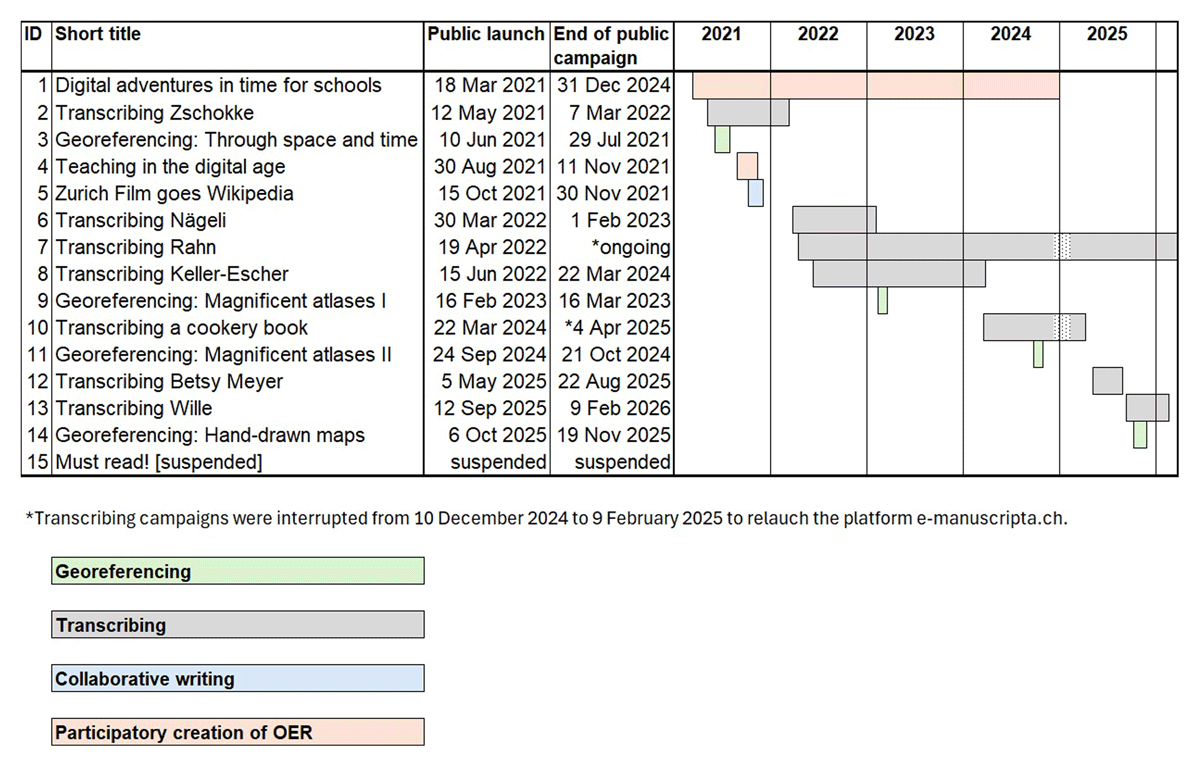
Figure 1
Overview of project types and campaign durations.
Strategic Approach and Basic Assumptions of Project Planning
In 2021, the ZB chose a strategic approach to establishing citizen humanities from scratch. In line with the above-mentioned relevant policymakers, it conceived of citizen humanities as a part of the broader open science movement allowing citizen scientists to participate in all stages of the research cycle, from formulating research questions to collecting, analyzing, and interpreting data to the publication of results (Haklay et al. 2021). Thus, its definition stressed the cooperation of full-time and paid academics with non-academics (Eitzel et al. 2017) and did not refer to the longstanding tradition of scholarship outside of universities, although this has always been a relevant phenomenon in the humanities.
The ZB drew conclusions from studying the experiences of other GLAM institutions, embedded its activities in the local Swiss and Zurich contexts, and provided additional internal funding for a 4-year project.
Conclusions from studying the experiences of other GLAM institutions
The most important observations from the study of other GLAM institutions’ experiences and the conclusions that the ZB drew from them were:
The success of citizen humanities projects does not depend on sophisticated IT tools but on creating space for social interaction among the citizen scientists as well as between them and the scholars (Bunge 2017; Göbel et al. 2020; Land-Zandstra et al. 2021; Werner 2021). That is why the ZB invested additional financial and staff resources mostly in community building and management, including campaigning, marketing, and communications fostering participation.
In terms of platforms and software, the ZB relied on established solutions to save resources. This technical approach had the further advantage that the project results were mostly produced in the ZB’s regular IT systems and transferred to digital long-term preservation by existing routine processes (Wiederkehr 2021). Running projects in technical infrastructures under the ZB’s full control gave the opportunity to define openness of the project results from the very beginning and ensure it by the terms of use and participation. Thus, many of the recommendations on data governance, documentation, and access given by Bowser et al. (2020) were addressed by entrusting the responsibility for the data life cycle to the ZB as a sustainable data infrastructure.
GLAM institutions with substantial heritage collections typically initiate citizen humanities projects closely related to these collections (Bunge 2017; Mumelaš et al. 2025, pp. 7–10). In the European context, this is a consequence of their fundamental mission: institutions such as libraries and archives are not focused on individual research questions and specific or even provocative theses. Instead, they provide reliable sources and data in neutral and permanent form for any topic scholars and non-academics alike want to examine (Graf et al. 2026). Thus, crowdsourcing in terms of Haklay’s (2013) typology—contributory projects in terms of Bonney et al. (2009)—is the most common type of citizen humanities projects initiated by GLAM institutions with substantial heritage collections (Ridge 2014; Ridge et al. 2021). The ZB decided to follow the example of other successful libraries, that is, to focus on crowdsourcing.
It is motivating for citizen scientists that they can share their specific local knowledge, make it available to research or scholarship, and feel recognized for their work. What makes citizen humanities projects attractive to them is the fact that they offer the opportunity to understand and shape local developments. Participation in citizen humanities projects is high if they allow the participants to meet people who share the same interests and are committed to the same cause (Göbel et al. 2020; Heinisch et al. 2021; see also below subsection Motivations: effects and side effects). Previous research also stated that making historical documents accessible, processing, and analyzing them as primary sources is an important manifestation of citizen humanities (Tauginienė et al. 2020, p. 5).
For the ZB, this meant that its profile and the interests of potential participants in citizen humanities projects best matched in doing research on local history based on the turicensia collection and other Zurich cultural heritage.
Embedding the Zentralbibliothek Zürich’s activities in the local context
The ZB opted for a complementary strategy regarding other Zurich and Swiss players. It refrained from duplicating existing offers and competing with the other local players. Instead, it chose to find its own niche—and to collaborate.
Citizen Science Zurich, a center at the Faculty of Arts and Social Sciences at the University of Zurich since 2026,1 teaches citizen science methodology to faculty members and other researchers. As it is actively advocating citizen science (including citizen humanities) in policy discourses, provides generic digital tools, and awards seed grants (University of Zurich 2026), the ZB did not follow these courses of action, which are often taken by academic and research libraries (Cavalier et al. 2020; Kaarsted et al. 2023; LIBER Citizen Science Working Group 2025).
The Image Archive located at the ETH Library in Zurich has been running successful crowdsourcing campaigns for many years. In these campaigns, volunteers have identified the motifs in the photographs the Image Archive provides digitally or have georeferenced aerial images (Graf 2024). Consequently, the ZB did not design campaigns based on its photograph collection. Rather, it started transcribing projects, which was a unique selling point in Switzerland at the time.
Objectives and structure of the 4-year project
In order to systematically establish citizen humanities as a field of activities, the ZB set up a strategic 4-year project on two levels (Wiederkehr 2022).
At the higher level, the project team was to systematically acquire competencies, establish a ZB citizen humanities brand through a coherent overall marketing concept, build up a pool of committed citizen scientists, and maintain systematic contacts with other relevant institutions and networks throughout the entire 4-year period (see below).
On the lower level, the project team was to conduct campaigns of shorter duration and to test the acceptance of different kinds of citizen humanities activities (see section Types of Citizen Humanities Activities) with the target groups, which were the broader Zurich public and students. The focus was placed on crowdsourcing projects using materials from the heritage and turicensia collections.
The concrete goals of the project included
– making parts of the ZB collection more accessible (improving metadata);
– raising the visibility of selected (digitized) parts of the ZB collection; and
– retaining library users and acquiring new ones.
ZB library users include professional scholars, academically trained individuals working outside academia, and residents from Zurich without any academic background.
The additional funding was mainly invested in staff for marketing and campaigning (0.5 full-time equivalents [FTE] for four years) and on-site events organized or hosted by the ZB. Permanent staff members contributed their expertise to specific campaigns.
The overall marketing concept involved coordinating the campaigns in terms of time, content, text modules, and visual elements. Communication was implemented across multiple media channels such as the ZB website (Zentralbibliothek Zürich 2025); its blog (Zentralbibliothek Zürich 2025b), social media networks, and digital newsletter; printed flyers and mailshots, as well as video tutorials and press releases. All campaigns were registered with the national citizen science platform Schweiz forscht (Stiftung Science et Cité 2025) and promoted by domain-specific platforms and networks such as the Swiss Society of Cartographers, which resulted in posts on third-party social media channels.
Networking and establishing systematic contacts with relevant players in the field of citizen humanities was realized by joining national citizen science networks not related to libraries (Schweiz forscht, mit:forschen!, Österreich forscht) and the LIBER (Ligue des Bibliothèques Européennes de Recherche) Citizen Science Working Group, as well as cooperating with other libraries engaged in citizen humanities in the German-speaking countries, especially the Sächsische Landesbibliothek –Staats- und Universitätsbibliothek (SLUB) Dresden. This included joint panels and presentations at conferences, co-authored publications (Mondardini et al. 2021; Graf et al. 2026), and teaching citizen humanities to librarians at Swiss institutions of higher education.
The ZB made the basic planning decision to take advantage of the new opportunities of the digital age. Following the example of other GLAM institutions (Terras 2016; Ridge et al. 2021), it organized its campaigns so that citizen scientists could participate at any time and in any place using simple online tools. The pandemic, which made in-person events impossible for some time, reinforced this approach. That is not to say that the ZB went without on-site events completely. By the time of writing, it has organized 23 citizen humanities workshops and public events at its premises.
Types of Citizen Humanities Activities
Since 2021, the ZB has engaged in four types of citizen humanities activities, two of which are described in this section:
– georeferencing old maps;
– transcribing handwritten documents;
– participatory creation of OER; and
– collaborative writing.
The subsections describe the main features of the activity and its significance for research, the target groups of the campaigns, the IT tools used, the main results, and what other academic libraries might learn from the ZB’s experiences for their own efforts.
The ZB conducted 14 public campaigns that are described in detail on the ZB’s website (Zentralbibliothek Zürich 2025; Figure 1; Supplemental File 1: Profiles of campaigns). All campaigns were addressed to scholars and citizen scientists interested in the specific topic of a campaign, in Zurich and Swiss history, and in the ZB collections. Previous research has shown that individuals with higher levels of education are overrepresented among participants in citizen science projects (Haklay 2018, pp. 55–56). Acknowledging this pattern, the ZB encouraged academically trained individuals to participate in citizen humanities projects outside their own fields, thereby exposing them to scholarly methods of the humanities. At the same time, it devoted comparatively limited effort to recruiting participants without any academic background. More specific target groups are given below.
The participatory creation of OER on local history (campaigns 1, 4) are not discussed herein because these campaigns diverged most clearly from classic citizen science and proved less successful than the other campaigns. Collaborative writing during Wikipedia edit-a-thons (campaign 5) is a well-established format of citizen humanities (Bemme and Munke 2021; 2022; Ridge et al. 2021, p. 367). As the ZB’s experience confirms earlier findings, it is not considered further here.
Georeferencing old maps
The task of the citizen scientists in georeferencing maps is to identify matching points on digitized old and modern maps to geographically locate and rectify the old maps, as Figure 2 shows for the famous Murer map (Murer 170x).
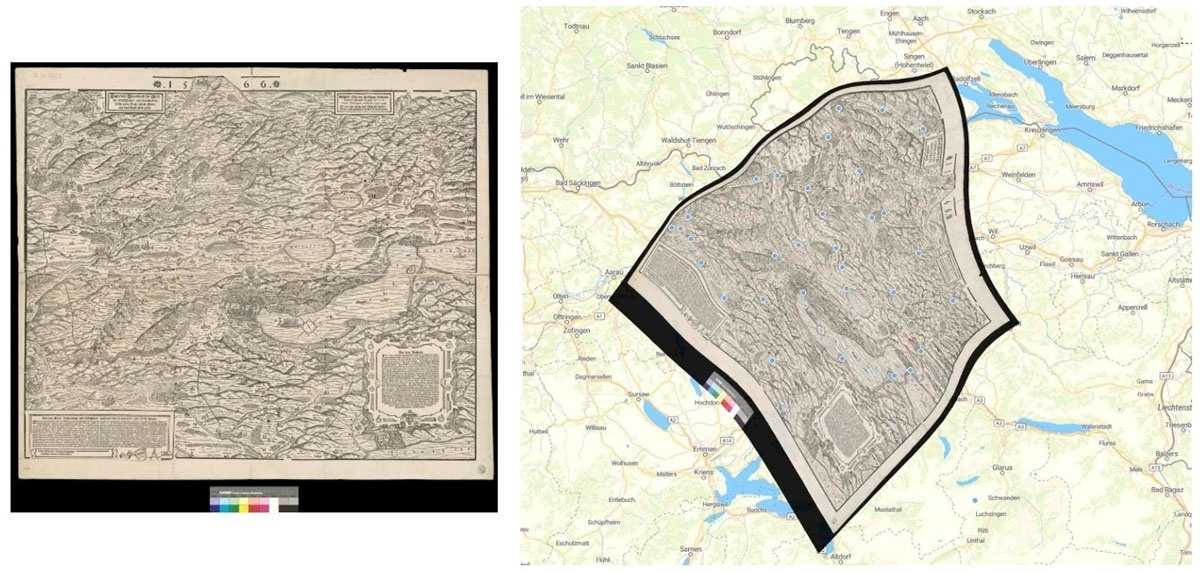
Figure 2
The fourth edition of the Murer map (left: original; right: georeferenced and rectified).
Georeferencing old maps allows comparison with modern ones. The data sets resulting from crowdsourced georeferencing projects are useful for answering research questions in map history as well as studying the evolution of mental maps from a cultural perspective (Schenk 2002; Cascón-Katchadourian and Alberich-Pascual 2021). These data sets are published by ZB as open data for reuse (Zentralbibliothek Zürich 2026) and transferred to ZB’s digital long-term preservation system.
The specific target group invited to participate comprised map historians, scholars, and citizen scientists interested in the history of cartography. This community is well organized and therefore easy to contact via their societies, such as the Swiss Society of Cartography, and topic-related newsletters.
The commercial tool Georeferencer (Old Maps Online 2025a) was used to allow participants to set reference points on maps, which were previously published online on the platforms e-rara.ch or e-manuscripta.ch. Quality management is implemented in the regular workflow, as reference points must be validated before publication by staff of the ZB Map Department. Participants can register to appear in rankings, which most of them opt for, or participate anonymously. Georeferencer had proven itself at institutions such as the British Library and the National Library of Scotland before (Fleet et al. 2012), so the public campaign could start without delay. The georeferenced maps are made accessible by ZB staff on the platform Old Maps Online (2025).
Four campaigns were conducted in 2021, 2023, 2024, and 2025 (see Supplemental File 1: Profiles of campaigns). The quality of the results and the pace shown in Table 1 were much higher than expected at the beginning (see also Supplemental File 2: Reference points set per citizen scientist in georeferencing campaigns).
Table 1
Participation and results of the ZB’s georeferencing campaigns.
| ID | REGISTERED CITIZEN SCIENTISTS | MAPS | REFERENCE POINTS | DURATION |
|---|---|---|---|---|
| 3 | 35 | 2,509 | 19,193 | 49 days |
| 9 | 48 | 2,919 | 35,994 | 28 days |
| 11 | 43 | 2,256 | 20,659 | 27 days |
| 14 | 29 | 1,180 | 9,889 | 44 days |
Georeferencing old maps is the most successful example of designing campaigns for target groups that were organized before and independently from the ZB’s citizen humanities activities. The potential citizen scientists responded very quickly; they even spread information among themselves in the short period between the silent launch of the project website and the official beginning of the campaign.
Transcribing handwritten documents
The task of the citizen scientists in transcribing handwritten documents is to decipher image scans of manuscripts and transform the text into a machine-readable format based on transcription rules (Causer and Terras 2014). Alternatively, citizen scientists correct software-generated raw transcriptions in an online tool, which profoundly transforms the study of manuscript sources (Terras 2022).
Handwritten documents are important sources for many disciplines in the humanities that have a historical dimension: history, art history, history of literature, historical linguistics, etc. Transferring analogue manuscripts into a machine-readable digitized form provides the humanities with enhanced primary sources and allows for new methodological approaches in the digital humanities in a wider sense, such as distant reading, text and data mining, or computational linguistics. Thus, this approach was chosen in pioneering projects such as Transcribe Bentham at the University College London and What’s on the Menu? at the New York Public Library (Ridge 2014). The transcriptions of the ZB’s crowdsourced transcribing projects are being published as open data for reuse (Zentralbibliothek Zürich 2025a).
The specific target group invited to participate were scholars and citizen scientists willing to learn (or already able) to read handwritten documents from earlier centuries. Experience from other memory institutions has shown that the initial hurdle for transcribing is high (Stört et al. 2023). Thus, for every individual campaign, the target groups were further specified. The focus was on organized communities that were assumed to be easily accessible through their existing communication channels (see Supplemental File 1: Profiles of campaigns). Examples of specific target groups are learned societies dedicated to a topic (campaign 2: Heinrich Zschokke Gesellschaft), the organizers and participants of the nationwide celebrations of an anniversary (campaign 12: 200th birthday of the Swiss writer Conrad Ferdinand Meyer), and a national libraries event (campaign 10: Biblioweekend).
Transcribing historical documents is done using the transcription tool integrated into e-manuscripta.ch, the digital platform for manuscript material from Swiss libraries and archives (Zentralbibliothek Zürich 2025a). Quality management is implemented in the regular workflow, as transcriptions have to be validated by ZB staff before publication. Participants have to register and thereby accept the terms and conditions of use. After registration, they can choose whether they want their work to be attributed publicly or not. At the time of the ZB’s first campaigns in 2021, the tool allowed participants to add their transcriptions to image scans (Renggli 2018). Since 2025, it has provided software-generated raw transcriptions to be improved by the citizen scientists (Renggli 2025). Transcribed pages are attributed to every transcriber who has worked on them and has not opted out of public attribution. All transcriptions are made accessible on the open access platform e-manuscripta.ch and transferred to ZB’s digital long-term preservation system by routine processes. The results of campaign 8 have been additionally released as a curated data set by the ZB (Zentralbibliothek Zürich 2026).
Seven campaigns have been conducted since 2021, six of which are completed at the time of writing (see Supplemental File 1: Profiles of campaigns). The pace differed from campaign to campaign (Table 2).
Table 2
Participation and results of the ZB’s transcribing campaigns (see also Supplemental File 3: Pages transcribed per citizen scientist in completed transcribing campaigns).*Campaign 10 was interrupted for two months to relaunch the platform.
| ID | REGISTERED CITIZEN SCIENTISTS | DOCUMENTS | PAGES | DURATION |
|---|---|---|---|---|
| 2 | 19 | 260 letters | 594 | 10 months |
| 6 | 10 | 100 letters | 199 | 10 months |
| 8 | 27 | 7 volumes | 2,810 | 21 months |
| 10 | 10 | 1 manuscript | 183 | *10 months |
| 12 | 8 | 104 letters | 230 | 4 months |
| 13 | 16 | 120 letters | 358 | 5 months |
The ZB’s experience supports the finding by Turcati et al. (2025) that, while documents with some difficulties that challenge the ambition of citizen scientists increase participation, the difficulties may also be too hard and discourage participants. In campaign 7, Rahn’s crabbed handwriting, the poor state of conservation of the original material leading to low-quality digitization, and the amount of over 10,000 pages taken together have obviously scared potential transcribers off. The quality of the transcriptions submitted by citizen scientists in campaign 7 was lower than in others; accordingly, the effort required from ZB staff for quality control was higher.
No one individual participated in all transcribing campaigns. Three percent of citizen scientists participated in five of six completed campaigns, while 87% of citizen scientists participated in only a single transcribing campaign (see Supplemental File 4: Persistence of participation in transcribing campaigns). Those participants who gave feedback on their contributions stated that they were interested in the content of the documents of a specific campaign but not generally interested in transcribing as one of the steps toward generating new scholarly knowledge. This corresponds to earlier findings by Dunn and Hedges that, in contrast to citizen science, participants in citizen humanities projects are first of all interested in the “material in question, and in the methods for dealing with that material” (2018, p. 39).
The most active citizen scientists regularly went beyond the primary task of transcribing. The tool offered the opportunity to add comments in footnotes, to identify people or places, and link them to authority files. This additional effort lays the groundwork for using these texts in linked open data applications. Thus, the boundaries between crowdsourcing and participatory critical editing of historical documents, which corresponds to a higher level of citizen science in Haklay’s (2013) typology, become blurred, as has been shown for citizen humanities projects time and again (Wyss et al. 2025; Heinisch 2020; Kasperowski et al. 2020).
Highlighted Challenges
Collaboration between academic librarians and full-time scholars
The ZB found that it was much easier to establish strong relationships with citizen scientists than with professional scholars. The latter may not be aware of what libraries are doing (Kaarsted et al. 2023, p. 16) or may underestimate the role of libraries as facilitators of scientific engagement (Mumelaš et al. 2025, p. 11). They did not take up project ideas offered by the ZB staff. As far as feedback was given, two main reasons can be identified:
– Scholars start with a research question and gather the relevant sources and data from different institutions. This is in direct opposition to the collection-based ZB approach.
– Scholars do not perceive academic librarians as peers, which reflects their status as third space professionals in the sense Whitchurch (2012) has used the term.
That said, the ZB was accepted by research groups as a supporting infrastructure that provided a platform for their ongoing projects.
A citizen humanities project on child removal from unmarried mothers and minority groups by the Swiss government, run by education scientists and historians from the University of Zurich and other Swiss institutions of higher education (Universität Zürich et al. 2025), took the opportunity to present their findings to a broader public on the ZB’s premises and to promote the event using the ZB marketing channels.
“Bullinger digital” (State Archives of the Canton of Zurich 2025), a joint edition project by theologians and computational linguists of the University of Zurich, introduced the citizen scientists, in a one-day workshop in the ZB’s computer classrooms, to their task and to the matter. The participants learned how to check and correct HTR-generated transcriptions as well as verify software-based linking of personal and geographical names with authority files. They also learned a lot about early modern theology and the history of Swiss Protestantism.
In both cases, a relevant part of the sources analyzed came from the ZB collections. Thus, through these events, the ZB demonstrated the value of the citizen humanities approach and of its own collections at once.
The most intense collaboration between librarians and professional scholars was campaign 6 (see Supplemental File 1: Profiles of campaigns): The transcriptions done by the citizen scientists laid the groundwork for the eventual digital edition of the Nägeli correspondence by musicologists at the University of Zurich, which is hosted by the ZB (Zentralbibliothek Zürich et al. 2025).
Motivations: effects and side effects
The ZB has invested significantly in community building and motivating citizen scientists. Its techniques have been successful in general. What has proven important were on-site events such as full-day transcribing workshops and informal meetings with food and drinks that facilitated interaction between the citizen scientists and fostered a sense of community. It also had a positive effect on the level of participation and the quality of contributions that scholars and the ZB expressed their appreciation for the citizen scientists’ skills and achievements and emphasized the importance of the project results for future research. This happened during on-site events and through social media publications both during and at the end of a campaign.
Motivations, however, have side effects that must be discussed critically. There are risks of bias and distortion emerging from citizen scientists’ behavior. A significant body of literature exists on the motivational structures of participants in citizen science projects (West and Pateman 2016; Curtis 2018, pp. 69–119; Land-Zandstra et al. 2021; Hart et al. 2022; Ngo et al. 2023). These studies typically distinguish between intrinsic and extrinsic motivation and discuss the differences among different types of projects, disciplines, and populations. They agree in identifying the wish to support science and to acquire new knowledge, the personal interest of the participants in a topic, as well as having fun and being part of a social group as some of the most significant motivators.
The ZB distinguished between two types of citizen scientists for the purpose of its crowdsourcing projects. These two types of citizen scientists were addressed by different techniques, increasing extrinsic motivation in addition to intrinsic motivation.
One type of citizen scientist responds to the principle of competition. For them, the ZB published public rankings. Evidence in the ZB’s crowdsourcing projects has shown that the shorter the update intervals, the more likely citizen scientists with almost the same ranking intensify their participation to outrun each other. In the rankings of its georeferencing and transcribing projects, the ZB observed the so-called skewed distribution of participation, which is typical for crowdsourcing projects (Sauermann and Franzoni 2015; Curtis 2018, pp. 122–124; see Supplemental File 2: Reference points set per citizen scientist in georeferencing campaigns and Supplemental File 3: Pages transcribed per citizen scientist in completed transcribing campaigns).
Another type of citizen scientist thinks cooperatively. They want to complete the joint task as quickly as possible together with the whole group of participants. For them, the ZB offered visualizations that demonstrate the progress of the collective effort, such as progress bars. In the ZB’s projects, increasing the frequency of updates of progress bars accelerated participation, too. The visual representation of gaps that still need to be filled (Figure 3) also has a steering effect on the behavior of the participants in ZB’s crowdsourcing projects: The smaller the gap was, the faster someone jumped in and closed it completely. There was, however, a side effect. In campaign 8, this kind of visualization motivated citizen scientists to work on as many families as possible as quickly as possible. The families, however, did not contain the same number of pages in this source. So, the visualization had the side effect that the citizen scientists took on the families with the fewest pages first. At one point, the participants had processed 70% of the families but only 40% of the pages of the Promptuarium Genealogicum (Keller-Escher n.d.).
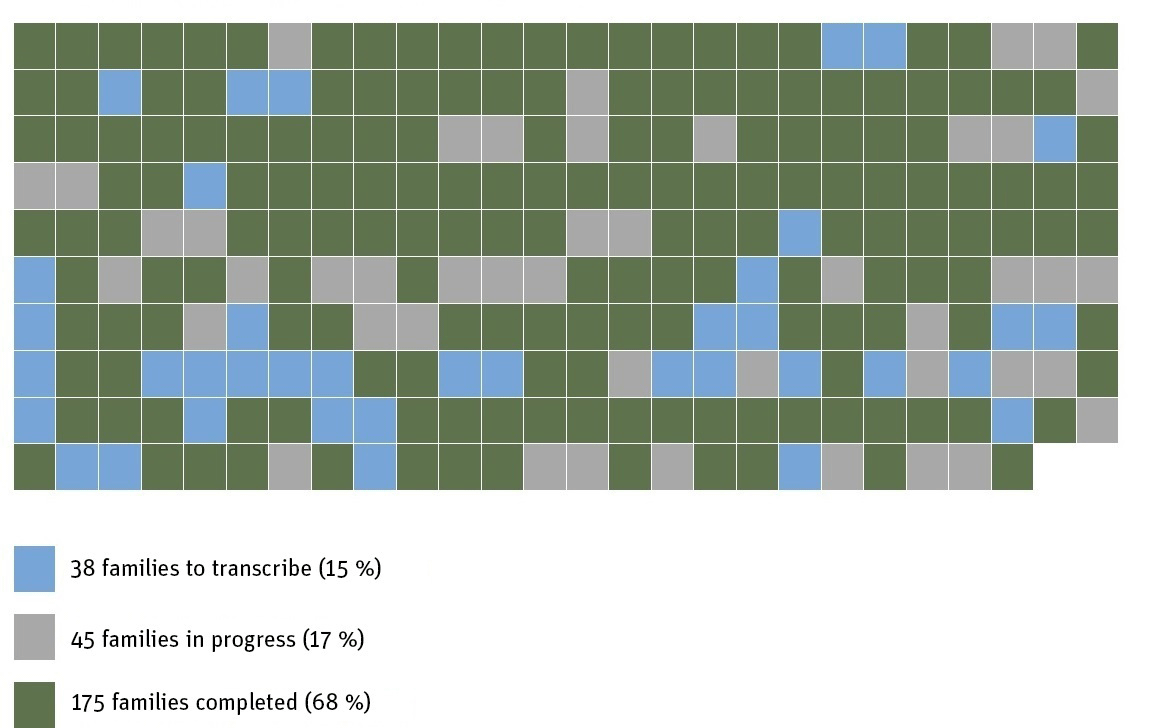
Figure 3
Progress visualization based on the game “Battleship” motivates citizen scientists to fill in the gaps.
Conclusions
This case study demonstrated how a library with a substantial heritage collection can seize the untapped opportunities of citizen humanities by providing humanities scholars with relevant primary source material. This source material is made accessible online permanently and in a reliable form that allows scholars to address a wide range of research questions.
In sum, the ZB has achieved its main objectives in relation to citizen humanities. Consequently, citizen humanities activities were transferred to the ZB’s regular library services at the end of the project phase. To ensure the necessary resources for fulfilling the new tasks, approximately half of the project staff and half of the project budget were made permanent. Since 2025, the special collections and digitization department has been responsible for citizen humanities at the ZB and has carried out campaigns 12–14.
From the very beginning in 2021, the ZB did not conduct a lone research project in the form of a citizen humanities initiative, as is typical for research groups at universities. Instead, it understood citizen humanities as a field of action that encompasses a variety of interrelated and coordinated activities. The most important guiding principles of the ZB’s activities that can be recommended to other libraries with a similar profile are the following:
– seeking its own niche and cooperation considering the activities of other major local stakeholders;
– actively managing community by combining digital activities and on-site events;
– ensuring the longevity of the project outcomes by integrating the results into the sustainable infrastructure and IT systems of the library; and
– focusing on its own heritage collection and taking advantage of its local focus.
Focusing on a library’s own collection, however, entails some limitations. This approach is closely aligned with crowdsourcing and contributory projects rather than with higher levels of citizen scientists’ participation. As a consequence, the scientific and thus the citizen science character of these activities is regularly questioned by representatives of the STEM disciplines. The ZB’s experience was that it is much easier for a library to encourage citizen scientists to participate than to engage professional academics, too. However, the ZB took this fact as a starting point to establish projects supporting humanities scholars with new and improved source material and data sets for various research questions. From this perspective, the crowdsourcing orientation of citizen humanities should not be regarded as a weakness but rather as a distinctive expression of citizen science within a particular cluster of disciplines.
Supplementary Files
Supplemental File 2
Reference points set per citizen scientist in georeferencing campaigns. DOI: https://doi.org/10.5334/cstp.917.s2
Supplemental File 3
Pages transcribed per citizen scientist in completed transcribing campaigns. DOI: https://doi.org/10.5334/cstp.917.s3
Supplemental File 4
Persistence of participation in transcribing campaigns. DOI: https://doi.org/10.5334/cstp.917.s4
Notes
Data Accessibility Statement
Data sets resulting from the ZB’s citizen humanities activities are published on https://www.zb.uzh.ch/en/services/datenangebote.