
Introduction
Community and citizen science (CCS), broadly defined as scientific research in which non-professional scientists actively contribute to one or more stages of a professional scientific research project, has grown into a vital tool for data collection, environmental monitoring, and science communication (Bonney et al. 2009; Irwin 1995). In environmental monitoring specifically, it enables data collection over wide geographic and temporal scales while also engaging the public in sustainability efforts (Koedel et al. 2024). Projects range from contributory models (where volunteers submit standardised data) to deeply collaborative designs involving communities in shaping research questions, methods, and applications (Pocock et al. 2014). A key tension, both in the literature and practice, lies between the number of participants involved and the extent of co-design.
Defining the tension: scale versus co-design
In environmental monitoring, large-scale CCS projects often prioritise spatial and temporal coverage. Projects like eBird, iNaturalist, and Nature’s Notebook have amassed millions of observations and enabled long-term biodiversity trend analyses in support of global conservation science (Sullivan et al. 2014; Chandler et al. 2017). These platforms typically use contributory models, with predefined protocols and limited participant input in project design.
Conversely, co-designed or collaborative CCS projects typically engage fewer participants but offer deeper involvement in shaping the research (Senabre Hidalgo et al. 2021). These include community-led air and water quality monitoring, urban greenspace mapping, and pollution tracking, where volunteers may be involved from the start in co-developing the project’s questions, sampling protocols, and analysis methods (Clarke et al. 2023).
Such models enhance local relevance, ownership, and stewardship, but are resource-intensive and less scalable (Robinson et al. 2024). Conceptualisations of participation in CCS increasingly recognise it as a spectrum of involvement and power, rather than a binary distinction. Foundational frameworks such as Arnstein’s (1969) ladder, the IAP2 Spectrum (International Association for Public Participation 2018), and Haklay’s (2013) typology each highlight how levels of participation vary in terms of influence, agency, and decision-making. Haklay (2013) proposed a four-level typology: crowdsourcing, distributed intelligence, participatory science, and extreme citizen science, showing that increased participant agency typically comes at the expense of scale.
Co-designed environmental monitoring projects offer advantages over contributory models:
Local relevance: Community members define what is worth monitoring, often addressing neglected or vulnerable ecosystems (Ballard et al. 2017a).
Empowerment and stewardship: Deep involvement can lead to stronger place attachment, advocacy, and sustainable behaviour changes (Pocock et al. 2023).
Data legitimacy: Locally grounded research is often more persuasive to policymakers when co-produced with affected communities (Pandya 2012).
However, co-design introduces logistical and institutional constraints:
Time and resource demands: Facilitating inclusive co-design requires ongoing dialogue, training, and trust-building (Vohland et al. eds 2021).
Limited reach: Co-design processes typically cap participant numbers, making broad coverage difficult. For example, the aforementioned examples of co-designed CCS (Clarke et al. 2023; Robinson et al. 2024) had fewer than 30 participants and were focused on a narrow geographic area; meanwhile, eBird, employing a contributory model, has now engaged 1.2 million people globally (eBird 2025).
Institutional pressures: Funders and institutions often prioritise data volume and geographic spread, undervaluing co-produced qualitative impacts (Hecker et al. 2018).
Emerging strategies seek to balance the depth of co-design with broad participation. Environmental monitoring projects increasingly adopt tiered engagement models, in which most volunteers contribute data through standardised protocols, while a smaller subset co-develop other aspects. For example, in community water quality monitoring initiatives, local leaders may co-design indicators and methods, while larger volunteer networks carry out sampling (Buytaert et al. 2014).
Projects like FreshWater Watch and Stream Selfie use modular toolkits, enabling communities to tailor monitoring efforts within a standardised scientific framework while still feeding into larger-scale monitoring efforts (Hadj-Hammou et al. 2017). This approach supports comparability of data from different sites, while accommodating local autonomy.
Online platforms, training videos, and mobile apps have also enabled more scalable co-design through distributed collaboration. For instance, the Air Quality Egg initiative allows communities to customise air monitoring kits while contributing data to a centralised platform. While digital tools increase access, they often favour communities with digital literacy and resources, raising equity concerns (Pykett et al. 2020).
Large-scale environmental monitoring projects often engage volunteers who are white, older, and educated, resulting in limited demographic representation (Pateman et al. 2021; Waugh et al. 2023). Lack of diversity can restrict the relevance and reach of such initiatives. Co-design can help diversify participation by focusing on specific interests and needs of underrepresented communities. For example, Robinson et al. (2024) worked with four diverse community groups to develop CCS projects that were locally meaningful and accessible, demonstrating benefits for participants and addressing barriers to access.
Co-designed projects frequently navigate issues of data ownership, consent, and use. Frameworks like the CARE Principles for Indigenous Data Governance (Carroll et al. 2020) emphasise collective benefit and ethical responsibility, especially in monitoring projects involving indigenous lands or knowledge.
Academic and funding systems have often undervalued the relational, educational, and political outcomes of co-designed projects. However, projects that blend quantitative metrics (e.g., number of samples) with qualitative indicators (e.g., learning, empowerment) are beginning to influence how success is measured in environmental CCS (Jordan et al. 2015).
Contrary to widespread concern about the reliability of data collected by non-professionals (Kosmala et al. 2016), due to variability in participant training, experience, and motivation, many co-designed environmental monitoring projects yield scientifically valid and policy-relevant data. One eDNA co-monitoring study found that community data closely matched professional electrofishing assessments (Clarke et al. 2023). Furthermore, environmental monitoring projects that incorporate co-design have reported greater participant learning, environmental awareness, and pro-environmental behaviour, particularly when linked to place-based issues (Phillips et al. 2019; Pocock et al. 2023).
Projects involving community-led air or water monitoring have influenced municipal decisions, environmental justice claims, and pollution policy, especially when supported by both local knowledge and scientific rigour (Ottinger 2009).
In summary, whilst co-designed projects foster community ownership and relevance, they face scalability constraints. Balancing participant numbers and co-design in environmental monitoring requires adaptive, context-sensitive approaches. Large-scale contributory models are essential for global biodiversity tracking and climate monitoring, while co-designed efforts are crucial for locally relevant, equitable, and transformative engagement. Emerging hybrid models and digital facilitation offer promising avenues to bridge this divide for co-design at a large scale.
The most promising models include:
Tiered designs with multiple engagement pathways (Wood et al. 2011; Allf et al. 2022; Collins et al. 2023a; Mesaglio 2024).
Modular toolkits allowing standardised data with local flexibility (Haklay 2015, p. 31; Krommyda et al. 2020; CitiObs 2023; Collins et al. 2023b).
Digital facilitation and collaboration that scales co-design, while being mindful of access gaps (Coulson et al. 2018; Balestrini et al. 2021; Neset et al. 2021; Dikker et al. 2022; West et al. 2023; Delmazo and Smaniotto 2025).
Ethical frameworks that foreground inclusion, representation, and data justice (Agyeman and Evans 2004; Taitingfong et al. 2024).
It is important to investigate the effectiveness of these models, so that funders and research institutions are better able to understand not only the importance of the scientific outcomes that community science can generate, but also how participatory processes can support meaningful, scalable, and equitable CCS. Different models should serve both scientific and societal goals, especially in contexts requiring both inclusivity and scientific rigour, such as GLAMs.
Urban Nature Project
The Museum led the Urban Nature Project (UNP) from 2021 to 2024.
The central element of UNP was the transformation of the Museum’s 5-acre site in central London to make “an accessible community green space in Central London as part of a highly visible agenda for change.” (Baker et al. 2025). Alongside the physical changes to the Museum’s grounds, staff worked with organisations across the United Kingdom (UK) to inspire the next generation, create new opportunities for young people in cities, and help everyone to learn about humanity’s impact on the natural world.
To scale the impact of this work nationally, the Museum established an Urban Nature Network alongside learning and CCS programmes. The learning and CCS programmes were designed deliberately to explore and seek solutions to the tensions outlined in scaling up CCS. The two teams collaborated to co-develop a research question at scale, created space for young people to steer the direction of the research, and developed a national-scale public CCS project. The purpose of this was to create advocates for the planet who act to increase urban biodiversity, develop environmental science agency (ESA) (Ballard et al. 2017b), increase wellbeing, and come together in a large and diverse community that amplifies their ESA.
This case study shares the lessons of the Nature Overheard CCS programme. It showcases how tensions with including participants in more stages of the research process can be reconciled when scaling up GLAM CCS programmes, because of and not despite relinquishing control of delivery and study design.
Programme Design and Tiered Participation Framework
The CCS programme aimed to conduct scientific research on urban nature, as well as connect communities to the natural world, develop scientific skills, and support positive action for nature across the UK through mass participation by:
engaging/involving audiences in all stages of the project (not just data monitoring or gathering);
providing a range of opportunities to participate, to reach wider audiences; and
empowering young people by basing the question to be explored on their interests and curiosity.
A CCS team dedicated to UNP aimed to achieve these aims as well as ambitious participation targets. A core team consisted of a full-time project officer and a project manager within the Angela Marmont Centre for UK Nature, plus members of the National Programme team, Digital & Marketing, Communications, and Data teams.
The CCS programme was conceived from its very outset to include several activities, to vary in the breadth of their reach, and the depth of their level of engagement, as well as to scale up participation in the survey. These activities were grouped into four levels, or tiers, and assigned targets. Tier 1 was inspired by the “Inform” stage of the IAP2 Spectrum of Public Participation (1998), and tiers 2–4 were inspired by the contributory/collaborative/co-created model of Shirk et al. (2012) (Supplementary File 1). A key goal was to co-develop the research question with young people, ensuring their perspectives shaped the direction of the project from the beginning (tier 4). The tiers then provided opportunities to take part in other stages of the research process via a range of activities suitable for a variety of levels of time availability, interest, and confidence; participants were encouraged to progress through the tiers (from engagement-focused participation in Tier 1 to more substantial contribution in tier 3) as their confidence and interest grew.
Co-created project development (Tier 4)
The goal of tier-4 participation— the deepest we aimed for— was to co-develop the research question. At this point, the project focus, name, and scientific goals had not been set. Tier 4 comprised four stages: soliciting research questions from school and public audiences, a scientist-led feasibility workshop, question refinement with student focus groups, and finally, definition/articulation of the final research question by the Museum’s staff.
Schools across the UK were invited to submit questions that they would like to be researched. Most questions were submitted at face-to-face workshops at schools, where team members facilitated discussions around issues that interested the students about their local environment; this included support and guidance on what constitutes a research question, suitable for scientific enquiry. Questions could also be submitted via an online form that was freely accessible and promoted to schools through Museum newsletters and mailing lists.
253 questions were generated by nine participating schools, recruited by the National Programme team; 111 were submitted at workshops, and 142 online. The core team then shortlisted the questions that were feasible, had limited research, and fell within the Museum’s area of expertise.
Three questions were shortlisted:
How can we make roads better for nature?
What is the ratio of human urban areas to areas with nature in it in m2? What is the ideal or optimum ratio for humans and nature to co-exist comfortably?
How many different species grow in Hyde Park compared to Kennedy Park? Why is that?
In October 2022, 13 Museum scientists participated in a facilitated workshop to assess the scientific relevance of the proposed questions and their suitability for investigation through a CCS approach. To explore methodological trade-offs, each question was explored under two scenarios: with an unlimited budget, and with unlimited participants. The Museum scientists identified that the question “How can we make roads better for nature?” was the most fruitful area of enquiry with a CCS approach.
Next, this question was taken to a school which had submitted research questions. In early December 2022, members of the project team and five Museum research scientists visited the school and delivered two 4-hour workshops for a group of 25 highly engaged students aged 11–12 years old. In these workshops, students explored the subject of roads and nature and developed a range of more specific research questions that interested them within this subject area, for example, that focused on specific taxa.
The project team presented the four top-scoring questions generated at the school co-design workshop to eight students aged 14–16 years old from a second school at an after-school workshop. These students critiqued the questions and fostered ideas about how people would gather data. Based on this workshop, the project team made the final decision to investigate the under-researched question, relating to the impact of road noise on insect populations.
By way of closing the loop, in early 2025, two members of the project team returned to the school that participated in the first co-design workshop to deliver a presentation to the year group who had been involved outlining the way that their ideas had evolved and summarise the preliminary results of the project.
Collaborative data collection (Tier 3)
The aim of Tier 3 was to provide opportunities for community scientists to connect with nature and expand their scientific knowledge and skills by engaging more deeply with the research, spending more time taking part and gathering both audio and visual data.
To reflect the chosen research question, the project team named the CCS programme “Nature Overheard,” which comprised a set of interrelated activities across tiers 1–3. The team worked intensively with an acoustic biology researcher at the Museum to develop the Nature Overheard survey to collect data at a scale that would allow an investigation of the impact of road noise on insects.
The protocol required participants to conduct a visual insect count and take a five-minute audio recording within a 10 × 2 m area of green space along a road. The count involved identifying and counting insects from the following groups: bees and wasps, ants, hoverflies, other flies, beetles, true bugs, butterflies and moths, and grasshoppers and crickets. It could be self-led by individuals, or in a group facilitated by a group leader, and typically took 20 minutes to complete.
Participants entered observation and audio data into an online form, which sent the data to the Museum’s Data Ecosystem, a data infrastructure platform that was introduced alongside Nature Overheard in April 2023.
Contributory participation (Tier 2)
The goal of Tier 2 was to provide opportunities for initial engagement with CCS through a variety of data collection, analysis, and interpretation activities, including:
Participating in an online insect identification activity: Participants identified pictures of insects to the same taxonomic level as the Tier-3 survey. The quiz aimed to support engagement and learning, while also assessing identification accuracy and validating observations submitted without photographic evidence.
Classifying audio data through FlyTunes activity: Audio recordings collected during the Tier 3 survey were cut into six-second segments and made available on the Zooniverse platform. Participants classified the sound they could hear (e.g., humans, insects, road traffic), contributing to data analysis and helping train an algorithm to identify sound types in audio recordings.
Engagement-focused participation (Tier 1)
The goal of Tier 1 was to introduce CCS and use insects, urban biodiversity, and the sounds of nature to spark interest in the more in-depth activities among a new audience.
The team delivered tier-1 activities at approximately 30 face-to-face events, mostly in London and southeast England because of proximity to the Museum, and most of which were external (e.g., festivals, fairs, schools). A typical event stall displayed an interactive birdsong identification activity with an acoustic box and bird models, and an insect identification activity with insects in resin and pictures printed on foam boards. Both activities were designed to introduce participants to key concepts of Nature Overheard (e.g., acoustic biodiversity monitoring, invertebrate species identification, and CCS) that provided foundational knowledge and awareness for engaging with the more advanced tiers.
Tier-1 activities were also delivered via paid social media advertising and seasonal Instagram quizzes to engage participants, and build awareness, confidence, and skills such that they were more likely to feel able to join the Tier-3 survey.
Learning and adaptation between years 1 and 2
During the summer of 2023, teachers were loaned survey equipment for one month to support delivery of Tier 3 activities with students. Following administrative challenges, low independent uptake, and consequently insufficient recordings for analysis, the loan box approach was replaced in 2024 by partnerships with two delivery organisations, focusing on areas with low participation on and building local capacity for future engagement.
Groundwork—a charity who work to take “practical action to create a fair and green future in which people, places, and nature thrive” —was identified following a competitive tender process, and delivered tier-3 activities with schools and community groups in North-West England. The project team facilitated their induction with in-person briefings.
Three 18–25-year-old students were recruited to take part in paid work placements in three regions where few surveys were carried out in 2023. Each placement ran for 10 weeks (120 hours), during which the students aimed to undertake 100 surveys each, alongside receiving formal natural history training by Museum staff. The students were tier-3 community scientists who each undertook multiple roadside surveys to supplement data collection by increasing overall numbers and geographical location of the surveys. Flexible support from the project team enabled them to develop complementary skills aligned with their interests (e.g., science communication, creation of insect collections, development of professional networks).
External evaluation
Throughout the project, the team engaged with two external evaluators who supported the project team to reflect on the design and scalability of the activities and their contribution to achieving the original aims of the mass CCS project. The team worked with the evaluators to understand Nature Overheard’s impact, identify where Nature Overheard was successfully meeting its goals, and highlight areas where desired outcomes were either failing or had not been designed for adequately. This contributed directly to the iterative development of the CCS programme for its second year.
Scaling Aspirations for Co-Design in Community Science: Challenges and Lessons from Nature Overheard
Nature Overheard set out to be fully co-designed but, in practice, co-design was largely concentrated in the early project development phase (Tier 4), with other tiers employing contributory, collaborative, and engagement-oriented approaches.
Here we discuss some of the sources of tension that emerged in scaling a multi-modal CCS project and share some of the lessons learned that are applicable to other GLAM institutions aiming to scale-up their CCS activities and/or integrate co-design approaches, whilst navigating the trade-offs.
Degree of control in co-design: navigating timelines and power dynamics
Nature Overheard provides a critical case through which to examine the practical implications of co-design aspirations within large-scale, institution-led CCS. While co-design approaches are often framed as enabling greater creativity, collaboration, and participant agency (Arnstein 1969; Haklay 2018; Senabre Hidalgo et al. 2021), this study highlights the structural constraints that shape how such participation can be realised in practice. In particular, relinquishing control over the scientific focus of the project during the co-design process in the development phase created opportunities for meaningful participant input, but simultaneously introduced significant challenges related to timescales, coordination, and decision-making at scale.
The project demonstrates a fundamental tension between the ambitions of co-design and the realities of large-scale programme delivery. The Museum’s national workshops successfully generated a substantial volume of participant-led research questions, demonstrating the feasibility of initiating early-stage co-design processes at scale. However, the subsequent need to refine and converge these inputs into a single research direction exposed the limits of co-design within fixed timelines. This reflects a broader challenge identified in CCS, whereby efforts to combine co-creation, scientific rigour, and scalability often result in trade-offs between breadth of participation and depth of engagement (Shirk et al. 2012; Bonney et al. 2016).
Central to this tension is the temporal dimension of co-design. Impactful participation requires time to build trust, establish relationships and iteratively develop ideas (Reed et al. 2018; Senabre Hidalgo et al. 2021). In this case, the co-design process was constrained by the fixed duration of a grant-funded project, limiting opportunities for sustained engagement and iterative refinement. This highlights a structural misalignment between funding models and the requirements of participatory approaches, suggesting that current funding frameworks may unintentionally constrain the depth and quality of co-design in CCS.
The project further illustrates how institutional and geographic distance can shape power dynamics within co-design processes. Despite efforts to involve students in shaping the research direction, the separation between the Museum and participating schools limited opportunities for ongoing dialogue and feedback. Participants’ reflections indicate that the extent of their influence on the final project was not fully apparent to them, pointing to challenges in maintaining transparency and continuity across distributed co-design processes. This aligns with wider critiques of participatory approaches, which emphasise the persistence of institutional hierarchies and the difficulty of redistributing power in practice (Arnstein 1969; Pandya 2012).
These challenges are further compounded when working with community groups that have limited capacity to engage in intensive co-design processes. As observed in this study, volunteer-led organisations often face constraints on time and resources, which can restrict their ability to participate in sustained, iterative engagement. This reinforces the importance of providing not only opportunities for participation, but also the financial, logistical, and relational support required to enable meaningful involvement (Pateman et al. 2021; West et al. 2021).
Importantly, the findings also demonstrate that relinquishing control over aspects of project delivery does not necessarily undermine participants’ understanding of, or connection to, the scientific aims of the project (Supplementary File 2). The successful involvement of intermediary organisations in delivering the survey suggests that distributed models of delivery can maintain coherence and meaning while enabling greater flexibility and scalability. This challenges assumptions that centralised control is required to ensure scientific integrity or participant understanding.
However, the project also exposes the limitations of delivering co-design within tightly constrained timelines. The lack of opportunity for piloting and iterative testing restricted the ability to refine both the co-design process and the resulting tools. This points to the need for alternative funding and delivery models that incorporate dedicated pilot phases and support incremental scaling. Multi-year partnerships can offer a mechanism for aligning the temporal requirements of co-design with the practical realities of programme delivery.
Collectively, these findings suggest that co-design in GLAM-led CCS should be understood not as a discrete methodological choice, but as a resource-intensive and context-dependent process that requires careful alignment between ambition, capacity, and timescale. While embedding co-design from the earliest stages of project development, including within funding proposals, can support substantive participation, projects must also be realistic about which elements of the research process can be genuinely co-designed within available timelines and resources. Without such alignment, there is a risk that co-design becomes constrained to early-stage consultation rather than sustained, impactful participation.
Scaling co-design in GLAM contexts: trade-offs, tensions, and lessons
The Nature Overheard project demonstrates both the potential and complexity of integrating institutional capacity with locally embedded delivery in large-scale community science. The coordination of multiple internal teams alongside external partners reflects a broader trend towards interdisciplinary and cross-sector collaboration in sustainability and participatory research (Wyborn et al. 2019; Norström et al. 2020). While such structures enable projects to draw on diverse expertise, they also introduce challenges around role clarity, coordination, and timelines, particularly in the early stages of programme development. These findings reinforce the importance of investing time in establishing shared understanding and governance structures when working across organisational boundaries.
A central tension identified in this study relates to the disconnect between participation and data contribution. While the loan box initiative successfully scaled participation across UK schools, this did not translate into equivalent levels of data submission. This discrepancy reflects a well-documented challenge in CCS, to translate initial engagement into sustained and impactful contribution (Rotman et al. 2012; Eveleigh et al. 2014). In this case, structural constraints including limited teacher time, low confidence with subject matter, and insufficient training, reduced the likelihood of data submission, despite high levels of reported enjoyment and perceived educational value. These findings highlight the need to design explicitly for contribution, rather than assuming it will emerge from participation alone. Feedback can play a key role in motivating participation and data submission in CCS, particularly when participants can clearly see the value of their contribution (Tang et al. 2021). In the GenePools project, for example, participants received information about the environmental DNA from their ponds only if they submitted water samples for analysis; the return rate in the final year of the project was 98%, suggesting a strong motivational effect of timely, personalised feedback (Dixon et al. 2025).
Similarly, in-person engagement strategies such as festival events were effective in generating awareness but yielded limited usable data, supporting existing evidence that such formats are better suited to community-building than to large-scale data collection (Cappa et al. 2016; Collins et al. 2023a). Attempts to increase data volume through re-engagement of individual participants also proved largely unsuccessful (Figure 1), despite the use of incentives, reflecting broader challenges in participant retention and repeat engagement in CCS (West and Pateman 2016; Sauermann and Franzoni 2015). Taken together, these approaches illustrate the limitations of centrally coordinated, individual-focused engagement models when applied at scale.
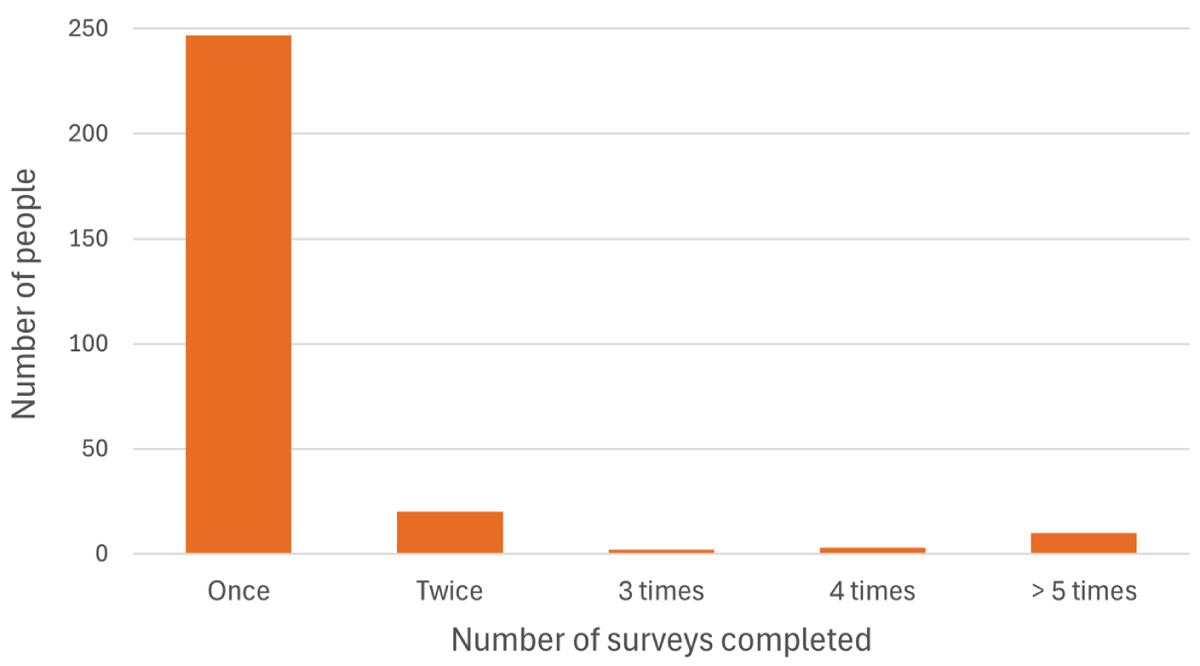
Figure 1
The number of times each participant in Nature Overheard completed the survey.
In response, the project pivoted towards a decentralised delivery model, shifting from direct engagement with individuals to collaboration with intermediary organisations and trained facilitators. This transition proved critical in achieving both increased data returns and deeper forms of engagement. The contribution of Groundwork, which accounted for 45% of total submissions, demonstrates the effectiveness of working through trusted local partners with existing community relationships and relevant domain expertise. This aligns with growing recognition of the role of intermediaries in CCS, particularly in enabling access to underserved communities and embedding activities within existing social and organisational infrastructures (Pandya 2012; Lhoste and Sardin 2024).
The success of this approach can be attributed to several interrelated factors. First, local partners brought contextual knowledge and facilitation expertise, enabling them to adapt protocols to suit group-based participation and to deliver activities in accessible, one-to-many formats. Second, their established relationships with community groups allowed for rapid recruitment and integration of activities into existing programmes, thereby reducing barriers to participation. Third, ongoing support through in-person training and regular check-ins ensured alignment with the scientific aims of the project while maintaining flexibility in delivery. These findings suggest that decentralised models not only enhance scalability but also support more impactful and sustained engagement.
The project further highlights the value of embedding capacity-building within CCS programmes. Targeted training of placement students enabled them to contribute significantly to data collection while simultaneously developing skills in natural history, data collection, and science communication. This dual benefit reflects the potential of CCS to support both research outcomes and workforce development, which is recognised within the field (Bonney et al. 2016; National Research Council 2018). Importantly, participants who were engaged through these more intensive pathways demonstrated deeper levels of engagement and skill acquisition, underscoring the importance of designing opportunities for progression and learning within project structures.
Collectively, these findings point towards the effectiveness of a hub-and-spoke model for scaling CCS within GLAM contexts, in which central institutions provide scientific oversight, infrastructure, and coordination, while local partners deliver activities and facilitate engagement. While such models remain under-explored in CCS, they resonate with broader approaches in community-based and participatory research that emphasise the importance of distributed expertise and locally embedded delivery (Wyborn et al. 2019; West et al. 2021). For GLAM institutions, this suggests a shift away from centrally delivered, individual-focused engagement towards partnership-based models that leverage existing community networks and capacities.
Finally, this case study reinforces the importance of integrating facilitation expertise into the design and delivery of co-design aims in CCS. As proposed by Golumbic et al. (2025), involving facilitators with experience in youth and community engagement from the outset can enhance both the quality of interaction and the feasibility of delivery at scale. In the context of Nature Overheard, the inclusion of such expertise proved instrumental in navigating the practical challenges of co-design ambitions, supporting both participant engagement and the generation of scientifically robust data.
Depth of participation: tiered framework as a tool for scaling up
Tiered engagement frameworks offer a practical mechanism for balancing scale and data quality in CCS, a challenge widely recognised in the literature (Haklay 2013; Shirk et al. 2012; Kosmala et al. 2016). In Nature Overheard, the tiered model initially assumed a linear progression of participants through increasing levels of engagement. However, findings from this project challenge this assumption, demonstrating that participation is better understood as non-linear and participant-led, aligning with broader conceptualisations of participation as a spectrum of involvement and influence (Arnstein 1969; International Association for Public Participation 2018; Haklay 2013).
Rather than functioning as a pipeline, the tiered structure enabled multiple entry points that accommodated diverse participant motivations, capacities, and contexts. This flexibility proved critical in supporting both breadth of engagement and depth of contribution, echoing prior work on heterogeneous participation in CCS (Rotman et al. 2012; West et al. 2021). Importantly, different tiers attracted distinct audiences and engagement patterns, with digital, gamified activities (e.g., FlyTunes) achieving substantial scale and diversity of participation, while higher-intensity activities (e.g., roadside surveys) fostered deeper engagement and skill development. This reinforces the value of designing for differentiated participation modes rather than assuming uniform engagement pathways (Pateman et al. 2021).
The success of Tier 2 (FlyTunes), which generated over 150,000 classifications, highlights the scalability of distributed, platform-based approaches to data processing, consistent with broader findings on crowdsourced science (Sauermann and Franzoni 2015; Tinati et al. 2015). These approaches can overcome geographic and technical barriers, enabling large-scale participation while maintaining meaningful contributions to scientific outputs (Newman et al. 2012). However, the project also illustrates the limitations of relying solely on individual participation pathways. While the tiered framework was originally conceived around individual engagement, the most effective scaling of both participation and data collection was achieved through intermediary organisations, which facilitated access to established community networks and enabled group-based participation.
This finding aligns with emerging evidence on the role of intermediaries in CCS, which emphasises their importance in building trust, reaching underserved audiences, and embedding activities within existing social infrastructures (Pandya 2012; Lhoste and Sardin 2024). In this context, tiered participation frameworks should not be viewed solely as tools for structuring individual engagement, but as adaptable systems that can be mobilised through both individual and organisational pathways.
A further limitation identified in this study relates to the challenge of tracking participant movement across tiers. Constraints around data privacy and the use of multiple engagement platforms limited the ability to analyse participant journeys in detail. This reflects a broader challenge in CCS relating to understanding participation trajectories and retention (Eveleigh et al. 2014; Rotman et al. 2012). Future implementations could address this through more deliberate design of user pathways and onboarding mechanisms, for example, by integrating sign-up processes across tiers or strengthening continuity between engagement platforms.
Conclusion
This detailed case study has underlined the opportunities and challenges involved in scaling co-designed CCS within a GLAM context. By combining early-stage co-design focused on research-question development, national delivery, and scientific data collection, the study highlights several practical tensions that are likely to be relevant to others working in this space, particularly those identified in established participation frameworks that distinguish between different depths and forms of public involvement. These include balancing co-design with fixed timelines, ensuring that participation leads to impactful contribution, and designing engagement approaches that work across different contexts and communities.
This study highlights three key learnings for practitioners and researchers. First, it shows that co-design at scale requires careful alignment between ambition, capacity, and time. While involving participants in shaping research can support creativity and relevance, it also requires sustained engagement, trust-building, and iteration. Where these conditions are constrained (particularly by short-term funding), co-design may be limited in depth. This reinforces the importance of embedding co-design early in project development and ensuring that sufficient time and resource are allocated to support it.
Second, the project demonstrates that scaling participation does not automatically result in increased data contribution. Approaches that relied on direct engagement with individuals were effective in raising awareness but less successful in generating data or repeat participation. In contrast, working with intermediary organisations, such as Groundwork, enabled both higher data returns and deeper engagement. These organisations brought local knowledge, existing relationships, and facilitation expertise, allowing activities to be embedded within community contexts. This suggests that partnership-based, decentralised delivery models may be particularly effective for projects seeking to achieve both scale and impact.
Third, the findings show the value of tiered participation frameworks as flexible tools for engaging diverse audiences. Rather than functioning as a linear pathway, the tiered approach enabled participants to engage in different ways depending on their interests, skills, and availability. Digital platforms supported large-scale participation, while more intensive, facilitated activities supported deeper engagement and skill development. This highlights the importance of offering multiple entry points and recognising that participants may not wish—or be able—to progress through predefined levels of engagement.
As a single, UK-based GLAM case study, these findings are shaped by the project’s institutional context, delivery model, and participant demographics, and their applicability to other participatory science or GLAM settings should be considered in relation to local audiences, capacities and organisational arrangements. Taken together, these findings highlight the central role of trade-offs in CCS. While individual participation tiers in Nature Overheard prioritised either depth of engagement or breadth of reach, the programme-level tiered model enabled both to be achieved across the project as a whole. Realising this balance involves designing systems that support different forms of participation, investing in relationships and facilitation, and working in partnership with organisations that are embedded within local communities. For GLAM institutions, this may involve moving away from centrally delivered models towards approaches that combine institutional expertise with locally led delivery.
Based on this case study, we recommend that future GLAM-led CCS projects: (1) embed co-design from the earliest stages of project development; (2) allocate time and resources for relationship-building and iteration; (3) work with intermediary organisations to extend reach and support engagement; and (4) design participation frameworks that are flexible and responsive to participant needs.
By adopting these approaches, CCS projects may be better positioned to achieve both meaningful participant and robust scientific outcomes, while contributing to wider goals of inclusion, learning, and environmental action.
Supplementary Files
Supplementary File 1
Alignment of tiers of participation with established participatory science categories (Shirk et al. 2012), from co-created project development (Tier 4), through collaborative data collection (Tier 3) and contributory participation (Tier 2), to engagement-focused activities (Tier 1). DOI: https://doi.org/10.5334/cstp.913.s1
Supplementary File 2
Evaluation responses to statements that measure the participants understanding of the activity’s wider context, delivered through the Museum (online) and via project delivery partner (in person). DOI: https://doi.org/10.5334/cstp.913.s2
Ethics and Consent
Although this study includes human subject research, museum-based projects are not required to have ethical oversight in accordance with UK regulation. However, this study did adhere to ethical guidelines in accordance with the Declaration of Helsinki. Co-design workshops involving school children were undertaken with informed consent obtained in advance from parents or guardians. Participation in community science and evaluation activities was voluntary. Evaluation responses were collected anonymously via online and paper-based forms as part of programme evaluation. No identifiable personal data were analysed or reported in this manuscript.
Acknowledgements
We would like to thank Ed Baker for providing the acoustic biology expertise, as well as colleagues in Digital, Marketing and National Programmes who collaborated on this project. Thank you to the staff and students at schools involved in the co-design workshops, and Natural History Museum scientists, who took part in the co-design workshops. To Victor Heng and Theo Blossom for support with development of tier-1 activities. To staff at Groundwork Cheshire, Lancashire, and Merseyside, and to Dayna Ledingham, Evan Williams, and Alice Slater. Thank you to Junyan Gao for initial data quality analysis and to colleagues in the Centre for UK Nature for verifying submissions and public engagement.
Author Contributions
JW: Conceptualisation, Methodology, Writing – Original Draft, Writing – Review & Editing, Project administration.
AL: Conceptualisation, Methodology, Investigation, Data curation, Writing – Original Draft, Writing – Review & Editing, Visualisation, Project administration.
GS: Conceptualisation, Investigation, Data curation, Writing – Original Draft, Writing – Review & Editing, Visualisation, Project administration.
FA: Methodology, Investigation, Writing – Reviewing & Editing.
DM: Validation, Writing – Reviewing & Editing.
JD: Validation, Writing – Reviewing & Editing.
LR: Conceptualisation, Methodology, Writing – Reviewing & Editing, Supervision, Funding acquisition.